
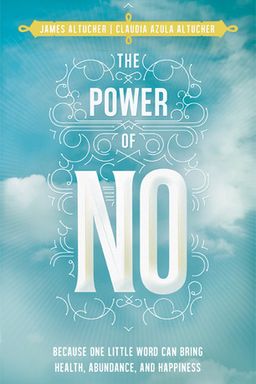
The Power of No cover

The Power of No

by James Altucher and Claudia Azula Altucher

The Power of No reveals how a simple word can transform your life by encouraging you to say no to negativity, toxic relationships, and societal pressures. By embracing this powerful tool, you open the door to health, happiness, and abundance, allowing you to focus on what truly matters.

The Transformative Power of Saying No

When was the last time you said no without guilt? In The Power of No, James Altucher and Claudia Azula Altucher challenge one of the most deeply embedded impulses in modern life—the reflex to say yes to everything and everyone. They argue that genuine freedom, creativity, and abundance begin not when you say yes, but when you reclaim the right to say no from your core self. For the Altuchers, ‘No’ is not rejection—it’s a gateway to spiritual awakening, emotional maturity, and self-directed living.

Throughout the book, they reveal an inner curriculum of seven ascending No’s—each one peeling back a layer of illusion, dependence, or fear. Starting from physical survival and moving toward spiritual liberation, these No’s act as stepping stones from chaos toward clarity. You learn to defend your life, protect your emotional boundaries, reject false stories, forgive the past, release scarcity, silence the noise, and finally transcend the illusion of separateness. Each step turns you away from ingrained conditioning and toward an authentic “Yes”—the yes to life itself.

No as Spiritual Grounding

The authors begin with a radical reframing: saying no is not rebellion—it’s survival. Whether it’s saying no to toxic relationships, manipulative colleagues, or addictive habits, your refusal draws a boundary around your energy, creativity, and health. This isn’t mere self-help rhetoric; it’s a spiritual discipline. Just as monks retreat into silence to find enlightenment, Altucher and Azula urge you to retreat from distractions so you can hear the whisper of your higher self. The act of saying no becomes an expression of divine discernment—a way to cut through noise and illusion to reach what truly matters.

Freedom Through Discernment

At the heart of the book lies the idea of discernment, which transforms every “no” into a clear form of wisdom. Each rejection becomes a practice of separating the essential from the trivial, the soul’s voice from the ego’s chatter. The Altuchers blend storytelling with philosophical insights, ranging from Buddhist detachment to Stoic acceptance. They describe how silence, gratitude, and daily rituals of awareness lead to independence from others’ opinions—a theme that resonates with Eckhart Tolle’s call to live in the present moment.

A Bridge from Pain to Presence

Both authors are candid about their personal suffering—James’s near-suicidal breakdown and Claudia’s spiritual awakening after years of destructive relationships. Through these stories, they show how “No” can rescue us from self-sabotage. When Claudia finally told an abusive man “I don’t ever want to talk to you again,” she experienced nausea, guilt, and release—all signs of the inner alchemy that comes with reclaiming self-worth. James’s version of “no” came during a breakdown, when gratitude saved him from ending his life. Saying no, in this sense, is not refusal—it’s resurrection.

Turning No Into Yes

Every No sets the stage for a truer Yes. The Altuchers’ philosophy culminates with the idea that once you say no to the illusions—scarcity, guilt, addiction, control—you finally create the space to say yes to authenticity, abundance, and meaning. You find that your purpose resides not in constant doing but in deliberate being. Saying No becomes the first courageous step toward living purposefully in alignment with your own higher frequency—a notion reminiscent of Wayne Dyer’s teachings on intention and Louise Hay’s focus on self-love (both referenced in the book). This journey merges psychology, spirituality, and practicality, turning every refusal into a declaration of freedom.

In essence, The Power of No proposes that boundaries are blessings. They keep out what drains you and open portals for divine wisdom to flow in. Through stories, exercises, and reflections, James and Claudia reveal that saying No doesn’t close life down—it makes space for the only Yes that matters: the one that aligns with your soul.


Saying No to Addictive Patterns and False Love

Claudia Altucher’s candor about her addiction to unavailable men forms one of the book’s most vivid lessons: toxic relationships are mirrors of inner scarcity. She describes pursuing charismatic but emotionally detached partners—her romantic illusions shattered again and again until she joined Sex and Love Addicts Anonymous, discovering that declaring “No” to destructive love was an act of self-healing. This emotional transparency gives her narrative its power: when she hit bottom, the moment she said “I am a love addict” became her rebirth.

Recognizing Emotional Addiction

The Altuchers teach that love addiction is not about sex or romance—it’s about control and fear. We pursue unavailable people or manipulate relationships because we fear true intimacy and vulnerability. Claudia’s earlier fantasies about marrying a pianist named Tim and her obsession with an aloof man during a yoga retreat illustrate how illusions become addictions. Saying no to these patterns releases not only the toxic people but also the inner narratives that depend on external validation.

Transformation Through Asking for Help

Claudia’s turning point came when she asked for help publicly in a support group—her act of surrender transformed isolation into communion. Her ‘big secret’ emerged: that we reach the divine not directly but “through other people’s ears.” Sharing vulnerability in front of witnesses multiplies prayer’s power because openness aligns our energy with others. In this sense, “No” to addiction becomes “Yes” to community, honesty, and divine support.

No as Boundary and Affirmation

After recovery, Claudia invented a practical mantra—ABC: Acknowledge, Boundary, Close. When faced with manipulation or guilt, acknowledge what the other says, set your boundary calmly (“I must leave in five minutes”), then close the interaction gracefully. This triad transforms confrontation into integrity. Saying no is not anger—it’s mindful clarity.

By reframing the rejection of false love into acceptance of divine love, Claudia models what genuine healing looks like. Her later story of meeting James through online dating underscores the book’s central theme: that authentic connection arises only after removing everything false. “No” is the purification ritual that opens the heart to truth.


The Daily Practice: Escaping Modern Slavery

James Altucher calls the average corporate worker a “slave.” While provocative, his metaphor captures a deeper truth: most people are owned by debt, fear, and obligation. The only escape, he insists, is through mastery of self—what he terms the Daily Practice. By attending daily to your physical, emotional, mental, and spiritual health, you begin to reclaim your freedom from the invisible chains of conformity.

Breaking Free from Institutional Control

James describes his own imprisonment in corporate routine—working in a gray cubicle, playing online chess to escape, surrounded by fluorescent lights while his soul atrophied. When he quit, he wasn’t merely changing jobs; he was practicing the power of No to reclaim autonomy. He reminds us that saying no to exploitative structures—be they jobs, societal expectations, or relationships—can be a spiritual act of liberation comparable to what Thoreau and Emerson advocated in self-reliance.

Four Dimensions of Freedom

  • Physical: Sleep adequately, eat clean, and exercise. The body anchors the soul.
  • Emotional: Surround yourself only with people who uplift your energy. Distance from negativity is not selfish—it’s self-respect.
  • Mental: Strengthen your “idea muscle.” Write ten ideas daily to rewire creativity and independence.
  • Spiritual: Practice gratitude and surrender—stop trying to control what isn’t yours to control.

Turning No into Discipline

Altucher’s exercises—such as labeling thoughts “useful or not useful”—train the mind to distinguish empowerment from noise. His pragmatic tone sets him apart from purely mystical authors; he combines entrepreneurship and spirituality. Freedom, he writes, is not found in rebellion but routine—daily acts of refusal against distraction and fear.

The Daily Practice becomes the antidote to modern slavery: instead of letting a boss or institution exploit your hours, you curate your inner world. This idea mirrors practices from mindfulness teachers like Jon Kabat-Zinn—freedom through presence. Ultimately, each small No to corruption or conformity is a Yes to genuine life ownership.


Saying No to Scarcity and Embracing Abundance

We live in what the authors call a ‘scarcity complex’—a prehistoric fear that there’s never enough love, money, or security. James reframes abundance not as a financial status but as a perception of the present moment. When Claudia lost her job after yoga training, she used this mindset to transform fear into opportunity. She trusted that her dismissal was divine redirection rather than punishment. Abundance, they argue, is always here, waiting to be noticed.

Practicing Mental Alchemy

Altucher describes abundance as “alchemy”—transforming the lead of fear into the gold of gratitude. You practice noticing scarcity thoughts (“I’ll run out of money,” “I’m not enough”) and gently saying, “No, brain.” This spiritual humor—conversing with your own mind—reveals that abundance is not gained, but remembered. The Serenity Prayer serves as their anchor, bridging faith and pragmatism.

The Reverse Law of Attraction

In a twist on popular self-help laws, James proposes the “Reverse Law of Attraction.” Instead of manifesting personal miracles, dedicate your blessings to others. Imagine others enjoying the wealth or health meant for you. When you release ownership, abundance multiplies. This paradox echoes spiritual masters from Deepak Chopra to Lao Tzu: generosity magnetizes prosperity because it dissolves ego.

By saying no to scarcity, you say yes to infinite flow. The authors remind you that every negative thought about lack is a contraction of the heart, and every act of gratitude is expansion. Gratitude becomes the frequency of abundance—it is the evidence that miracles already exist.


Silence, Noise, and the Power of Stillness

Noise, according to the Altuchers, is anything that clouds awareness—constant media, gossip, fear, and opinions. They compare it to cosmic static leftover from the Big Bang. We live surrounded by this perpetual hum until we tune our consciousness to the right frequency: silence. Mastering this No to noise is the gateway to spiritual clarity and creativity.

The Silence Practice

Claudia’s doctor once prescribed her a simple cure for depression: “Sit in silence for one hour every day.” Resistant at first, she realized that silence was medicine, not meditation. Through grounded breathing exercises, skull-shining techniques, and mindful sitting, she learned to release emotions without judgment. Her practice echoes Thich Nhat Hanh’s teachings on compassion: when pain arises, observe and let it pass instead of drowning in it.

No to External Static

The authors classify noise as fear mongering in media, complaints, gossip, and mental chatter. Identifying these sources is the first step—then replacing them with quiet gratitude. The physical benefits of silence include reduced stress, sharper intuition, and creative inspiration. Altucher illustrates this with his career turnaround: each profitable idea came from a calm, silent space of surrender, not frantic analysis.

Minimalism Beyond Possessions

James redefines minimalism—not as owning less but thinking less. True simplicity comes from tuning out mental clutter. His list of silence’s benefits—trust, mystique, professionalism—aligns with ancient Stoic ideals of restraint. By conserving words and energy, your wisdom gains value. As he observes, “Silence is the sign of a professional.”

Ultimately, saying no to noise and embracing silence aligns your life with serenity. In stillness, abundance speaks. The quieter you become, the more clearly the divine whispers.


Reinvention Through the Power of No

Late in the book, James Altucher provides a full roadmap for reinvention—a five-year plan for transforming your life through continuous practice of saying no. Reinvention is not occasional; it’s daily. You say no to outdated labels and begin again, as a beginner, every day. Each refusal to cling to the past opens infinite futures.

The Five-Year Framework

Year One: Flailing and learning. Year Two: Networking and clarity. Year Three: Competence and initial income. Year Four: Freedom and independence. Year Five: Wealth through mastery. This gradual process mirrors deliberate practice theory (popularized by Anders Ericsson): sustained effort surpasses talent. “Patience,” James insists, “is the key.”

Mentorship and Learning

The authors outline three types of mentors—direct (people), indirect (books), and universal (everything). Reading 500 books equals one mentor. Even failures become teachers; every reinvention is a new chapter. You start now, today—writing, painting, designing, even amid chaos. Their approach democratizes growth: anyone, regardless of background, can rebuild life through dedicated curiosity.

The Idea Muscle and Daily Creativity

The most tangible technique is strengthening your “idea muscle.” Write ten ideas daily. Bad ideas welcome. Over time this act of mental stretching converts fear into invention. Creativity becomes abundance’s engine. Saying no to conformity and routine allows your idea muscle to thrive in the open air of originality.

Altucher’s reinvention strategy blends entrepreneurship with spirituality—a combination rare in self-help literature. His humor and humility remind readers that falling apart is prerequisite for creation. Reinvention begins the moment you stop saying yes to your old story.


The Ultimate No: Surrender and Freedom

The Altuchers conclude with the most paradoxical insight: the highest No is saying no to yourself—the idea of “me.” When you surrender your history, ego, and drama, you return to flow, the divine current that guides purpose. They call this ‘clear discrimination,’ the ability to separate the divine directive from ego chatter. At this level, no separates illusion from truth, not person from person.

No to Control, Yes to Trust

Surrender is not giving up; it’s releasing control. You still act—eat well, work honestly—but without clinging to results. The brain, obsessed with survival, uses fear to replicate DNA, but consciousness transcends survival. Meditation, gratitude, and silence hypnotize the mind into letting go. Once you stop resisting uncertainty, you discover peace underneath striving.

The Alien Technique

In their creative exercise “The Alien Technique,” you imagine you’re an extraterrestrial waking up in this body for one day. You don’t identify with its worries or regrets—you simply serve its needs. The method dissolves attachments and cultivates compassion, turning every day into a mission of service. It’s a playful way to practice detachment—a concept echoing Zen’s beginner’s mind.

Becoming One with All

Ultimately, the authors describe a spiritual transcendence where “there is only one of us here.” This isn’t mysticism for mysticism’s sake—it’s practical enlightenment. When you say no to separateness, judgment, and ego, creativity and joy arise effortlessly. Free from outcomes, you act through divine wisdom; your life becomes a flowing prayer.

Key Reflection

You can’t say yes until you’ve lived the deepest No.

This final chapter transforms No into transcendence. When outcomes cease to define you, creativity and peace become your natural inheritance. You are no longer reacting—you are participating in divine orchestration. The journey of No culminates in yes to everything that is.

Dig Deeper

Get personalized prompts to apply these lessons to your life and deepen your understanding.

Go Deeper

Get the Full Experience

Download Insight Books for AI-powered reflections, quizzes, and more.