
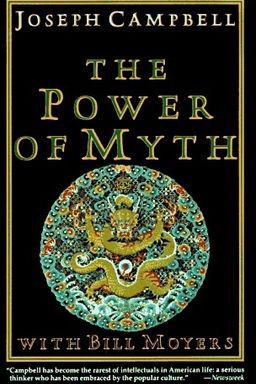
The Power of Myth cover

The Power of Myth

by Joseph Campbell with Bill Moyers

The Power of Myth illuminates how ancient stories shape our understanding of life, love, and death. By exploring myths across cultures, Joseph Campbell reveals their role in uniting humanity and guiding us through life''s challenges, even in a modern world.

Myth as the Experience and Map of Life

What does it mean to feel truly alive? Joseph Campbell argues that myth is not a collection of archaic stories but a living system of symbols that awaken the experience of being alive. His famous remark to Bill Moyers—“what we’re all seeking is an experience of being alive”—anchors his lifelong investigation into how myths help you align with the rhythms of reality. Myths, he contends, are living metaphors, not dogmas. They point beyond themselves to experiences that unite body, psyche, and spirit.

The Central Purpose of Myth

Campbell believes myths serve as maps of the inner landscape. They don’t give you facts; they give you understanding. Ancient or modern, a myth’s function is to provide symbols that guide you through life’s unavoidable stages—birth, growth, love, conflict, loss, and death—helping you participate consciously in the cycles of transformation that sustain life. When you face a personal crisis or turning point, myth gives you metaphoric grounding: Jonah in the whale signals entrapment and rebirth, the Buddha under the Bodhi Tree represents awakening, Luke Skywalker’s training reflects the inward search for courage.

Four Functions of Living Myth

Campbell classifies myth into four interlocking functions. The mystical function opens you to wonder and the rapture of being. The cosmological function renders the universe intelligible as a sacred order. The sociological function validates social institutions and ideals, giving shape to law, justice, and ritual life. Finally, the pedagogical or existential function offers instructions for navigating each stage of life. When you see which function you need most, myths change from entertainment to practical wisdom.

Myth, Science, and the Modern World

Many people today imagine science and myth are enemies. Campbell insists they are complementary: science describes what happens; myth addresses why it matters. Both ultimately circle mystery. When quantum physics admits paradox or cosmology evokes awe, it brushes the threshold of mythic consciousness. You can approach both as different languages pointing toward the same ineffable truth—that existence itself is miraculous and interconnected.

Myth as a Personal Practice

For Campbell, mythology isn’t an academic study; it’s a discipline of life. Your dreams are private myths just as society’s myths are its collective dreams. By attending to recurring images in sleep or story, you learn what your psyche demands for growth. When you enact rituals—whether a marriage ceremony, daily meditation, or a symbolic farewell—you participate in mythic space, transforming ordinary time into sacred time. (Note: Campbell often calls ritual the enactment of myth—an embodied rehearsal of transformation.)

From Ancient Symbols to Modern Stories

Campbell sees mythology renewing itself through modern art and cinema. Star Wars retells the hero’s journey for a technological era: Luke learns that intuition surpasses machinery and that self-mastery defines victory. Likewise, the Great Seal of the United States encodes Enlightenment myth—reason crowned with divine vision, symbolized by the Eye atop a pyramid. Whether through movies, machines, or civic emblems, we continue to generate myths that tell us who we are and what we value.

A Living Tradition

Campbell’s central challenge is to live mythically—to treat your story as a sacred quest rather than a random survival exercise. The myths you love are not about remote gods but clues to your own depths. They help you face joy, death, and change with grace. As he says, the goal is not to search for meaning but to feel the rapture of being alive.

This book’s argument unfolds as an extended proof of that thesis. You explore myth’s psychological roots, its social enactments, its modern analogues, and its ethical summit—compassion. Each section illuminates a facet of how myths can restore wholeness in a disenchanted age. In the end, Campbell redefines religion, art, and science as partners in the same adventure: your awakening to the eternal within the temporal world.


Archetypes, Dreams, and the Shamanic Imagination

Behind all myths and dreams lies a shared symbolic grammar. Campbell, drawing on Jung, explains that both spring from bodily and psychic energies common to the species. That’s why the same archetypes—serpent, hero, mother, trickster—repeat from Polynesia to Plato. When you dream an archetypal image, you touch the collective myth your culture may have forgotten.

Dreams as Private Myths

Personal dreams process daily stress; archetypal dreams connect to larger transformations. Keep a dream journal, Campbell advises, and note recurring motifs. Over time, you’ll recognize that dreams are dramatizations of inner thresholds—marriage, loss, vocation—that demand symbolic enactment. (Note: Campbell viewed psychoanalysis as modern ritual; it translates ancient initiations into therapeutic practice.)

The Shaman as Cultural Mediator

Across traditional societies, shamans undergo symbolic death and rebirth. The Sioux visionary Black Elk, who saw the cosmic center and returned to teach, embodies this path. The shaman’s illness, dismemberment, or descent corresponds to the ego’s breaking so that the Self—the transpersonal psyche—can speak. Artists and healers perform this mediating role today, bringing visions from the unconscious into communal form.

Myth as Society’s Dream

Campbell sums it up: “The myth is the society’s dream; the dream is the individual’s myth.” When your private images coincide with public symbols, you rediscover your culture’s creative center. This unity bridges individual psychology and collective meaning.

By linking the symbolic logic of dreams and myths, Campbell gives you a way to understand your night visions as an invitation to transformation. To follow myth is to honor imagination as revelation, the voice of what shamans call the spirits and psychologists call the unconscious.


Ritual, Initiation, and the Power of Passage

Campbell argues that myth without ritual is dead ideology. Ritual enacts mythic truth through symbolic gestures that change identity. Traditional cultures marked transitions—birth, puberty, marriage, death—through rites that aligned personal development with cosmic order. Modern society, he warns, has lost such rites, leaving citizens spiritually uninitiated.

Initiation and the Formation of Self

Initiation rites dramatize death and rebirth. Whether the circumcisions and scarifications of tribal societies or symbolic trials like college graduation and military enlistment, initiation converts a dependent person into a social adult. When these rituals vanish, people seek substitutes—gang violence, extreme risk, or addictions—that mimic initiation’s intensity without its guiding wisdom.

Marriage as Spiritual Union

For Campbell, marriage is not a perpetual love affair but a ritual union of opposites—a reunion of what was one at birth. The wedding ceremony marks the transpersonal creation of a single life out of two. Think of the ring’s endless circle: it signifies wholeness. Viewed mythically, marriage becomes an initiation into shared destiny, not private romance.

Rituals in Modern Life

You can restore meaning by crafting small, intentional ceremonies—a moment of silence before meals, a ritualized start to creative work, a farewell ceremony at life transitions. Ritual integrates your psychology with the larger rhythms of society and cosmos. It keeps ethics embodied rather than abstract.

Without Ritual, Society Fragments

Campbell warned, “If you want to understand a society without ritual, read the newspaper.” In the absence of binding mythic rites, chaos and alienation grow. Rituals restore both belonging and transcendence—the two poles your psyche requires.

Ritual, then, is myth in action. By reintroducing conscious rites into daily life, you recover myth’s transformative power in your own modern context.


The Hero’s Journey and the Call to Transformation

Campbell’s best-known contribution, the hero’s journey, crystallizes myth’s universal pattern: departure, initiation, and return. Every life, he says, contains thresholds where you are summoned to growth. The call may come as crisis, love, vocation, or loss. Accepting it transforms you; refusing it keeps you trapped in stagnation.

Stages of the Journey

The hero leaves home, encounters trials, achieves illumination, and returns bearing a boon for others. Odysseus’s voyage, Buddha’s enlightenment, and Luke Skywalker’s awakening all illustrate the same psychic rhythm. The tests—a desert’s temptation, a labyrinth’s confusion, a battle with the inner shadow—strip the ego so the deeper Self can emerge. When you interpret your own obstacles this way, your suffering gains purpose.

Follow Your Bliss

Campbell’s most practical maxim, “Follow your bliss,” directs you to identify what energizes your soul and pursue it despite fear or convention. This is not mere hedonism but a compass toward authentic vocation. He observed that once you commit to your true path, “doors will open where there were none before.” (Note: The phrase echoes Nietzsche’s and Emerson’s injunctions to live from the center.)

Hero vs. Leader

Not all leaders are heroes. Napoleon and Hitler, Campbell remarks, serve power, not transcendence. The true hero serves life itself. The test of heroism is not conquest but sacrifice—what you are willing to give up to renew the world.

Heroic Practice

Whenever you undergo change—a career shift, a breakup, a spiritual crisis—you walk the hero’s road. Meet challenges consciously; interpret them as calls to transformation; return with compassion for others still struggling at the threshold.

The hero’s journey teaches that every threshold, personal or collective, hides a deeper invitation: to die to the old self and bring back renewal for the tribe of humanity.


Sacred Landscapes and the Feminine Ground

For Campbell, the world itself is myth incarnate—a sacred landscape shaped by imagination. Indigenous and ancient cultures sanctified their geography: the Navaho four mountains, Chartres Cathedral, and the buffalo jump each encoded cosmology into place. To live mythically is to inhabit earth as temple, not resource. Modern alienation, he warns, begins when land loses sanctity.

The Goddess and the Earth Body

Early myths focus on the Great Goddess, the creative and sustaining principle of life. Figurines of fertility, Egyptian Nut, and the Indian Shakti image express reverence for earth as mother. Over time, patriarchal religions subordinated the feminine—Marduk’s slaying of Tiamat symbolized male conquest of cosmic nature. Yet the feminine resurfaces again and again—as Isis restoring Osiris, as the Virgin Mary nurturing the child, as modern ecological consciousness reclaiming the sanctity of Earth.

Sanctifying Space and Spirit

Every sacred site teaches belonging and reciprocity. When Chief Seattle says, “The earth does not belong to man; man belongs to the earth,” Campbell sees a mythic philosophy of ecological interdependence. The affliction of modern cities is desacralization; the cure is rediscovery of small sacred centers—rooms, hours, rituals—that reconnect you to the living ground.

Reclaiming the feminine and the sacred place restores wholeness. It reintegrates spirit and matter, culture and nature, masculine striving and feminine care. In Campbell’s mythic ecology, compassion for the earth and reverence for the feminine become identical acts.


Death, Sacrifice, and the Renewal of Life

All myths converge on a single paradox: life feeds on life. Campbell explores this through the serpent that sheds its skin, the dying-and-rising god, and ritual sacrifice. To live fully is to accept death as part of the eternal cycle. Denial of death, he warns, breeds violence and numbness; reverent acceptance yields gratitude and vitality.

Symbols of Regeneration

The serpent—revered in India and Pueblo myths, demonized in Genesis—embodies perpetual renewal. Vegetation deities like Osiris or the Polynesian eel whose body becomes crops dramatize the truth that life’s continuity requires sacrifice. The Christian Eucharist, for Campbell, is a late expression of this vegetal pattern: consuming the god who dies to nourish his people.

Ritual Sacrifice and Gratitude

In hunting and agrarian rites—from buffalo ceremonies to the Mayan ballgame—the killing act becomes sacred acknowledgment of interdependence. Proper ritual transforms necessity into blessing. Modern mechanized slaughter, stripped of ceremony, erases that awareness and turns consumption into moral blindness.

From Sacrifice, Bliss

Campbell condenses the lesson: “From sacrifice, bliss.” The descent to death yields new life; the seed that dies bears fruit; the cross, properly understood, is not tragedy but the pattern of cosmic renewal.

When you embrace mortality—your own and others’—you rediscover participation in an ongoing dance of creation and dissolution. In mythic consciousness, death is not the opposite of life; it’s the condition that makes life sacred.


Love, Compassion, and the Unity of Being

Campbell culminates his vision in compassion—the realization that all beings are one life. He illustrates it through Schopenhauer’s philosophy and a vivid story: a Hawaiian policeman saving a suicidal youth, declaring afterward, “I couldn’t let go.” In that instant, the illusion of separateness vanished; compassion became metaphysical truth.

From Amor to Agape

Tracing love’s evolution, Campbell distinguishes Eros (instinctual desire), Amor (individualized passion of the troubadours), and Agape (universal compassion). Courtly love’s discovery of personal experience paved the way for spiritual awakening through human relationship. But ultimate compassion transcends individuality—it’s life recognizing itself in another form.

Compassion as Existential Courage

Compassion is not pity; it’s courage to suffer with. The bodhisattva who postpones nirvana, Christ on the cross, a mother nursing a sick child—all live the same archetype of participation in universal life. Heroism, Campbell concludes, is any act of self-surrender to something larger than self-preservation.

Practicing the Mythic Heart

You cultivate compassion through ritual, meditation, art, and noticing the small moments when empathy naturally arises. Such experiences are thresholds of awakening: joy and sorrow fuse, self and other disappear. If myth begins with the experience of being alive, it ends with the realization that all life is one being breathing through countless forms.

The Final Revelation

Compassion fulfills myth’s final function: to reveal the unity of life behind apparent multiplicity. In the moment you act out of that awareness, Campbell says, you are living myth—not talking about it.

Thus the cycle closes. Myth starts as story, becomes vision, leads through death and rebirth, and culminates in the consciousness of compassion—the mask of eternity seen through human eyes.

Dig Deeper

Get personalized prompts to apply these lessons to your life and deepen your understanding.

Go Deeper

Get the Full Experience

Download Insight Books for AI-powered reflections, quizzes, and more.