
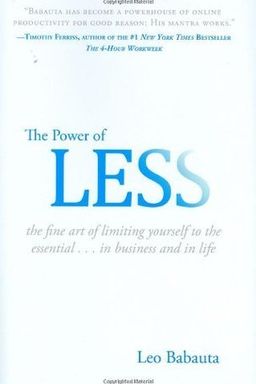
The Power of Less cover

The Power of Less

by Leo Babauta

The Power of Less teaches the art of productive minimalism, emphasizing the importance of focusing on essential tasks and habits to achieve greater impact with less effort. Discover how to prioritize, set limits, and transform your life through small, consistent changes.

The Power of Less: Doing More by Choosing Less

What if the secret to achieving more wasn’t about hustling harder, but about doing less? In The Power of Less, productivity expert Leo Babauta makes a daring case: true productivity, clarity, and peace come not from adding tasks, but from stripping life down to its essentials. The modern world, he argues, has seduced us into believing that doing more equals success—but that equation leaves us exhausted, distracted, and unfulfilled. The antidote lies in focus, simplicity, and deliberate limitation.

Babauta’s central argument is simple yet radical: by setting boundaries around your time, attention, and possessions, you can reclaim control. Constraints, paradoxically, free you. The book’s message flows from his experience transforming his life—from a stressed, debt-ridden father of six to a calm and successful blogger, marathoner, and author. His approach, rooted in Zen-inspired minimalism, teaches that every area of life—work, relationships, health, and creativity—thrives when you identify the essential and eliminate everything else.

The Problem of Overload

Babauta begins by diagnosing the modern malaise: life has become a blur of e-mails, tasks, social media feeds, and unending commitments. We pride ourselves on multitasking and speed, yet we end each day frazzled and unfocused. The problem, he says, isn’t lack of time or tools—it’s lack of choice. We’ve stopped questioning whether the things occupying our time are truly important. Like drinking from a fire hose, we take in more than we can handle and drown in the process.

The Philosophy of Less

“Identify the essential. Eliminate the rest.” This, Babauta insists, is the core equation for success. Rather than managing the chaos, he proposes we reduce it. This philosophy isn’t merely about cleaning your desk or unsubscribing from e-mail lists—it’s about clarity of purpose. As he puts it, living without limits dilutes our power. Concentration, not abundance, creates strength. Like a pitcher who throws one perfect inning instead of nine weak ones, we become powerful by channeling energy where it matters most.

The Six Principles of Simple Productivity

Babauta structures his method around six foundational principles: Set limitations, Choose the essential, Simplify, Focus, Create new habits, and Start small. These principles overlap and build on one another. Setting limits forces prioritization; choosing the essential guides what stays; simplifying clears the path; focusing concentrates your energy; creating habits sustains progress; and starting small ensures success without burnout.

Through these six pillars, Babauta turns abstract wisdom into actionable routines. He applies them to everything from managing e-mail and time to decluttering your desk, commitments, and mind. Each chapter in the book explores practical “Power of Less” practices in specific spheres of life—work, home, health, and purpose—demonstrating how minimalism is not about deprivation but deliberate living.

Why It Matters

Why does this philosophy resonate today? Because information overload is not just a time-management issue—it’s existential. We spend energy reacting instead of creating, accumulating instead of appreciating, and adding without meaning. The Power of Less invites you to step off the treadmill and define what matters. Once you choose what’s essential, saying “no” becomes an act of liberation. In Babauta’s view, simplicity isn’t a luxury; it’s survival in a world that never stops asking for more.

By the end of the book, the reader walks away with a blueprint for calm and accomplishment: cut down commitments, manage tasks through daily focus on three essentials, declutter your environment, develop habits one at a time, and cultivate mindfulness through presence. Babauta’s message echoes ancient Stoics and Zen teachers but feels startlingly modern: less truly is more. The path to mastery, freedom, and happiness begins when you do fewer things—but do them fully.


Setting Limits: The Art of Controlled Focus

Babauta’s second principle, Setting Limits, functions as the foundation of everything else in The Power of Less. He argues that most stress and inefficiency result from living without boundaries. Like trying to empty the ocean with a teaspoon, modern life’s limitless demands scatter our focus and dilute our strength. By imposing rules—on time, tasks, consumption, or communication—you narrow your field of attention, and paradoxically, that restriction increases power.

Why Limits Are Liberating

Imagine a pitcher throwing every day until his arm gives out—he’s exhausted and ineffective. But pitch that same arm every three days for one inning, and he’s unstoppable. Limits, Babauta says, work like energy reservoirs. They force you to use strength where it counts. This is why artists often create masterpieces within strict forms like haiku—constraint drives clarity. As the haiku poet must express beauty in seventeen syllables, you must learn to express meaning within time’s natural boundaries.

He invites readers to set limits in practical ways: limit e-mail checks to twice a day, projects to three at a time, and goals to one per cycle. Limit possessions, meetings, information sources, and even social obligations. When you say “no” to excess, you say “yes” to purpose.

Designing Your Limits

Setting limits isn’t about arbitrary austerity—it’s an experiment in optimization. Start by analyzing current behaviors. How many times do you check your phone, attend meetings, or start projects? Then pick one area that feels overloaded and assign a number. For instance, “I’ll check e-mail at 10 a.m. and 4 p.m. only.” Test the limit for a week and observe how it impacts both work and peace of mind. Adjust as needed until the habit sticks.

“Limitless is weak.”

Babauta turns contemporary logic upside down: strength doesn’t come from endless capacity, but from disciplined containment.

Practical Outcomes

Each limit is a permission slip for focus. With fewer goals, you achieve more of them. With fewer commitments, you care more deeply. Even communication boundaries—such as reducing inboxes or disabling notifications—help restore mental stability. The outcome is both quantitative (greater productivity) and qualitative (more peace). As Babauta shows through his own story—building Zen Habits into a top blog while raising six kids—power multiplies as you narrow your attention.

In contrast with time-management gurus like David Allen of Getting Things Done, who optimize processing of inputs, Babauta teaches that transformation begins before the input—by deciding what shouldn’t enter in the first place. Less flow equals less friction. For busy professionals and overwhelmed parents alike, limits are not cages; they are the walls of a temple protecting your sacred energy.


Choosing the Essential and Simplifying

After learning to set limits, Babauta turns to the deeper question: What actually matters? In Principle 2, “Choosing the Essential,” and Principle 3, “Simplifying,” he merges minimalism with strategic focus. The goal isn’t to cut for the sake of cutting—it’s to peel away distractions until you reveal your core priorities. Like Michelangelo sculpting an angel from marble, you remove everything that isn’t essential to what you love and value.

Knowing What’s Essential

Most of us make endless to-do lists without pausing to ask whether the tasks have any long-term impact. Babauta introduces a series of reflective questions that help you identify your essentials:

  • What aligns with my values and long-term goals?
  • What activities or commitments give me joy or meaning?
  • Which tasks will make the biggest difference months or years from now, not just this week?

By filtering tasks through these questions, you start distinguishing activity from achievement. For instance, replying to every e-mail might feel urgent but rarely shapes your life; writing your book or building your product might.

Eliminating the Nonessential

Simplifying, for Babauta, means removing the noise after you’ve found the music. Once you’ve identified essential projects, discard or delegate everything else. This works for all areas—work tasks, personal commitments, possessions, even thoughts. It echoes Greg McKeown’s concept in Essentialism: “If it isn’t a definite yes, it’s a no.”

He suggests you start small. Declutter one part of life at a time—your inbox, your project list, your wardrobe. Say no more often, post fewer blog entries but make them deeper, or read fewer blogs but more mindfully. The process is ongoing; simplification is a practice, not a one-time purge.

“Simplifying isn’t meant to leave your life empty—it’s meant to leave space for what you really want to do.”

The Power of Editing Your Life

Like a skilled editor who cuts redundant sentences, you must cut nonessential life paragraphs. This editing process deepens clarity and joy. As he puts it, simplifying doesn’t deprive you; it amplifies what remains. You regain emotional room for creativity, family, and gratitude. You stop chasing everything and start living something.

By combining the courage to choose with the discipline to simplify, you begin to live life on purpose. Babauta’s method transforms minimalism from an aesthetic trend into a conscious act of self-definition: deciding what your life is for by deciding what it’s not.


Focus: The Science of Doing One Thing Well

In one of the book’s most practical and transformative chapters, Babauta declares that focus—not discipline, not motivation—is the single most critical skill for effectiveness. When you control attention, you control results. Modern culture celebrates multitasking, but the human brain isn’t built for it. Shifting between tasks drains cognitive energy and creates illusionary productivity. The real efficiency comes from devotion to a single purpose at a time.

Focus on a Goal, a Task, and the Moment

Babauta breaks focus into three dimensions. First, focus on one goal—his “One Goal System.” Choose one transformative aspiration and make it the center of your efforts until you complete it. Too many goals dissolve your drive. Second, focus on one task. Practice “single-tasking”: when you write, just write. When you eat, just eat. When you talk to someone, give them full presence. Lastly, focus on the present moment. The more you live here and now, the less anxiety you carry about the past or future.

How to Train Your Focus

He offers exercises reminiscent of mindfulness practice. Start by eliminating obvious distractions—phones, notifications, clutter. Then create time blocks for undisturbed work on your Most Important Task (MIT). If other ideas pop up, jot them down but stay the course. When your mind wanders, gently bring it back. Over time, you strengthen your “focus muscle.”

He also emphasizes the emotional side of attention: learn to focus on the positive. When quitting smoking or running marathons, Babauta replaced thoughts of pain with thoughts of strength. Choosing positivity is choosing focus on what fuels you, not what drains you. This aligns with findings in positive psychology (as in Shawn Achor’s The Happiness Advantage), where attention determines attitude.

Focus, he writes, is mindfulness in action—it’s what turns fleeting concentration into flow.

The outcome of single-tasking and mindful work is profound: less stress, higher creativity, and a sense of timeless immersion known as “flow.” You stop scattering yourself thin and start channeling your life into what matters most. Modern productivity, Babauta reminds us, isn’t about managing more; it’s about mastering attention.


Creating Habits That Last

Change, Babauta argues, doesn’t come through willpower but through habit architecture—building automatic behaviors one at a time. Principle 5, “Create New Habits,” anchors his philosophy in psychology and practice. His method, known as the Power of Less Challenge, turns habit creation into a 30-day experiment powered by simplicity and public accountability.

The Power of the One Habit

The first rule: focus on one habit at a time. Attempting multiple changes divides energy and leads to failure. Instead, choose one small action that delivers big returns—like exercising, decluttering for fifteen minutes, or checking e-mail twice a day. Write down the plan with clarity: when it will occur, what triggers it, and who you’ll report to. Then commit publicly, either through friends or online communities, and post daily progress.

Why It Works

Accountability creates social pressure; small daily wins build momentum. Babauta explains that consistency matters more than intensity. Doing a ten-minute run every day for 30 days rewires both brain and identity—you become “a runner.” Each 30-day cycle compounds, creating stability in your new lifestyle. This incremental, human-scale approach parallels James Clear’s Atomic Habits, though Babauta originated his framework years earlier.

“Focus on one habit for one month, and you’ll build a lifetime of momentum.”

Twelve Foundational Habits

To guide readers, Babauta offers twelve habits to master—one per month—including setting daily MITs, single-tasking, exercising, decluttering, and limiting e-mail. Together, these habits form the infrastructure for a simple, effective life. His community-driven “Power of Less Challenge” (hosted on Zen Habits) shows how collective progress amplifies personal discipline.

In essence, Babauta reframes self-improvement as slow cultivation. Change isn’t a sprint of heroic effort but a rhythm—you learn, stabilize, and move forward. Each habit becomes a stepping-stone toward the life you want, achieved with compassionate focus instead of exhaustion.


Simple Time and E-mail Management

In Chapters 9 and 10, Babauta reimagines time and communication systems with minimalist precision. He knows our days are ruled by calendars and inboxes, yet insists neither should dictate our lives. The remedy? Limit access, batch tasks, and focus on the few things that matter daily.

Minimalist Time Management

Traditional scheduling overstructures life. Babauta suggests a more fluid model built around three Most Important Tasks (MITs) each day. Choose them first thing in the morning, finish them before distractions, and treat everything else as optional. This simplified framework resembles essentialist approaches by Cal Newport (Deep Work) but is easier to adopt—less about calendar blocks, more about daily intention.

He also recommends batching—grouping similar activities such as calls, errands, or paperwork. Batch processing reduces cognitive switching and saves hours weekly. Combined with single-tasking, this method turns chaos into flow.

E-mail Mastery

E-mail, Babauta writes, is the ultimate modern distraction. His approach reframes digital overwhelm into clear habits:

  • Limit inboxes: consolidate all channels—texts, DMs, multiple e-mails—into one streamlined system.
  • Check messages at fixed times (morning and afternoon only).
  • Reduce incoming flow via filters, unsubscribes, and communication policies.
  • Process to empty—delete, delegate, archive, reply immediately, or add to a separate to-do list.
  • Write concisely: cap replies at five sentences to force clarity.

The magic of this system is its simplicity. Within weeks, users reclaim hours daily and experience what he calls “e-mail nirvana”—an empty inbox and a calm mind.

“The way to e-mail nirvana is by applying the Power of Less—simplify, set limits, and process quickly.”

Through MITs and disciplined e-mail habits, Babauta teaches that productivity doesn’t come from speed—it comes from control. You stop reacting and start directing your attention where it makes a difference.


Declutter, Simplify, and Slow Down

Babauta extends his simplicity mindset into physical space and daily rhythm. In chapters like “Declutter Your Work Space,” “Slow Down,” and “Simple Daily Routine,” he demonstrates how outer order enables inner calm. Much like Marie Kondo would later popularize, he links decluttering with emotional clarity and focus.

Creating Physical and Mental Space

A cluttered desk mirrors a cluttered mind. Babauta’s decluttering method is straightforward: remove everything from your work area, sort once, make fast decisions (trash, delegate, file, or act), and afterward assign every item a home. Maintain the order through three micro-habits: always use an in-box, process it daily, and put things away immediately. The same principles apply at home—one shelf, one drawer at a time. The result is a minimalist environment that encourages peace and focus.

The Power of Routine

For Babauta, simplicity isn’t chaotic freedom—it’s rhythm. His morning routine begins at 4:30 a.m. with coffee, solitude, running, and writing. He encourages designing your own: pick four to six energizing actions that prepare your mind and body. Likewise, evening routines should release tension and prepare tomorrow—journaling, meditating, reading, or family time. Routines turn intention into effortless flow and replace confusion with calm predictability.

Slowing Down

Finally, Babauta challenges the cult of speed. Moving faster doesn’t mean achieving more—it often means missing life. By walking, driving, eating, and working slowly, he discovered mindfulness and joy. Eat slowly to lose weight and increase gratitude; drive slowly to reduce stress; perform one task with total immersion. Slowness reconnects you with living instead of merely doing.

“Life is a journey—make it a pleasant one.”

Babauta’s slow philosophy transforms simplicity from technique into way of life. Your desk, inbox, meals, commute, and days become aligned around ease and presence, creating the stillness from which your best work—and best self—emerges.


Motivation and the Long Game of Simplicity

In his final chapter, Babauta ties everything together with an essential truth: sustained simplicity requires sustained motivation. Anyone can begin decluttering or focusing, but perseverance decides success. So he devotes the book’s closing to the psychology of staying inspired, offering timeless techniques to rekindle purpose when energy fades.

Start Small, Stay Consistent

Motivation fades when goals feel insurmountable. The antidote is to start ridiculously small—run for five minutes, meditate for one, clean one drawer. Success builds self-trust, which fuels further progress. Each act creates a feedback loop of achievement, similar to scientific “micro-motivation” models in behavioral psychology (as described later by BJ Fogg).

Emotional Triggers and Commitment

Babauta encourages aligning goals with emotion. Don’t chase abstract “better habits”—connect them to deeper meaning: health for your kids, simplicity for peace, focus for creative impact. Then amplify commitment through public accountability—tell others, report progress, and celebrate milestones. Public honesty converts fleeting enthusiasm into sustained obligation.

Reigniting Passion When You Struggle

He enumerates dozens of hacks for days when enthusiasm disappears: visualize success, read inspiring stories, find a workout buddy, track progress visually, reward small wins, never skip two days, and—most importantly—find joy in the process. “You can’t stick to something for long if it feels unpleasant,” Babauta reminds us. The secret is not delayed gratification but daily pleasure in the act itself.

“Find pleasure in the process. There has to be joy every day, or you won’t want to do it.”

In the end, The Power of Less isn’t about productivity—it’s about fulfillment. Motivation grounded in love, simplicity, and gratitude never runs dry. Babauta’s message is clear: slow down, focus small, stay kind to yourself, and let incremental mastery reshape your world. The power of less isn’t about subtraction—it’s about amplifying the meaning in everything that remains.

Dig Deeper

Get personalized prompts to apply these lessons to your life and deepen your understanding.

Go Deeper

Get the Full Experience

Download Insight Books for AI-powered reflections, quizzes, and more.