
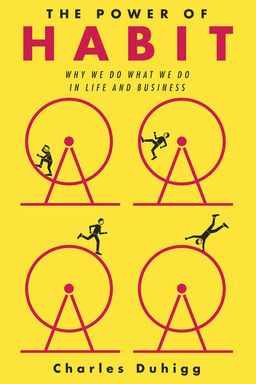
The Power of Habit cover

The Power of Habit

by Charles Duhigg

The Power of Habit unveils the science behind why habits exist and how they can be changed. Through compelling research and stories, Charles Duhigg provides actionable insights for individuals and organizations to transform routines and achieve success.

The Science and Power of Habit

Why do you act the way you do—even when you swear you’ll change tomorrow? In The Power of Habit, Charles Duhigg argues that almost everything you do, from how you brush your teeth to how organizations handle crises, is governed by repeating neurological loops of cue, routine, and reward. Habits are not moral failings or quirks but embedded programs that let your brain conserve energy. Understanding these loops gives you the power to redesign them and to reshape the wider systems—your company, community, and culture—that run on similar routines.

How Habits Work in the Brain

Duhigg begins with Eugene Pauly, whose memory was destroyed yet who could still form new routines, like finding his way home. His basal ganglia—the brain’s habit center—remained intact. Researchers at MIT observed similar patterns in rats learning mazes: as repetition increased, their cortex quieted and the basal ganglia took over. This process, called "chunking," means the brain compresses steps into automatic sequences so higher thought can focus elsewhere. Once a habit is formed, decision-making largely shuts off until a disruption or conscious intervention occurs.

Cue, Routine, Reward—and Craving

Every habit runs through a three-part loop. The cue triggers an automatic routine, which delivers a reward that teaches your brain what to expect next time. Over time the brain begins to anticipate that reward—creating craving. Wolfram Schultz’s monkey experiments illustrated this: the dopamine rush moved from the juice itself to the stimulus predicting it. In humans, that anticipation powers the persistence of routines, whether brushing teeth for the Pepsodent tingle or finishing chores to enjoy Febreze’s scent. Craving transforms repetition into desire and desire into ingrained habit.

Changing the Routine: The Golden Rule

Habits rarely disappear; they can only be replaced. The key is to keep the cue and reward constant while changing the routine. Tony Dungy’s NFL coaching focused on rewriting automatic reactions—not the triggers. Alcoholics Anonymous uses the same principle: replace the drinking routine with meetings and companionship that offer similar relief and social reward. Psychologists apply the tactic in habit-reversal therapy, teaching substitutes for nail-biting or smoking. You change the habit by keeping its scaffolding intact.

From Individuals to Organizations

Organizations run on collective routines—reporting habits, communication patterns, power dynamics. Paul O’Neill transformed Alcoa by focusing on one keystone habit: safety. That narrow target forced changes in communication, accountability, and even productivity. Similarly, when crises struck Rhode Island Hospital and King’s Cross station, those shocks broke entrenched routines and opened a window for reform. Systems evolve only when leaders use disruption or keystone focus to redraw habitual behaviors.

Prediction, Familiarity, and Ethics

Modern companies exploit habits through data analysis. Target’s analysts predicted pregnancies from shopping patterns and learned that new parents—amid disrupted routines—are most malleable. Yet overt prediction felt invasive, so marketers disguised baby coupons among unrelated items, making novelty appear familiar. Radio programmers used the same psychology to turn Outkast’s "Hey Ya!" from an unpopular novelty into a hit by sandwiching it between familiar songs. These stories reveal a dual edge: the same science that enables beneficial habit formation can easily manipulate you when corporations use it to engineer craving.

Responsibility and Choice

The book ends with the moral question: if habits drive behavior automatically, how responsible are we? The contrast between Brian Thomas, who killed his wife in a sleep terror, and Angie Bachmann, compelled by gambling designed to exploit habit circuitry, illustrates two sides of the line. Automatism can excuse; informed compulsion cannot. When you understand how habits work, knowledge becomes obligation. You must use it to design better routines—both for yourself and ethically for others. Awareness is power, and power demands moral restraint.

Core understanding

Habits govern individuals, organizations, and industries. Once you learn their architecture—cue, routine, reward, craving—you can reclaim control and design them consciously. What begins in neurology ends in ethics: understanding habits gives you both freedom and responsibility.


Inside the Habit Loop

Every habit originates in a neurological loop of cue, routine, and reward. Duhigg grounds this in experiments at MIT, where rats learned mazes as brain activity shifted from the cortex to the basal ganglia. That transfer defines automation: your brain chunks sequences, allowing you to act with less effort. Humans operate the same way—Eugene Pauly could find the jar of nuts without remembering where he lived because cues triggered intact routines.

Cue: The Trigger

A cue can be time, place, emotion, company, or preceding action. It’s the signal telling your brain which routine to run. Recognizing cues gives you leverage: once you spot the trigger, you can anticipate what behavior will follow. For example, the smell of coffee may cue a cigarette; the sight of running shoes may cue exercise. (Note: researchers at Duke found about 40% of daily actions are cued and habitual.)

Routine: The Behavior

The routine is the observable act—tying a shoe, snacking, checking your phone. The miracle and the danger of routines is their independence from conscious thought. A rat runs a maze even when the food turns poisonous; a person can overeat without realizing it. Habits persist beyond rational evaluation because they serve learned rewards.

Reward: The Payoff and Craving

Rewards teach the brain to remember loops. They can be sensory (the taste of chocolate), emotional (feeling relaxed), or cognitive (checking a task off a list). Schultz’s monkey Julio learned that the signal predicting juice produced the same dopamine spike as the juice itself. That shift from consumption to anticipation is craving—the invisible fuel of all habits. When craving develops, the loop becomes self-propelling: you feel uneasy until you fulfill it.

Practical takeaway

To alter any habit, dissect its loop. Identify the cue, test alternate rewards, map the craving, and modify the routine. Once craving shifts, so does the behavior.


Building New Habits

Changing habits means rewiring your brain’s expectations, not erasing routines. Duhigg’s "Golden Rule"—same cue, same reward, new routine—shows how substitution works. You start by understanding what drives your current habit and then design an alternate path that satisfies the same craving more positively.

Substitution and Practice

Tony Dungy’s football players didn’t have time to think mid-play. Dungy trained new reflexes around existing visual cues—changing routines under identical triggers. Alcoholics Anonymous follows the same structure, replacing isolation with community and relief through conversation. Mandy’s nail-biting therapy teaches her to grip a pencil whenever tension arises; the cue stays, the reward shifts from self-damage to relaxation.

Keystone Habits

Some habits generate cascades of other improvements. Paul O’Neill’s safety obsession at Alcoa transformed operations because safety requirements demanded transparency and cooperation. Michael Phelps’s pre-race rituals extended into nutrition and calm focus. On a personal level, keeping a food journal increases mindfulness and weight control. Keystone habits create momentum by empowering small wins that modify surrounding routines automatically.

Willpower as a Habit

Willpower itself works like a habit. Experiments by Mark Muraven show it depletes temporarily but strengthens through practice. Starbucks institutionalized this idea, teaching employees to handle stressful moments via scripts (LATTE: Listen, Acknowledge, Take action, Thank, Explain). What starts as deliberate effort becomes automatic professionalism. Treat self-control as a trainable routine—plan responses, rehearse them, and conserve energy for crucial decisions.

Lesson

Small actions repeated under consistent cues, supported by meaningful rewards, create lasting change. Focus on structure, not just motivation.


Habits in Organizations and Movements

Organizations and social movements follow the same principles as individual habits: they depend on routines, cues, rewards, and social reinforcement. When you see institutions behaving irrationally, you’re witnessing systems of habits that can persist until a crisis or keystone focus forces change.

Organizational Routines and Crises

Companies form truces—unspoken agreements that let rival departments coexist. At Rhode Island Hospital, doctors dominated nurses, and flawed routines led to operating on the wrong patient. At King’s Cross Station, departmental boundaries prevented fire warnings from spreading. Crises revealed how deeply ingrained habits could be deadly. Leaders used those moments to reassign authority and establish new standard procedures, turning shock into reform. (Note: similar pattern seen after NASA and airline disasters.)

Social Movements and Collective Habits

The Montgomery Bus Boycott demonstrates how private habits scale to mass action. Rosa Parks’s strong social ties activated immediate support; weak ties spread expectations that everyone would join. Sustaining the boycott required new communal routines—carpools, meetings, nonviolent discipline—that created identity. Granovetter’s theory of weak ties explains why movements grow when participation becomes habitual and socially reinforced. Rick Warren’s Saddleback Church and Freedom Summer replicate that architecture: attract broadly, then deepen ties through rituals.

Key understanding

Strong ties ignite commitment; weak ties spread momentum; shared routines sustain identity. Change in groups requires altering the daily habits that define belonging.


Predicting and Shaping Consumer Habits

Modern analytics push habit science into commerce. Retailers and media firms predict what you’ll want and subtly shape your routines. The Target pregnancy algorithm and radio’s manipulation of familiarity illustrate how predictive power meets psychological strategy to change behavior.

Target’s Data Science and the Life-Event Window

Analyst Andrew Pole discovered that expecting mothers reveal pregnancy through purchases—unscented lotion, vitamins, zinc supplements. Target used this knowledge to send timed coupons during periods when buying habits were malleable, but they camouflaged those offers among ordinary items to avoid seeming intrusive. Alan Andreasen’s research confirms that life transitions like childbirth, marriage, or moving provide rare openings when established routines can be replaced with new ones.

The Familiarity Principle in Media

When radio stations tried to popularize Outkast’s “Hey Ya!,” listeners initially tuned out—the song was too novel. Consultants "sandwiched" it between familiar tracks, helping audiences accept it subconsciously. Familiarity lowers cognitive resistance and helps novelty integrate into existing habit patterns. The same principle drives successful social or health campaigns: connect foreign behaviors to comfortable contexts.

Ethical Constraints

Data and design can either support helpful adaptation or exploit vulnerability. Casinos use “near-miss” effects—outcomes that resemble wins—to sustain gambling—a warning case of manipulation. Responsible use of predictive analytics requires transparency and consent; unchecked habit engineering erodes autonomy. (Parenthetical note: similar ethical tensions appear in digital ad targeting and social-media algorithms.)

Insight

Prediction alone doesn’t change behavior. The novel must be made familiar, and the incentives must respect rather than exploit human craving.


Responsibility and the Ethics of Habit Design

When you realize how powerful habits are, the question becomes moral: who carries responsibility? Duhigg’s final chapters contrast involuntary automatism, like Brian Thomas’s sleep terror killing, with pathological compulsion, like Angie Bachmann’s gambling. Both stem from the same neural mechanisms, but society judges differently because awareness creates accountability.

Knowledge and Moral Obligation

William James argued that self-awareness converts habit from fate to choice. Duhigg adopts that stance: once you understand cue-routine-reward dynamics, you must act intentionally. Ignorance can absolve; insight demands responsibility. This applies equally to companies designing products—Target, Harrah’s, and Spotify’s recommendation algorithms each make moral decisions when they engineer behavior. Power over habit is power over freedom.

Corporate and Social Reckoning

Data-driven persuasion crosses ethical lines when it preys on compulsion. Courts have debated corporate liability for gambling addiction and for pharmaceutical side effects that induce compulsive actions. These controversies remind leaders to adopt an explicit “do no harm” design ethic: balance convenience and profit with transparency and restraint.

Personal Framework for Change

Duhigg closes with a practical tool: identify your routine, experiment with rewards, isolate your cue, and plan a new response. It’s self-experimentation for autonomy. You can escape destructive loops by recording cues, testing substitutes, and committing to implementation plans until repetition rewires your brain. The method restores conscious choice where habit once ruled.

Final message

Understanding habits equips you not only to change yourself but also to weigh the ethics of influencing others. Knowledge of habit is both a toolkit and a moral test.

Dig Deeper

Get personalized prompts to apply these lessons to your life and deepen your understanding.

Go Deeper

Get the Full Experience

Download Insight Books for AI-powered reflections, quizzes, and more.