
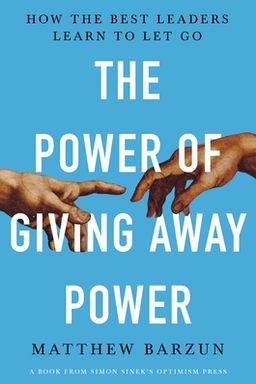
The Power of Giving Away Power cover

The Power of Giving Away Power

by Matthew Barzun

The Power of Giving Away Power reveals how leaders can achieve extraordinary results by embracing a constellation mindset. By sharing power and fostering collaboration, organizations can unlock creativity and adaptability, transforming traditional hierarchical structures into dynamic networks capable of tackling today''s complex challenges.

The Power of Giving Away Power

Have you ever felt exhausted from pretending to have all the answers—whether at work, in a team, or even at home? In The Power of Giving Away Power, former U.S. Ambassador Matthew Barzun challenges the traditional belief that effective leadership is about control, dominance, and certainty. Instead, he argues that the most creative and cohesive kind of power emerges when leaders give away power. Through history, business case studies, and his own experiences in diplomacy and politics, Barzun explores a radical idea: true power grows not from accumulation but from interconnection.

Barzun’s central argument rests on a contrast between two mindsets that shape how we organize and lead: the Pyramid mindset and the Constellation mindset. The Pyramid represents hierarchy, control, and independence—structures that may provide temporary stability but ultimately stifle growth and creativity. The Constellation, by contrast, represents interdependence, openness, and voluntary collaboration. Each person both stands out and fits in, like stars forming patterns in the sky. The book shows how this mindset shift—from control to collaboration—has powered remarkable transformations, from the founding of the United States to the creation of Wikipedia and Visa.

Why This Idea Matters

For centuries, leadership was synonymous with authority—the leader at the top knowing more and commanding others. Barzun argues that we are reaching the limits of this model. Our institutions—from schools and corporations to governments—are organized around Pyramid structures that thrive on predictability and certainty. Yet the modern world is increasingly defined by unpredictability and complexity. The Pyramid mindset creates control but also isolation. We end up “bowling alone,” as sociologist Robert Putnam noted, even while surrounded by millions online. Barzun’s proposal to give away power offers a pathway out of this exhaustion—toward leadership defined by connection and co-creation.

The Book’s Journey

Barzun traces this mindset back to the very birth of America. In his opening chapter, “The Lost Constellation,” he revisits the story of the Great Seal of the United States—the symbol on the back of the dollar bill. Few of us notice that it shows two sides: a Constellation of stars on one side and a Pyramid on the other. The founders, through Charles Thomson’s guidance, found a way to express interdependence symbolically—“out of many, one.” But over the centuries, the Pyramid half gained dominance, especially after Franklin D. Roosevelt placed it front and center on the dollar during the Great Depression. That act reflected the mindset of order and consolidation—the belief that power must be centralized to confront crisis. Barzun sees this historical reversal as emblematic of our own challenges: we keep putting the Pyramid in front of our thinking when what’s needed most is the Constellation.

What You’ll Learn

Across seven chapters, Barzun unpacks how giving away power works in practice. You’ll hear about leaders who discovered “freedom together” rather than “freedom from”: Dee Hock, who founded Visa by replacing corporate hierarchy with a self-organizing network of banks; Jimmy Wales, whose leap from Nupedia to Wikipedia showed that collaboration without gatekeeping could create history’s largest encyclopedia; and Mary Parker Follett, the forgotten management philosopher who championed “power-with” rather than “power-over.” Following Follett’s wisdom, Barzun shows that innovation emerges from integration—all participants contributing their truth and being changed by others in the process.

Why It’s Relevant to You

The message is deeply personal: giving away power isn’t surrender—it’s growth. Whether you lead a team, a family, or even a community group, the same principle applies. When you make space for others’ ideas and voices, the result isn’t chaos, as traditional leadership fears, but energy. Barzun calls this the leap toward interdependence—recognizing our dependence on others while maintaining individuality. He contrasts “freedom from,” the independence we’ve long celebrated, with “freedom with,” the freedom that arises in working alongside others toward shared purpose.

Why This Book Stands Out

Barzun draws from wide-ranging sources—American history, business innovation, campaign organizing, and even neuroscience—to demonstrate that giving away power isn’t just an idealistic notion. It’s how life itself operates. He echoes thinkers such as Peter Drucker, Simon Sinek, and Jane Jacobs, all advocates of collaboration and distributed leadership. But where Sinek or Drucker analyze systems, Barzun gives you stories—from diplomats walking bombed-out streets in wartime London to teenagers sharing hopes and frustrations in British schools—that animate what interdependence looks and feels like. The Power of Giving Away Power ultimately asks you to trust a paradox: when you let go of control, you don’t lose strength—you create it. The result isn’t less power but more—because, given away wisely, power multiplies.


The Lost Constellation: Rediscovering Interdependence

Barzun begins with a story most Americans have never heard—the making of the Great Seal of the United States. On July 4, 1776, the founders made not one but two declarations: independence from Britain and a need for an emblem to represent their new nation. What emerged was more than just a logo; it was a symbol of how diverse states could unite without hierarchy. The seal’s design evolution reveals profound lessons on power, collaboration, and freedom.

The Birth of the Constellation

Through Charles Thomson’s persistence, the final seal combined two powerful images: a bald eagle carrying a shield, and above it a “radiant constellation” representing the thirteen states. Unlike Europe’s lions or crowns, this image symbolized voluntary union—independent bodies aligned around shared purpose. The motto beneath—E Pluribus Unum (“out of many, one”)—captured the spirit of interdependence. Barzun calls this the founding pattern of America’s “Constellation mindset.” Its message: we can be distinct yet connected, free yet together.

How the Pyramid Took Over

But that balance didn’t last. In the 1930s, as the country faced depression, FDR discovered the pyramid on the neglected back side of the Great Seal. He interpreted its Latin motto, Novus Ordo Seclorum (“A New Order for the Ages”), as a metaphor for the New Deal’s centralized power. He ordered both seal sides printed on the dollar bill—but placed the pyramid first. This symbolic decision reflected a shift from interdependence to control. The Pyramid mindset, once just the seal’s reverse side, became the dominant lens for power—one based on hierarchy, dependence, and consolidation.

Freedom From vs. Freedom With

Barzun contrasts the Pyramid’s “freedom from” with the Constellation’s “freedom with.” The Pyramid promises stability through dependence—whether through governments, corporations, or individuals who stand alone. The Constellation, in contrast, offers energy through cooperation and mutual influence. He traces how technological revolutions—from the fall of the Berlin Wall to the rise of the web—revived the spirit of connectivity, yet paradoxically left us more isolated. In today’s “bowling alone, together” world, we need to reclaim the lost constellation of interdependence, the mindset Thomson embedded in America’s founding symbol.

The Leap to Interdependence

For Barzun, rediscovering the Constellation means making a conscious leap—from dependence or independence toward interdependence. That leap demands faith: letting go of the security of centralized control to trust the creative energy that arises among people freely connecting. It’s not chaos but harmony through diversity. The founders placed the pyramid on the back of the seal, Barzun reminds us; we should do the same with our thinking. The Pyramid has its place—in emergencies, in structure—but the Constellation must lead. Our challenge today is to bring it back to the front of our vision, where it belongs.


Constellation Makers: Building Power Through Collaboration

In one of the most compelling sections, Barzun introduces modern “Constellation Makers”—leaders who unlocked immense creativity by sharing power. Through stories of Wikipedia founder Jimmy Wales and Visa founder Dee Hock, he shows how collaboration can outperform control and how giving away authority leads to exponential growth.

Jimmy Wales and Wikipedia

When Jimmy Wales launched Nupedia in 2000, he imagined a top-down digital encyclopedia, curated by experts. But strict peer review caused paralysis: one year produced only eighteen articles. Then Wales took a leap—adopting the new collaborative technology “Wiki,” meaning “quick” in Hawaiian. He renamed the project Wikipedia and opened it to anyone. Accused of anarchy, Wales gave away control, allowing users to write, edit, and improve content together. Within a year, Wikipedia had 18,000 articles; today, it exceeds six million in English alone, rivaling Britannica’s accuracy (as confirmed by Nature magazine). Wales discovered that when you trust people collectively, they don’t just contribute—they multiply energy.

Dee Hock and Visa

Dee Hock’s story mirrors Wales’s leap but in the corporate realm. In the 1960s, the credit card industry was collapsing under chaos and competition. Hock proposed a revolutionary solution: instead of banks fighting for dominance under Bank of America, they’d form a network where each participant held a right to participate rather than ownership. Freedom to compete and freedom to cooperate would coexist. Against all odds, the model succeeded. Visa grew into the most globally integrated financial system ever—processing over sixty-five thousand transactions per second. Hock described this structure as “chaordic”—a fusion of chaos and order. By giving away centralized control, he created something stronger, more adaptive, and profoundly human.

The Genius of Shared Power

Both Wales and Hock made the same discovery as Charles Thomson centuries earlier: interdependence breeds energy. Wales replaced gatekeeping with trust; Hock transformed ownership into participation. Neither sought dominance—both sought connection. Their organizations are constellations because they allow individuals to stand out as stars while fitting into a larger pattern. Barzun reminds us that this doesn’t mean abandoning structure. Instead, the structure itself becomes flexible, shaped by shared purpose rather than control.

Lessons for You

If you lead a project, team, or cause, Barzun’s constellation makers teach that empowerment isn’t delegation—it’s creation. Giving away power doesn’t mean abdication but invitation: letting others act with you, not for you. Dee Hock called this process “educing,” bringing forth what was already there but latent. Wales described it as “collective intelligence.” Whether you’re building a business or a community, the true leap happens when you stop hoarding power for control and start sharing it to grow—when your job shifts from directing people to connecting them.


Mary Parker Follett and the Art of Integration

To explain the mindset behind these shared-power breakthroughs, Barzun resurrects a forgotten pioneer: Mary Parker Follett, a visionary thinker whose writings in the early 20th century laid the foundation for modern organizational psychology. Called the “gurus’ guru” by Peter Drucker, Follett introduced concepts like “power-with,” “integration,” and “co-creation”—ideas that anticipated the collaborative world we live in today.

Follett’s Discovery: The Four Meeting Outcomes

Through years of studying social and business structures, Follett identified four types of outcomes from meetings: acquiescence (submission), victory (domination), compromise (partial satisfaction), and integration (co-creation). Only integration creates new energy. It arises when all participants bring their full selves—hopes, fears, and ideas—to create something none could have conceived alone. Unlike compromise, integration enhances individuality rather than diluting it. Follett’s principle sounds simple but remains rare: “Instead of shutting out what is different, we should welcome it because it is different.”

Power-With, Not Power-Over

Follett rejected both authoritarian control (power-over) and the illusion of independence. She believed real strength lies in power-with—collaboration that generates growth for all involved. This idea influenced thinkers like Drucker and Stephen Covey (whose habit “Think Win/Win” echoes Follett’s integration). Yet, Barzun notes, even Covey’s “win/win” language still belongs to the Pyramid mindset that sees life as competition. Follett urged us to leap beyond winning—to making. The goal of meetings, teams, and communities isn’t victory but energy creation.

Expect to Need, Be Needed, and Be Changed

Barzun distills Follett’s method into three expectations for any collaboration: expect to need others, expect to be needed by others, and expect to be changed. That final step—the willingness to change through encounter—is the hardest and most transformative. It’s what turns a group into a Constellation. Follett’s insights, forgotten during decades dominated by hierarchical “scientific management,” still challenge today’s workplaces to replace conformity with connection.

A Practical Philosophy

For Barzun, Follett becomes the matron saint of constellation thinking. Every high-functioning team, every creative meeting follows her philosophy of fruitful friction—where opposing ideas spark discovery instead of division. You don’t win by conquering others; you lead by inviting them. The act of giving away power thus becomes moral, emotional, and practical: a daily art of making space for others so something new can emerge between you.


Letting It Go: Freedom Together

Barzun next turns to wartime history to show how “freedom together” transforms even global politics. Through U.S. ambassador John Winant’s collaboration with Winston Churchill during World War II, he illustrates how empathy and shared purpose can generate strength that no hierarchy could command. This chapter offers not just a metaphor but a living model of interdependence in action.

Churchill and Winant’s Sinews of Peace

Replacing Joseph Kennedy, who favored appeasement, Winant forged intimacy with British citizens amid the Blitz—walking streets after air raids, asking what people needed, sharing their danger. His famous statement, “There is no place I’d rather be than in England,” became a rallying cry. Years later, Churchill extended that pattern of “freedom together” in his “Iron Curtain” speech, which he titled “The Sinews of Peace.” His prescription for a fractured world wasn’t domination but special relationships—a global web of cooperation built from millions of human bonds.

The Power of Fruitful Friction

Barzun connects this diplomatic history to modern teamwork and psychology. He cites Google’s landmark study on effective teams, which found psychological safety—the ability to disagree without fear—was the key to high performance. Teams built on empathy and curiosity mirrored Churchill’s “sinews.” This is the opposite of frictionless efficiency: fruitful friction nurtures trust and creativity. Whether in diplomacy or business, the pattern holds: energy arises where power is shared.

Freedom Together, Not Helping

To ground this idea personally, Barzun recounts Lynne Twist’s encounter with an Amazonian chief. When she offered help, he replied, “If you are here to help, please leave. But if you are here because your liberation is bound up with ours, then stay.” That distinction defines the leap into interdependence—seeing one another not as saviors but as partners in liberation. The same pattern underlies Alcoholics Anonymous, where healing occurs only in mutual vulnerability—each helping another to heal themselves.

Power Given, Power Multiplied

From embassies to rainforest villages, freedom together proves universal: giving away power creates reciprocity, not weakness. Barzun shows that the most enduring movements—from AA to democratic alliances—depend on shared responsibility. Letting go isn’t passive; it’s catalytic. The courage to admit uncertainty, to say “I might” instead of “I know,” becomes the source of a different kind of might—the strength born from connection.


Letting It Grow: Patterns of Energy

This chapter brings the theory of interdependence to life through the story of Barack Obama’s rise—from a cornfield in Iowa to the White House—as the modern embodiment of the Constellation mindset. Barzun, who served as Obama’s National Finance Chair, reveals how giving away power ignited unprecedented energy and growth.

Respect, Empower, Include

In the 2008 campaign, volunteers weren’t managed—they were trusted. Two young organizers, Buffy Wicks and Jeremy Bird, proposed opening up the campaign’s voter database to unpaid volunteers. Traditional wisdom called it reckless; Obama’s team took the risk. The result: volunteers didn’t just show up—they brought others. The “flake rate,” which predicts no-shows, became negative: for every ten volunteers expected, fifteen arrived. Barzun describes this as a “snowflake” of collaboration—each person becoming a node in a branching network of trust.

Fractal Growth and the Math of Multiplication

Barzun likens the campaign’s structure to fractals in nature—like trees or river deltas. Each branch repeats the same pattern at every scale. Obama’s version of that pattern was listen to link up: respecting voices, empowering them, and including others to repeat the process. This fractal growth transformed political organizing into a living ecosystem of grassroots energy. The campaign’s success lay not in fundraising alone but in multiplying relationships through shared purpose.

Jane Jacobs and the Fractal of Life

Barzun connects Obama’s network to urban theorist Jane Jacobs, who saw thriving cities as “constellations” of relationships—branching and connecting like rainforests. Jacobs defended life against the dead order of Robert Moses’s top-down plans. Her insight parallels Barzun’s: creativity depends on recirculating energy through human interaction. The pyramid promises efficiency but kills vitality; the constellation lets energy flow.

Growth as Letting Go

The lesson Barzun draws is that growth cannot be forced; it must be allowed. Like branches reaching for light, constellations expand when nurtured, not commanded. Uncertainty, he says, is potential energy. The Pyramid mindset fears it; the Constellation embraces it. Letting things grow—letting others contribute and evolve—is the essence of leadership that multiplies rather than controls. Growth and uncertainty are not enemies but partners.


Daylight Between Us: Practicing Diplomacy of Connection

Barzun’s years as ambassador to Sweden and the UK become a laboratory for testing constellation leadership in diplomacy. Faced with bureaucracy and formality, he tried creating spaces of listening and connection—turning embassies from fortresses into communities. This chapter shows what giving away power looks like in real institutions.

The Embassy as Constellation

When Barzun began, “Charm School” for new ambassadors was defined by PowerPoint and hierarchy. Everyone imagined leadership flowed from Washington. Barzun flipped the perspective, inspired by Colin Powell’s comment that State’s true power lay not in its headquarters but in its 220 embassies worldwide. He sought to make each embassy a constellation: a web of local relationships rather than a top-down outpost.

Listening as Diplomacy

Following Obama’s simple advice—“Listen”—Barzun built programs like the U.S. Embassy Road Show in Sweden and “Listening Tours” in British high schools. He asked students to write what frustrated or inspired them about America. The exercise created empathy instead of propaganda. Their most common frustrations—guns, racism—became starting points for dialogue. Barzun’s method reflected Follett’s expectations: need others, be needed, and be changed.

From Bureaucracy to Community

Inside the embassy, Barzun confronted the Pyramid head-on. Staff drawings of their workplace all featured triangles with “me” at the bottom. He replaced the “Protocol Office” with an “Office of Network Engagement”—symbolically renamed ONE, meaning “Only Need Everybody.” The idea was simple: treat people as whole humans, not functions. When community flows, bureaucracy heals; when energy stagnates, it kills.

The Daylight Lesson

Barzun’s key insight as a diplomat came when he fainted mid-speech after trying to adopt the “muscular” tone of certainty. The experience reminded him that diplomacy thrives not on pretending, but on openness. Real leaders don’t eliminate daylight between people or nations—they illuminate it. The phrase “There is no daylight between us,” standard diplomatic jargon, is false comfort. Barzun argues we need that daylight—the space for difference where fruitful friction lives. Pretending to be certain is exhausting; listening is liberating.


A Different Kind of Might: The Strength of Uncertainty

Barzun ends his journey with a simple but powerful reframing of what strength means. In a world obsessed with winning, precision, and control, he invites you to embrace “a different kind of might”—one grounded in curiosity, uncertainty, and shared creation.

The Myth of the Arena

He challenges the beloved “man in the arena” speech by Theodore Roosevelt. While it celebrates courage, Barzun says it perpetuates the Pyramid myth: the lone fighter surrounded by critics, battling for victory. Life isn’t an arena, he argues—it’s a collaboration. You don’t win relationships, families, or teams; you build them through mutual engagement. Fighting is easy; connecting is hard—but only connection earns lasting power.

The Strength to Say ‘I Might’

Barzun’s most moving example comes from Barack Obama’s eulogy after the Charleston church shooting, when Obama said, “I might sing.” Against advice, he did—and as others joined, the act turned grief into healing. “I might,” Barzun notes, contains both strength and uncertainty. It embodies the core of constellation leadership: willingness to act humbly, together, without guarantee.

Redefining Leadership

Too often, leadership means certainty and charisma—the illusion of “having it all figured out.” Barzun’s encounters with CEOs show this is outdated. The jobs of the future, these leaders admit, require people who can ask questions of strangers and follow answers together. Power today lies not in control but in connection. This is the new might: the courage to leap into uncertainty and trust collective wisdom to find the way.

The Leap Forward

Barzun closes where he began—with the image of the Great Seal. The pyramid represents “strength and duration,” but the constellation above the eagle represents “radiant possibility.” We need both—but we must lead with light. “I might” leads to “I might too,” and soon to “we might.” That shared leap, powered by humility and hope, is the essence of the power of giving away power.

Dig Deeper

Get personalized prompts to apply these lessons to your life and deepen your understanding.

Go Deeper

Get the Full Experience

Download Insight Books for AI-powered reflections, quizzes, and more.