
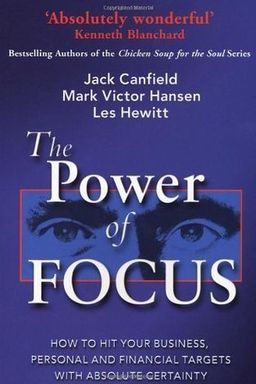
The Power of Focus cover

The Power of Focus

by Jack Canfield, Mark Victor Hansen, and Les Hewitt

The Power of Focus equips readers with essential tools to channel their efforts toward fulfilling their life purpose and achieving financial success. Through practical exercises, it emphasizes the importance of positive habits, strategic questioning, and nurturing relationships, guiding readers to overcome setbacks and thrive in both personal and business ventures.

The Power of Focus: Building a Purposeful, Prosperous Life

How often do you feel that your energy is scattered across dozens of tasks, leaving you falling short of your potential? In The Power of Focus by Jack Canfield, Mark Victor Hansen, and Les Hewitt, you learn that success isn’t so much about talent, luck, or even intelligence—it’s about your ability to focus on what truly matters. The authors—famous for creating the Chicken Soup for the Soul series and coaching millions of entrepreneurs—argue that most people fail not because they lack skill, but because they lose focus on their key goals and forget how to channel consistent effort toward them.

According to the authors, focus is the single most valuable resource you can cultivate in business and life. Your ability to prioritize—doing the right things at the right time, in the right way—determines your results far more than working harder or juggling more tasks. The book distills decades of real-world research, global success stories, and proven coaching principles into eleven core focusing strategies that anyone can master. Each strategy is introduced through vivid, often emotional stories—from entrepreneurs rebuilding empires to athletes overcoming self-doubt—all showing how simple habits and consistent action lead to extraordinary success.

The Authors’ Central Argument: Focus Shapes Fortune

Canfield, Hansen, and Hewitt claim that in both good and bad economic times, focused people thrive because they know what to ignore. They don’t try to excel at everything; they zoom in on strengths and design habits that align with clear goals. Each author brings a distinctive voice: Canfield, the motivational coach, provides the mindset; Hansen, the serial entrepreneur, brings high-energy sales and marketing wisdom; and Hewitt, the performance coach, grounds it all in practical systems that enhance clarity, discipline, and daily structure. Together they offer a framework for personal transformation built around focus and follow-through.

Why It Matters Today

Modern life is a minefield of distractions. We’re flooded with notifications, overloaded with commitments, and conditioned to multitask. Yet, as the authors emphasize, this fractured attention sabotages our potential. They show how developing unusual clarity (knowing exactly what you want), consistent persistence (doing it even when you don’t feel like it), and decisive action (moving forward despite fear) can replace chaos with momentum. These aren’t abstract ideas—they’re daily disciplines that reprogram your mind toward peak performance and peace of mind.

An Eleven-Part Blueprint for Success

The book unfolds like a master course in self-leadership. It begins by showing how habits determine destiny—an idea at the heart of personal development classics like Stephen Covey’s The 7 Habits of Highly Effective People. Then it moves into practical focus strategies: honing strengths instead of patching weaknesses, setting crystal-clear goals, cultivating resilience to setbacks, building powerful relationships, elevating confidence, learning to ask for what you want, sustaining consistent persistence, taking decisive action, and finally, living and working on purpose. The last chapters showcase real business leaders and entrepreneurs who’ve reached wealth and fulfillment using these principles.

Throughout, the authors integrate concrete stories: Maria Sosa, a Colombian refugee who redefined courage through action; W. Mitchell, who rose from severe burns and paralysis to become a motivational legend; Lisa Petrilli, whose life-saving request for a kidney exemplified the transformative art of asking. Each story reinforces that focus isn’t just about productivity—it’s about courage, clarity, and connection.

Focus in the Context of Timeless Wisdom

The authors link their ideas to timeless truths echoed in other sources: the Bible’s “Ask and you shall receive,” Jim Rohn’s distinction between major and minor things, Napoleon Hill’s persistence principle in Think and Grow Rich. They ground lofty ideals in simple formulas—the 4-D Formula (Dump it, Delegate it, Defer it, Do it), the TA-DA Formula (Think, Ask, Decide, Act), and the Magic Matrix for boosting sales—all aimed at keeping you aligned with purpose.

From Inspiration to Implementation

At its heart, The Power of Focus isn’t just motivational—it’s unapologetically actionable. Every chapter ends with “Action Steps,” translating insight into implementation. The book teaches you to identify your top three priorities, to replace Have-To habits with Choose-To attitudes, and to embody integrity and consistency—the hallmarks of top performers. The tone is friendly but firm, combining the warmth of a mentor with the precision of a performance coach.

Ultimately, this book is a manual for mastering life through concentrated energy. If you’re tired of diffuse effort and want clarity, control, and confidence in every area—business, money, relationships, health—The Power of Focus shows you how to build it, one focused habit at a time.


Your Habits Create Your Future

Jack Canfield, Mark Victor Hansen, and Les Hewitt open their focus journey by declaring an unshakeable truth: successful people have successful habits, unsuccessful people do not. Habit is the invisible architecture of your life—the thread you weave each day until it becomes an unbreakable cable. The first step toward focus, therefore, is intentional habit creation.

The Psychology of Habit

Habits are learned behaviors performed automatically. Like changing gears in a car, they shift below consciousness once repeated enough times. The authors remind you that about 47% of daily actions are habitual—not deliberate choices. That means half your life runs on autopilot, for better or worse. Developing awareness of this “automatic pilot” is essential to redirect it toward what you truly want.

They illustrate this with the story of Maria Sosa, a Colombian mother who escaped terrorists, poverty, and tragedy by making a defining choice—taking action despite fear. Her leap of faith symbolized the transformation of crisis into character. You too, they argue, build or break your future through daily choices accumulated over time. One cigarette, one missed phone call, one postponed goal seems trivial—but together they become destiny.

Breaking and Building Habits

Canfield, Hansen, and Hewitt show a simple pattern: identify the bad habit, define its cost, and replace it with a productive new one. For instance, if you routinely work weekends and neglect your family, your price is stress, guilt, and disconnection. The new habit—protecting weekends for rest—rewards you with renewed energy and healthier relationships. The book’s Successful Habits Formula formalizes this: (1) identify the unproductive habit, (2) define the desired habit, (3) create three realistic action steps to replace the old behavior, and (4) commit to consistency.

The simplest habits can transform your day: putting keys on the same hook, using a “no exceptions” policy for saving a portion of your income, and practicing gratitude nightly. Even small shifts compound into enormous results. (James Clear echoes this principle decades later in Atomic Habits: “Habits are the compound interest of self-improvement.”)

Environment and Influence

The authors emphasize that habits are not formed in isolation; they are shaped by environment. If you surround yourself with complainers, you adopt their tone. If you spend time with driven, positive people, your ambitions rise. From this emerges one of the book’s golden rules: you become the average of the people you spend the most time with. Change your company, and you change your habits; change your habits, and you change your life.

Reflection and Renewal

The authors encourage honest reflection: write out the habits holding you back—procrastination, avoidance, overcommitment—and ask: “What are the long-term consequences if I continue this?” Pair that with a vision of the rewards of change. As with Maria Sosa, life rarely changes overnight. But every minute choice, when repeated with awareness, threads toward the future you truly want.


Focus on Strengths, Not Weaknesses

Most people try to fix their weaknesses, the authors note—but that’s backward. Success comes from doubling down on your strengths and delegating the rest. They illustrate this through a range of examples—from Mick Jagger and the Rolling Stones focusing purely on performance, not stage construction, to entrepreneurs learning to let go of control so they can excel at what they love.

The Entrepreneur’s Dilemma

Many entrepreneurs wear too many hats—boss, marketer, accountant—and end up stressed and average at everything. The antidote is priority focus: spend most of your week on the few things you do brilliantly and that generate your greatest income or joy. This is the 80/20 rule applied personally. The authors suggest performing a “Priority Focus Workshop,” listing all your weekly activities and isolating the three that bring the most results. Everything else should be delegated, automated, or eliminated.

Tools for Simplification

Their 4-D formula—Dump it, Delegate it, Defer it, Do it—cuts through clutter instantly. It reminds you that focus requires boundaries, especially saying no. They add practical tips: hire a personal assistant to handle logistical “stuff,” reject interruptions, and use technology intentionally rather than reactively. The lesson parallels Greg McKeown’s Essentialism: focus means choosing what not to do.

The Power of No

Saying no reclaims control of your time and protects your focus. Mark Victor Hansen himself reflects, “I used to be Dr. Yes.” Learning to say no transformed his productivity. This discipline refines your identity: if everything matters, nothing does. Saying no to distractions means saying yes to excellence.

When You Do What You Do Best

The chapter’s underlying truth: you were designed to excel in specific areas. LeBron James practices jump shots every day. Gord Wiebe built a multimillion-dollar window company by cultivating his natural sales and design brilliance. By arranging your life around what you do best—and freeing energy from what you don’t—you create both productivity and peace. In focused simplicity lies greatness.


See the Big Picture

What separates people drifting through life from those shaping their destiny? Clarity. In this chapter, the authors introduce the practice of developing “unusual clarity”—a fusion of vision, focus, and purpose. They recount the story of Peter Daniels, an Australian who went broke three times but became a multimillionaire after learning to think deeply and plan deliberately. His breakthrough habit was setting aside one day every week to do nothing but think.

A Clear Vision Requires Scheduled Thinking

Most people spend more time planning vacations than planning their lives. Peter Daniels turned this around, using focused “thinking days” to visualize his financial independence and write goals that inspired daily action. You don’t need an extra day each week, the authors note—just disciplined blocks of reflection. Start with an hour. Clarity grows through intentional solitude.

Goal Setting Done Right

The authors redefine goal setting through the Top-10 Goals Checklist: goals must be yours, meaningful, specific, flexible, exciting, aligned with values, balanced, realistic, contributive, and supported. Real goals drive behavior; vague wishes dissolve into procrastination. One favorite example is John Goddard, who, at fifteen, listed 127 lifetime goals—climbing Everest, exploring the Amazon—and achieved over 100 of them. You, too, need a “master plan” that extends years ahead but is lived daily in small, measurable actions.

Inspiration, Not Just Motivation

Motivation, they explain, is ego-driven—“I want to succeed.” Inspiration, on the other hand, is spirit-driven—“I’m called to create.” When you act from inspiration, roadblocks dissolve. To cultivate it, the authors advise turning off life’s noise regularly and listening inwardly to what truly matters. (Echoing Wayne Dyer: “Inspiration is when an idea takes hold of you.”)

By seeing the big picture, you trade stress for strategy. You start living by design, not default. Every decision becomes easier because you can measure it against your larger vision.


Build Excellent Relationships

No one succeeds alone. The authors call relationships “your entry into the big leagues.” Whether in business, family, or friendship, success depends on the alliances you build and how you nurture trust. They contrast the Upward Spiral of healthy connections with the Downward Spiral of neglect and conflict, showing how simple habits—communication, consistency, and care—expand opportunity and joy.

Trust and the Three Big Questions

Warren Buffett famously evaluates potential partners by asking three questions: “Do I like them? Do I trust them? Do I respect them?” If any answer is no, the deal is off. The authors suggest using this checklist in all relationships, from hiring to marriage. Doing business with people you distrust is a formula for stress; choosing positive alliances creates synergy and peace.

Say No to Toxic People

Equally important is whom to avoid. The authors call chronic complainers “toxic people”—emotional vampires who drain energy and sabotage focus. Your power begins with choice: you can’t control their behavior, but you can remove your exposure. A voicemail example humorously drives the point home: “If you don’t hear back from me, you are one of the changes.”

Mentors and Core Clients

The chapter highlights finding mentors as one of the smartest leverage tools in business. Ashley Meszaros built her company by calling a distant mentor who guided her monthly—for free—because she simply asked. Likewise, identify your “core clients”—the people who truly sustain your business. Nurture them, provide win-win value, and your reputation compounds through referrals. This principle echoes Stephen Covey’s “emotional bank account”: make deposits of trust and generosity before withdrawals of requests.

Ultimately, building excellent relationships is about authenticity. Be interested, not interesting. Succeed by helping others succeed. When relationships flourish, focus multiplies.


Develop Unshakable Confidence

Confidence, the authors argue, is the antidote to fear—the mental muscle you build by acting despite uncertainty. They open with Nelson Mandela’s famous words: “Our deepest fear is not that we are inadequate. Our deepest fear is that we are powerful beyond measure.” True focus requires believing you are capable and worthy of success.

Stepping Into Fear

Most unfinished business—old failures, guilt, or resentment—drains confidence. Fear grows in the dark; it dissolves when confronted. The authors tell of a firefighter who feels fear vanish only when stepping into the burning building—because full presence overrides anxiety. Likewise, confidence grows through action, not reflection. Write out your fears, confront them, and step forward anyway.

Resilience Through Forgiveness

Forgiveness, they reveal, is one of the most liberating confidence boosters. The story of Annette Stanwick forgiving her brother’s murderer demonstrates transcendent strength. Letting go of resentment releases emotional energy for creation and growth. You can’t radiate confidence while clutching bitterness.

The Six Confidence Builders

  • Remind yourself daily what you did well.
  • Read inspiring stories of persistence.
  • Practice gratitude and perspective.
  • Build supportive networks.
  • Pursue short-term goals for quick wins.
  • Reward yourself weekly to celebrate progress.

Confidence expands when you recognize your capability. As figure skater Elvis Stojko said after winning two world championships: “I believe in myself; yes, that’s it.” Faith in your potential transforms setbacks into stepping-stones.


Ask for What You Want

If you don’t ask, you don’t receive. In one of the most memorable chapters, the authors dismantle the fear of rejection that stops people from asking—for sales, help, or opportunity. The story of Lisa Petrilli, who asked strangers for a kidney and received one, illustrates the extraordinary power of asking boldly and sincerely. Once she survived that, she said, “I’m never afraid to ask for anything again.”

The Barriers to Asking

Three forces block us: beliefs that asking is impolite, lack of confidence, and fear of rejection. The authors urge readers to treat asking as a life skill. Children ask without hesitation; adults lose this ability through conditioning. To re-learn it, detach from “no” as a personal verdict—it’s merely data, not a denial of your worth.

Seven Ways to Ask

  • Ask for information: discover people’s real needs before pitching.
  • Ask for business: follow Melanie the six-year-old lemonade seller and close every time.
  • Ask for endorsements: testimonials amplify credibility.
  • Ask for referrals: leverage satisfied clients into new ones.
  • Ask for more business: recognize re-sell cycles (McDonald’s ‘Would you like fries with that?’).
  • Ask to renegotiate: confident requests reclaim value (interest rates, contracts, timelines).
  • Ask for feedback: continuous improvement requires listening.

Each form of asking expands your network, knowledge, and confidence. The acronym A.S.K.—“Always Seeking Knowledge”—captures the spirit.

How to Ask Effectively

Be clear, confident, consistent, creative, and sincere. Ask with precision, not apology. The research cited—94% of salespeople quit before the fourth call, though 60% of sales happen after it—proves that persistence pays. Whether in business or life, every major turning point begins with a courageous, direct question.


Take Decisive Action

Action transforms focus into results. Procrastination, the book warns, is the thief of dreams. The authors define it bluntly: the art of “castrating your future.” They profile achievers like Ed Foreman—a self-made millionaire turned congressman—who crusades against the “Someday Syndrome,” that habit of postponing life for a mythical future. The message: there’s no someday on the calendar.

Why We Delay

They identify four causes of procrastination: boredom, overwhelm, doing work you dislike, and distractions. Each has an antidote. Boredom requires new goals; overwhelm requires organization; distasteful tasks require discipline; distractions require boundaries. And laziness? It’s replaced by momentum—get started, and motivation will follow.

The TA-DA Formula

The authors’ powerful four-step model for decision-making—Think, Ask, Decide, Act—bridges planning and execution. Think to clarify purpose; Ask experts for input; Decide based on facts, not fear; and Act immediately. Success belongs to those who move before conditions are perfect.

Making Money Work

In business, decisive action also means mastering money. Drawing on ideas from financial icons Sir John Templeton, Art Linkletter, and Warren Buffett, the authors outline timeless wealth principles: create value before profit, live debt-free, invest systematically, and align money with purpose. Money follows contribution. They remind you that “God gives every bird its food but does not throw it into the nest.”

Finally, decisive leaders know when to act, when to delegate, and when to let go. As motivational speaker Jim Rohn asked: “Why not you—and why not now?” Success rewards those who dare to move.


Live and Work on Purpose

The ultimate aim of focus is purpose. Canfield, Hansen, and Hewitt close their framework by linking external success to internal meaning. Without purpose, even achievement feels hollow. They illustrate this through the story of Terry Fox, the Canadian amputee who ran across his country with one leg to raise $24 million for cancer research—a campaign driven purely by purpose, not fame.

Purpose vs. Goals

Goals are milestones; purpose is direction. Purpose transcends any single accomplishment—it’s your reason for being. You discover it by reflecting on your greatest joys, values, and talents, then aligning your work around them. Jack Canfield phrases it simply: “My purpose is to inspire and empower people to live their highest vision.” When you live on purpose, decisions become effortless because they all serve a deeper mission.

Discovering Your Why

To identify purpose, the authors suggest asking: What do you do best? What activities give you energy? Where do you make the greatest contribution? When you’re aligned with these answers, work becomes joy. The story of Anna Jarmics, who lost both hands at age ten and built a full life of art, sports, and service, proves that purpose turns limitations into platforms for inspiration. Her mantra: “I never give up. I never did, and I never will.”

Living with Contribution

Purpose expands when you serve others. The authors encourage creating personal and organizational “purpose statements” as living commitments. Harry Rosen’s company distilled theirs into four words: “To Exceed Customer Expectations.” Simplicity drives integrity. Whether mentoring youth, improving your community, or parenting, contribution transforms achievement into fulfillment.

To live on purpose, schedule reflection, align daily habits with values, and cultivate gratitude. As Erma Bombeck wrote, “When I stand before God, I hope I would not have a single bit of talent left.” Purpose makes sure you use it all.

Dig Deeper

Get personalized prompts to apply these lessons to your life and deepen your understanding.

Go Deeper

Get the Full Experience

Download Insight Books for AI-powered reflections, quizzes, and more.