
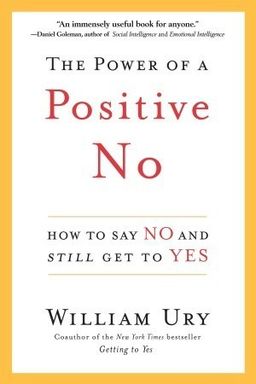
The Power of a Positive No cover

The Power of a Positive No

by William Ury

The Power of a Positive No by William Ury reveals how to say no effectively, protecting your values and relationships. Learn to assert your boundaries confidently and constructively, turning potential conflicts into opportunities for personal growth and mutual respect.

The Power of Saying No Positively

When was the last time you said “no” and felt good about it? In The Power of a Positive No, negotiation expert William Ury—co-author of the classic Getting to Yes—argues that the ability to say “no” thoughtfully may be one of the most essential life skills in our overloaded world. We are constantly buffeted by demands at work, home, and society, and yet many of us fear saying no because it feels selfish, cold, or destructive. Ury contends that learning to say No positively—that is, respectfully and in the service of a deeper Yes—enables you to stand up for what you value without destroying relationships.

A Positive No, Ury insists, begins with an affirmation of what matters most to you (your “Yes”), creates a clear boundary (“No”), and then opens a pathway toward cooperation (“Yes?”). It’s a method that turns refusal into an act of integrity rather than hostility. Saying No properly is not the opposite of saying Yes—it is its prerequisite. You cannot truly say Yes to one thing unless you can say No to others.

Why Saying No Matters

Ury opens with vivid personal stories, including his experience navigating complex medical care for his daughter. He had to say No—politely but firmly—to doctors’ behaviors that caused unnecessary stress, and to work commitments that stole precious time with his family. Each No was rooted in a deeper Yes to his daughter’s well-being. This balance between strength and empathy, Ury realized, was missing in many lives and organizations around the world. From negotiations in war zones to conversations in boardrooms, people either avoid conflict (saying Yes when they mean No), attack (saying No aggressively), or withdraw (saying nothing). Ury calls this the “Three-A Trap”—Accommodation, Attack, or Avoidance. A Positive No offers a way out by uniting power and relationship.

Throughout history, Ury observes, destructive conflict often begins with a badly delivered No, whether in a family argument, a workplace crisis, or an international standoff. But the absence of No can be equally damaging. Without boundaries, people become resentful, organizations lose focus, and societies tolerate injustice. Saying No positively is therefore both a personal and social imperative—it allows individuals and leaders to create, protect, and change what matters most.

The Three Stages of a Positive No

Ury structures his book around a three-stage process: Prepare, Deliver, and Follow Through. In preparation, you uncover your inner Yes—the values, needs, or priorities your No serves. You empower your No by developing confidence and a Plan B (your alternative if the other side resists). You then respect your way to Yes by preparing others to hear your No, showing genuine attention and dignity. When you deliver, you express your Yes (why you’re saying No), assert your No clearly, and propose a Yes that points toward mutual benefit. Finally, in follow-through, you stay true to your Yes even under pressure, underscore your No with patient persistence or positive power, and negotiate to reach a healthy agreement or relationship.

Balancing Power and Relationship

Ury’s approach redefines power as the ability to protect your interests without needing to dominate. He draws upon lessons from figures such as Rosa Parks and Mahatma Gandhi, who demonstrated how deliberate, principled No’s can dismantle oppression while maintaining respect for opponents. The Positive No is therefore less about the word itself and more about the spirit behind it—clarity, calm, and conviction.

The metaphor of the tree appears throughout the book: your No is the trunk, firm and straight; your Yes is the root, grounding you in purpose; and your second Yes is the branches reaching outward toward understanding and growth. When rooted in love or conviction, a No becomes the foundation for peace, creativity, and justice. As Nelson Mandela, one of Ury’s inspirations, showed, a positive No to apartheid was also a Yes to freedom and reconciliation.

Beyond Negotiation: A Life Skill

Though Ury’s background is negotiation theory, his message expands far beyond business or diplomacy. He presents saying No as an essential life skill for parents setting limits, employees managing workloads, partners maintaining boundaries, and citizens saying No to unethical behavior. The art of a Positive No helps you transform resistance into respect, fear into confidence, and guilt into commitment. “Saying No,” Ury writes, “is not rejection—it is creation.”

By mastering the interplay of Yes and No, you gain the freedom to be who you truly are. You can guard your time, defend your values, and still preserve harmony with those around you. In an era overwhelmed by communication and demands, this book offers a simple yet profound roadmap to both sanity and strength: the marriage of Yes and No.


Uncover Your Yes Before Saying No

Ury emphasizes that the greatest mistake people make is starting with No. Instead, you must begin with Yes—a deeper affirmation of your purpose or values. “The power of your No comes from the power of your Yes,” he reminds us. Until you identify what you’re saying Yes to, your No will lack conviction and clarity. This first stage—Uncover Your Yes—turns reactive emotion into proactive intention.

From Reactive to Proactive

We are emotional creatures. Fear makes us accommodate, anger makes us attack, and guilt makes us avoid. Ury teaches us to move from reaction to reflection—to pause, breathe, and “go to the balcony,” his metaphor for gaining perspective. Imagine stepping above the stage of conflict and observing calmly before responding. In that space, you uncover your real motivation. Like the samurai who stopped himself from striking in anger, you must learn to act with purpose, not emotion.

Digging Beneath the Surface: Interests, Needs, and Values

Ury uses concrete questions—“Why do I want to say No?” and “What do I truly want?”—to help you identify your interests. Beneath these lie basic human needs: safety, respect, freedom, belonging, and meaning. Beneath even those are your values, such as honesty or love. Couples refusing unreasonable work hours may not just be protecting schedules—they are guarding their need for love and connection. When Rosa Parks said No to giving up her seat, her underlying Yes was dignity and equality.

(Comparatively, Stephen Covey’s The 7 Habits of Highly Effective People echoes this focus on principle-centered decisions—your values guide your boundaries, not fleeting emotions.)

Clarify Your Intention

Once you’ve identified your Yes, turn it into a clear intention. Intention transforms vague desire into commitment. It means writing it down, saying it aloud, and standing in it. Ury advises distinguishing between whether to say No and how to say No—a critical mental shift. Decide first that No is right for your integrity; only later figure out the delivery.

Turning Emotion into Resolve

Emotional energy can become your fuel. Ury quotes Gandhi: “Anger controlled can be transmuted into power that moves the world.” Instead of suppressing or exploding, channel emotion into determination. A mother advocating for her child, a leader standing up to injustice, or an employee protecting their time—all draw strength from emotion transformed into resolve. Recognizing what you care about deeply gives your No moral weight and courage.

Uncovering your Yes grounds your No in authenticity. It provides direction, prevents regret, and transforms boundaries from mere resistance into acts of creation. Your No becomes not an obstacle but a declaration of self-respect.


Empowering Your No Through Positive Power

Once you’ve uncovered your Yes, you must empower your No. Ury draws a distinction between negative power—the power to punish—and positive power—the power to protect and advance your interests. Rosa Parks’ calm refusal in 1955 exemplified positive power. She wasn’t seeking revenge against bus drivers or white passengers; she was asserting dignity. Her No mobilized millions precisely because it came from moral clarity, not hostility.

Plan B: The Foundation of Confidence

Empowering your No means developing a clear Plan B—the alternative you’ll pursue if the other side refuses to respect your No. Knowing you have options frees you from dependence and fear. In negotiation terms, this is your BATNA (Best Alternative to a Negotiated Agreement), a concept Ury helped popularize in Getting to Yes. Without a solid Plan B, you become hostage to others’ reactions and may accommodate out of desperation.

He offers concrete examples: a sales manager refusing unrealistic price cuts strengthens his position by finding alternate customers; an employee tired of an abusive boss builds alliances or explores new job options. Each alternative restores dignity and choice.

Transforming Fear into Confidence

Fear subsides when you realize you don’t need the other’s cooperation to meet your basic needs. The paradox, Ury notes, is that people are more likely to cooperate with you when you don’t depend on them to survive. Joan, a wife in counseling, regained her power when she prepared to separate rather than continue begging her husband for attention. Her confidence compelled him to listen more openly and change.

Designing your Plan B

Ury teaches how to brainstorm alternatives creatively. Consider self-help actions (“What can I do on my own?”), exit strategies (“What if I leave?”), or third-side solutions (“Who else can help?”). Coalitions are another form of power—united voices can equalize an otherwise lopsided fight. (“There are two kinds of power in the world,” activist Saul Alinsky once said, “organized money and organized people.”)

Backup, Not Punishment

Plan B isn’t revenge—it’s readiness. When a mother tells her adult child she won’t babysit anymore without notice, her backup plan is simply making herself unavailable, not inflicting guilt. This type of positive power turns boundaries into choices rather than threats. By planning in advance, you can deliver your No confidently, knowing you can endure refusal and still thrive.

Empowering your No, then, is about shifting from victimhood to agency. As Ury writes, “Stand up to yourself first.” When you possess alternatives, people listen—not because you coerce them, but because you radiate calm, earned authority.


Respect Opens the Door to Understanding

Saying No doesn’t have to end relationships—it can strengthen them. The third preparatory stage in Ury’s model is about Respect. Before delivering your No, you prepare the other to hear it. Respect works like emotional oxygen: it keeps communication alive even when disagreement feels suffocating.

Why Respect Matters

Ury retells Terry Dobson’s story of a drunken man on a Tokyo train who was disarmed not by punches but by compassion. An old man, instead of confronting violence with force, calmly engaged the drunk in conversation about his love for sake and his wife. Within minutes, the man broke down crying in the old man’s lap. Respect turned potential tragedy into peace. This, Ury says, is the heart of a Positive No—you assert truth while preserving dignity.

Listening as a Form of Respect

Before delivering No, listen like a negotiator. Ask clarifying questions (“Help me understand your needs.”) and seek to grasp the emotions behind words. When you demonstrate genuine concern, people drop defensiveness. Police hostage negotiator Dominick Misino, for example, could never simply command a gunman to surrender; he first acknowledged their fear and used respect to create trust that defused danger.

Acknowledgment vs. Agreement

Acknowledging another person is not the same as agreeing with them. Ury encourages saying Yes to the person while saying No to their demand. Bob Iger, Disney’s CEO, calmed shareholder revolt by visiting Roy Disney personally and acknowledging his loyalty, even while refusing to concede policy changes. Recognition costs nothing but builds bridges. “Respect,” Ury writes, “is the cheapest concession you can give.”

Setting a Positive Tone

Start and end your No on a positive note. Begin with appreciation (“I value your offer”), then deliver your boundaries calmly. End with goodwill (“I look forward to future collaboration”). This approach, modeled by leaders like Anwar Sadat when he flew to Jerusalem, transforms adversaries into partners. In everyday life, it might mean telling a friend, “You’ve done wonderful work, but I can’t take on more commitments right now.” Tone determines outcome.

Respect does not mean submission—it means strength through empathy. You protect your dignity and theirs, which makes your No not a weapon, but an invitation to mutual understanding.


Delivering the Yes! No. Yes? Sequence

Armed with preparation, you’re ready to deliver your Positive No—the practical choreography of conversation. Ury’s formula is straightforward yet powerful: Yes! No. Yes? Start by affirming your values, assert your boundary, and finish with a constructive alternative. This rhythm makes refusal not an endpoint but a bridge to possibility.

Step 1: Express Your Yes

Before the No, explain what you’re for. “I’m committed to family time,” says the parent declining weekend overtime. “I value our relationship,” says the employee refusing unethical requests. This clarity helps others see your motive as principled, not personal. Mandela’s courtroom statement—his Yes to freedom and equality—showed how affirmation lends moral authority to every subsequent No.

Step 2: Assert Your No Calmly

Delivering No is like drawing a line in sand—clear but respectful. Ury encourages neutral tones: “I’m not taking additional tasks right now,” or “That’s outside my budget.” Emotional baggage—anger or guilt—only clouds the message. A “natural No” is simple, transparent, and free from drama. Like Sandra, who politely told a caller, “Thank you for thinking of me, but I won’t be serving on the committee,” then stopped talking. Silence, used well, reinforces strength.

Step 3: Propose a Yes?

To finish, offer an alternative or redirect energy: “I can help next month,” “Try this contact instead,” “Let’s find another solution.” Diane Nash, a civil rights leader, exemplified this in 1960 when she asked Mayor Ben West not just if segregation was wrong, but if he recommended desegregation. Her respectful question transformed confrontation into collaboration. This is the essence of persuasion—guiding others toward shared Yes.

Delivering Yes! No. Yes? turns difficult conversations into moments of integrity and possibility. It’s not manipulation—it’s humanization. You start with truth, protect your limits, and invite connection beyond disagreement.


Staying True When Resistance Strikes

Even after delivering your No, resistance is inevitable. People may deny, plead, argue, or threaten. Ury calls this stage “Follow Through,” beginning with staying true to your Yes when the pressure to yield or attack is strongest. Here, patience becomes power.

Understanding Emotional Stages

Borrowing from Elisabeth Kübler-Ross’s grief model, Ury outlines the emotional curve of acceptance: avoidance, denial, anxiety, anger, bargaining, sadness, and acceptance. Like LBJ angrily refusing his speechwriter’s resignation in Path to War, people need time to process your No. By staying calm, you help them move through the stages toward understanding. You cannot force acceptance—but you can make it safe to reach it.

Avoid Reactivity

Reacting—either by attacking back or folding—is self-defeating. Gandhi’s parable of Hercules and Strife teaches that fighting only enlarges conflict. Ury’s advice: pause, breathe, count to ten, or click “save as draft” before replying to angry emails. Going “to the balcony” once again gives perspective that turns emotional pressure into psychological distance.

Use Detachment Techniques

He suggests “naming the game”: silently labeling tactics like guilt, flattery, or threats to break their spell. Pinch your palm, physically remind yourself not to react. Enlist allies who can observe and calm you. Every period of silence helps the other cycle through denial toward acceptance.

Staying true to your Yes turns No from confrontation into transformation. It’s how Gandhi endured imprisonment without anger, how Mandela negotiated with adversaries without hate, and how you can maintain both boundaries and peace in everyday life.


Underscoring No with Persistence and Positive Power

When someone still refuses to respect your boundary, Ury teaches the art of underscoring your No patiently and firmly. Mahatma Gandhi’s Salt March epitomizes this principle: a peaceful act that repeated a single message—taxing salt is unjust—until the British Empire had to listen. The art of persistence lies in showing that your No means No, without hostility.

Repetition and Consistency

Sometimes people pretend not to hear your No. You must repeat it—politely but consistently. Emily Wilson, who refused even the President’s call to wake economist John Kenneth Galbraith, demonstrated dignified firmness: “I work for Mr. Galbraith, not for you.” Her persistence won respect, not conflict. Repetition teaches others that boundaries are facts, not moods.

Educate, Don’t Threaten

If calm repetition fails, educate through consequences. Ask reality-testing questions (“What will happen if this continues?”) or issue respectful warnings (“I’ll have to file a report if this doesn’t stop”). The goal is learning, not punishment. Consequences should be logical and proportionate, like the employee who withdrew cooperation from a bullying boss until respect was restored.

Using Plan B

When all else fails, follow through on your Plan B—with restraint. The more power you have, the more respect you must show when using it. Parents enforcing consequences say No with sadness, not rage. Organizations like San Antonio’s COPS used creative nonviolent tactics—lining banks for penny exchanges—to compel officials to fix poor neighborhoods. Their respectful persistence achieved both justice and dignity.

Persistence, Ury concludes, is patience in action. Meet resistance with respect and endurance, not aggression. Like Gandhi’s salt or a tree bending yet unbroken, your steady No transforms power struggles into moral lessons.


Negotiating Toward a Positive Outcome

After standing firm, you must rebuild bridges. The final stage, Negotiate to Yes, ensures your No leads to a healthier relationship or creative agreement. Abraham’s negotiation with God over Sodom illustrates this boldly: he said No to injustice but reasoned through respectful dialogue until they found partial accord. The art lies in converting moral conviction into collaborative solution.

Building the Golden Bridge

Ury borrows from Sun Tzu’s wisdom: “Build your opponent a golden bridge to retreat across.” Better yet, he writes, build them a golden bridge to advance across. Help people save face and cross the emotional canyon separating your No from their needs. Identify what truly matters to them and adjust proposals accordingly. When a buyer wouldn’t pay an inflated price for a company, but understood the seller’s deeper wish to fund an environmental foundation, they offered him leadership in a corporate environmental council instead—mutual victory.

Approval and Face

Even good deals fail if the other’s reputation suffers. Ury counsels applying the “Acceptance Speech Test”—anticipate how they’ll explain the agreement to their constituents. Dominick Misino’s hostage negotiation demonstrated this: he allowed a gunman to surrender dramatically so his community would cheer rather than shame him. Respect protects dignity, which secures compliance.

Healing Relationships

No should end not in rejection but renewal. Mandela’s act of reaching across to F.W. de Klerk on camera, taking his hand after fierce debate, showed how forgiveness turns boundaries into bonds. In personal life, Ury’s example of a respectful divorce demonstrates that saying No to a marriage can still result in lasting friendship.

Negotiating to Yes completes the circle: you began with a Yes to yourself; now, through empathy, you help the other discover theirs. The fruit of a Positive No is not compromise—it’s integrity paired with connection.

Dig Deeper

Get personalized prompts to apply these lessons to your life and deepen your understanding.

Go Deeper

Get the Full Experience

Download Insight Books for AI-powered reflections, quizzes, and more.