
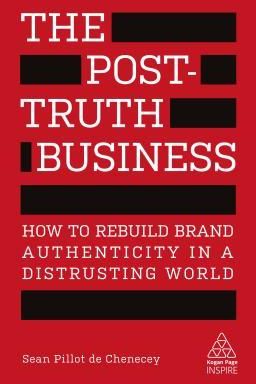
The Post-Truth Business cover

The Post-Truth Business

by Sean Pillot de Chenecey

The Post-Truth Business explores how brands can rebuild trust in a world where skepticism rules. Sean Pillot de Chenecey offers insights into authentic advertising, leveraging cultural connections, and embracing ethical practices to create meaningful consumer relationships and ensure brand credibility.

Truth, Trust and the Post‑Truth Marketplace

You live in a destabilized information ecosystem—one the author calls the post‑truth marketplace. Here, emotion, bias and identity often outweigh verifiable facts. This book argues that truth and trust, once taken for granted, are now strategic assets. Whether you work in branding, politics, or media, you must contend with an environment where attention is scarce, scepticism is high, and misinformation spreads faster than correction.

The book’s central thesis is clear: truth has become the most valuable currency for brands and societies alike. To operate successfully, you must design communication, technology and corporate behaviour that reinforce credibility. Across its chapters, the book connects disinformation, privacy, advertising, activism, provenance and emerging technologies into a unified framework for rebuilding trust.

The Rise of Post‑Truth

The author traces today’s climate to political and technological shifts. From Steve Tesich’s early use of the term after Iran–Contra to the 'alternative facts' of the Trump era, the public sphere drifted from evidence toward emotion. Mistrust in media dropped from over 70% in the 1970s to around 30% by 2016, according to Gallup. Social media amplified this erosion: platforms like Facebook and Twitter rewarded outrage, echo chambers and headline‑driven belief. With algorithms prioritising engagement, fake news flourished. (Note: Kahneman’s System One and System Two model explains why emotional, intuitive reactions often beat slower analytical thought when users share content.)

Brands no longer operate in neutral informational space. If you make false or inflated claims, adversaries and consumers alike can—and will—expose them instantly. That vulnerability is the new price of connectivity.

Data, Privacy and the New Democratic Bargain

The author argues that your personal data is not just transactional—it’s political. The Cambridge Analytica scandal revealed how harvested data shaped elections, prompting laws like the GDPR and California’s privacy acts. These laws shifted power toward individuals, mandating consent and transparency. The idea that 'Privacy + Data = Democracy' captures a central revelation: how we handle data is now a democratic responsibility, not just a technical one.

You exchange privacy for convenience every time you use an app or smart speaker. But surveillance capitalism—where every action becomes ad fuel—erodes trust. The book urges brands to act as stewards of data, embedding transparency and respect for privacy as key pillars of trustworthiness.

Advertising’s Crisis of Meaning

Adtech promised precision but delivered clutter. With #SkipAd as a cultural reflex, the industry discovered that technical targeting without emotional truth backfires. Havas found that most people wouldn’t care if three‑quarters of brands disappeared—a damning indictment. Meaningful brands like State Street’s Fearless Girl or Deutsche Telekom’s Sea Hero Quest stand out because they connect creativity with social value.

For you, the message is direct: advertising must add meaning, not noise. Brands that build trust through participation, measurement transparency and community commitment outperform those that rely on algorithmic bombardment.

From Purpose to Proof

A recurring theme in the book is the shift from storytelling to story‑doing. Conscious capitalism, maker authenticity, transparent pricing and blockchain provenance all converge on the same truth: the only credible story is the one you can verify. Purpose must live in operations, not slogans. Nike, TOMS, Oiselle and Ecoalf illustrate how integrated ethics generate not only goodwill but competitive advantage.

The Five Pillars of the Post‑Truth Brand

The concluding manifesto crystallises the book into five enduring lessons: be authentic, be transparent, respect privacy, demonstrate empathy, and be trustworthy. Each is reinforced through case evidence—from Everlane’s price transparency to Whole Foods’ traceability and GDPR compliance models. These pillars also form a blueprint for resisting misinformation: facts, clarity and verifiable claims are the brand’s most effective weapons against distortion.

Ultimately, this book teaches that in a world where truth is fragile, your brand’s survival depends on verifiable behaviour, not rhetoric. When you prove what you stand for—through data ethics, creative substance, community investment and open communication—you don’t just win attention. You earn belief.

Key principle

Trust is no longer a given—it’s an outcome. In the post‑truth age, transparent action is your only sustainable form of persuasion.


The Mechanics of Misinformation

The book dissects how fake news, disinformation and digital amplification work as systemic forces. Fake news thrives because it feeds emotional biases faster than verified content can correct them. Social media algorithms heighten this by favouring outrage and engagement over neutrality.

Emotional Economy of Sharing

Using Daniel Kahneman’s System One/System Two dual thinking, the author explains that we all share content that feels right, not necessarily what’s true. System One drives instinctive responses—fast, emotional and tribal. System Two requires mental effort to check facts. Misinformation weaponises System One, especially in high‑arousal contexts such as election campaigns or crises.

Political actors exploit this vulnerability. From the Russia‑led Internet Research Agency’s targeted ads to Macedonian click farms spinning viral hoaxes, fabricated content combines human psychology with data analytics. Deepfakes, augmented reality forgeries and mimic accounts now expand that threat beyond text into audio‑visual deception.

The Brand Consequence

For brands, the implication is existential. When truth itself is contested, reputation can unravel within hours of a viral claim—true or false. The author urges communicators to pre‑empt rather than react: verify facts before publication, support reputable journalism, and train audiences toward System Two engagement (encouraging checking, citing and context).

Core guidance

Treat misinformation management as reputation insurance. Facts lose when emotion dominates—so design content that satisfies both head and heart, grounded in evidence but told humanly.

(Note: This parallels the argument in Sander van der Linden’s work on 'prebunking', which shows inoculating audiences against falsehood works better than disputing it after the fact.)


Data, Democracy and the Privacy Contract

The relationship between consumers and brands increasingly revolves around data. You trade personal information for convenience, but the book emphasises that these exchanges shape society itself. The Cambridge Analytica episode exposed how data manipulation threatens democratic integrity.

Lessons of Cambridge Analytica

When Aleksandr Kogan’s Facebook app funneled millions of profiles to Cambridge Analytica, the resulting voter profiling and micro‑targeting campaigns blurred lines between persuasion and coercion. Public outrage produced regulatory tipping points: GDPR in Europe and later CCPA in California reframed corporate duties around consent, erasure and portability.

The Moral Economy of Data

You now live within what commentators call surveillance capitalism—a system extracting behavioural data to monetise prediction. The author insists privacy isn’t an individual luxury but a collective precondition of democracy. Without boundaries, manipulation seeps into public debate, purchase behaviour and trust itself.

Brands therefore face a civic obligation. To sustain credibility, they must redesign data practice as a relationship of stewardship. Transparency dashboards, opt‑in architectures and clear language are not optional extras; they are moral infrastructure.

(Parenthetical: The author draws parallels to Shoshana Zuboff’s arguments in The Age of Surveillance Capitalism, reinforcing that informed consent is the societal firewall between convenience and manipulation.)


Reclaiming Advertising with Meaning

Digital media promised perfect targeting but instead triggered fatigue. The book diagnoses an advertising crisis rooted in distrust and irrelevance. #SkipAd culture signals consumers’ power to reject clutter. You can't buy attention—you must earn it with social meaning and creative authenticity.

The Industry’s Self‑Inflicted Wounds

Automation and ad fraud have damaged confidence. P&G trimmed $100 m in digital spend with negligible effect on sales—proof that scale without credibility is waste. Viewability scandals, fake metrics and opaque intermediaries further eroded trust. Havas’ finding that most consumers wouldn’t mourn the disappearance of most brands underscores a hollow system.

Rebuilding Through Participation and Creativity

Effective campaigns now unite story, participation and social value. Examples include Fearless Girl—a corporate sculpture turned feminist icon— and Sea Hero Quest, which gamified dementia research. Both exceeded commercial aims because they embodied purpose larger than the product. Influencer and dark‑social strategies also re‑emphasise word‑of‑mouth trust, though the author warns of saturation and cynicism.

Practical rule

If no one would notice your brand’s disappearance, start creating something worth missing—culture, contribution or conversation that improves lives, not just impressions.

Agencies must restore transparency, enforce independent measurement and prioritise meaning over mechanisation. Advertising becomes powerful again only when it tells the truth creatively.


Purpose, Activism and Conscious Capitalism

A new expectation defines modern consumers: brands must stand for something. The book’s chapters on conscious capitalism position activism and authenticity as intertwined duties. You can’t posture moral purpose—you must live it operationally.

From Values to Systems

Brands like Nike, TOMS and Oiselle demonstrate how values, when embedded, create community loyalty. TOMS’ One‑for‑One model or Vans’ House of Vans events prove that consistent purpose generates reputation capital. B Corporation certification formalises such intent, ensuring social and environmental criteria are measurable.

Avoiding Purpose‑Washing

Superficial stances invite backlash. The author recounts the Pepsi/Kendall Jenner fiasco as a warning: cultural ignorance meets instant cancelation online. Authentic activism requires sustained action—funding, employee engagement and transparent metrics. Movement‑oriented strategies like Strawberry Frog’s OnUp campaign show how corporate goals and public needs can align.

In practice, conscious capitalism merges profit with progress. Take stands that reflect genuine capability, resource them properly, and expect opposition. Polarisation is proof you’re part of the civic conversation.


Transparency, Provenance and Proof

In a suspicious world, transparency converts doubt into trust. The author explores new models of pricing honesty, origin storytelling and blockchain verification that let consumers 'see the truth themselves.'

Radical Openness

Beauty Pie exposes its margins; Everlane lists production costs; Whole Foods tracks tuna catches by vessel. These gestures redefine premium as proof, not mystery. Deloitte’s research backs this: Millennials value provenance as a signal of integrity. Price transparency challenges old retail logic and educates customers about fair margins.

Blockchain as a Trust Layer

Blockchain gives every product a verifiable digital identity. From Ecoalf’s recycled materials to Arket’s origin filters, ledger systems link storytelling with evidence. The ledger can’t lie retroactively—once written, each supply‑chain event endures as a shared truth. Yet, as the author cautions, garbage in means garbage recorded: human verification still matters.

Takeaway

Proof‑of‑provenance transforms ethics into evidence. In the post‑truth era, transparency isn’t marketing spin—it’s infrastructure for trust.

(Parenthetical note: The author contrasts traditional audits—episodic and opaque—with blockchain traceability that’s continuous and visible, offering a 'cost of trust' advantage.)


The Maker Ethos and Authenticity Economy

Small‑scale makers, artisans and local founders illustrate authenticity the way spreadsheets can’t. Their stories show that credibility grows from proximity and purpose. You trust people you can see, not corporations hiding behind PR.

Human‑Scale Credibility

Maker brands like BrewDog, Beavertown or street‑food collectives humanise commerce. Transparency about process—the brewer’s face on the bottle, the chef at the stall—creates connection. As globalisation breeds sameness, this 'new localism' offers emotional differentiation. (Note: similar arguments appear in Seth Godin’s This Is Marketing, where small tribes outcompete mass advertising in engagement depth.)

Scaling Without Losing Soul

Growth tests authenticity. When Camden Town Brewery sold to a conglomerate, fan backlash showed ownership transparency matters. Brands can scale honestly by keeping founders visible, disclosing partnerships and maintaining craft rituals. Burberry’s artisan studios exemplify scaling transparency without diluting identity.

The maker ethos teaches that modern consumers favour integrity over efficiency. Show who made it, where and why—because in a post‑truth culture, authenticity is evidence.


Algorithms, Voice and the New Gatekeepers

Voice assistants and AI purchase algorithms have silently become arbiters of choice. The book illuminates how asking Alexa or Google turns selection into automation: users want one answer, not dozens. Consequently, algorithmic visibility becomes vital.

The One‑Answer World

Mindshare’s research finds that most voice users expect a single definitive response. This shifts marketing from persuasion to qualification: if your metadata, reviews or ethical badges aren’t machine‑readable, you vanish from the conversation. Algorithm optimisation is the new SEO.

Ethical Filters and Opportunity

The flip side is potential good: assistants can surface brands with verified provenance when users select ethical modes. Imagine telling Alexa to 'buy sustainable coffee' and getting blockchain‑validated options first. Voice becomes a trust multiplier if data integrity underpins it.

Prepare by structuring data for machine comprehension, embedding trust credentials, and creating concise, accurate voice content. The algorithmic future rewards brands that express truth at machine speed.


Nation Branding and Collective Reputation

Countries, like companies, compete on trust. The author extends brand logic to national image: exports, tourism and diplomacy all depend on perceived authenticity. Simon Anholt’s framework—actions over slogans—anchors this idea.

From Cool Britannia to Britain is GREAT

'Cool Britannia' harnessed pop culture momentarily; 'Britain is GREAT' institutionalised credibility through measurable programs spanning culture, education and trade. That pivot—from fashion to fact—demonstrates how evidence‑anchored storytelling earns global respect.

For brand strategists, the lesson is universal: reputation arises from proof of performance, not perception management. (Parenthetical: This view parallels Naomi Klein’s critique in No Logo, replacing glossy nationalism with grounded delivery.)

National provenance remains a trust vector in global commerce—'Made in Japan' or 'Made in France' still conveys quality. The same logic applies to brands: identity must rest on demonstrable substance.


Truth as Brand Strategy

The book culminates in a manifesto uniting all lessons into action. In a distrustful world, truth isn’t an abstract virtue—it’s a business model. The author frames five pillars that together define a 'post‑truth brand.'

Authenticity

Your story must match your actions. Everlane, TOMS and PARK Soccer Co illustrate narrative‑action consistency. Pretence collapses under digital scrutiny.

Transparency

Disclose processes and sources. Whole Foods’ traceability and blockchain pilots show how verification can be a competitive advantage.

Privacy

Respect data as mutual trust. Explain what you collect, why, and what users gain. Simplify consent to rebuild clarity post‑GDPR.

Empathy and Trustworthiness

Demonstrate empathy through social missions, community investment and public accountability. Trust accrues from sustained integrity, not campaigns. Leadership sets the tone: governance must cascade truth through product, culture and communication.

Action checklist

  • Audit provenance and publish findings.
  • Simplify data policies—make privacy usable.
  • Co‑create cultural projects with real communities.
  • Track trust metrics alongside profit.

The post‑truth brand doesn’t fight misinformation with slogans; it inoculates against it with proof. Truth scaled through systems becomes not a vulnerability but your ultimate differentiator.

Dig Deeper

Get personalized prompts to apply these lessons to your life and deepen your understanding.

Go Deeper

Get the Full Experience

Download Insight Books for AI-powered reflections, quizzes, and more.