
Idea 1
Chemistry, Crime, and the Birth of Modern Forensic Science
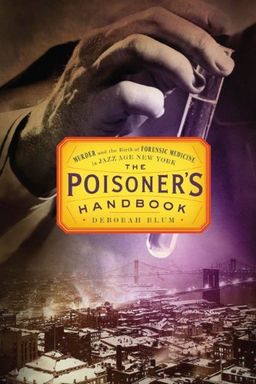
How does science learn to speak for the dead? In The Poisoner's Handbook, Deborah Blum answers that question through the intertwined stories of chemistry, poison, and public health in early twentieth-century New York. The book argues that modern forensic toxicology emerged not from detached laboratory research but from the messy intersection of politics, corruption, and scientific perseverance. Its central claim is that chemistry—applied rigorously and ethically—transformed both criminal justice and public health by revealing invisible dangers and holding power accountable.
You begin in an era when death investigations were corrupt and unscientific. New York’s coroners were elected amateurs, often saloon keepers or undertakers, who sold verdicts for cash. Into this broken system came two reformers: Charles Norris, a physician determined to bring credibility to the city morgue, and Alexander Gettler, a chemist with the patience to extract poisons from decaying organs. Together, they built America’s first scientific medical examiner’s office and defined nearly every major toxicological method of the age.
From abstract chemistry to applied forensics
Norris and Gettler inherited a world where elements themselves were newly understood. Chemists across the nineteenth century had isolated substances like morphine, strychnine, and chloroform—creating tools for healing and for harm. Mathieu Orfila’s 1814 treatise on poisons and Jean Servais Stas’s extraction of alkaloids from corpses had set foundations, yet American death investigations lagged behind. Science was evolving; institutions were not. New York’s reform in 1918 turned that gap into an opportunity to fuse chemical knowledge with legal power.
In the Norris–Gettler partnership, you watch chemistry gain civic purpose. Norris built systems—preserving samples, archiving evidence, and enforcing standards—while Gettler devised new chemical assays. Their laboratory became a hub where wet chemistry met moral responsibility, a place where a glass of whiskey or a bottle of face cream could tell stories of murder, politics, or industrial neglect.
The city as a chemical battleground
The 1920s and 1930s turned toxicology into social history. Prohibition transformed alcohol from a beverage into a national experiment in chemical policy. Bootleggers used methanol and industrial solvents; federal officials endorsed poisonous denaturing agents to deter drinkers. The result was mass poisoning on a scale normally seen only in epidemics. At the same time, chloroform, cyanide, arsenic, and mercury moved between medicine, household use, and murder. Each new poison forced Gettler’s lab to invent techniques—steam distillation, spectrographic analysis, ultraviolet detection—that modern toxicologists still recognize.
Meanwhile, industrialization delivered subtler forms of poisoning: tetraethyl lead in gasoline, mercury in medicines, radium in cosmetics, and thallium in depilatories and pesticides. Norris and Gettler understood that crimes of chemistry extended beyond individuals to corporations and governments. They saw how social class and political ideology determined who suffered and who was protected. A working-class drinker poisoned by government-mandated denaturing, or a factory girl sickened by radium dust, was as much a victim of policy as of poison.
Chemistry’s moral awakening
Blum’s larger theme is moral as well as scientific. Every case—from carbon monoxide deaths to Ginger Jake paralysis—shows the moment when invisible molecules become visible proof of injustice. You learn that scientific progress requires not only discovery but integrity: willingness to testify against corporations, to challenge government dogma, and to resist sensationalism in the courtroom. Gettler’s team often worked with decaying organs, tiny samples, and relentless doubt, yet their discipline established what modern justice demands—reproducible, impartial evidence.
By the end of the story, you understand that forensic toxicology is both a science and an act of citizenship. The poisons change—from arsenic and chloroform to methanol, radium, and thallium—but the principle endures: when chemistry speaks truthfully, it protects the living by giving voice to the dead. That conviction turned a chaotic city morgue into a national model and forever changed how societies confront the chemistry of everyday life.