
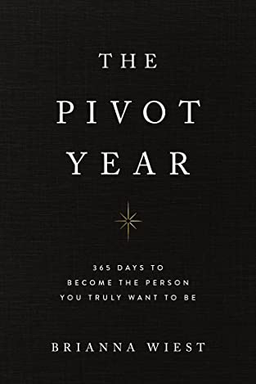
The Pivot Year cover

The Pivot Year

by Brianna Wiest

The Pivot Year is a year-long guide to transformative change, filled with daily meditations that inspire courage and personal growth. Discover how to tune out distractions, reconnect with your true desires, and embrace life''s challenges with compassion.

Becoming the Person You Truly Want to Be

Have you ever felt that, despite all your striving, you are circling the edges of the life you were meant to live? In The Pivot Year: 365 Days to Become the Person You Truly Want to Be, Brianna Wiest invites you to stop orbiting your potential and take a deliberate step into your fullest self. The book is not a quick fix or a single motivational narrative—it is a daily process of rediscovery, reflection, and subtle transformation. Every day offers a short meditation designed to awaken one aspect of your awareness, asking you to tune back in to an inner voice that the noise of the world has made easy to ignore.

Wiest contends that each human being has an internal compass—a kind of quiet wisdom—capable of steering them toward their truest path. However, most people are pulled downstream by the louder "river of the world," swept along by expectations, cultural scripts, and fears of inadequacy. Through her year-long sequence, she teaches that transformation does not happen when you rearrange externals; it happens when you root into your inner truth, release the need for outside validation, and learn to meet life with courage and openness.

Living from the Inside Out

At its core, The Pivot Year revolves around the idea of reorienting your life from internal alignment rather than external expectation. Wiest invites you to see every moment as a doorway, not a deadline—each day an opportunity to pivot, even slightly, toward authenticity. She argues that living from within begins with the art of presence. In one of her earliest daily meditations, she reminds readers that happiness is not about achieving milestones but about being able to love the reality in front of you—the laughter inside your home, the quiet morning light, the ability to feel peace in your own skin. This echoes mindfulness teachers such as Jon Kabat-Zinn and authors like Pema Chödrön, who emphasize presence as the true foundation of change. Wiest’s approach, however, makes it deeply personal: she frames mindfulness as an act of radical self-return.

Courage, Change, and Self-Trust

A recurring thread throughout the text is courage—not just heroic bravery, but the softer, daily kind. One of her early reflections, “The courage with which you enter today will become the fate that you meet tomorrow,” captures the book’s spirit: transformation unfolds through a thousand small acts of courage. Wiest often describes courage as a practice of self-trust: trusting that if you walk into the unknown, the ground will rise to meet you. Drawing from stoic and psychological traditions, she portrays discomfort not as an enemy but as a signal of growth. Much like the Stoic philosopher Seneca’s advice to “choose not to be harmed,” Wiest reframes life’s adversity as meaningful data about the self. Pain becomes a passageway—something to feel and release rather than to repress.

Desire as an Inner Mirror

Wiest teaches that you only long for what you are already inherently capable of manifesting. “You cannot desire what you do not already contain.” This principle links longing with potential: your desires are not random wishes but reflections of what your soul intends to experience. The real work, she suggests, is to become worthy of your desires—not in the moral sense, but practically and psychologically. In self-help terms, this bridges the gap between James Clear’s Atomic Habits and Carl Jung’s concept of individuation: aligning who you are becoming with what you already sense you are.

Healing through Awareness

Throughout the text, Wiest returns to healing—not as a romanticized process, but as a gritty encounter with one’s own truth. Healing arises when you can sit calmly with feelings instead of avoiding them, when you process pain rather than perform perfection. She writes, “The journey is not how you place down what’s weighing on you, but how you learn to stop picking it up.” This echoes Buddhist insights into non-attachment (Thich Nhat Hanh’s letting go) yet grounded in everyday emotion. Through such daily guidance, Wiest blends poetry with practicality: her reflections are lyrical but actionable, encouraging readers to cultivate small daily awareness until it transforms their entire identity.

The Year as a Metaphor

The structure of The Pivot Year—365 entries—is no accident. It invites a steady rhythm of self-inquiry, suggesting that change unfolds through repetition and reflection, not epiphany. Wiest likens transformation to seasons: periods of quiet dormancy, chaotic growth, shedding, and bloom. She asks readers to honor the “winter of the soul,” those pauses when nothing seems to happen but everything is incubating under the surface. Each phase matters; life is not a linear ascent to success but an ongoing spiral inward and outward. By living through these cycles intentionally, you pivot from reaction to creation.

Why These Ideas Matter

In a culture obsessed with external validation and instant gratification, Wiest’s work is a quiet rebellion. She challenges you to stop measuring progress by visible milestones and start measuring it by inner peace and presence. Her message resonates especially now, in a post-pandemic world where many people are questioning the definitions of success. The Pivot Year is therefore a manual for redefining direction—not by chasing something new, but by becoming conscious of your alignment within what already is. The result is a life that is not simply productive, but profoundly alive.

In short, Wiest argues that your turning point is not an external event—it is a daily practice. Each thought, boundary, and act of kindness toward yourself becomes a pivot. Over twelve months, those pivots become a revolution. Her simple instruction—to meet every day with courage, curiosity, and compassion—is, ultimately, the way to become who you truly are.


The Art of Presence

One of Brianna Wiest’s earliest teachings in The Pivot Year centers around presence—the art of being where your feet are. She dismantles the misconception that living fully must involve reckless adventure or perpetual progress. Instead, she reframes presence as conscious participation in the current moment, a radical act in a culture that glorifies speed and control.

Finding Peace in the Ordinary

Wiest offers the example of a home: happiness, she writes, doesn’t come from what your house looks like but how you love within its walls. This simple imagery transforms presence into practice. She urges you to shift focus from appearance to experience—from performing life for external metrics to actually inhabiting it. Through daily awareness, you realize that joy isn’t behind future accomplishments but embedded in every unnoticed breath. (This is reminiscent of Eckhart Tolle’s The Power of Now, which also describes presence as the only real source of freedom.)

The Pause Between Perception and Reaction

Presence also means emotional regulation. Wiest’s meditation on self-protection—"learn to take a pause between what you feel and how you react"—is profoundly practical. When you widen that gap, you reclaim agency over your inner world. The space between stimulus and response is where self-mastery lives. Viktor Frankl wrote of this same space in Man’s Search for Meaning, describing how freedom exists in choosing one’s response even under suffering. Wiest reframes this as an act of compassion toward oneself: every pause is an opportunity to choose what energy to give your attention to.

Presence as Self-Alignment

Through repetition, presence becomes a spiritual anchor. In Wiest’s worldview, being fully awake to the moment aligns you with your inner river—the quiet current of intuition that often gets drowned by external noise. Every fragment of your life, then, becomes a mirror of your inner state. When you are calm, the world looks clearer. When you are scattered, everything appears fragmented. Practicing presence teaches you to stabilize the inner world first; external clarity follows. In doing so, you begin to see life not as a web of problems to solve, but as experiences to meet consciously.

Practice Prompt

Wiest encourages keeping a micro-journal: document three brief instances a day where you felt truly present. Over time, this exercises awareness like a muscle, showing you how to find extraordinary meaning in ordinary hours.

Ultimately, the art of presence is Wiest’s foundation because it transforms the reader’s relationship with time. The more present you are, the less you crave control, and the more miracles seem to appear effortlessly—because you are finally in the same place as your life.


Listening to the Inner Voice

A central motif in The Pivot Year is the image of two rivers: the loud external current of societal pressure, and the quiet internal stream of intuition. Wiest writes that most people live downstream of the first, swept away by inherited goals and expectations, until they look down and find their hands empty. The turning point, she says, is the day you decide to follow that second, quieter river—the one that flows from within you.

The Two Rivers Within

The external river is the voice of the world: it tells you what to want, what success should look like, and how to measure your worth. The internal river, by contrast, speaks softly in “nudges” and curiosities. Wiest warns that ignoring your internal compass leads to confusion, indecision, and a disconnection from joy. You drift in a life you didn’t actually choose. Reconnecting with your inner river doesn’t require withdrawing from society—it means cultivating discernment: knowing when to listen to the collective and when to honor your individual knowing.

Truth in Fragments

Wiest argues that wisdom is rarely absolute; truth is “fragmented everywhere.” You can learn from both inner and outer sources without idolizing one or demonizing the other. Maturity, she suggests, is found in recognizing complexity—understanding that both rivers can inform your path at different times. This approach reflects holistic psychology and mindfulness: balance rather than binary thinking. (It resonates with Parker Palmer’s Let Your Life Speak, another exploration of vocation guided by inner voice.)

Cultivating the Inner Guide

Wiest’s instruction for hearing this intuition is deceptively simple: quiet the noise. Disconnect from the constant inflow of others’ opinions. Spend time in solitude, listen more than you speak, write without censoring. In doing so, you begin to recognize the difference between fear (which shouts) and guidance (which whispers). To live by your intuition is not to ignore reason, but to partner it with the wisdom of feeling. This kind of living produces alignment—the peace of knowing you are walking your own path, not someone else’s.

“Our lives begin,” Wiest writes, “the day we choose to follow our inner knowing.” Listening within is thus the pivot point of the entire year—a single decision that realigns your life with truth.


Embracing Change and Uncertainty

Throughout The Pivot Year, Wiest emphasizes that growth demands surrender to the unknown. Change is not an enemy to be feared, but a rhythm to be danced with. Each transformation begins the moment you acknowledge that what once felt stable no longer contains you. “You will have to outgrow some things you love,” she reminds readers, reframing loss as evolution rather than failure.

The Myth of Certainty

Wiest dismantles the modern myth that safety lies in certainty. True security, she argues, comes from adaptability—the ability to trust that you will rise to meet whatever comes. “When you feel lost,” she writes, “remember that nothing feels right at the beginning because nothing is familiar.” Fear, therefore, is often mistaken for misalignment. Change feels wrong not because it is wrong, but because it is new. This insight mirrors Joseph Campbell’s Hero’s Journey: every adventure begins in discomfort. What distinguishes growth is not the absence of fear but the willingness to walk with it.

Transformation Requires Letting Go

Letting go, in Wiest’s language, is not erasure but completion. Relationships, identities, and dreams serve their purpose and then release you. She likens endings to seasons—they do not disappear; they integrate into your next beginning. The pain of transition is often the body’s protest against its own expansion. If you interpret that ache as guidance rather than punishment, you learn to see dissolution as an act of grace.

The Pivot as Daily Renewal

In the structure of her 365-day framework, Wiest teaches that change doesn’t just happen once—it’s daily. Every morning is a rebirth, every choice a pivot. The power of her method lies in repetition; by treating each day as an opportunity to start again, you cease fearing failure. (Comparable practices exist in Buddhist mindfulness training, which frames each breath as a new beginning.) Over time, this daily renewal strengthens resilience: transformation becomes less of a dramatic leap and more of an ongoing dialogue with life itself.

Ultimately, Wiest’s message is that uncertainty is the soil of destiny. The unknown is not a void but a field of infinite potential—the very space where your soul finally has room to grow.


Redefining Happiness

Wiest’s philosophy challenges the Western conception of happiness as perpetual pleasure or accomplishment. She writes that “happiness is not having the best of everything, but making the best of anything.” In other words, happiness arises from meaning, not conditions. It is the alignment between your inner values and outer actions, not the completion of external goals.

Happiness as Inner Stability

Early in The Pivot Year, Wiest defines happiness as peace—the grounding underneath every high and low. “You are the sky,” she writes, “and the storms will pass through you.” This imagery, simple yet profound, reframes joy as awareness rather than an emotion. Comparison-driven pursuit, she warns, dislocates us from the present. Like Matthieu Ricard’s Happiness: A Guide to Developing Life’s Most Important Skill, Wiest treats joy as a skill that can be cultivated through focus and gratitude, not acquired through consumption.

The Role of Desire

Desire in Wiest’s framework is holy—it signals potential. But she cautions against confusing desire with dependency. You can want deeply without being enslaved by what you want. Happiness is found in this paradox: longing without lack, pursuing without frantic attachment. Wiest describes contentment not as settling for less but as knowing enoughness. “Enough,” she writes, “is not a point you reach but a feeling in your heart.”

From Gratitude to Purpose

Wiest repeatedly returns to gratitude—not as blind optimism but as a survival mechanism. Gratitude grounds the psyche in sufficiency. You don’t have to be grateful for everything, she clarifies, but for anything. This nuanced understanding makes gratitude accessible even in hardship. Over time, persistent gratitude matures into purpose: when you focus on what you already have, you naturally begin to use it meaningfully. What began as appreciation becomes contribution.

For Wiest, happiness is radical realism: the ability to love what is while welcoming what could be. To master this balance is to be free.


Choosing the Path of Authenticity

By the midpoint of the book, Wiest’s message converges around authenticity—the courage to live your own alignment even when it disrupts expectations. To become the person you truly want to be, you must stop performing for imagined audiences and begin embodying what feels true from the inside out. “You are not failing because you’re not motivated,” she writes. “You’re not supposed to get far on a path that was never yours to walk.”

The Cost of Conformity

Wiest observes that many people remain stuck not because they lack willpower but because they chase borrowed dreams. The pursuit of conventional success often becomes a prison disguised as purpose. When the inner and outer selves are misaligned, exhaustion and self-doubt creep in. In psychological terms, this is cognitive dissonance—living in conflict with one’s true values. Wiest offers liberation through honesty: stop forcing yourself into molds that don’t fit and begin constructing a life that does. (Her perspective aligns with Brené Brown’s idea of “wholehearted living,” where authenticity is the antidote to shame.)

Authenticity in Practice

Living authentically, Wiest says, is not rebellion for rebellion’s sake. It’s about integrity—the alignment between your thoughts, words, and actions. Every small decision becomes a vote for your true identity. She encourages readers to judge success not by external milestones but by internal resonance: does this choice expand or contract you? This bodily awareness becomes a spiritual compass. Over time, the habit of checking in with yourself builds a life of coherence, where joy replaces justification.

Key Reminder

“You can become what you decide to be.” Wiest insists your identity is not static but sculpted by consistent action. What you do repeatedly becomes who you are.

Authenticity, for Wiest, is both destination and journey. The moment you stop betraying yourself for approval, you arrive.


The Practice of Letting Go

To pivot is, inherently, to release. Wiest devotes many of her meditations to the art of letting go—of identities, attachments, and illusions that were once essential survival tools but now obstruct growth. “The journey is not how you place down what’s weighing on you, but how you learn to stop picking it up,” she writes, teaching that release is as much discipline as courage.

Releasing Emotional Baggage

Letting go means moving beyond repetitive sadness, beyond revisiting old pain as identity. Wiest compares healing to metabolizing food: emotions must be digested, not stored indefinitely. This requires presence (seeing the emotion), patience (allowing it), and perspective (recognizing it’s transient). The work of letting go is not passive; it’s an active collaboration with life’s unfolding. You stop fighting what is, and in doing so, create space for what wants to be.

Trusting Life’s Timing

A recurring reassurance throughout The Pivot Year is that “life knows things you don’t.” When desire or opportunity slips away, it’s often redirection, not deprivation. Wiest calls this divine timing—the belief that what is truly meant for you cannot miss you. This perspective transforms disappointment into faith practice, allowing peace to coexist with uncertainty. It’s reminiscent of Paulo Coelho’s notion in The Alchemist: the universe conspires with authentic intent.

Completion, Not Failure

Every ending, Wiest reminds, marks completion. Moving on from people and places does not erase their significance; it honors their fulfillment. To hold on forever is to stop evolving. When you redefine closure as integration, not loss, love ceases to bind—it liberates. The true pivot, then, is not running from your past but thanking it and proceeding gracefully forward.

Letting go, as Wiest presents it, is an act of supreme faith. You do not abandon what was beautiful—you acknowledge it has served its sacred purpose.


Wholeness and Self-Love

By the close of The Pivot Year, Wiest’s reflections circle back to one essential truth: your life changes the moment you decide to be on your own side. “Declare: I will no longer participate in my own suffering,” she urges. The work of self-love, for her, is not indulgence—it’s integrity. It’s the willingness to see yourself clearly, hold your contradictions with grace, and stop outsourcing self-approval.

Becoming Your Own Companion

Wiest writes passionately about self-loyalty. Rather than waiting for perfect friends or partners, you begin by being loyal to yourself. This includes defending your peace, respecting your energy, and refusing to betray your values. When you become your own ally, external relationships mirror that wholeness instead of your wounds. The boundary between loneliness and solitude, she notes, is self-companionship.

Integrating Shadow and Light

She extends this self-love into shadow integration: acknowledging anger, fear, and imperfection without shame. “You cannot heal what you do not let yourself see,” she writes. Self-love doesn’t mean constant bliss—it’s the stability to hold yourself through turbulence. When you stop treating discomfort as evidence of failure, you begin to experience freedom. (This aligns with the work of psychologist Kristin Neff on self-compassion as a practice of humanity and mindfulness.)

Love as the Transformation Principle

For Wiest, love is the highest transformative force—toward yourself, others, and life itself. “Love introduces the highest possible frequency into the equation,” she writes. Once love enters, fear dissolves. But this love begins inwardly: by honoring who you already are. The idea mirrors bell hooks’s teaching in All About Love that love is a verb, a daily practice of nurturing growth. For Wiest, every act of patience, every moment of compassion is a small revolution in consciousness.

In the end, the person you truly want to be is the person who can love freely—yourself first, so that your life may overflow that same generosity toward others. Wholeness, she suggests, is not a reward for fixing yourself, but a birthright you remember when you finally come home.

Dig Deeper

Get personalized prompts to apply these lessons to your life and deepen your understanding.

Go Deeper

Get the Full Experience

Download Insight Books for AI-powered reflections, quizzes, and more.