
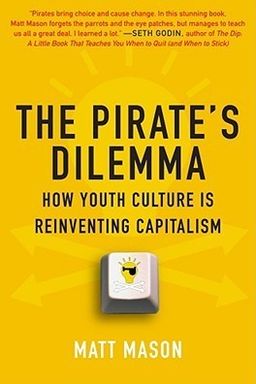
The Pirate’s Dilemma cover

The Pirate’s Dilemma

by Matt Mason

The Pirate’s Dilemma explores the transformative power of the pirate spirit in reshaping capitalism. By adopting open-source methods and challenging traditional norms, individuals and businesses can innovate, thrive, and positively influence the evolving economy where anything can be copied.

The Pirate Economy and Cultural Innovation

How can you thrive when rules and industries are constantly disrupted? In The Pirate's Dilemma, Matt Mason argues that you live in an age where pirates — outsiders who remix, share, and repurpose — drive the evolution of culture, technology, and markets. Pirates aren’t just thieves; they’re innovators challenging outdated systems. The book reframes piracy as a form of research and development that exposes dysfunction in markets and institutions. If incumbents treat pirates only as threats, they risk extinction; if they learn from pirates, they open new markets and cultures.

Mason moves from the punk clubs of the 1970s to the torrent servers of the 2000s, showing a continuous thread of rebellion fueling creativity. He calls this dynamic the pirate economy — an alternative system where ideas, not assets, create power. Instead of a static war between old and new, you face an iterative game: piracy provokes adaptation, adaptation spawns innovation, and innovation redefines legitimacy.

The Pirate’s Dilemma at Work

Mason reimagines the prisoner's dilemma for modern markets. When pirates invent new ways to share or make things, traditional players must decide whether to fight or collaborate. Fight, and you might win legally but lose culturally; collaborate, and you may unlock entirely new business models. Napster illustrated this clash: the record industry sued while Apple launched iTunes and profited by legalizing the pirate’s convenience. The same dilemma appears in software (Microsoft versus Linux), journalism (mainstream news versus bloggers), and global health (pharmaceutical monopolies versus generic drug producers).

The Cultural Feedback Loop

What unites punk rockers, open-source coders, graffiti artists, and peer-to-peer engineers is their willingness to repurpose what exists and share what works. Punk’s DIY ethic birthed independent media; hip-hop’s remix logic redefined creativity; street art reclaimed public space; and open-source projects proved that collaboration could outperform corporations. Each wave faced suppression before being co-opted and normalized. Mason’s analysis is cyclical rather than moralistic: piracy surfaces needs; markets react; the boundaries shift; and everyone learns.

From Counterculture to Blueprint

Across 12 chapters, Mason maps how creative dissent becomes industrial practice. He traces the transformation of one-off hacks — pirate radio’s signal-jamming, dub’s version culture, file-sharing’s peer topology — into legitimate sectors. He situates these stories in global youth culture, where ideas spread virally through nanocultures operating on digital infrastructure. For Mason, pirates aren’t criminals so much as early adopters; their experiments reveal the suppressed demand for openness, access, and authenticity.

Why It Matters for You

The lesson is practical. Whether you’re an entrepreneur, policymaker, or artist, you can treat piracy as a barometer. When people openly circumvent old systems to get or make something, they’re telling you what the next market looks like. Instead of tightening control, you can channel this behavior into sustainable innovation. Mason’s point is that you now live in an environment where openness, remixability, and participation are not fringe behaviors but default economic logics. The pirate’s dilemma challenges you to choose response over repression — because those who learn from the pirates become the pioneers of tomorrow.

Key idea

When piracy adds social value — through innovation, access, or expression — you cannot suppress it without suppressing progress. The winning strategy is to legitimize what pirates reveal about unmet needs and turn that insight into new business and cultural models.

Mason’s argument situates creativity as rebellion, community as production, and openness as strategy. The pirate, in his telling, is not the enemy of capitalism but the engine of its next evolution — a decentralized, participatory capitalism that rewards those who innovate faster than the law can catch up.


Punk Capitalism and the DIY Economy

Mason begins with punk’s do‑it‑yourself rebellion as the seed of a wider transformation. When Richard Hell tore his shirt and spiked his hair in the early 1970s, he broadcast a message: liberation lies in taking control of your creativity. This visual and musical refusal became the basis for what Mason calls Punk Capitalism — a fusion of independent production, social conscience, and entrepreneurial thinking. Punk rejected gatekeepers and replaced them with networks, fanzines, and micro‑enterprises that amplified individual agency.

DIY as Market Strategy

The DIY attitude taught creators to prototype and distribute their own ideas. VICE evolved from a punk zine into a global media powerhouse by resisting conformity and pursuing risk-laden reporting. American Apparel built its brand by aligning commerce with ethics — paying fair wages and promoting sweatshop-free production. Both show that rejecting the mainstream can become a profitable business strategy if the public trusts your authenticity.

Principles of Punk Capitalism

  • Do it yourself — acquire skills, make prototypes, and rely less on permission.
  • Resist authority — create parallel markets when the mainstream limits choice.
  • Combine altruism with self-interest — the ethical route can be the profitable one.

These ideas prefigure modern start‑up culture: the lean prototype, the user community, the hybrid of purpose and profit. Punk was an early proof that decentralized creativity could compete with corporate structure.

From Music Scenes to Maker Spaces

As this spirit spread into technology, the hacker and maker movements inherited punk’s script. Open hardware initiatives like RepRap — a self‑replicating 3‑D printer — extend DIY logic into production itself. Adrian Bowyer’s vision of printers printing printers collapses the distinction between producer and consumer, hinting at an economy based on customization and shared design. In Mason’s view, punk capitalism becomes the cultural DNA of a participatory economy where you earn trust through transparency and usefulness, not hierarchy and control.

Takeaway

Punk Capitalism tells you that creativity, community, and conscience are not opposites of profit — they are its future infrastructure. Every time you build something authentic from the ground up, you practice the punk principle: make meaning, not permission.


Pirate Mentality and the Power of Rule-Breaking

The archetype of the pirate — whether on a ship, a sea fort, or a server — symbolizes how progress happens outside the law before the law catches up. Mason reconstructs this lineage from Reginald Fessenden’s early broadcasts to Pirate Bay’s file trackers. The core tactic never changes: find unregulated space, create freely, and gather community support. Pirates reveal that innovation often needs edges where norms haven’t yet solidified.

From Sealand to Pirate Bay

When Major Roy Bates occupied a North Sea fort to found Sealand, he proved that new sovereignty could begin in steel and saltwater. Pirate radio stations like Radio Caroline then broadcast from international waters to evade state control, forcing traditional broadcasters to modernize. A century later, the Pirate Bay mirrored the pattern digitally — exploiting gray legal zones to build a global file-sharing community and inspiring the Pirate Party’s political rise. Each iteration makes the same point: when gatekeepers close doors, pirates find new channels.

Piracy as Civic Pressure

OhmyNews in South Korea turned user-generated journalism into a political force that helped elect President Roh Moo-hyun. When official media ignored young voters, decentralized digital pirates filled the gap. Piracy in this sense becomes public service — an emergency valve for excluded voices. Mason extends this to net neutrality, arguing that the Internet’s openness is itself a pirate inheritance. The moment corporations stratify access, the system ceases to innovate.

Three pirate habits

Look where rules are thin, build communication platforms there, and mobilize the community to enforce legitimacy from below. Whether in broadcasting or bytes, that is how revolutions spread.

Pirates don’t just copy; they correct. They identify inefficiencies and open new commons. Mason’s historical sweep shows that repression rarely works: instead, the pirate model of exploration and sharing becomes the prototype for the next institution. Piracy, paradoxically, is how societies test new freedoms.


Remix Culture and the Evolution of Creativity

Mason shows that in the remix, modern culture found its universal creative framework. Beginning with reggae’s dub versions, extending through disco edits and hip‑hop sampling, and culminating in digital mash‑ups, the remix transforms reuse from taboo to technique. It is how you think creatively in an information age: combining, editing, and re‑contextualizing existing elements to express something new.

From Dub to Hip‑Hop

A studio error in Jamaica produced the first instrumental ‘version’, proving that technology could liberate listening. Disco editor Tom Moulton’s extended cuts and Kool Herc’s Bronx breakbeats evolved that idea into full-fledged remix theory — isolate the good parts, loop them, and give dancers or listeners what works. As hip‑hop spread globally, its remix aesthetic turned into a blueprint for fashion, language, and politics: borrow, transform, and give back.

Creativity vs. Control

Legal systems, however, still treat copying as theft rather than method. The Grey Album’s sampling controversy and the Bridgeport ruling exposed this clash between cultural evolution and rigid IP frameworks. Mason suggests that remix law needs reform, just as Creative Commons and open licensing offer. Art builds by reference; culture progresses through citation.

Remix method

Take something known, dissect it, combine it with other materials, and add your signature. This is not stealing; it’s how you think with culture instead of starting from zero.

In Mason’s view, remixing is not a subculture but the metaculture of modern life — the reason innovation accelerates and boundaries blur. Industries that punish remixers lose relevance; those that harness remix logic (like fashion or software) thrive through perpetual re‑creation.


Open-Source Thinking and Collaborative Economies

Open-source began as hacker philosophy but now defines an economic system. Mason explores how Richard Stallman’s Free Software Foundation, Linus Torvalds’ Linux, and Jimmy Wales’ Wikipedia embody a cultural shift: value emerges from open participation rather than closed ownership. Openness allows many contributors to improve a product, which increases both quality and trust faster than proprietary control can manage.

The Four Motivations That Power Communities

  • Altruism: people share because they believe in the mission (as with Wikipedia).
  • Reputation: contributions build status and create career opportunities.
  • Experience: open projects become learning laboratories.
  • Pay: companies monetize openness through services, customization, or complementary goods.

The result is a hybrid economy where public goods become springboards for private enterprise. Linux and the open Web illustrate that giving away a strong foundation can stimulate entire industries above it. Openness, once radical, has become infrastructural.

Beyond Software: The Maker Future

Open thinking spreads to hardware and manufacturing. Game modding gave hobbyists control of digital worlds; 3‑D printers like RepRap extend that ethos to physical goods. The logic repeats: users who tinker add unexpected value. For you, this signals a future where innovation depends on inclusion — the ability to invite the crowd into the design process.

Key takeaway

Open systems generate resilience. By sharing core resources and monetizing layers above them, you create an ecosystem that grows through participation rather than scarcity.


Street Art and the Politics of Public Space

Graffiti and street art show how citizens reclaim visibility. Mason traces this lineage from TAKI 183’s subway tags to Banksy’s stencils and Ji Lee’s billboard bubbles. Each act contests who controls the message in shared spaces. When advertising saturates public view, artists respond by turning the street into a conversation rather than a monologue. This visual piracy teaches that communication belongs to everyone.

From Vandals to Visionaries

Marc Ecko’s fake Air Force One stunt, produced with Droga5, demonstrated how guerrilla aesthetics could fool mainstream media, revealing blurred lines between art, activism, and marketing. Meanwhile, techniques evolved: reverse graffiti, stickers, and temporary installations created playful yet pointed interventions. The risk of misfire — as shown by Cartoon Network’s ‘Aqua Teen’ scare — underscores that context and consent matter as much as creativity.

Culture Jamming and Digital Futures

Groups like Adbusters pioneered culture jamming, hijacking commercial imagery to critique consumerism. Mason links this to an emerging digital frontier — augmented reality and the Internet of Things — where virtual graffiti will contest ownership of digital layers mapped onto real places. As space becomes data, the struggle for visibility persists.

Lesson

When viewers are treated as passive consumers, artists will hack the medium to restore dialogue. Public space without participation breeds rebellion — first visual, then structural.


Music, Sharing, and the Pirate’s Lesson

The record industry’s repeated cycle — fight, lose, adapt — is Mason’s favorite case study. He parallels David Mancuso’s 1970s disco record-pools with Napster’s file-sharing networks. Both began as peer systems that served demand faster than labels could. Mancuso’s pool legitimized DJs; Napster connected millions of listeners. The reaction? Lawsuits, fear, and eventually, reinvention via iTunes and streaming. The pirate’s dilemma plays out in every beat.

Sharing as Market Signal

When Napster offered free access, it revealed that customers prioritized convenience and discovery over ownership. Apple’s iTunes succeeded not by punishing users but by competing on those terms: easy, fair, and integrated. Mason argues that the industry wasted years criminalizing its best marketers — fans. As with Mancuso’s record pools, the audience that shares music is also the one that grows the market for it.

New Middle-Class Musicians

File-sharing didn’t kill music; it diversified it. Independent artists now bypass labels through direct digital sales, social platforms, and crowdfunding. Distribution democratized production, echoing punk’s ethos from decades earlier. As artists like DJ Jazzy Jeff and Courtney Love argued, freedom from exploitative contracts can outweigh chart positions.

Practical insight

When consumers act like pirates, they are telling you the price of friction. Remove it, and they become customers again.

Mason situates this transformation as cultural evolution, not collapse: every act of unauthorized distribution eventually teaches industries how to serve audiences better.


Patents, Piracy, and Public Purpose

Piracy isn’t limited to entertainment. Mason exposes how rigid patent regimes can harm global well-being — particularly in medicine. He recounts Dr. Yusuf Hamied’s work producing generic AIDS drugs for $1 a day when Western pharmaceutical monopolies charged over twenty times that amount. These generics, though technically ‘pirate’ products, saved millions. Mason frames this as moral economics: when protection blocks survival, piracy becomes humanitarian defiance.

Bad Patents and Troll Economies

Forgent Networks’ abuse of a JPEG patent exemplified rent-seeking — owning rights but adding no value. Similar logics appear in gene and seed patents that restrict research and farming independence. By spotlighting these abuses, Mason argues that intellectual property must serve innovation, not hoarding. He endorses alternative incentives like public prize funds championed by economists such as Stiglitz.

Moral insight

Piracy becomes ethical when it restores access to essentials. The challenge is not to outlaw it but to design systems where markets and morals reinforce each other.

Mason’s broader implication: your definition of piracy must consider context. Civil disobedience in defense of life or knowledge differs fundamentally from commercial counterfeiting. The future of innovation depends on policies that respect both creativity and collective good.


Authenticity, Hip-Hop, and Brand Connection

Authenticity anchors modern communication. Hip-hop proved that realness — not polish — builds trust. Mason explores how this cultural law migrated into marketing. When Diddy’s overt Burger King ad bombed online but Lisa Nova’s parody soared, it showed that audiences can spot performative hype instantly. Credibility, not capital, commands attention in the network age.

Co‑Creation vs Appropriation

Brands that collaborate with authentic voices thrive; those that co‑opt fail. FUBU’s LL Cool J moment — sneaking its hat into a Gap ad — turned resistance into exposure. Vitamin Water’s partnership with 50 Cent worked because it offered ownership and voice rather than mere endorsement. Authenticity and profit coexisted because both sides respected the community’s cultural codes.

From Commerce to Civic Action

Hip‑hop entrepreneurs like Russell Simmons and Jay‑Z demonstrate how business success can expand into social influence. Campaigns for clean water and public service transform celebrity into agency. Mason’s underlying message: in participatory cultures, brands must act like citizens or be treated like intruders.

Lesson

In ecosystems driven by participation, cultural literacy is the new currency. Realness can’t be bought; it must be lived.


Nanocultures and the Global Youth Wave

Mason closes by zooming out to global youth culture. You live in an era of nanocultures — small, self‑organizing scenes that propagate ideas like viruses. Whether it’s grime in East London, flash mobs, or viral web series like Booo Krooo, these micro‑movements show how creativity scales in networks rather than nations. Each culture breeds locally but can spike globally within days.

Viral Playbooks

  • Empower the core first; authenticity spreads outward.
  • Scale only when insiders approve and participate.
  • End while you’re ahead; overexposure kills credibility.

The lesson from grime’s rise and fall, and from corporate misadventures with parkour, is that cultural goodwill is fragile. Communities grant legitimacy; outsiders can only borrow it carefully.

Global South as Creative Engine

With over a billion youth in developing countries gaining connectivity, Mason predicts the next wave of innovation will emerge from places under pressure — where necessity fuels invention. The combination of digital access, demographic weight, and political awakening will make global youth culture the primary driver of social change in the twenty‑first century.

Final insight

Disruption is decentralizing. The next cultural revolutions will not start in boardrooms or studios but in favelas, medinas, and chatrooms where imagination meets constraint.

Dig Deeper

Get personalized prompts to apply these lessons to your life and deepen your understanding.

Go Deeper

Get the Full Experience

Download Insight Books for AI-powered reflections, quizzes, and more.