
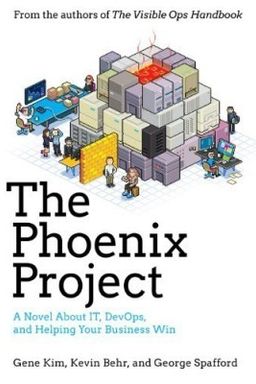
The Phoenix Project cover

The Phoenix Project

by Gene Kim, Kevin Behr and George Spafford

The Phoenix Project reveals how integrating Development and IT Operations through DevOps can revolutionize a company''s workflow. Through a compelling fictional narrative, it demonstrates strategies to adapt to rapid changes and unlock significant business value with efficiency.

Turning Chaos into Flow

What do you do when your IT organization is drowning in emergencies, politics, and pressure to deliver impossible projects? The Phoenix Project by Gene Kim, Kevin Behr, and George Spafford gives you the blueprint for transforming crisis-driven operations into a reliable, adaptive flow of work. Through the story of Bill Palmer—the newly appointed VP of IT Operations at the fictional Parts Unlimited—you learn how to balance reliability, speed, and strategic delivery under extreme pressure.

The central dilemma: reliability vs. innovation

From day one, Bill faces conflicting imperatives. The CEO, Steve Masters, demands the immediate rescue of the company’s flagship project, Phoenix, while insisting that critical systems like payroll and inventory never fail. You’re expected to be both a janitor and a visionary—to fix yesterday’s problems and enable tomorrow’s transformation. This dual burden sets up the book’s core question: how can an organization innovate without destroying reliability?

Discovering the system of work

Mentored by Erik Reid, a mysterious Lean expert who draws analogies from manufacturing, Bill begins to understand that IT behaves like a factory floor. Work flows through constrained resources, gets stuck at bottlenecks, and accumulates queues. The secret is not heroics but systems thinking: make work visible, manage flow, and protect your constraint. The company’s biggest problems—fragile systems, endless unplanned work, and one irreplaceable engineer named Brent—all stem from invisible, unmanaged flow.

The four types of work

Erik helps Bill categorize all IT work into four types: business projects, IT projects, changes, and unplanned work. This taxonomy becomes the lens through which the team regains control. Phoenix represents a high-stakes business project; SAN upgrades and virtualization are IT projects that enable operations; weekly deployments and patches are changes; the payroll outage and data leak are unplanned work. You learn that every minute spent on unplanned recovery erases capacity that could complete planned value. Managing these types explicitly transforms firefighting into disciplined prioritization.

Protecting bottlenecks and managing flow

Central to the story is Brent—the brilliant engineer and single point of failure. Bill realizes that unless Brent’s time is protected, no project will finish. Applying Theory of Constraints (from Eliyahu Goldratt’s The Goal), Bill and Patty identify, exploit, subordinate, and elevate the constraint. They throttle incoming work to Brent’s capacity, document his knowledge, and create a visible kanban board that exposes dependencies and risks. Once the bottleneck is stabilized, throughput increases dramatically.

Making work visible and reducing chaos

Patty’s index-card change board becomes the book’s emblem of transformation. By listing all changes, color-coding priorities, and enforcing a cadence, she converts chaos into coordination. You see how visibility plus limited work-in-progress turns random emergencies into predictable schedules. The team learns that managing flow is not bureaucracy—it’s survival. Each improvement reveals capacity lost to collisions and multitasking.

From firefighting to continuous improvement

As operations stabilize, the narrative shifts toward automation, integration, and culture. The Unicorn team demonstrates modern DevOps principles: automating environments, treating infrastructure as code, embedding security, and using the cloud for experiments. Bill’s group evolves from crisis response to continuous delivery, bridging operations and development into one flow. Through practice, retrospectives, and chaos engineering, they turn learning into habit.

Core principle

Reliability and innovation are two sides of the same flow. When you protect constraints, visualize work, and manage limitations consciously, you create systems that deliver business value without constant crisis.

This story is not just an IT fable—it’s a manual for systemic change. From Brent’s bottleneck to Patty’s kanban, from Erik’s lean mentoring to Steve’s political urgency, you see how one team can transform an organization’s fate. And if you lead operations, the same path—visibility, flow, constraint management, practice—can transform yours too.


The Four Types of Work

One of the most powerful lenses introduced by Erik Reid is the four types of work—an elegant framework that stops the chaos of competing priorities. When you classify each task according to its type, you stop mixing strategic projects with emergencies and start allocating capacity intentionally.

Business projects versus IT projects

Business projects, like Phoenix, generate external revenue value and are visible to customers and executives. IT projects are internal enablers—firmware upgrades or virtualization initiatives that make operations smoother but often invisible to leadership. When your organization conflates the two, you experience missed deadlines and political friction. Bill learns to protect business projects while still funding technical debt repayment through deliberate IT programs.

Changes and unplanned work

Changes are controlled modifications—patches, configuration updates, or deployments. Patty’s change board reveals these as manageable when tracked and scheduled. Unplanned work, in contrast, is pure chaos—outages, malware infections, broken builds. It destroys planned capacity. When Bill measures how much time the team spends on unplanned work, the data shock motivates radical capacity protection and preventive improvements.

Remedy principle

Every hour spent in firefighting is a loan from your future productivity. The interest compounds as technical debt. Categorize it, measure it, and pay it down before it bankrupts your capacity.

When applied rigorously, this classification gives you control. You can balance Phoenix’s deadlines against infrastructure fixes, assign ownership, and tell executives what must stop to make room for what matters. The four types of work are not bureaucratic—they’re the backbone of disciplined IT management.


Protect and Elevate Constraints

Bill’s most pivotal insight is the constraint problem. Brent, the genius engineer, knows everything about Parts Unlimited’s systems—but that makes him the bottleneck. Every task eventually needs Brent’s touch, creating queues, stress, and failure. Erik’s application of Goldratt’s The Goal gives Bill the method: identify, exploit, subordinate, and elevate the constraint.

Identify and exploit

Bill starts by tracking where work stops. Logs reveal Brent as the common dependency. By protecting Brent’s schedule—no drive-by interruptions, no emergency diversions—Bill ensures Brent works only on high-value Phoenix tasks. This deliberate exploitation transforms a bottleneck into leverage.

Subordinate and elevate

Subordination means adapting other work to Brent’s capacity. Patty freezes projects and organizes kanban lanes around his workflow. Elevation means growing that capacity: documenting dependencies, training peers, automating repeatable fixes. Brent’s tacit knowledge becomes shared institutional memory.

Constraint insight

Protect your constraint first; productivity elsewhere doesn’t matter if the bottleneck can’t absorb output. Every system flows at the speed of its most limited resource.

Over time, Brent’s role evolves from hero firefighter to system teacher. The organization learns that managing people like constraints is not punishment—it’s liberation. This discipline sets the stage for flow, throughput, and predictable delivery.


Make Work Visible

You can’t manage what you can’t see. In chaos, invisible work multiplies—hundreds of tickets, uncoordinated changes, and overlapping efforts. Patty’s kanban board is the turning point that restores sanity to Parts Unlimited. By visualizing all work, establishing cadence, and enforcing approval discipline, teams finally align instead of collide.

Kanban and cadence

Patty classifies changes by risk and color-codes work: purple for major projects, yellow for routine, green for infrastructure, and pink for blocked items. She introduces submission rules and daily standups around the board. This simple practice reveals dependency hotspots—like the cluster of Friday deployments that previously caused outages.

Production-control thinking

Borrowed from manufacturing, Patty’s production-control discipline uses readiness checklists, sequencing, and capacity checks before starting work. The analogy to MRP systems shows how planning upstream inputs prevents chaos downstream. Bill realizes that managing IT flow is no different than managing plant throughput.

Visibility transforms culture

When everyone sees the same board, political debates give way to data. Decisions become factual, not emotional.

Visibility and flow management turn the IT department from a reactive mess to a disciplined operation. It’s not the tool—it’s the act of seeing together that changes behavior. Once work is visible, predictability follows.


Break the Spiral of Unplanned Work

Every crisis consumes the hours meant for progress. Bill’s biggest enemy is not incompetence but unplanned work—the cascading failures caused by hitting dates through shortcuts. When teams skip testing or introduce fragile fixes, they create technical debt that spawns future outages. The remedy is prevention and disciplined capacity management.

Seeing technical debt as interest

The book’s metaphor is memorable: unplanned work is the interest you pay on technical debt. Short-term speed comes at long-term cost. Phoenix’s rushed releases prove it: each emergency patch generates more risk and less stability. Bill and Patty respond by declaring a project freeze—a deliberate slowdown to pay down debt through automation and monitoring.

Quantify and publish the impact

When Bill publishes how many hours per week go to unplanned recovery, executives can finally see why projects slip. Transparency converts technical pain into business language. Using Erik’s flow diagrams, they start measuring capacity losses as quantifiable debt interest.

Prevention insight

You can’t innovate until you stop the bleeding. Treat reliability improvements—monitoring, automation, documentation—as high-impact business projects, not chores.

Reducing unplanned work restores the oxygen of IT: time. Bill’s freeze buys that time, enabling cultural change and technical modernization. Without this step, no transformation lasts.


Incident Discipline and Practice

When crises strike, process saves you. After payroll, SAN, and credit-card incidents, Bill learns the power of standardized response. Patty formalizes Sev-1 protocols: single leadership, clear timelines, evidence preservation, and factual communication. This discipline prevents chaos from multiplying.

Structure and rehearsal

Each incident follows a cadence: the incident leader owns the bridge, evidence is recorded, and hypotheses are proposed based on data. Fire drills are mandatory. By rehearsing outages like military exercises, the team replaces panic with muscle memory.

Blameless analysis and improvement

Post-incident retrospectives turn failures into knowledge. Brent’s session recordings become training material. Rather than punishing errors, they convert them into standard work. This builds psychological safety and opens the door for continuous improvement.

Practice principle

You gain reliability through deliberate practice, not luck. A team trained to handle failure calmly will recover faster and learn deeply.

Incident discipline transforms fear into mastery. Combined with the cultural shift toward learning and chaos engineering, it ensures that Parts Unlimited not only survives crises—it grows stronger from them.


Automation, Security, and Learning

The final stage of transformation comes when automation and culture converge. The Unicorn team—William, Brent, and John—demonstrates the DevOps ideal: automated environments, continuous delivery, integrated security, and a learning mindset. Their breakthroughs show how technology and culture reinforce each other.

Infrastructure as code and reproducible environments

Automation begins with environment parity. By scripting Dev, QA, and Production builds from one source, Unicorn eliminates variance—the root cause of deployment pain. Version control transforms fragile setups into repeatable systems. Packaging and promotion make deployments standardized and risk-free.

Cloud and experimentation

Using the cloud, the team runs large-scale recommendation algorithms cheaply, tearing down instances after computation. Maggie turns experiments into business wins with real-time campaigns. Combined with governance controls from John’s security team, cloud experiments balance speed and safety.

Security integration and cultural learning

John’s transformation—from gatekeeper to embedded partner—models the future of compliance. By embedding automated tests and scope controls into pipelines, he makes security continuous and invisible. Chaos experiments (“Narwhal,” “Evil Chaos Monkey”) prove resilience by simulating faults deliberately. Leaders turn practice and failure into institutional learning, supported by Erik’s teaching and Steve’s sponsorship.

Final insight

Automation without learning is fragility disguised as speed. Culture and tooling must mature together to create true operational excellence.

By pairing automation with learning and security integration, the organization completes its journey—from firefighting to a disciplined, experimental machine capable of continuous delivery. This is the lasting message: reliability is built through flow, but sustained through culture.

Dig Deeper

Get personalized prompts to apply these lessons to your life and deepen your understanding.

Go Deeper

Get the Full Experience

Download Insight Books for AI-powered reflections, quizzes, and more.