
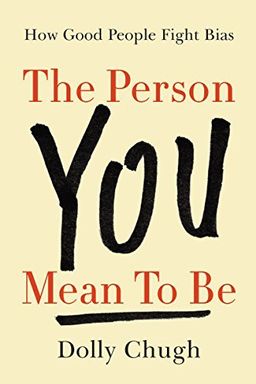
The Person You Mean to Be cover

The Person You Mean to Be

by Dolly Chugh

The Person You Mean to Be is a compelling exploration of unconscious biases and their impact on our interactions. Dolly Chugh provides insightful strategies to recognize and overcome these hidden prejudices, empowering readers to foster inclusivity and equality in everyday life.

Becoming a Good-ish Person

How can you genuinely live your values when the world—and your own mind—make it easy to fall short? In The Person You Mean to Be, Dolly Chugh argues that moral growth is not about perfection but about progress. She introduces the concept of being good-ish—someone who strives to act ethically yet recognizes innate limits to awareness, empathy, and fairness.

Chugh combines research in social psychology, ethics, cognitive science, and leadership to explain why good intentions don’t always lead to good outcomes, and how you can bridge that gap. The book’s journey takes you from personal blind spots to systemic insight, from awkward moments to meaningful repair, offering a realistic path for becoming an ally and a builder of inclusion.

Why Good Intentions Fall Short

Most people identify as fair and caring. Yet biases, fear of discomfort, and identity protection distort how you act. Chugh calls these limits bounded ethicality—predictable cognitive blind spots that prevent even well-meaning people from living up to their ideals. This perspective replaces the binary good/bad judgment with a continuum of ethical learning: making mistakes, repairing them, and continuing to grow.

When your moral identity is threatened—for instance, when someone suggests your words were insensitive—your brain defends itself. You may seek affirmation (“I’m not racist; I have friends of color”) instead of listening. Chugh suggests interrupting that cycle through pre-affirmation: remind yourself of your values before difficult conversations to lower defensiveness.

Awareness and Growth

Chugh expands Carol Dweck’s concept of the growth mindset into ethics: instead of proving you’re unbiased, treat bias awareness as a learnable skill. A fixed mindset says, “I’m a good person already,” while a growth mindset says, “I’m a work in progress.” Neuroscience confirms that people with a growth mindset pay closer attention to correcting their mistakes, turning shame into motivation.

Amy Edmondson’s research on psychological safety shows that leaders who admit fallibility encourage teams to speak up. Perrin Chiles and Brittany Turner modeled this at Project Greenlight when they redesigned Hollywood’s biased contest systems after criticism—proof that public learning multiplies trust.

From Bias to Systems

Individual awareness alone isn’t enough. You exist in systems—schools, companies, neighborhoods—that generate headwinds for some and tailwinds for others. Recognizing privilege doesn’t erase effort; it contextualizes achievement. Chugh’s metaphor of headwinds and tailwinds (adapted from Debby Irving) helps you see how unequal structures accumulate advantages across generations, such as housing access through the GI Bill.

Seeing systems can trigger guilt or shame, but Chugh urges shifting to action-oriented awareness. Use historical checklists—ask what laws or institutions advantaged your family—and move from guilt to advocacy. Privilege becomes a resource for fairer design, not a burden to deny.

Using Influence Wisely

Ordinary privilege—your identity, position, or familiarity—gives you influence. Research by Kevin Munger and David Hekman shows that privileged voices can interrupt bias more effectively, with less backlash. Instead of withdrawing from uncomfortable conversations, you can use that credibility to speak up, invite others in, and rotate leadership so burdened groups can rest.

From Seeing to Building

Ultimately, Chugh asks you to move from believer to builder: not merely claiming to care about inclusion, but designing for it—in meetings, mentorships, networks, and media choices. Each chapter connects self-awareness with systemic change, proving that ethical growth starts where cognition, privilege, and design meet.

(Note: Chugh’s integration of psychology and design thinking parallels works like Mahzarin Banaji’s Blindspot and Brené Brown’s Dare to Lead, but adds pragmatism: small, repeatable habits that translate ideals into behavior.)

If you accept that you are good-ish—the person you mean to be but are still becoming—you unlock humility and agency. That identity fuels continuous learning, deeper empathy, and meaningful action—the moral muscle the book teaches you to strengthen.


Seeing Bias and Limits of Awareness

You cannot fix what you cannot see. Chugh shows that our minds filter information through bounded awareness—the tendency to miss obvious cues—and confirmation bias, which leads us to notice evidence that flatters our self-image. These cognitive filters explain why well-intentioned people overlook exclusion right in front of them.

Invisible Gorillas and Everyday Blind Spots

Borrowing the famous Simons & Chabris experiment, Chugh points out that when you’re focused on counting passes, you miss the person in a gorilla suit walking through the frame. In workplaces, bounded awareness shows up when you ignore quieter voices or overlook who was excluded from a meeting. Bias hides not because it’s invisible, but because attention is limited.

Kim Davis’s networking story—a woman unnoticed though standing in a group—illustrates how polite norms and social hierarchy narrow what people perceive. Recognizing this helps you design better contexts: slower conversations, explicit turn-taking, deliberate inclusion.

Echo Chambers and Meritocracy Myths

Most people live in racial or ideological echo chambers that reinforce comfort. Drew Jacoby-Senghor and PRRI data show that white Americans’ networks are especially homogeneous, limiting corrective viewpoints. Inside such chambers, meritocracy becomes a self-confirming belief—Castilla & Benard’s paradox study reveals that claiming meritocracy can actually increase bias by masking unequal decision patterns.

You can break this bias loop by asking disconfirming questions: “Who isn’t in this room?” or “What am I missing?” Feed diversity into your digital life—follow voices you don’t already hear—and treat discomfort as data, not danger.

Bounded awareness is a normal limit. Breaking it requires deliberate attention: not faster judgment, but slower noticing.

When you widen your awareness, you stop mistaking the visible majority for reality itself—an essential first step toward being the person you mean to be.


Willful Awareness and De-Otherizing

Once you start noticing bias, the next challenge is discomfort. Chugh calls the solution willful awareness: choosing to see and stay present, even when shame or guilt tempt you to look away. This deliberate state helps you counter the four toxic modes that otherize your good intentions—savior, sympathy, tolerance, and typecasting.

Four Modes That Distort Empathy

In Savior mode, you make helping about your heroism rather than others’ agency. Mel Wymore resisted this by organizing with, not for, public-housing tenants—where voicing others’ needs, not replacing them, preserved dignity. Chugh recalls wanting to rescue a homeless student, realizing later that she had framed him as a project.

In Sympathy mode, you feel compassion from afar but avoid engagement; empathy, by contrast, enters the circle and feels with. In Tolerance or "difference-blindness," you claim not to see color—masking structural inequity instead of facing it. Finally, Typecasting praises people into boxes—like glorifying women as nurturing while penalizing assertiveness or calling Asian Americans "model minorities," erasing individuality.

Humanizing Others

Neuroscience shows this isn’t abstract moral theory. Katrina Fincher and Jason Mitchell’s research finds that seeing someone as an individual activates richer facial and emotional processing. When you stereotype, your brain literally stops encoding their expression fully—dehumanization becomes perceptual.

Practices to De-Otherize

Start with small but powerful habits: learn and use names (Chugh’s prison classroom example turned numbers into people); ask short, sincere follow-up questions (as Mel’s secretary did after his gender transition); and design conversations to center others, not yourself. Each act teaches your brain and community to see more humanity.

Sympathy keeps you outside; empathy brings you in. De-otherizing asks you to move closer, inquire more, and make repair visible, turning mistakes into connection points rather than exits.

Willful awareness is uncomfortable—but moral growth lives there. By dropping savior instincts and replacing guilt with curiosity, you deepen both understanding and impact.


Privilege, Systems, and Action

You work hard, yet the playing field isn’t level. Chugh shows how systems of privilege and bias create invisible headwinds for some and tailwinds for others. The key is not to deny personal effort, but to see the broader context that multiplies or limits it.

Headwinds, Tailwinds, and Accumulation

Debby Irving’s headwind/tailwind metaphor captures how advantage compounds. The GI Bill boosted white veterans’ home ownership and education while discriminatory local practices blocked black veterans. These historical “winds” set trajectories for generations. Small procedural favors—like loan approvals or neighborhood access—cascade into big results.

Seeing Systems Without Shame

When you realize your group has benefited, defensiveness is natural. Chugh advises pre-affirming your values—reminding yourself that accepting systemic reality doesn’t negate your hard work. Systems thinking moves you from guilt to accountability: you start asking structural questions rather than personal ones.

  • Use historical checklists to link personal stories to structural ones.
  • Think in accumulation—small biases build large gaps.
  • Turn awareness into advocacy for fair design instead of moral posturing.

Turning Privilege Into Influence

Ordinary privilege—race, gender, or professional status—gives you access others don’t have. Use it to confront bias strategically. Experiments by Kevin Munger show that high-status confrontations reduce racist behavior more effectively. White male leaders promoting diversity face less backlash than marginalized counterparts; this asymmetry implies duty: intervene when your voice can protect and legitimize.

Privilege isn’t personal fault—it’s a tool for repair. By understanding systemic wind patterns and acting within your zone of influence, you shift from silent beneficiary to intentional builder.


Building Inclusive Habits and Systems

Inclusion succeeds not through slogans but through habits. Chugh turns research into design principles for teams, meetings, and organizations—small practices that collectively change who thrives. She distinguishes between gateways (formal access points) and pathways (daily moments of belonging).

Gateways: Who Gets In

Formal decisions—admissions, hires, promotions—shape representation. Max Bazerman models gateway allyship by sponsoring junior scholars into elite forums, then stepping back. Gateways widen when inclusion is not charity but structural opportunity.

Pathways: What Happens After Entry

Most bias occurs on pathways: mentoring replies, credit sharing, meeting invitations. Chugh’s 6,500-email experiment revealed that professors responded more to “Meredith Roberts” than “Juanita Martinez” or “Raj Singh.” Small differences before any official selection create cumulative exclusion. Pathway audits—asking who gets informal mentoring or visibility—can uncover inequities early.

Meetings as Keystone Habits

Meetings are microcosms of equity. Who speaks, is interrupted, or gets credit matters. Tony Prophet’s audit questions—“Who spoke? Who was praised?”—turn meetings into learning labs. Subha Barry’s deliberate seating mixes networks and yields collaboration. Round-robin formats and explicit credit acknowledgment prevent stereotype taxes (Chugh’s Boston train-station study showed people discounted female advisers, costing actual earnings).

Inclusion isn’t an abstract value—it’s built in minutes, replies, and seats. Turning gateway awareness into pathway design ensures diversity becomes sustainable belonging.


Changing Conversations and Culture

You shape culture every time you talk, share, and listen. Chugh shows how media, parenting, and personal networks act as levers for social change. Shifting narratives—public or private—changes norms more powerfully than preaching does.

Art and Storytelling

Thomas Kail’s direction of Hamilton exemplifies color-conscious storytelling—casting people of color as founding fathers reframed who built America. Art can force visibility where history erased it. (Note: Like Ava DuVernay’s 13th, this technique turns systemic critique into story that shifts perception.)

Elizabeth Levy Paluck’s Rwanda radio experiment proved that perceived social norms drive action: listeners changed behavior after hearing characters challenge prejudice. You can do the same by amplifying inclusive narratives—preordering diverse media, recommending minority authors, and funding art that widens mirrors and windows.

Parenting and Micro-Narratives

At home, silence breeds distortion. Many white parents avoid race talk, leaving children to invent myths. Choose books showing varied experiences, discuss gender and race openly, and correct misperceptions (“It was illegal for a Black person to be president” isn’t factual; it’s unconfronted narrative). Everyday storytelling teaches inclusion as normal, not exceptional.

Social Circles and Courageous Conversations

Jeana Marinelli’s structured pre-Thanksgiving dialogue among twelve white Christian women demonstrates that organized reflection—prework, questions, and timing—can break echo-chamber comfort. Online, listening before speaking (as on Black Twitter) builds respect and understanding. When you treat conversations as design spaces for empathy, you start steering cultural currents consciously, not reactively.

Changing narratives is activism in miniature: it’s how culture evolves from individual attention to collective vision.


Acting with Courage and Meaningful Support

Awareness must turn into action. Chugh closes with relational courage—how to educate, confront, and support effectively. You influence norms most when you combine empathy with assertive presence, using the 20/60/20 rule to choose your battles and your audiences.

The 20/60/20 Rule

When witnessing bias, spend energy strategically: educate the receptive easy 20%, engage stories for the movable middle 60%, and protect targets rather than debating the immovable stuck 20%. Dolly’s own brunch mistake—attacking an offender without assessing audience—taught her that public learning often matters more than winning a confrontation.

Support Without Centering Yourself

Rabbi Eric Solomon’s alliance with Imam Baianonie shows how listening precedes leadership: curiosity and humility amplify solidarity. Ben Schwartzbach’s simple email to grieving colleague Rachel Hurnyak—specific, uncentered, sincere—illustrates quiet allyship that heals more than speeches.

Respecting the Heat

Change needs both light (structured ally efforts) and heat (protest). Joe McNeil of the Greensboro Four reminded us that radical action carries cost; ally presence distributes that burden. Whether you amplify protestors’ messages, fund their work, or translate their motives to observers, partnership across temperaments sustains justice.

You can’t be perfect—but you can be present. Courage in conversation and solidarity in support turn everyday morality into collective progress.

The final lesson: good-ish people act. They educate where possible, protect when necessary, and build together, blending humility and resolve so moral growth becomes contagious.

Dig Deeper

Get personalized prompts to apply these lessons to your life and deepen your understanding.

Go Deeper

Get the Full Experience

Download Insight Books for AI-powered reflections, quizzes, and more.