
Idea 1
Democracy at War with Technology
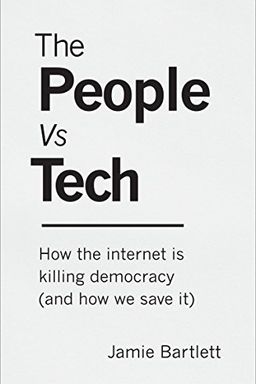
Have you ever wondered whether technology is improving society—or quietly dismantling the foundations that hold it together? In The People vs Tech, Jamie Bartlett argues that our digital revolution is eroding the six pillars that make democracy work: active citizens, shared culture, free elections, equality, a competitive economy, and trust in authority. He contends that the power and speed of technological change have outpaced democracy’s ability to manage it, setting up a collision course between digital progress and political stability.
Bartlett isn’t a Luddite; he’s a realist who’s spent years studying technology’s social impact as a researcher at Demos. His central claim is stark: if democracy doesn’t evolve, it will be replaced—by a techno-authoritarian future run not by tyrants with armies, but by engineers with algorithms. The very systems that promised connectivity and empowerment now threaten to dilute free will, polarize communities, manipulate elections, and concentrate economic and political power in the hands of a digital elite.
From Free Connection to Constant Control
The book opens with the paradox of our digital age. Social media and big data were meant to democratize information and connect the world. But instead, they’ve created what Bartlett calls a “new panopticon”—a vast surveillance and manipulation system where every interaction is tracked, analyzed, and used to predict our behavior. Drawing on early psychology and Silicon Valley’s obsession with “hacking” the human mind, Bartlett argues that platforms like Facebook and Google have turned freedom-loving citizens into predictable data sets. He likens modern dataism to the 20th-century behavioral science movement—an experiment in shaping desire and control that now spans billions of people.
Technology, he says, isn’t neutral. It rewires how people think and feel, which in turn transforms politics. The dopamine-driven design of apps keeps us endlessly scrolling and swiping—what Tristan Harris calls “the attention economy.” This addictive behavior doesn’t just waste time; it undermines autonomy and moral maturity, because citizens ceaselessly trade conscious thought for artificial stimulation.
Six Pillars at Risk
Bartlett organizes his argument around six democratic pillars that technology is weakening. In chapters rich with real-world examples, he explains how constant connectivity fuels tribalism (“The Global Village”), how big data corrupts elections (“Software Wars”), and how automation threatens the middle class (“Driverless Democracy”). The second half examines the rise of monopolies (“The Everything Monopoly”) and movements like crypto-anarchy (“Crypto-Anarchy”) that seek total liberty by dismantling state power entirely. Each trend, in isolation, seems manageable. Together, they form an ecosystem hostile to democratic balance.
For example, artificial intelligence promises efficiency but risks stratifying society into a “barbell economy” of elites and service workers, erasing the middle class—the group history shows is essential for stable democracy. Meanwhile, blockchain, cryptocurrency, and radical encryption challenge governments’ ability to tax, regulate, or enforce laws. Bartlett notes with irony that technology meant to protect privacy could end up destroying the collective institutions that guarantee rights, replacing them with chaotic systems of self-interest.
When Technology Governs Morality
Underlying everything is a philosophical struggle: can we remain moral agents when machines predict and optimize our decisions? Bartlett compares modern algorithms to Jeremy Bentham’s long-lost dream of a “felicific calculus”—a formula to measure right and wrong. Big data makes Bentham’s fantasy plausible again, but with devastating implications. When machines are consistently “better” than humans at diagnosis, strategy, or judgment, citizens may surrender moral choice to algorithms. Bartlett warns this moral singularity—the moment we delegate ethics to AI—would mark democracy’s true death knell.
The Coming Political Reckoning
Bartlett ultimately sees two possible futures. One is utopian: an age of universal basic income, jobless prosperity, and liberation from drudgery. The other is dystopian: deep inequality, digital manipulation, and techno-authoritarian governance. The most likely path, he believes, lies between them—a society strained by inequality and disillusioned with democracy, where citizens trade freedom for efficiency. In this world, algorithms become instruments of control rather than tools of progress. His reminder is haunting: the next great threat to democracy won’t come from generals or ideologues, but from coders who claim to serve humanity while concentrating power beyond accountability.
Throughout The People vs Tech, Bartlett balances vivid storytelling—such as the Starsky Robotics truck “Rosebud” driving autonomously down the Florida highway—with political analysis and philosophical depth. The book’s question is both urgent and personal: as technology rewrites everything from our economy to our emotions, can democracy rewrite itself fast enough to survive?
In the end, Bartlett doesn’t call for smashing the machines. He calls for redesigning democracy to harness technology while defending freedom. He warns that unless we act, liberal democracy—the imperfect but resilient system built over centuries—will quietly vanish, replaced by a glittering but hollow technocracy that governs not through violence, but through code.