
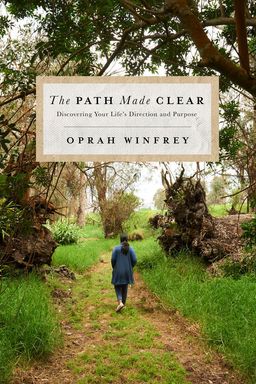
The Path Made Clear cover

The Path Made Clear

by Oprah Winfrey

In ''The Path Made Clear,'' Oprah Winfrey shares profound insights and wisdom on discovering one''s life purpose. Through personal stories and lessons, she guides readers on a journey towards authenticity and fulfillment, emphasizing the importance of listening to inner whispers and embracing one''s true path.

Discovering and Living Your True Purpose

Have you ever asked yourself, “Why am I here?” or “What am I truly meant to do?” In The Path Made Clear, Oprah Winfrey argues that every person’s greatest task is to discover and honor their divine calling—the unique contribution only they can make to the world. She contends that when you align your life with that purpose, every experience, even pain and challenge, becomes fuel for personal evolution.

Oprah’s central claim is this: you already have everything within you to fulfill your destiny. Her role—as a teacher and curator of wisdom—is to illuminate that truth through her own stories and the insights of visionary guests such as Eckhart Tolle, Brené Brown, Deepak Chopra, and Maya Angelou. Across ten chapters, the book serves as both mirror and map: guiding you to awaken to your purpose, listen to your inner whispers, face fear with courage, and ultimately live in peace and authenticity.

The Architecture of Purpose

Oprah divides her book into ten chapters with poetic titles—like “The Seeds,” “The Whispers,” “The Give,” “The Reward,” and “Home.” Each explores a stage of discovering and living one’s calling. The early chapters plant awareness that life constantly sends signals, while the later ones describe how to give back and find your way home to spiritual peace. Oprah parallels this to a journey up a mountain: every step matters, and each obstacle, setback, or detour refines who you truly are.

She begins with the conviction that purpose is not something external to chase but something to uncover—already encoded in your being, like a seed ready to sprout. When Oprah describes being demoted from a news desk in Baltimore to a human-interest talk show, she recalls it as her first moment of awakening. That supposed setback became the seed of her life’s work, revealing what brought her joy: deep conversations that help others see themselves more clearly. This is the heart of the book’s message: pay attention to what makes you come alive, because vitality is the clue to vocation (echoing Frederick Buechner’s idea of “the place where your deep gladness meets the world's deep hunger”).

Listening to Life’s Whispers

A recurring theme is that life speaks in whispers long before it shouts. Oprah insists that most chaos, heartbreak, and failure arise because we ignore those subtle nudges. The body warns through restlessness, anxiety, or fatigue; the soul whispers through intuition. Contributors like Caroline Myss and Shauna Niequist reveal how our intuition is an internal compass toward truth. When ignored, it turns into crisis. But when honored, it leads to profound transformation.

Oprah’s approach blends ancient wisdom with contemporary psychology. She quotes Eckhart Tolle about human evolution being cyclic—two steps forward, one step back. She also draws from Thich Nhat Hanh’s teaching of “compassionate listening” and Father Richard Rohr’s idea that suffering either transforms us or gets transmitted to others. For Oprah, spiritual growth means daring to sit inside discomfort until we understand what it’s teaching us.

From Vision to Intention

Midway through the book, Oprah makes a pivotal distinction: a dream without intention is just a fantasy. Quoting her late mentor Maya Angelou—“When you know, teach. When you get, give.”—she urges readers to turn awakening into service. The path is not fully clear until you align your actions with your highest motives. She likens intention to the map for your road. If your why is grounded in love and authenticity, the universe rises to meet you. But ego-based goals built on fear or comparison eventually collapse. (This mirrors Wayne Dyer’s view in The Power of Intention that alignment, not ambition, drives creation.)

Oprah embodies this lesson through her own pursuits—the creation of the Leadership Academy for Girls in South Africa, for instance, which she describes as her “divine calling made tangible.” Despite naysayers, she trusted that pure intention would sustain the project, and today hundreds of young women have graduated from that vision.

The Evolution of Giving and Receiving

Later chapters such as “The Give” and “The Reward” build on the spiritual cycle of energy: everything we give returns in multiplied form. Oprah recounts Maya Angelou’s enduring reminder that people will always remember how we made them feel. She expands this to mean that legacy is measured by energetic exchange, not material wealth. True fulfillment lies in serving others from abundance rather than scarcity—a principle echoed by Lynne Twist’s line, “What you appreciate, appreciates.” Once you stop chasing what you lack and start nourishing what you already have, prosperity expands naturally.

Oprah also reframes “reward” away from financial gain. She tells stories of people like Sarah Ban Breathnach and Jordan Peele to show that success is fragile when tethered to ego but enduring when rooted in authenticity. The real treasure, she concludes, is contentment born from living your truth—not external praise or wealth that can be lost overnight.

Finding Your Way Home

The final chapter, “Home,” returns to where the journey began: with self-knowledge and trust. Drawing powerfully from The Wizard of Oz, Oprah interprets Dorothy’s adventure as a spiritual allegory. Each character represents parts of us seeking wholeness—the mind, the heart, the courage—and Glinda’s reminder that Dorothy “always had the power” underscores the book’s concluding truth: you are your own home. Everything you’ve been searching for exists within you.

In her epilogue, Oprah invokes a mother’s words to her dying son—“It’s so simple, Mom”—to remind us that life’s meaning doesn’t need complexity. Purpose is revealed in simplicity, gratitude, and presence. You don’t need to search for your calling; you only need to clear the path to it. That’s what she calls “the path made clear.”

Through memoir, dialogue, and meditation-like prose, Oprah gives readers a gentle but radical call to action: get still, listen deeply, and live intentionally. The book’s wisdom unfolds not as commandments but as echoes of universal truths told by diverse voices—spiritual teachers, artists, politicians, and ordinary people who found peace through purpose. Together, they compose a radiant map back to yourself.


The Seeds: Listening to the Call Within

Oprah begins her journey with the metaphor of seeds—tiny beginnings that contain limitless potential. For her, discovering purpose starts with paying attention to the moments when you feel most alive. When she was a young news anchor in Baltimore, she felt drained and out of place. But after being reassigned to a morning talk show, she instantly felt illuminated. That sensation—energy, excitement, and ease—was her first signal. It told her she was home.

Discovering the Oak Within the Acorn

Every person, Oprah says, carries what psychologist James Hillman called “the oak within the acorn.” Your destiny already exists in potential form; your task is to nourish it through awareness, education, and faith. Pastor A.R. Bernard reinforces this idea: purpose isn’t one fixed achievement but a dynamic force expressed in many forms throughout life. You may express the same essence across multiple roles—as teacher, parent, leader, or artist.

The Power of Belief and Faith

Central to this stage is belief—the seed of all creation. Oprah draws from her childhood in the church, recalling the biblical mustard seed: all you need is a sliver of faith to move mountains. The lesson isn’t religious exclusivity but universal truth: what you believe, you become. If you believe in your worth and possibility, you summon experiences that mirror that faith.

Guests like Deepak Chopra and T.D. Jakes expand this with their own lenses. Chopra sees belief as resonance between soul and cosmos—your gifts bloom naturally when aligned with your energy. Jakes adds that removing clutter, guilt, and worry from your mind allows “the seed of an idea” to take root. Without clearing mental weeds, the soil of your soul stays barren.

Owning the Permission to Grow

Author Elizabeth Gilbert reminds readers—especially women—that they need no external permission slip to grow. The act of asking “What have I come here to do?” is the first sign you’re ready to change. As Sue Monk Kidd puts it, life is continuous awakening: self after self “dies and is reborn.” The seed doesn’t become an oak overnight—it evolves through seasons of loss and flowering. The courage to keep evolving is the first mark of spiritual maturity.

(In contrast, other self-development writers like Viktor Frankl in Man’s Search for Meaning describe meaning as something found through suffering. Oprah extends that idea—but roots it in joy and attention rather than pain.)

The takeaway: A seed doesn’t doubt its potential to grow. Neither should you. Every whisper of passion, curiosity, or compassion is a pulse of that hidden oak calling you forward.


The Whispers: When Life Speaks

Life rarely announces its messages through trumpets. It whispers. Oprah writes that these whispers appear as interoceptive clues—fatigue, anxiety, a sense of misalignment, or the quiet voice saying, “This isn’t right.” Those signals are sacred. Ignoring them is what leads to breakdowns and crises that force us to pay attention later.

Recognizing the Early Warnings

Writer Shauna Niequist provides a vivid example. Professionally successful but spiritually exhausted, she ignored migraines, insomnia, and nausea until she realized her pace masked a deeper pain—self-rejection. It was only in silence, snorkeling with her son, that she heard the truth: she had built a life inconsistent with her values. Her story illustrates Oprah’s law of whispers: discomfort is divine redirection.

The Voice of Intuition

Caroline Myss calls intuition the conscience of the soul. It’s the inner voice that says, “This is not for you.” When disregarded, this voice becomes suffering. Oprah encourages you to develop a practice of paying attention—to the unease, to the wake-up calls at 3 a.m., to the quiet longing for change. As Jon Kabat-Zinn notes, mindfulness is “living your life as if it matters—because it does.”

Transformation Through Awareness

Adyashanti reminds readers that when we disconnect from the truth of our being, we compensate through outside validation. Reconnection comes from surrender. Similarly, Cheryl Strayed’s fateful discovery of a trail guidebook for the Pacific Crest Trail—leading her to hike a thousand miles alone—embodied that surrender. She followed the whisper and found herself transformed. As Thomas Moore writes, “Your individuality comes from your soul, not from your head.”

The lesson from this chapter is simple yet profound: If you don’t listen to the gentle voice of intuition, life will eventually send a storm. Begin to trust your inner knowing; the whispers are love trying to guide you home.


The Clouds: Confronting Fear and Doubt

When Oprah speaks of “the clouds,” she’s referring to fear, doubt, and resistance—the obstacles that obscure the light of our calling. She uses her own experience writing her Harvard commencement address as metaphor. Despite decades of public speaking, she felt frozen by fear until she realized, through author Steven Pressfield’s advice, that “resistance is the shadow of the dream.” The closer something is to your soul’s purpose, the more fear it triggers. That realization transformed fear from an enemy into a teacher.

Understanding the Source of Resistance

Oprah learned that resistance is natural—it exists to test our courage. Steven Pressfield (author of The War of Art) calls it a universal law of creation. Fear shows up precisely where growth awaits. For Joel Osteen, stepping into his father’s role as pastor sparked crippling self-doubt, until he realized he had to “run his own race.” Fear, in other words, invites authenticity.

The Inner Battle of Trust

Iyanla Vanzant reframes fear as a control strategy. Remaining small feels safer than vulnerability. We stay in mediocrity because we know it. True faith requires trusting yourself—and God—enough to move beyond what you can predict. “The core ingredient of trust is vulnerability,” she says. Only those willing to “look different, sound different, be different” experience transformation.

From Self-Betrayal to Alignment

Caroline Myss’s contribution powerfully identifies self-betrayal as the root of despair. You never lose your path, she insists; you just mismanage it. Pain signals that you’ve chosen fear over truth. Similarly, India.Arie’s story of losing all seven of her Grammy nominations taught her that “self-worth is your job.” Compare this to Elizabeth Gilbert’s image of “mothering” your own fear—it’s part of you but not your driver. You acknowledge it, soothe it, then move forward anyway.

Letting Go and Rising Above

Michael Singer, author of The Untethered Soul, offers the practical path: when fear or chaos rises, “relax and lean away” rather than reacting. This space between reaction and response allows intuition to speak. The clouds may always hover, but they no longer block the light. The spiritual ascent begins here: courage isn’t absence of fear—it’s intimacy with it.

In short, the clouds eventually part, not when you wait for calm skies, but when you accept the storm as your classroom. Fear ceases to be the barrier and becomes the wind that lifts you higher.


The Map: Setting Intention and Direction

Once fear is faced, you must decide where to go. In “The Map,” Oprah defines intention as the inner compass that aligns your actions with purpose. Borrowing from Paulo Coelho’s The Alchemist, she writes that when your intent is pure, “the universe conspires” to help you. But when the motive is egoic, your path falters.

The Alignment of Personality and Soul

Spiritual teacher Gary Zukav, one of Oprah’s frequent mentors, provides the cornerstone of this chapter: “Your job is to align your personality with your soul.” Every choice either strengthens love or expands fear. Building what he calls “authentic power” requires emotional awareness—recognizing impulses before acting. This allows you to inject consciousness into the moment, turning reaction into creation.

Why Intention Matters

Oprah applies this principle in recounting her founding of The Oprah Winfrey Leadership Academy for Girls in South Africa. When critics doubted its longevity, she stood firm, knowing her motive was pure service, not ego. That integrity gave the vision endurance. Intention, she teaches, is the map that keeps you on course when obstacles arise.

Defining Success Through Values

Brené Brown illustrates intention through her family “manifesto,” written as a compass for living wholeheartedly—with courage, compassion, and joy. Meanwhile, comedian Stephen Colbert recalls setting his show’s intention “to be about love.” These examples prove that intention need not be complicated. It simply clarifies who you are and how you wish to serve. As Marianne Williamson says, “Blast everyone with love before you walk into any room.” It changes the entire energetic field.

When your why is rooted in authenticity and love, the path unfolds with unexpected grace. You no longer chase success; you attract synchronicity. That is how your map becomes your miracle.


The Give: Living in Service

Oprah calls giving “the heartbeat of purpose.” To her, the highest expression of one’s calling is service to humanity. Channeling her mentor Maya Angelou, she reminds us that “people will forget what you said or did but never how you made them feel.” Giving, therefore, is less about charity and more about the energy we choose to bring into our relationships and work.

Service as Energy Exchange

Oprah views life as a continuous exchange of energy—positive or negative. Every interaction contributes to your legacy. Living intentionally from compassion expands the collective good. Father Richard Rohr notes that when we fail to transform our suffering, we transmit it to others. Service interrupts that pattern by transforming pain into empathy.

Listening and Bridge-Building

Thich Nhat Hanh’s concept of “deep listening” perfectly captures this. True service begins with listening that helps relieve another’s suffering. Activist Bryan Stevenson adds that justice is measured by “how many stones you catch” for those under attack. Former U.S. Representative John Lewis emphasizes moral courage—“You too can make a contribution.” Together, their voices reveal service as both personal and political: compassion paired with action.

From Giving to Wholeness

Lynne Twist offers a wake-up call against the culture of scarcity: you free up energy when you stop chasing what you don’t need and start nurturing what you already have. “What you appreciate, appreciates,” she says. This principle flips consumerism into gratitude. Through appreciation, giving becomes not depletion but expansion.

In a world that often equates significance with wealth, Oprah’s theology of giving restores sacred balance: to serve is to align yourself with the pulse of creation itself. When you know, teach. When you get, give.


The Reward and Home: Returning to Yourself

The final phases of Oprah’s path—“The Reward” and “Home”—bring the journey full circle. The reward of living your purpose is not fame or fortune but peace of mind and self-respect. Oprah illustrates this with her first babysitting job at fifteen, when she learned to value her work even when others didn’t. “I am not my salary,” she declared—an early revelation that worth is intrinsic, not transactional.

Redefining Success and Enoughness

In interviews with figures like Cicely Tyson, Sarah Ban Breathnach, and Lynne Twist, Oprah dismantles the myth that wealth guarantees happiness. Tyson says she’s never taken a role that didn’t “enhance humanity.” Breathnach recounts how fame and millions ultimately left her broken until she discovered gratitude again. Twist explains that society’s obsession with “not enough” fuels greed and suffering. The antidote is sufficiency—a mindset of completeness and gratitude.

Finding Home Within

The book’s closing chapters function as spiritual homecomings. Drawing on To Kill a Mockingbird and The Wizard of Oz, Oprah shows how literature shaped her realization that the path home is inward. Dorothy discovered she “always had the power.” Likewise, Father Richard Rohr says spiritual knowledge is recognition, not acquisition—you’re remembering what your soul already knows. Elizabeth Lesser echoes: “Deep inside, you are already enough.”

Living Whole and Uncomplicated

Jane Fonda captures this perfectly: “The goal is to be whole. To reside inside your skin.” For Oprah, wholeness means ending the search for external validation. Her epilogue closes with a mother’s story of her dying son whispering, “It’s so simple.” Indeed, life’s teaching, stripped of complexity, is simple: be present, be grateful, and be led by love.

When you come home to yourself, you realize that purpose was never a destination—it was the path itself. The path made clear isn’t out there; it’s the light you’ve carried all along.

Dig Deeper

Get personalized prompts to apply these lessons to your life and deepen your understanding.

Go Deeper

Get the Full Experience

Download Insight Books for AI-powered reflections, quizzes, and more.