
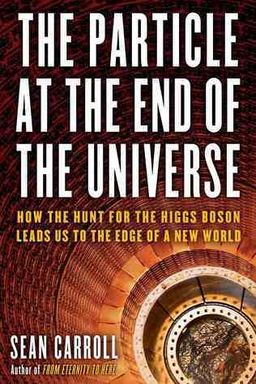
The Particle at the End of the Universe cover

The Particle at the End of the Universe

by Sean Carroll

The Particle at the End of the Universe unveils the thrilling journey to discover the Higgs boson, a pivotal element in understanding our universe''s structure. Sean Carroll takes readers through particle physics'' complex world and the groundbreaking experiments at the Large Hadron Collider, offering insights into the forces that shape our cosmos.

The Discovery That Completed a Theory and Began a New Era

On July 4, 2012, thousands of physicists and engineers across the world watched as Fabiola Gianotti and Joe Incandela stood before graphs showing a small but unmistakable bump near 125 GeV. They had found a new particle—consistent with the Higgs boson predicted half a century earlier. The announcement was the culmination of decades of theory, experimentation, and international collaboration. But it also marked the beginning of a deeper exploration into what mass really is and how the universe holds together.

The Higgs discovery was not just another data point in physics; it confirmed the final piece of the Standard Model, the theoretical framework that unites electromagnetism, the weak force, and the strong force. Yet rather than closing the story, it opened up new questions. Is the discovered particle the simple version predicted by the model, or part of something richer—perhaps tied to supersymmetry, dark matter, or extra dimensions?

From the Quantum Field to You

To understand why the Higgs boson matters, you must first shift how you think about matter itself. In quantum field theory, everything you call a particle—the electron, photon, or quark—is a vibration of an underlying field that fills all of space. These fields interact, overlap, and sometimes change the behavior of each other. The Higgs field is unique because it doesn’t vanish in empty space—it has a background value everywhere. Particles that interact strongly with it (like the top quark) appear heavy; those that couple weakly (like the electron) appear light. If that field were turned off, all matter would zip around at light speed and complex structures like atoms and chemistry could not exist.

Symmetry and the Hidden Order of Nature

The beauty of particle physics lies in symmetry. When physical laws remain unchanged under transformations—like rotations or charge swaps—those symmetries dictate which forces exist. Local symmetries, known as gauge symmetries, require connection fields that act as force carriers. The photon carries electromagnetism, gluons carry the strong force, and the W and Z bosons carry the weak force. The trouble was that gauge symmetry seemed to forbid these carriers from having mass, yet the weak force clearly involved massive particles. The Higgs field resolved this paradox. By “hiding” the symmetry rather than destroying it, the field allows some force carriers to acquire mass, explaining why some forces are short‑range and others infinite.

The Road to Discovery: Machines, People, and Politics

The particle was elusive because it decays almost instantly. Finding it required the most powerful machine ever built—the Large Hadron Collider (LHC), a 17‑mile ring buried beneath the Swiss-French border. To control beams of protons traveling near light speed, engineers devised gigantic superconducting magnets, cooled with liquid helium to just above absolute zero. The project endured setbacks (a devastating magnet quench in 2008, even a mythic “bird drop” of baguette causing electrical faults) but rose to operate steadily. Political drama shaped the project as well: America’s own Superconducting Super Collider was canceled in 1993 after budget battles, leaving CERN as the global hub for high‑energy physics.

Thousands of scientists worked in two independent detectors—ATLAS and CMS—each the size of a small building. These experiments didn’t “see” Higgs particles directly. Instead, they reconstructed the sprays of decay products and compared them statistically to predictions. By 2012, both teams had compiled enough data to independently surpass the 5‑sigma threshold—a level of statistical certainty so high that random chance was nearly impossible. Their simultaneous confirmations made the discovery credible and historic.

After the Triumph

Yet even amid celebration, scientists knew the story wasn’t over. Careful language—“a Higgs-like particle”—reflected humility and precision. Since then, experimental teams have measured its properties with increasing accuracy, searching for deviations that might hint at new physics. The Higgs remains both a triumph of the Standard Model and a gateway to the mysteries beyond it: why the universe contains mass, why empty space holds energy, and whether unseen realms—dark matter, supersymmetry, or extra dimensions—lie waiting just beyond our reach.

Big-picture takeaway

The discovery of the Higgs is not an ending but a beginning. It validated one of the most profound ideas in theoretical physics—that fields, symmetry, and spontaneous breaking can give birth to mass—and it set the stage for a new era of exploration into what lies beyond the known world.


Quantum Fields and the Nature of Matter

You’ve been taught to think of particles as tiny billiard balls, but in modern physics, that picture is obsolete. Quantum field theory (QFT) replaces it with a more fluid image: the universe is composed of fields filling all of space, and what you call a particle is just a localized vibration or quantized ripple in one of those fields. The Higgs boson is merely one such vibration in the Higgs field, a background that quietly determines the masses of all other particles.

Particles as Ripples in Space

Think of each field like a piano string stretched through space. Striking it produces distinct notes—its quanta. Photons come from the electromagnetic field, quarks from the corresponding color fields, and the Higgs boson from the Higgs field. The amplitude of a field’s vibration and the energy required to excite it determine the particle’s mass. In this sense, heavy particles are hard-to‑pluck strings: their vibrations demand high energy.

What Makes the Higgs Different

Most fields minimize their energy by sitting at zero, where nothing is vibrating. The Higgs field is peculiar—its minimum occurs at a nonzero value, about 246 GeV. That ever‑present value gives mass to other fields’ excitations. Without it, electrons and quarks would be massless and unable to combine into atoms. The universe owes its structure and stability to this invisible ocean of field energy under every atom you see.

Interactions and Virtual Particles

Fields do more than vibrate—they interact. When they do, quantum uncertainty allows brief "borrowing" of energy to form transient, virtual particles. Richard Feynman created diagrams to visualize these interactions, showing how particles scatter, annihilate, or decay. In the Higgs’s case, gluons (from the strong field) can fuse through a virtual top-quark loop to create a Higgs boson. Likewise, a Higgs can decay into two photons through loops of virtual heavy particles. These calculations, though intricate, predict precise probabilities—the same ones that guided experimentalists in identifying where and how to look for the Higgs at CERN.

Why This Matters

Understanding the Higgs as a quantum field effect reshapes your view of reality. Matter is not made of hard spheres but of excitations in overlapping fields; forces arise where those fields talk to each other. QFT connects the quantum world with relativity, providing the mathematical framework for both the mundane (why magnets attract) and the marvelous (how empty space itself grants mass). The Higgs field, as the last missing ingredient of this framework, confirms that the field-centric view of the universe works all the way down.


Symmetry, Superconductors, and the Higgs Mechanism

Symmetry is the deep logic of physics—a rule that ensures consistency as you shift frames, rotate systems, or alter phases. When a law remains unchanged under these transformations, symmetry dictates the allowed interactions and conserved quantities. Yet the world you observe is not perfectly symmetric. Snowflakes are delicate but irregular, magnets pick directions, and particles have masses they shouldn’t, according to symmetry’s strictest form. This apparent contradiction is resolved by a stunning idea: spontaneous symmetry breaking.

Spontaneous Symmetry Breaking

Imagine balancing a pencil perfectly on its tip. The laws governing its fall are symmetric—all directions are equivalent—but once it falls, a direction is chosen. The symmetry remains in the laws, but the state itself breaks it. In physics, fields can behave similarly, settling into one of many equivalent states and thereby "choosing" a direction in internal space. This choice can make some interactions act differently from others, giving fields apparent mass or structure.

From Superconductors to Particle Physics

The bridge from condensed matter to high‑energy physics came through superconductivity. In a superconductor, electrons form collective pairs, creating a field with a nonzero value throughout the material. Inside it, photons effectively gain mass, making magnetic fields decay rapidly—a phenomenon known as the Meissner effect. Physicist Philip Anderson recognized that this mechanism could explain how gauge bosons—force carriers—might acquire mass without violating symmetry. The 1964 papers by Englert & Brout, Peter Higgs, and Guralnik–Hagen–Kibble turned that intuition into relativistic quantum theory. The Higgs mechanism showed how gauge fields “eat” massless excitations and become heavy, leaving behind one tangible scalar boson: the Higgs.

A Hidden but Powerful Architecture

This symmetry‑breaking engine underlies the electroweak theory, developed by Weinberg and Salam, where the W and Z bosons gain mass from the Higgs field. The same mathematical relations explain why photons remain massless (the electromagnetic symmetry stays unbroken) while weak force carriers don’t. In essence, nature’s visible complexity emerges not from broken laws, but from hidden order: a universe still symmetric underneath, yet selectively revealing parts of that symmetry through the values fields choose in vacuum.


How the Higgs Was Hunted and Found

Finding the Higgs required ingenuity in both engineering and statistics. No detector can see the particle directly; it decays in less than a trillionth of a trillionth of a second. What physicists actually measure are the remnants—pairs of photons, leptons, or jets—that emerge from those decays. Each detector layer captures a different clue, and only when you piece them together statistically do patterns reveal themselves.

The LHC as a Machine

The Large Hadron Collider accelerates trillions of protons organized into thousands of bunches, pushing them to nearly light speed before colliding them at several trillion electronvolts. To steer these beams around a 27‑kilometer tunnel, engineers built superconducting magnets cooled by liquid helium to just above absolute zero. Even tiny instabilities could destroy magnets or unbalance the beam, so precision and redundancy were mandatory. The LHC is a triumph of human collaboration as much as physics—a machine that required the contributions of thousands across disciplines and continents.

Layered Detection and Data Deluge

ATLAS and CMS both rely on multiple sub‑detectors. The inner trackers measure charged‑particle trajectories; calorimeters record how particles deposit energy; outer chambers tag muons. Triggers filter through millions of collisions per second, keeping only a few hundred worth saving. Data flow through the Worldwide LHC Computing Grid, which extends from CERN to universities across the globe. Each recorded collision is a tiny mystery to decode.

Channels and Significance

The Higgs decays through several channels, each with tradeoffs. The cleanest, H→ZZ→4ℓ, yields four well‑measured leptons. The H→γγ channel, though rare, produces a narrow, unmistakable bump in energy. More abundant decays like H→bb̄ or H→ττ suffer from messy backgrounds. By mid‑2012, combining channels, both ATLAS and CMS recorded a consistent 5‑sigma excess near 125 GeV—the gold standard of discovery. In statistics, 5‑sigma means a chance of less than one in three million that the result is a random fluctuation.

Seeing Patterns in Noise

The discovery was less like glimpsing a new color and more like hearing a faint signal in static get louder and clearer with time. Each update refined backgrounds, removed biases, and checked external calibration. When both experiments, independent in design and leadership, found the same bump at the same mass, confidence soared. The Higgs had finally revealed itself in the data.


Inside Big Science: Collaboration, Culture, and Communication

Behind every headline about a discovery lies a human ecosystem—decades of labor, cautious vetting, and political drama. The Higgs story is a masterclass in Big Science: how thousands coordinate, argue, and publish together while navigating politics and public perception.

The Human Dimension

From Lyn Evans—the LHC’s chief engineer—to Fabiola Gianotti and Joe Incandela, leaders share the same rare mix: scientific rigor and public composure. Researchers like JoAnne Hewett invested decades waiting for data that could validate their theoretical hopes. The community endured canceled projects (like the U.S. Superconducting Super Collider) before the LHC arose as a truly international enterprise, with scientists from 70 nations working together under the CERN banner.

Collaboration Mechanics

Producing results in ATLAS or CMS means following a strict process: an idea moves through working groups, internal reviews, blind analyses, and multi‑stage approvals. Every paper carries thousands of authors because every contributor—from detector calibration to software maintenance—shares responsibility. Meticulous internal checks through review committees and statistics panels safeguard against false claims, exemplified by lessons from past errors such as the OPERA neutrino anomaly (a loose cable causing a false >6‑sigma signal).

Managing Information in the Internet Era

Modern communication poses new challenges. Leaked slides, preprints, and blogs can spread rumors worldwide in minutes. The infamous 2011 ATLAS memo leak claiming a large γγ signal illustrated why collaborations move cautiously. Yet public outreach successes—Kate McAlpine’s viral “Large Hadron Rap” or the documentary *Particle Fever*—proved that storytelling can inspire without misinforming. Scientists now juggle transparency with restraint, balancing public appetite with methodological rigor.

Politics and Funding

Science progresses in negotiation with politics. The fall of the SSC in the U.S. redirected funds and expertise to CERN, transforming the LHC into a global cooperative rather than a continental race. Whether future colliders are built will depend not only on physics but also on diplomacy, economics, and the ability to maintain public trust in scientific institutions.

Ultimately, the Higgs discovery is also a human triumph—a demonstration that with shared purpose and patience, humanity can construct machines that glimpse the universe’s most subtle truths.


From the Higgs to the Unknown: Dark Matter and Beyond

The Higgs may complete the Standard Model, but it also points directly to its limitations. The model explains visible matter but leaves 95% of the cosmos—dark matter and dark energy—untouched. By studying Higgs properties closely, physicists hope to find signs of these hidden sectors.

The Higgs Portal

One possibility is that the Higgs interacts weakly with invisible particles, providing a “portal” to the dark sector. If such invisible decays occur, they would alter the fraction of Higgs events in known channels. Both collider searches and underground detectors (like liquid‑noble setups for WIMPs) now test that link. A deviation from Standard Model predictions could reveal dark matter’s connection to the Higgs field itself.

Supersymmetry and Extra Higgs Bosons

Supersymmetry (SUSY) offers another path. It pairs fermions and bosons, elegantly canceling quantum corrections that otherwise destabilize the Higgs mass—a cure for the so‑called hierarchy problem. SUSY predicts partner particles (squarks, photinos, etc.) and at least five Higgs bosons, any of which might show up at higher energies. While the LHC has not yet found these partners, the search continues in the hope of unifying forces at deeper levels.

Strings, Dimensions, and Multiverses

String theory takes an even grander view: all particles arise from vibrating strings in a ten‑dimensional space, with extra dimensions compactified into microscopic shapes. The sheer number of possible configurations—perhaps 10^500—poses a challenge known as the "landscape problem." Some physicists invoke an anthropic argument (as Steven Weinberg did for the cosmological constant): we can exist only in regions where parameters permit stable matter. Whether this is explanation or resignation remains debated, but it shows how the Higgs discovery reshaped deep philosophical questions about what constitutes a scientific answer.

The Higgs isn’t an endpoint—it’s a diagnostic tool, a new probe into the unseen structure of reality. By studying it precisely, you illuminate the edges of the known and prepare for the next revolution in physics.


Naturalness, the Vacuum, and the Limits of Explanation

The Higgs gives mass to the cosmos but also deepens two profound mysteries: why its mass is so light and why the vacuum energy of space is so small. These questions expose the conceptual cracks in the Standard Model and challenge what physicists mean by explanation itself.

The Hierarchy Problem

Quantum corrections from high‑energy loops threaten to drive the Higgs mass toward enormous values, far beyond what we measure. To keep its mass near 125 GeV, vast cancellations must occur between positive and negative terms—a balancing act that feels unnaturally precise. Supersymmetry once promised a fix: partner particles cancel those divergences, stabilizing the mass. But as data continue to rule out lightweight superpartners, the "little hierarchy problem" grows. Perhaps symmetry is broken differently—or perhaps nature simply tolerates fine-tuning more than theorists would like.

Vacuum Energy and Metastability

The cosmological constant problem dwarfs even this challenge. Naive quantum‑field estimates overshoot reality by 120 orders of magnitude. The Higgs’s own vacuum expectation value contributes massively to that mismatch. Observations of cosmic acceleration indicate a tiny but nonzero vacuum energy. Weinberg’s 1987 anthropic argument—only universes with small cosmological constants allow galaxies to form—proved roughly correct after dark energy’s discovery in 1998, though it remains philosophically unsettling. Meanwhile, the measured Higgs mass places our universe near the boundary of stability: the current vacuum could, in theory, tunnel to a lower‑energy state billions of times longer than the universe’s age.

Beyond Naturalness

The failure to uncover low‑energy new physics forces new thinking. Maybe the universe’s parameters arise from selection rather than symmetry, or maybe our notion of probability in cosmology needs revision. Physicists have begun questioning whether naturalness—once a guiding heuristic—always applies. In that reconsideration, the Higgs stands as both triumph and torment: it answered how mass arises yet left us wondering why the universe chose the values it did.

Dig Deeper

Get personalized prompts to apply these lessons to your life and deepen your understanding.

Go Deeper

Get the Full Experience

Download Insight Books for AI-powered reflections, quizzes, and more.