
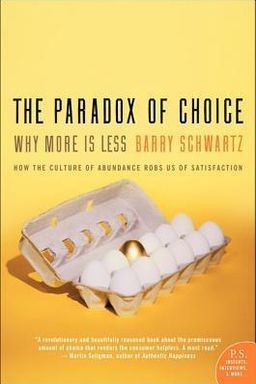
The Paradox of Choice cover

The Paradox of Choice

by Barry Schwartz

Barry Schwartz explores how the modern deluge of choices impacts our psychological well-being, often leading to stress and dissatisfaction. By understanding the paradox of choice, readers can learn strategies to simplify decision-making, embrace ''good enough,'' and improve overall happiness and mental health.

The Paradox of Choice: Why More Is Less

Have you ever stared at a supermarket shelf packed with dozens of brands of cereal or toothpaste and felt overwhelmed instead of delighted? Barry Schwartz’s The Paradox of Choice: Why More Is Less begins with this familiar frustration and builds a profound psychological argument: although freedom and choice are essential to happiness, having too many options can diminish our satisfaction, increase anxiety, and even lead to paralysis and depression.

Schwartz, a professor of psychology at Swarthmore College, argues that modern life’s explosion of choices—from what to eat, wear, and buy to where to live, work, and even whom to marry—has not made us freer or happier. Instead, it has introduced what he calls a “tyranny of choice.” People now face thousands of trivial and significant decisions daily, from selecting a cell phone plan to deciding on medical treatments. This constant decision load creates chronic dissatisfaction, regret, and self-blame. Schwartz’s provocative thesis resonates deeply in a culture that prizes autonomy, revealing how the quest for perfect freedom can undermine well-being.

From Freedom to Paralysis

At the core of Schwartz’s argument lies the paradox itself: while some choice is better than none, more choice is not always better than some. The American devotion to unlimited choice—rooted in what Isaiah Berlin called “negative liberty,” or freedom from constraint—has grown so dominant that we equate it directly with happiness. Yet, Schwartz warns, the relationship isn’t linear. Once we reach a threshold, additional options stop empowering us and start overwhelming us. The result is that we end up less satisfied with our decisions and more fearful of making mistakes.

Schwartz’s own experience buying jeans captures this trend perfectly. When Levi’s introduced a multitude of fits—slim, relaxed, boot-cut, distressed—he spent hours deciding, only to feel unsure whether he made the “best” choice. In the past, he would have accepted whatever was available. Today, the abundance of options not only creates decision fatigue but also raises expectations to impossible heights. When products and life outcomes cannot meet these inflated hopes, disappointment naturally follows.

The Psychology Behind Too Much Choice

Drawing from decades of behavioral economics and social psychology, Schwartz reveals how the human mind struggles with excessive freedom. Decision-making requires predicting what we want—a daunting task given how poorly we foresee our future satisfaction. Furthermore, each unchosen option carries an emotional cost—what economists call opportunity costs—which builds regret and second-guessing. Add to this our tendency to compare ourselves to others, and even good choices feel mediocre. Schwartz integrates research from Daniel Kahneman and Amos Tversky on heuristics, from Herbert Simon on satisficing, and from Robert Frank on social comparison, weaving a compelling story that connects consumer behavior to deep psychological distress.

In Schwartz’s view, modern people have become “maximizers,” individuals who seek the best possible outcome from every decision. While maximizers might achieve objectively better results, they experience more anxiety, regret, and depression than “satisficers”—those who settle for options that are “good enough.” In a world of endless possibilities, maximizers are trapped in perpetual dissatisfaction because perfection is always just out of reach.

Why This Paradox Matters

Schwartz’s insights go beyond consumer choices to touch nearly every corner of life in affluent societies. Choices about careers, relationships, education, and even personal identities now seem endless, creating both liberation and paralysis. In arenas like healthcare, retirement planning, and technology, people are forced to become experts overnight, making decisions that can have lifelong consequences. Rather than relieve anxiety, such autonomy often burdens us with responsibility for every possible failure.

As Schwartz demonstrates through cases like deregulated utilities and patient-directed medical care, society’s growing emphasis on “freedom to choose” often transfers complexity from institutions to individuals. The more decisions you face, the more room there is for doubt, self-blame, and fatigue. Eventually, the privilege of choice feels like a curse.

Finding Freedom Within Limits

Schwartz concludes by suggesting that reclaiming happiness requires accepting limits. Voluntary simplicity, gratitude, and becoming a “chooser” rather than a “picker” can help people navigate the modern world without drowning in its options. Imposing personal boundaries—choosing when to choose—restores meaning and peace. Ultimately, true freedom is not the endless pursuit of better choices but the ability to decide what actually deserves our attention.

Core Insight

“We would be better off seeking what is ‘good enough’ instead of seeking the best,” Schwartz writes. The paradox of choice reveals that happiness depends not on eliminating freedom but on learning to live wisely with it.


The Overload of Modern Choice

Schwartz begins by mapping the modern landscape of overwhelming variety. Visiting a modest supermarket, he finds more than 30,000 items—from 85 kinds of crackers to 285 kinds of cookies and dozens of toothpastes, shampoos, and painkillers. Such abundance, he argues, defines the modern condition: nearly every decision, from groceries to college degrees, involves a dizzying number of options. But rather than enhancing satisfaction, this bounty often leads to confusion, frustration, and fatigue.

Choice Without Limits

In earlier generations, life’s choices were constrained. Utilities were monopolies, pensions were provided, and doctors made medical decisions. Today’s deregulated, individualized culture demands that you choose everything: your electric provider, your investment strategy, your healthcare plan, even your own treatment options. Far from liberating, this makes daily life an endless research project, shifting responsibility from experts to amateurs—namely, you.

The explosion of autonomy affects not only material decisions but personal identity. You can select your gender expression, spirituality, career path, and living arrangement. While this flexibility can be empowering, it also demands a level of self-knowledge and deliberation that few people possess. Schwartz calls this an unprecedented “demand to decide,” a psychological weight unique to modernity.

Decision Fatigue and the Jam Study

Schwartz cites psychologist Sheena Iyengar’s landmark “jam study” as evidence that too much choice can paralyze. When shoppers at a gourmet store were presented with six jams, 30 percent bought one. When offered twenty-four, only 3 percent made a purchase. A similar experiment with chocolates showed that participants exposed to fewer options were more satisfied with their choice. Choice overload makes the decision process more demanding, heightens expectations, and increases the risk of regret—so much that people often avoid deciding altogether.

Each additional alternative represents a new opportunity—but also a new lost opportunity. What economists call “the tyranny of small decisions” accumulates until we are paralyzed by possibilities. Whereas past generations settled for what was available, today’s consumers face a world in which every purchase, job, or relationship can always be optimized. This turns life into a series of exhausting micro-calculations rather than a coherent journey.

Freedom’s Hidden Cost

Schwartz’s conclusion is that you cannot enjoy freedom without limits. When everything is possible, nothing feels meaningful. The task of selecting from endless options drains time and emotional energy that could be spent cultivating relationships, creativity, or contentment. Paradoxically, more choice can trap you in perpetual dissatisfaction—a lesson reinforced by the rise of “voluntary simplicity” movements and Mindfulness culture, which echo Schwartz’s call to value restraint over abundance.


The Myth of Rational Decision-Making

Why do we assume that more information and more choice lead to better decisions? Schwartz dismantles the rational-consumer myth by showing how our minds use shortcuts that often mislead us. Drawing on research by Daniel Kahneman and Amos Tversky, he demonstrates how heuristics—mental rules of thumb—produce predictable errors in judgment.

Cognitive Biases

One bias is the availability heuristic: we overestimate the likelihood of things that come easily to mind. For example, shoppers may avoid buying a car after hearing one vivid story about a mechanical failure, even if statistical data suggests it’s one of the safest models. Another is the framing effect, in which presentation alters perception. People prefer “95% fat-free” yogurt to “5% fat” even though they’re identical. We are also victims of the endowment effect—we value what we own more than what we don’t—making us reluctant to trade or return items, even for better ones.

Loss Aversion and the Fear of Regret

Prospect theory, another Kahneman and Tversky insight, shows that losses loom larger than equivalent gains. People would rather avoid losing $100 than gain it. Schwartz connects this to choice overload: each rejected alternative feels like a loss, making decisions emotionally painful. This emotional friction explains why people hesitate to act—even when potential gains outweigh risks.

When Knowledge Backfires

In the digital age, access to infinite product reviews, search results, and ratings gives an illusion of mastery but overwhelms our limited cognitive bandwidth. Rather than producing smarter consumers, it often creates chronic second-guessers who feel less confident than before. Schwartz’s point is striking: knowledge doesn’t always equal wisdom. Emotion, simplicity, and trust still play indispensable roles in navigating complexity.


Maximizers and Satisficers

Herbert Simon’s concept of “satisficing” lies at the heart of Schwartz’s solution. Simon proposed that because the search for the absolute best is cognitively impossible, wise decision-makers settle for “good enough.” Schwartz expands this by contrasting two psychological types:

  • Maximizers constantly seek the best possible choice. They compare all options, worry about missed opportunities, and regret their decisions.
  • Satisficers accept options that meet their criteria for adequacy, moving on once a decision feels right.

The Price of Perfectionism

Schwartz’s research shows that maximizers experience lower happiness, less optimism, and higher rates of depression—even though they often achieve objectively better outcomes. Because they continually imagine superior alternatives, satisfaction eludes them. In contrast, satisficers enjoy greater peace of mind and self-acceptance. They still uphold standards but focus on meaningful satisfaction rather than perfection.

Regret and Self-Blame

For maximizers, every decision carries the threat of regret. After choosing something, they can’t help but imagine what they might be missing. This chronic self-doubt becomes a self-reinforcing loop: the more they deliberate, the less confident they feel. Schwartz likens this to the “curse of discernment”—the more attuned we are to subtle differences, the harder satisfaction becomes.

Learning to Satisfice

To satisfice is not to settle for mediocrity—it’s to focus on values that truly matter. Schwartz encourages developing personal standards for “good enough,” particularly in low-stakes domains (like buying socks or choosing restaurants). This saves decision energy for life’s larger questions and cultivates gratitude. The key insight: being content is not about lowering ambition but about narrowing attention.


Trade-offs, Opportunity Costs, and Regret

Every choice has a cost—not just in money but in what you give up by not choosing something else. Schwartz illuminates how opportunity costs and emotional trade-offs are the hidden taxes of decision-making. When options multiply, these unseen sacrifices become overwhelming. Each decision invites new “what ifs,” leading to regret, indecision, and chronic dissatisfaction.

The Emotional Cost of Trade-offs

Schwartz describes experiments where the mere introduction of a second, slightly different alternative reduced people’s willingness to choose either. Faced with conflicting options—say, a cheaper but less safe car—many avoided deciding altogether. Even trivial choices like picking a pen over cash caused hesitation when alternatives were added. The more trade-offs a decision requires, the more negative emotion it triggers.

The Regret Trap

Regret, Schwartz notes, arises when your imagined alternative world seems better than your real one. Psychologically, regret hits hardest when you feel responsible for the outcome. It explains why people blame themselves for bad investments or failed relationships. Anticipating regret can even prevent action—a phenomenon called “inaction inertia,” like refusing a discounted deal because you missed an even better one earlier.

His conclusion is sobering: while choice promises control, it breeds self-blame. The freedom to choose means the freedom to be at fault when life disappoints. Hence, managing expectations and embracing imperfection becomes vital for emotional resilience.


Adaptation and the Hedonic Treadmill

Why don’t expensive cars, luxury homes, and career success make people lastingly happy? Because of hedonic adaptation—our tendency to return to a baseline level of satisfaction no matter how big the change. Schwartz draws from studies showing that lottery winners and paraplegics report similar happiness levels a year after their life-altering events. Pleasure fades quickly; humans get used to almost everything.

The Moving Baseline

Each new pleasure—your first flat-screen TV, your upgraded kitchen—soon becomes the new normal. As standards rise, satisfaction resets, pushing you to seek even more. Tibor Scitovsky called this the “joyless economy”: comfort replaces delight. Schwartz warns that adaptation turns us into consumers of novelty rather than enjoyers of stability. Even “perfect” choices can feel dull because their pleasure diminishes over time.

Breaking the Cycle

Schwartz suggests that awareness and gratitude can slow this cycle. By recognizing adaptation, you can temper expectations and focus on meaningful experiences rather than material accumulation. Instead of chasing constant upgrades, learn to savor fleeting pleasures. As he notes, adaptation can be resisted not by adding more choices but by appreciating what you already have.


Social Comparison and the Status Trap

If adaptation dulls satisfaction from within, social comparison corrodes it from without. Schwartz shows that we constantly evaluate our worth by comparing ourselves to others—friends, neighbors, or even strangers online. The rise of media and globalization has expanded our “pond,” ensuring that there’s always someone richer, fitter, or more successful to measure against. The result is anxiety and envy in the midst of abundance.

The Race for Status

Drawing on economist Robert Frank’s Choosing the Right Pond, Schwartz explains that people care more about their relative status than absolute wealth. Studies reveal that many would prefer earning $50,000 when others make $25,000 over earning $100,000 when others make $200,000. Our happiness depends less on what we have than on how we rank.

Maximizers and Social Comparison

Because maximizers constantly seek the best, they are especially vulnerable to comparison. Even when satisfied, they imagine another person doing better. Satisficers, by contrast, focus inward, basing contentment on personal standards rather than external benchmarks. Schwartz’s experiments confirmed this: maximizers’ moods worsened when others performed slightly better, while satisficers remained stable.

Escaping the Comparison Trap

To combat comparison’s tyranny, Schwartz recommends reframing success around meaning, not ranking. Choosing relationships, work, and goals aligned with values creates immunity to envy. As he writes, “Better to be a big fish in your own pond than a small fish in someone else’s ocean.” The task is to define your pond deliberately—to stop measuring life by someone else’s depth chart.


Choice and the Rise of Depression

In one of the book’s most striking arguments, Schwartz connects excessive choice to the epidemic of depression in modern societies. Despite unprecedented wealth and freedom, Americans report declining happiness and soaring rates of depression. Schwartz cites research showing that the risk of major depression is roughly ten times higher than it was a century ago, and that it now appears at younger ages than ever before.

From Helplessness to Self-Blame

Using Martin Seligman’s theory of “learned helplessness,” Schwartz explains that feelings of control improve well-being only up to a point. When people are given responsibility without clear guidance or limits—such as choosing medical care, career paths, or lifestyles—they begin to blame themselves for every setback. More control brings more opportunities for self-reproach. In contrast, traditional societies, with fewer personal choices and stronger communal bonds, show far lower rates of depression.

Individualism and Isolation

Modern individualism compounds this trap. As you define yourself entirely by personal choices, you lose the buffer of community and shared responsibility. The Amish, Schwartz observes, exhibit far lower depression rates precisely because they enjoy meaningful structure and connection. In contrast, modern Americans, obsessed with autonomy and perfection, feel isolated when their freedom produces imperfect results. What once was “fate” is now “my fault.”


Managing Choice: Practical Wisdom

In the final chapter, Schwartz offers practical steps for reclaiming joy in an age of frantic decision-making. These strategies balance freedom with constraint, empowering you to live deliberately rather than drown in possibilities.

  • Choose when to choose: Not every decision deserves equal time. Save mental energy for what truly matters.
  • Be a chooser, not a picker: Instead of reacting to what’s available, define what you care about beforehand.
  • Satisfice more, maximize less: Set criteria for “good enough” and trust them.
  • Practice gratitude: Regularly reflect on what’s already good in your life to reduce adaptation’s sting.
  • Limit comparison: Withdraw from the status race—social media detox is a modern application.
  • Embrace constraints: Rules, routines, and commitments can enhance freedom by reducing trivial decisions.

Schwartz’s closing message echoes ancient Stoic wisdom: freedom isn’t about endless choice, but wise self-limitation. True happiness is not getting more but wanting less—and being content in the choices you’ve already made.

Dig Deeper

Get personalized prompts to apply these lessons to your life and deepen your understanding.

Go Deeper

Get the Full Experience

Download Insight Books for AI-powered reflections, quizzes, and more.