
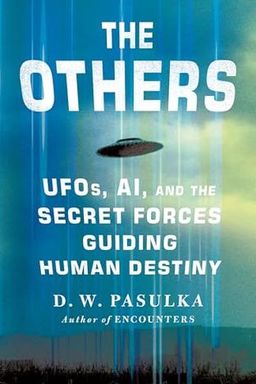
The Others cover

The Others

by D.w. Pasulka

A professor of religious studies at the University of North Carolina, Wilmington, describes alleged contact with nonhuman intelligences.

UFOs, Religion, and Technology as One Story

When a strange light catches your eye, do you assume it’s a plane, a drone, a trick of vision—or could it be something else entirely? In American Cosmic, D.W. Pasulka argues that in our hyper-mediated age, UFOs are no longer just claims about objects in the sky; they’ve become a living religious form shaped by technology, secrecy, and stories. She contends that we’re witnessing the emergence of a new sacred—one where advanced "phenomena" operate like technologies, technologies function like sacred media, and belief is built by screen-saturated cultures as much as by direct encounters.

This isn’t a book that asks you to choose between “real” craft and “imagined” angels. Instead, Pasulka shows how both can coexist in a third space: a cultural field where nonhuman intelligence, scientific secrecy, and media mechanisms generate experiences, artifacts, and enduring communities of faith. Her narrative blends an ethnographer’s eye with a thriller’s itinerary—blindfolded treks to a New Mexico crash site; private lab tours with a rocket scientist-entrepreneur; Skype calls with an Apollo astronaut who had a mystical epiphany on the way back from the moon; and quiet hours in the Vatican Observatory, where a tech insider surprises himself by having a spiritual conversion.

Three Braided Strands

Pasulka braids three strands you can’t easily pull apart:

  • Scientist-believers working in secret: An "Invisible College" of elite scientists—exemplified by the pseudonymous Tyler (a space-industry innovator) and James (a world-class biologist)—study artifacts, physiological effects, and mind–information anomalies, but stay invisible to protect careers, programs, and sources (see also Jacques Vallée’s classic The Invisible College).
  • Mediated myth-making at scale: Film, TV, social media, and “specialist factual” productions create convincing pseudo-documentaries that blur fiction and fact. Our brains often store these scenes as if they were memories—what Pasulka calls the "Total Recall Effect."
  • Religiosity built from contact and interpretation: Encounters—whether aerial, visionary, or inner—become sacred through interpretation, institutions, and repetition. The result looks like religion: sacred sites, relic-like artifacts, conversion narratives, and a cosmology of nonhuman intelligences.

Why It Matters for You

If you’ve ever clicked a mesmerizing clip of a glowing "orb," or if a sci-fi scene lingers in your memory like it happened to you, this book explains why. It shows how belief is practical (humans need meaning and models), how truth can be both experiential and malleable, and how technology quietly re-wires what counts as real. Pasulka’s big move is to treat UFOs not as a fringe curiosity but as a mirror of our moment: in a world where algorithms curate wonder and anxiety, and where secrecy and disclosure play cat-and-mouse, the sacred migrates from temples into labs, feeds, and field kits.

What You’ll Learn in This Summary

You’ll meet Tyler and James and see why brilliant insiders keep quiet—and why their work still leaks into culture as rumors, hoaxes, and narrative fuel. You’ll learn how contact events become religious events; how "book encounters" (the right text at the right time) and uncanny "synchronicities" turn a memory into a mission; and why media strategies like "realist montage" make fiction feel true (think The X-Files or National Geographic’s UFO polls). You’ll also explore Vallée’s argument that the phenomenon itself behaves like a technology—sometimes absurd, often tricksterish—shaping human creativity beneath notice; the neuroscientific and quantum-flavored models that Tyler, the late astronaut Edgar Mitchell, and others use to talk about consciousness and information; and the awkward role of institutions from MUFON to Disney to the Vatican in policing and propagating belief.

The Stakes: Wonder, Wisdom, and Wary Attention

American Cosmic ultimately asks you to hold two ideas at once: the phenomenon is both real (it leaves traces, transforms lives, inspires technologies) and constructed (it’s mediated, storied, branded, and often bent to institutional ends). That tension—between contact and construction—may be the defining spiritual skill of our time. Learn to read the screen without dismissing the sky; protect your curiosity without surrendering your discernment. As Nietzsche warned and Vallée repeats: embrace coincidences with wonder, but don’t outsource your judgment.

Key Idea

UFOs, in Pasulka’s hands, are a 21st‑century religion of the screen and the lab: a sacred that travels by fiber-optic cable, hides in black budgets, and still shows up, sometimes, as a rainbow over a desert gully while a metal detector starts to sing.


Inside the Invisible College

Pasulka brings you into an "Invisible College"—a term J. Allen Hynek and Jacques Vallée used for networks of scientists and insiders who study anomalous phenomena out of public view. In American Cosmic, this network becomes palpable through two composite figures: Tyler, a space-industry innovator and biomedical entrepreneur with more than forty patents, and James, a renowned biologist who heads a cutting-edge lab at a top university. Both believe the phenomenon is real, both insist on withholding premature conclusions, and both keep a code of silence that clashes with academic norms of openness.

Secrecy Versus Transparency

When Pasulka convenes a closed meeting of scholars, ufologists, and scientists, she watches protocols collide. Academics ask for sources and methods; the insiders talk about clearance, compartmentalization, and oaths. A public interruption—one researcher accusing another of breaking an agreement—exposes how different "truth cultures" clash: disclosure in the academy is virtue; in the national-security world, it can be a firing offense. The message is sobering: the best data and the most serious programs may remain hidden for a long time (Vallée and physicist Eric Davis have said as much).

A Pilgrimage to a "Sacred" Site

Tyler blindfolds Pasulka and James for a 40‑minute drive into no‑fly New Mexico desert. They call it, half-jokingly, the "sacred place"—a zone where a 1947 crash allegedly left behind metallic fragments. What unfolds feels like religious pilgrimage: protective boots against rattlesnakes, silence in the wind, a mesa recalled from The X-Files, and then the ritual of detection, collection, labeling, and care. James, wearing leather gloves, reaches into a rock crevice and pulls out a material that looks like crumpled metal-fabric. Tyler finds another. The artifacts enter evidence bags like relics placed in reliquaries.

Back at the airport, James’s bag triggers a scanner shutdown—an ominous real-world reminder that matter can carry mysteries through systems tuned to find the ordinary. Months later, preliminary analyses suggest the materials are "genuinely anomalous"—either impossibly expensive fabrications left in the desert gully (but by whom, and why?), or products from somewhere—or somewhen—our 1947 Earth couldn’t reach. James won’t claim "alien"; he will claim "anomaly."

How Leaks Become Lore

Here’s the twist you need to recognize in your media life: what these insiders actually do—careful fieldwork, cautious analysis—rarely reaches the public intact. Instead, rumors of their findings become the soil in which hoaxes, docu-tainment, and wild assertions take root. Pasulka watches in real time as stories unspool; she becomes a reluctant bridge between closed-door scientists and producers hungry for soundbites. A videographer once asks a scientist to compress "twenty years of research into two sentences." He refuses—and you can feel why. The serious work doesn’t fit the format.

Sacred Science, Refusing Dogma

Strikingly, the scientists are allergic to religious framing even as they feel the "sacredness" of the task. "Too sacred to become dogma," one tells Pasulka. Think of it like this: their vocation blends a monk’s devotion, a hacker’s curiosity, and a test pilot’s risk-tolerance. They pursue what Vallée once proposed at the UN: that belief in visitors and the physical reality of UFOs are independent variables. Culture will believe with or without hardware; the Invisible College chases the hardware knowing belief will spin its own stories regardless.

Key Idea

Where you look shapes what you find. If you only watch TV, you’ll see certainty packaged for consumption. If you follow the Invisibles, you’ll meet humility before anomalies, patient craft, and a refusal to confuse mystery with mythology.

(Context: Hynek’s Project Blue Book and Vallée’s Passport to Magonia already mapped this terrain. American Cosmic updates it with 21st‑century labs, private aerospace, and the digital swarm that turns secrets into folklore overnight.)


From Contact To Religion

Why do some sightings become sacred stories? Pasulka argues that encounters—however ambiguous—become religious through interpretation. A light in the sky or a "download" of ideas doesn’t carry its own label. People, communities, and institutions supply meaning. Over time, you get the components of religion: sacred sites (New Mexico deserts; Fatima’s fields), relics ("alloys" or shrouds), conversion testimonies, and authorities who authenticate or suppress.

The Contact Event and Its Interpreters

Think of two categories of players: percipients (those who encounter) and interpreters (those who frame). In the past, the interpreters were scribes and priests; today they’re producers, influencers, and field investigators. Pasulka’s case studies show the pattern. Rey Hernandez, an atheist lawyer, sees a plasma-like "being," hears a telepathic directive, and watches his paralyzed dog, Niña, healed as his wife prays. He and his wife interpret differently: Rey turns to near-death literature and quantum-informed models of consciousness; Dulce, a devout Catholic, sees angelic aid. Both read their world through a contact lens. Rey co-founds FREE with Harvard astrophysicist Rudy Schild, author Mary Rodwell, and Apollo astronaut Edgar Mitchell to study thousands of such reports.

“Book Encounters” and Synchronicities

Pasulka coins the "book encounter": the right book appearing at the right time, seeming almost fated. Tyler finds Carl Sagan’s Cosmos in his briefcase at a crisis point after the Challenger disaster; it orients him to interstellar possibility and, eventually, biomedical invention. James stumbles on John Mack’s Abduction and recognizes his own life in its pages. Videographer Scott Browne picks up Howard Blum’s Out There and decides to devote himself to field documentation. These moments feel like divine breadcrumbs—what Jung called synchronicities: meaningful coincidences that nudge lives onto new tracks.

Pasulka invites you to hold them lightly yet seriously. David Stinnett, a sober investigator, says synchronicities are unavoidable if you’re close to the phenomenon—and also dangerous if you inflate them. Nietzsche offers the same warning: don’t mistake meaningful chance for a micro-managing god; cherish the music without worshiping the conductor.

Amplificatory Interpretation: How Meaning Accretes

Carl Jung proposed "amplificatory interpretation": we fill in confusing stimuli with images and narratives sourced from culture and the unconscious. Pasulka applies this to modern UFOs and historic apparitions. Consider Teresa of Ávila’s famous "transverberation" (piercing by a fiery angel): what if we read it alongside modern "beams of light" and interior downloads? Or Fatima (1917): witnesses report a spinning sun, descending cloud, humming sounds, heat effects, and children in trance—motifs recurring in UFO catalogs. Jacques Vallée goes further: the phenomenon behaves like a control system, dosing symbols and absurdities on reinforcement schedules that shape culture beneath awareness (Master of the Trickster meets Skinner box).

Witness, Then Institution

Witnesses lead; institutions follow, bless, or suppress. The Church takes thirteen years to approve Fatima (as private revelation). MUFON logs your report—and a TV series may reframe it as a horror home invasion (this happened to Rey). Nation-states convene panels (the CIA’s 1953 Robertson Panel) not necessarily to find truth, but to manage perception. And yet, as with early Christianity’s rise from absurdity to state religion, the "message" often outruns gatekeepers.

Key Idea

Encounters don’t come pre-labeled. Your story—plus your community and your screens—does the labeling. That’s where religions come from.

(Comparison: Ann Taves’s Religious Experience Reconsidered similarly treats “specialness” as built through processes; Vallée’s Passport to Magonia catalogs cross-era motifs; Mack pressed academia to face experiential data head-on.)


How Media Manufactures Belief

You live in a world where screens teach you how to see. Pasulka shows how modern media techniques turn speculative narratives into mental furniture you mistake for memory. Two concepts matter most: the "based on true events" strategy (which cues your brain to file fiction as plausible history) and realist montage (splicing real and staged images—e.g., actors with actual photos—to blur boundaries). Neuroscientist Jeffrey Zacks finds we don’t store movies in a separate "fiction bucket"; with enough realism, our brains interfile scenes alongside lived events (Flicker: Your Brain on Movies). That’s the cognitive engine of the book’s "Total Recall Effect."

From The Conjuring to The X‑Files

Pasulka consults for The Conjuring and watches montage make a haunting feel historical by interlacing actors with vintage photos of the real Perron family and demonologists Ed and Lorraine Warren. Then she pivots to The X‑Files, which married two masterful loglines—“The Truth Is Out There” and “I Want to Believe”—to keep belief in a safe future tense. Declassified documents later confirmed the CIA’s 1953 Robertson Panel recommended just such media strategies—using Disney and World War II–style training films to "educate" via debunking and entertainment. If you felt the show’s government-conspiracy backbone was "kind of true," it’s because, historically, it kind of was.

Specialist Factual: Fake Doc, Real Memory

A new genre—specialist factual programming—perfects the blend. The production house Impossible Factual’s The Great Martian War 1913–1917 chops real World War I footage together with CG walkers and veterans’ testimonies to craft an alien conflict documentary that never happened. Marketed next to actual WWII documentaries, it trains audiences (especially youth) to accept digital grafts on real history. Pair this with viral inserts like "Death Star over San Francisco," Russian dash-cam mashups with stormtroopers, and the site If Star Wars Was Real, and you see how pop myth saturates the ordinary. The result? A collective memory haze in which aliens at Verdun feel as plausible as zeppelins.

VR, Phones, and the Monolith

A developer working on Oculus Rift tells Pasulka he sometimes can’t tell if a memory happened in real life or "in the set." Stanley Kubrick saw this coming. Rob Ager’s close reading shows how 2001: A Space Odyssey’s monolith is a cinema screen; the stargate collapses into Bowman’s retina; Apple’s ads later literally replace the monolith with an iPhone. Media isn’t just external—it’s a cognitive prosthesis (Andy Clark’s "extended mind").

Disney’s Alien Encounters and MUFON’s Hangar 1

Pasulka dissects Disney’s 1995 TV special Alien Encounters from Tomorrowland and its theme-park ride ExtraTERRORestrial Alien Encounter. The documentary uses credible voices (Budd Hopkins, military B‑roll, abduction testimonies) to cue fear—then parks you in a ride designed to mimic abduction sensations. One participant says, "I thought I dreamt it … but it was real and terrifying." MUFON’s Hangar 1 follows a similar playbook: Rey Hernandez watches his carefully logged case reframed on the History Channel as a "UFO Home Invasion," omitting the dog’s healing and his wife’s prayer. The lesson is blunt: if you hand your story to content pipelines, expect editing toward sensation.

Key Idea

Screens don’t just show you things; they install models in your head. Be grateful for wonder—and suspicious of montage.

(Context: Alison Landsberg’s "prosthetic memory" and Zacks’s event cognition give this a scientific backbone; Jean Baudrillard’s hyperreality is the philosophical backdrop.)


Technology As The New Sacred

American Cosmic reframes technology not as mere instrument but as a sacred medium. Following philosopher Martin Heidegger (technology "enframes" and reveals a new epoch) and Jacques Vallée (the phenomenon operates like technology, not necessarily like space travel), Pasulka shows how modern sacredness flows through labs, code, and biomedicine.

Vallée’s "Material Code"

Vallée noticed decades ago that UFO events break our mind–matter split. They leave burns, radar returns, physiological traces—and yet spawn telepathic episodes, synchronicities, and trickster absurdities. He urged researchers to drop the false choice between "nuts-and-bolts" and "spiritual." Treat the phenomenon like a technological system whose operations we don’t yet model. In The Invisible College he even sketched "morphologies of miracles"—recurring features across religious apparitions (Fatima; Lourdes) and modern cases: humming sounds, descending luminous globes, heat effects, cloud-like veils, and post-encounter exhaustion.

The Human Receiver

Tyler articulates a provocative version you can test against your own hunches: think of your body as a biotechnological receiver. Sleep like a monk (his "8+1" rule), hydrate in sunlight, avoid substances that scramble signal (coffee, alcohol), and notice ideas that "arrive" with a different felt signature. He suspects DNA functions as a photonic information medium and antenna (he notes its natural frequency aligns with satellite comm bands); bone acts as structural antenna; the brain is a router, not just a CPU. Whether or not the biophysics checks out, the protocol yields results in his world: bone matrices etched at the molecular level with information that human bodies "read" as self, accelerating healing (he shows Pasulka a mother of twins walking again).

Consciousness, Information, and the Quantum Hologram

Apollo 14 astronaut Edgar Mitchell experiences savikalpa samadhi returning from the moon—an ecstatic oneness long cataloged in Sanskrit literature. Back on Earth, he founds the Institute of Noetic Sciences and later develops, with colleagues like Rudy Schild, a quantum hologram theory of consciousness: information is patterned energy; matter radiates signatures; minds can sometimes access nonlocal information (remote viewing, telepathy, classic psi). In this dyadic model, mystical states are the nervous system resonating with a deep field; the "reward" of ecstasy is evolution’s way of encouraging re-entry into integrative states. FREE’s survey work then correlates such frameworks with experiencers’ reports at scale.

Extended Mind, Embedded Media

Andy Clark’s "extended mind" research backs the intuition you probably have from your phone: cognition isn’t skull-bound. We think with tools and networks. Pasulka adds a caution: as cognition extends into screens and social bots, it also becomes a target surface. Vallée foresaw this: coincidence-machines (today’s ad tech) can manufacture synthetic "synchronicities." One experiencer reports seeing the Michelin Man (after chatting about him) show up as a personalized sidebar ad featuring his new avatar; he still felt the nudge, even knowing why the algorithm served it. The sacred now rides alongside marketing.

Key Idea

What if the "holy" today is a frequency match—between biological receivers, informational fields, and a phenomenon that prefers to hide in plain technological sight?

(Comparison: N. Katherine Hayles critiques disembodied "informationalism" yet still embraces technogenesis; Gaymon Bennett tracks how Silicon Valley biologists treat cells as programmable matter. Pasulka shows those imaginaries bleeding into sacred practice.)


Policing The Real In A Hoax Culture

In a world where anyone can fake a UFO, who protects the signal from the noise? Enter field investigators like Scott Browne (graphic designer, videographer) and his Facebook group In the Field. They’re true believers precisely because they debunk: if you don’t ruthlessly filter lens flares, CGI, and balloons, the genuine anomalies get buried—and belief becomes a parody of itself.

A Vocation Without Pay

Browne treats his role like a sacred calling. He has childhood oddities (a missing toddler episode; a brother’s recurring dreams of big-headed beings; sleep paralysis in adulthood) but resists regression hypnosis that might plant false memories (Elizabeth Loftus showed how suggestible memory is). Instead, he builds a community bound by methods: share original footage; invite peer critique; remove hoaxers; publish exposes. The work earns him threats online—including for the crime of proving a "UFO" was an oddly shaped balloon. In a surreal twist, believers sometimes reply: "Then the UFO disguised itself as a balloon." When a community has to choose between evidence and a cherished narrative, evidence often loses.

Allison Kruse’s Busy Sky

Allison Kruse, a Pennsylvania mother, isn’t a sci‑fi fan. After her daughter sees a saucer-like "red plane," Kruse starts documenting starlike objects that twinkle like stars but move like drones—then fade. The FAA confirms no aircraft on several nights, even titling a disc "Murrysville UFO." She notes the objects sometimes mimic aircraft lighting and seem aware of her camera. Meanwhile, she’s harassed as a hoaxer and targeted with malware. Fieldwork earns little but stress.

Perception Management at Scale

Pasulka pairs grassroots policing with top-down "perception management." The 1953 Robertson Panel recommended systematic debunking via mass media. That’s not a conspiracy theory—it’s declassified history. More recently, TV brands like the History Channel’s Hangar 1 monetize MUFON’s database by dramatizing cases—often warping them (Rey’s healing episode becomes a home-invasion terror). Disney’s 1995 Alien Encounters used documentary trappings and a theme-park ride to imprint abduction fear. In parallel, social platforms now algorithmically amplify spectacle. When Scott created fake UFO images for an educational challenge explaining how he did it, those same images later recirculated as "real"—complete with invented locations.

Why You Should Still Care

If you’re tempted to shrug and say "it’s all fake," Pasulka’s fieldwork says: not so fast. There is a core of high-strangeness (Stinnett’s term) that resists trivial explanation—orb clusters observed by trained teams; physiological effects; rare materials that defy easy provenance. But caring requires a double discipline: methodical skepticism toward images and a refusal to let hoax culture erase anomalies. It’s a stance you can apply outside ufology: in politics, health, finance—everywhere noise drowns signal.

Key Idea

Belief without method becomes gullibility; method without wonder becomes blindness. The field needs both.

(Context: George Hansen’s The Trickster and the Paranormal explains why ambiguity and disruption cling to the phenomenon; Jung reminds you to expect meaning-making to rush in when stimuli are uncertain.)


Institutions: From MUFON To The Vatican

Institutions don’t just referee belief; they often shape it—sometimes helpfully, sometimes not. Pasulka puts you in three very different rooms: MUFON’s public-facing machinery, a Disney boardroom packaged as documentary authority, and the Vatican Observatory’s library where a space-industry insider unexpectedly kneels to pray.

MUFON’s Double-Edged Database

On paper, MUFON offers scientific field methods and a huge reports database. In practice, when reports become "content," experiencers lose control of their own stories. Hangar 1 reframes Rey Hernandez’s healing episode into a threat narrative and strips the faith element that mattered to his family. Meanwhile, nonlocal analysts mine MUFON data without understanding local contexts (weather anomalies; military exercises), exaggerating the "UFO" count. Data is power; so is editing.

The Vatican Observatory: An Unexpected Welcome

Travel with Pasulka to Rome. She navigates the Vatican Secret Archives (where access depends on credentials and, surprisingly, on who you really are) and then to Castel Gandolfo, home of the Vatican Observatory. There, Jesuit astronomer Brother Guy Consolmagno (MIT PhD) jokes about conspiracy depictions and then speaks on vocation: people need bread and they also need wonder; telescopes feed the soul. Tyler—whose life fuses rockets and biotech—listens, shaken. After accompanying a priest on hospital rounds to anoint the sick, he weeps in a side chapel at Santa Sabina. Days later he attends daily Mass at the Observatory, asks for prayers for his dying mother, and eventually returns to Rome to receive his First Communion—at Santa Sabina, on a rare St. Valentine’s Day that falls on Ash Wednesday.

A 17th‑Century Meta‑Experiencer

Pasulka reads the canonization files of Sister María de Ágreda, a cloistered nun who claimed angelically assisted bilocations to New Mexico (the "Lady in Blue"). Her visions reportedly primed indigenous groups to welcome Franciscan catechesis; officials like Alonso de Benavides leveraged her story to justify imperial funding. Then, as now, sacred encounters and political projects interwove. María’s early cosmographies, which imagined Earth as a spinning globe, were burned—another reminder that institutions curate the sacred archive.

Religions Reborn In Media

Jediism—once a census joke—has become a living religion for some, centered on the Force (with roots in Daoism and Zen). David Chidester calls such forms "authentic fakes": invented, yes, and still capable of producing real effects. Carole Cusack and Markus Davidsen argue fiction-based religions merit serious study. Pasulka agrees—reminding you that belief often follows experience and that media is now where many experiences happen first.

Key Idea

Institutions can distort stories—or dignify them. Learn to see who’s editing your sacred.

(Context: Robert Orsi’s call to take gods and saints as autonomous agents pairs well with Pasulka’s Vatican chapter; MUFON’s tensions echo broader debates about citizen science and TV-era sensationalism.)


Living With Ambiguity, Practicing Discernment

What do you do when evidence is compelling but conclusions are premature? Pasulka closes with a posture you can practice: humble agnosticism paired with disciplined inquiry. James trains students to run toward anomalies, not away from them; Thomas Kuhn said scientific revolutions begin where data doesn’t fit. At the same time, Vallée’s warning about trickster absurdity and manufactured coincidences cautions you not to sanctify every oddity.

The Artifact as Relic and Rorschach

A scientist tells Pasulka the desert artifact "could not have been made on Earth"—then adds: that doesn’t make it "alien" in any simplistic sense. It might be a product from an elsewhere in space, time, or human capability we don’t map. For Tyler and colleagues, the artifact radiates presence—one friend dreams of a "universe within your backpack." Whitley Strieber tells Pasulka that artifacts and phenomena "study us" as we study them. Like the Shroud of Turin (still debated yet deeply venerated), relics can function as conduits of belief and catalysts for work regardless of final provenance.

Practical Discernment For You

  • Separate experience from explanation: Journal exactly what happened; postpone labels. Ask: what did I see/hear/feel—versus what did I infer?
  • Audit the medium: Before sharing clips, interrogate provenance, compression artifacts, and montage cues. Look for independent, time-stamped corroboration.
  • Invite peer review: Borrow the ethos of In the Field. Strong claims deserve strong scrutiny; strong scrutiny keeps your wonder honest.
  • Use—don’t worship—synchronicities: Let them open possibilities; don’t let them close inquiry.
  • Honor transformation, resist dogma: Conversions (Rey’s; Tyler’s) are real human events. Hold them with respect without forcing others into your frame.

Promise and Peril

Pasulka ends with a disquieting echo. In Intelligent Life in the Universe, Shklovsky warned: "The prey runs to the predator." She applies it to technology. As we rush to embrace the monolith—phones, feeds, VR—we may also be inviting manipulation at the speed of light. Heidegger’s late interview concludes: "Only a God can save us now." American Cosmic suggests the saving may come, paradoxically, from practicing a wiser secularity—one that grants room for the sacred without abandoning method; one that uses tools without becoming prey to them.

Key Idea

Live at the edge where curiosity meets care. Run toward anomalies; refuse easy myths; let mystery change you—but not con you.

(Note: This is the stance many contemporary philosophers of science recommend when confronting frontier data sets and complex sociotechnical systems.)

Dig Deeper

Get personalized prompts to apply these lessons to your life and deepen your understanding.

Go Deeper

Get the Full Experience

Download Insight Books for AI-powered reflections, quizzes, and more.