
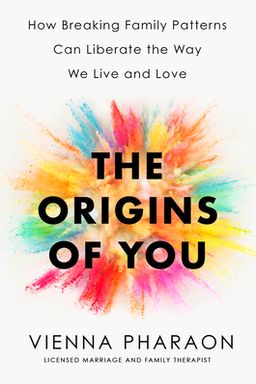
The Origins of You cover

The Origins of You

by Vienna Pharaon

In ''The Origins of You,'' Vienna Pharaon guides readers on a journey of self-discovery. By exploring origin stories and emotional wounds, this book provides tools for healing, embracing authenticity, and cultivating meaningful relationships, empowering readers to transform their lives.

Breaking Family Patterns to Heal Yourself

Why do you keep repeating patterns you swore you'd never repeat? Why do relationships, friendships, or even workplace conflicts feel eerily familiar, as if you’re living a sequel you didn’t sign up for? In The Origins of You, marriage and family therapist Vienna Pharaon argues that the key to breaking those destructive cycles lies in revisiting — and healing — what she calls your origin wounds: the deep, unprocessed pain you carry from your family of origin.

Pharaon contends that emotional wounds from childhood do not disappear with time; instead, they surface as adult behaviors, relationship struggles, and self-sabotaging cycles. To become whole, you must not only understand where those wounds originated but also deliberately heal them using awareness, compassion, and conscious new choices. Her core message: Your past is not a life sentence — it’s a map pointing you toward liberation.

Your Family of Origin Shapes Everything

At the heart of the book lies family systems theory. Your “family of origin,” Pharaon explains, provides the blueprint for how you relate to love, conflict, trust, and safety. Whether your childhood home was chaotic or calm, attentive or absent, it left an emotional imprint. She illustrates this concept through her own story: witnessing her parents’ explosive conflict at age five, hiding with her mother while police arrived, and unconsciously becoming the “peacekeeper” child who learned to keep everyone calm at the expense of her own needs. This moment became her safety wound — a fear of disconnection that reverberated for decades.

Just as influential as overt trauma are subtler experiences of rejection, overcontrol, or emotional neglect. Pharaon calls this constellation of experiences our origin stories—our “first lessons in love, trust, and worthiness.” They explain why you might over-function in relationships, chronically please others, demand perfection, or wall yourself off emotionally. When we ignore these stories, she warns, “we become bystanders in our own lives.”

Five Core Wounds We All Carry

Pharaon distills years of therapy and research into five recurring origin wounds that shape most human struggles: worthiness, belonging, prioritization, trust, and safety. Everyone has at least one, and many of us have several. Each wound arises from something you longed for as a child but didn’t receive — unconditional love, affirmation, security, or consistency. The worthiness wound may stem from criticism or conditional affection; the belonging wound from feeling different or excluded; the prioritization wound from being overlooked; the trust wound from betrayal or deceit; and the safety wound from danger or chaos at home.

In each case, the wound silently dictates your adult behaviors: overachieving, shutting down, controlling, avoiding intimacy, or attaching quickly to the wrong people. Pharaon’s approach isn’t about blaming parents; it’s about context. She reminds readers that “our caregivers were also shaped by their own origin stories.” Healing doesn’t require casting villains — it requires truth-telling and compassion.

From Awareness to Action: The Origin Healing Practice

Throughout the book, Pharaon outlines her signature four-step framework — The Origin Healing Practice — for transforming insight into integration. The process involves naming your wound, witnessing it compassionately, grieving the pain or loss associated with it, and finally pivoting toward healthier patterns. These steps are illustrated through vivid stories from clients like Natasha, who learned her lifelong distrust in relationships stemmed from secretly keeping her father’s affair for him, or Isabel, whose need to be prioritized in love traced back to her mother’s depression.

Each story demonstrates that what we identify as adult “problems” — fear of intimacy, conflict avoidance, perfectionism, or emotional shutdown — are survival strategies we crafted as children. The healing practice invites you to see these behaviors not as flaws but as evidence of your ingenuity. Only after acknowledging how they served you can you choose differently.

Changing How You Relate – Conflict, Communication, and Boundaries

Once you’ve named your wound, Pharaon guides you to transform the three relationship behaviors that keep wounds alive: conflict, communication, and boundaries. You learn that most fights are “protests of disconnection,” that communication styles often repeat what you saw at home, and that boundary issues mirror whether your childhood safety depended on saying yes or staying silent. Healing requires replacing reactivity with awareness, learning to speak with clarity, and building or lifting boundaries as acts of self-respect.

Through examples like Miyako and Jin, a couple stuck in cycles of control and withdrawal, Pharaon shows how recognizing one another’s wounds can turn fights into deeper understanding rather than mutual triggers. Her practical exercises — journaling prompts, “I feel” statements, and guided meditations — encourage embodied healing, not just cognitive insight. (This somatic approach echoes the ideas of Bessel van der Kolk’s The Body Keeps the Score.)

Integration: Turning Knowledge into Freedom

In the book’s final section, “Your Reclamation,” Pharaon reframes healing as integration — the moment we stop oscillating between rebellion and repetition and finally live from the center. Integration means aligning your inner truths with outer behaviors: setting boundaries that honor your needs, communicating with grounded honesty, and choosing authenticity over approval. The reward isn’t perfection; it’s peace. Healing, she promises, is not about erasing the past but relating differently to it. You learn to pause before reacting, to choose peace over suffering, and to practice self-love that combines compassion with accountability. Ultimately, The Origins of You is both mirror and manual — a call to bravely face the flames of generational pain so you can bring peace to yourself, your ancestors, and those who come after.


Five Origin Wounds That Shape Your Life

Pharaon identifies five universal wounds that take root in childhood and echo throughout adulthood: worthiness, belonging, prioritization, trust, and safety. Each originates from something you most wanted but didn’t receive, creating lifelong protective patterns that once ensured survival but now block connection.

The Worthiness Wound

The worthiness wound begins when love feels conditional—when approval depends on performance, perfection, or compliance. For example, Veronica internalized unworthiness after her mother abandoned her at five. As an adult, she tested partners endlessly, demanding proof of devotion while pushing them away. Worthiness wounds often produce overachievers or chronic caretakers. Healing means reclaiming inherent value — that you are worthy because you exist, not because you earn it.

The Belonging Wound

The belonging wound surfaces when your differences are denied, controlled, or shamed. Neil, a gay man from a religious Southern family, spent years pretending to be straight to avoid rejection. Even after moving to New York, he sabotaged himself to fit into new groups. His healing required learning that true belonging starts within — embracing authenticity even if it risks disapproval. (As Brené Brown writes in Braving the Wilderness, “True belonging is not something we negotiate externally, it’s what we carry inside.”)

The Prioritization Wound

Isabel developed this wound when her mother’s depression consumed the family after her aunt’s death. She grew up believing she must earn attention by over-functioning. In adulthood, she sought constant reassurance that her partner valued her, unintentionally driving him away. Many with this wound become either excessive givers or demanders of attention, equating significance with how much others invest. Healing involves learning self-prioritization—showing yourself you matter before demanding proof from others.

The Trust Wound

The trust wound emerges when deceit, betrayal, or abandonment replace safety. Natasha discovered her father’s long-term affair at fifteen and kept his secret to protect her family. This forced complicity destroyed her ability to trust, leaving her anxious in every romantic relationship. Others, like Mahmoud, who was abandoned by his father, develop anxious attachments, rushing intimacy to stave off rejection. Healing requires cautious re-engagement — testing trust with small acts of honesty and learning to trust yourself first.

The Safety Wound

The deepest of all, the safety wound arises from chaos, neglect, or abuse. In Vienna’s own story, hiding in a closet during her parents’ explosive fight programmed her nervous system to equate love with danger. Others, like Ally, whose mentally ill mother accused her of “flirting” with her father, learn that vulnerability is unsafe. Healing safety wounds involves retraining your body to experience calm — grounding exercises, mindfulness, and relationships that prove safety can coexist with connection.


The Roles You Adopted to Survive

When pain entered your childhood home, you adapted. You may not remember consciously deciding to, but you adopted a role — the peacemaker, performer, caretaker, or invisible one — to keep your family functioning. These roles, Pharaon explains, were ingenious survival strategies that became the scaffolding of your adult relationships.

Childhood Roles as Survival Strategies

Children are wired for attachment; connection is survival. When authenticity threatens attachment, you unconsciously trade one for the other. “When authenticity threatens attachment,” Pharaon quotes Dr. Gabor Maté, “attachment trumps authenticity.” You learned: if I please, I’ll be loved; if I stay quiet, I’ll be safe; if I perform, I’ll be seen. The five-year-old girl who kept her parents calm now becomes the adult who smooths over every workplace conflict or says yes even when she’s drowning.

Trading Authenticity for Attachment

These early bargains create lifelong self-abandonment. When you censor opinions to keep peace or hide real feelings to avoid rejection, you’re replaying those trades. The performer’s applause feels good until exhaustion sets in; the caretaker’s generosity turns into resentment. As Pharaon notes, shapeshifting may keep you connected, but it prevents true intimacy—because if you hide who you are, no one can love the real you.

Reclaiming the Authentic Self

Healing requires choosing authenticity over attachment. That means disappointing others to stay true to yourself, as reflected in her favorite line from Oriah’s poem: “I want to know if you can disappoint another to stay true to yourself.” This reclamation doesn’t destroy love; it deepens it. When you let your real self emerge, the relationships that endure are the ones safe enough for you to be seen. Those that fall away make room for something far truer.


The Four-Step Origin Healing Practice

Pharaon’s signature framework — the Origin Healing Practice — turns reflection into transformation. Built on principles from family systems therapy and trauma-informed mindfulness, it guides you through four cyclical steps: naming, witnessing, grieving, and pivoting. Each stage helps you meet your wounds with understanding rather than avoidance.

1. Naming

You can’t heal what you won’t name. Many clients, like Veronica or Natasha, minimize childhood pain because “others had it worse.” Naming means admitting what truly hurt without exaggerating or invalidating it. This isn’t about blame—it’s about accuracy. You identify the wound’s flavor: “I felt unworthy when he left,” “I was never prioritized,” or “I stopped trusting when she lied.” Clarity begins here.

2. Witnessing

To be witnessed is to have your pain seen and validated. Sometimes that’s from another person—a partner, therapist, or friend—and sometimes it’s from yourself. When Pharaon’s husband listened to her recurring family conflict without dismissing or defending, she felt fully seen for the first time. That witnessing, she writes, released a decades-long pattern. Being heard transforms shame into relief.

3. Grieving

Grief isn’t just for death—it’s for the childhood you didn’t have, the love that wasn’t offered, the ease you never knew. As Pharaon says, “We grieve who we were before the wounds.” This stage allows emotions long suppressed to surface, opening the valve for movement. Without grief, knowledge remains intellectual. With grief, healing becomes embodied.

4. Pivoting

The pivot is the behavioral shift — that moment between reaction and response, where you act from awareness instead of autopilot. Isabel learned to replace angry demands for attention with calm statements of need. Veronica practiced catching herself before testing partners. These small pivots accumulate into freedom. As author Iyanla Vanzant says, quoted here: “When you can call a thing the thing, you take the first step toward your freedom.”


Conflict as a Doorway to Connection

Conflict isn’t failure; it’s feedback. Pharaon argues that every argument hides a longing — to be seen, heard, or validated. The problem isn’t the fight itself but how we fight. Your childhood model of conflict predicts whether you withdraw, explode, or appease. Healing starts when you stop fighting for victory and start fighting for understanding.

Uncovering the Wound Beneath the Fight

Pharaon draws on Dr. John Gottman’s “Four Horsemen” — criticism, defensiveness, contempt, and stonewalling — showing how each is a wounded protest. Criticism masks a worthiness wound (“Tell me I matter”), defensiveness protects a safety wound (“Don’t hurt me again”), contempt hides belonging pain (“You’ll reject me first”), and stonewalling shields a trust wound (“I won’t be betrayed”). When you recognize which wound you're channeling, you can transform reactivity into revelation.

From Reactivity to Understanding

Instead of lashing out or shutting down, Pharaon teaches couples and individuals to pause — literally pressing “pause” on their emotional remote — and ask, “What wound is being activated right now?” She calls this “respecting the pause.” This space between stimulus and response creates possibility. Over time, these mindful interruptions rewire your relational patterns (echoing Dr. Viktor Frankl’s observation that “in that space lies our growth and our freedom”).

Practicing Constructive Conflict

In her sessions with couples like Isabel and Jo, Pharaon reframed fights about phone use or freedom as competing wounds: Isabel’s need to feel prioritized clashing with Jo’s fear of control. When both named their needs, connection replaced accusation. Learning to identify emotions beneath behaviors turns conflict into intimacy. As Pharaon notes, “Most fights are protests over emotional disconnection.” Recognize the protest, name the need, and your battles become bridges.


Communication That Honors You and Others

Healing doesn’t end when you identify your wounds; it relies on learning to communicate from wholeness. The way you speak mirrors your history. If emotions weren’t safe growing up, you might default to passivity; if honesty was punished, you might become aggressive; if you craved control, you might oscillate between both. Pharaon helps readers replace reactive communication with grounded, direct, compassionate expression.

Four Unhealthy Styles

She outlines four common but destructive styles: passive (swallowing truth to avoid conflict, like Ally hesitating to ask for exclusivity), aggressive (bulldozing others with bluntness, like Trish whose disability shame led her to overcorrect), passive-aggressive (using silence or sarcasm as punishment, like Veronica freezing out partners), and disorganized (swinging between care and attack, like Miyako switching moods to gain prioritization). Each style protects a wound but prevents true closeness.

Grounded Communication

Grounded communication honors both parties. It’s direct about needs but compassionate about impact. Pharaon coaches readers to use “I” statements (“I feel hurt when...”) and curiosity instead of accusation. Before speaking, she suggests asking: “What am I really trying to say?” and “What am I hoping the other person communicates to me?” This introspection converts emotional upheaval into clarity.

Freedom Through Courageous Conversations

Pharaon closes this section with Shonda Rhimes’s insight: “Freedom lies across the field of difficult conversations.” The courage to speak from your authentic self — even when your voice shakes — is both boundary and breakthrough. To communicate consciously isn’t just to talk; it’s to reveal yourself without abandoning yourself or harming another. That’s not just better conversation; it’s emotional sovereignty.


Building and Lifting Boundaries

Boundaries are love’s architecture. Without them, relationships collapse under resentment or distance. Pharaon reframes boundaries not as walls but as bridges that define where you end and another begins. She distinguishes between porous (too open) and rigid (too closed) boundaries — both of which are trauma adaptations.

Porous Boundaries: The People-Pleasing Trap

People with porous boundaries (like Ally, who let lateness slide to avoid conflict) value connection over self-respect. They say yes when they mean no, fear rejection, and prioritize others’ comfort above their own. Healing this requires small acts of courage: stating needs, tolerating others’ disappointment, and seeing boundaries as acts of authenticity, not aggression. As Pharaon reminds, “Boundaries are meant to preserve relationships” (citing therapist Nedra Glover Tawwab).

Rigid Boundaries: The Fortress of Fear

Rigid boundaries, by contrast, keep everyone out. Tony, who grew up protecting his mother from an abusive father, built emotional walls so high no partner could reach him. His healing required learning not to demolish the wall but to create a doorway—to risk vulnerability incrementally with people who had earned it. Healthy boundaries balance protection and connection.

Courage as the Bridge

Pharaon shares her own act of courage: ending a relationship in which she played the “cool girl,” letting disrespect slide. Naming the disrespect and leaving became her boundary breakthrough. Setting or lifting boundaries, she explains, is a form of integration — turning insight into embodied truth. Healthy love can only grow within the clarity of self-respect.

Your assignment? Find one porous or rigid boundary and rewrite it as a healthy one: “The boundary I have is ____; the risk I’m taking is ____; but I’m taking it because ____.” The more you practice, the more you learn that disappointing others is survivable—but disappointing yourself is not.


Integration: Making Healing Stick

In the final chapter, Pharaon emphasizes that healing is not a one-time insight but a lifelong integration. Awareness without accountability is merely knowledge; awareness with accountability becomes wisdom. Integration, she says, is the center point between repetition and opposition—the eye of the pendulum where stillness lives.

Leading with Authenticity

When you stop bending to fit others’ needs, you begin to lead with authenticity. This means aligning behavior with truth, even at the cost of approval. Integration demands consistency between inner value and outer action—communicating needs, setting boundaries, and responding from the present instead of your past. Pharaon invites you to identify where you still trade authenticity for attachment and to replace those moments, one by one, with honest presence.

Respecting the Pause

Borrowing from Viktor Frankl, she teaches the art of the pause: the breath between trigger and reaction where you ask, “Will this bring peace or suffering?” This micro-moment is neuroplastic gold—it rewires your brain from impulsivity to choice. Over time, respecting the pause builds emotional maturity and reestablishes safety within yourself.

Practicing Self-Love with Accountability

True self-love isn’t indulgence—it’s the balance of compassion and accountability. You forgive your humanity while owning your impact. Healing people, she notes, help heal people. By tending your wounds consciously, you shift family legacies and model relational health for future generations.

The closing reminder lingers: Healing doesn’t erase your scars; it changes how you see them. Once you understand your origins, you no longer live from them—you live with them, gently, intentionally, and free.

Dig Deeper

Get personalized prompts to apply these lessons to your life and deepen your understanding.

Go Deeper

Get the Full Experience

Download Insight Books for AI-powered reflections, quizzes, and more.