
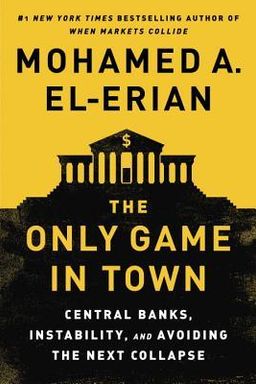
The Only Game In Town cover

The Only Game In Town

by Mohamed A El-Erian

In ''The Only Game In Town,'' Mohamed A El-Erian explores the pivotal role of central banks in today''s volatile economic climate. Post-2008, these institutions face unprecedented challenges, from rising inequality to financial instability. Discover the essential strategies needed to navigate and stabilize this complex landscape.

Central Banks as the Only Game in Town

What happens when the institutions meant to quietly maintain stability in the background suddenly become the main actors holding up the global economy? In The Only Game in Town, Mohamed El-Erian, former CEO of PIMCO and one of the world’s most respected economic thinkers, argues that ever since the 2008 financial crisis, central banks have moved from being technocratic caretakers to the last line of defense preventing global collapse. This seismic shift has redefined how economies function, how markets behave, and even how politics and societies respond to crises.

El-Erian contends that the global financial system now sits at a dramatic crossroads—a “T junction”—where the road maintained by hyperactive central banks will soon end, forcing the world onto one of two possible paths. One leads to inclusive, sustainable growth and political renewal; the other descends into continuing stagnation, inequality, and instability. His core argument is simple yet urgent: central banks alone cannot fix a broken economic engine. Without coordinated fiscal policy, structural reforms, and political courage, their extraordinary interventions will eventually fail, creating new dangers instead of stability.

From Modest Technocrats to Policy Superstars

To understand how central banks became “the only game in town,” El-Erian walks readers through their unlikely transformation. Once obscure institutions operating quietly behind the scenes—think of the Federal Reserve, the European Central Bank, or the Bank of England—they were thrust into the spotlight by the global financial crisis. Overnight, they evolved from managing inflation and interest rates to improvising trillion-dollar solutions, rescuing banks, and backstopping the global economy with never-before-tested measures like quantitative easing (QE). He describes this as a shift from a world of rules and predictability to one of improvisation and experimentation.

These central bankers were “forced to make things up on the spot,” deploying unconventional tools like massive bond purchases and negative interest rates. While their actions saved the global economy from depression, they also created distortions—artificial markets, moral hazard, and deep dependency on liquidity injections. The Fed, for example, became markets’ “best friend forever,” reassuring investors that it would always step in if conditions worsened. This cultivated complacency, inflated asset prices, and widened the gap between Wall Street and Main Street.

The Fragile Road Ahead: The T Junction

El-Erian’s “T junction” metaphor captures the world’s precarious position. The current road—the path of central bank-engineered recovery—cannot continue indefinitely. Ahead lies a split between two radically different futures. The “good road” involves structural reforms, inclusive growth, and political rebuilding that could stabilize the global economy. The “bad road” leads to worsening inequality, repeated financial crises, and eroding trust in institutions. Both paths are equally probable, and the direction depends on how political leaders, businesses, and individuals respond in coming years.

He warns that if governments fail to act, we could lose “generations of growth.” Global stagnation—what he calls the “new normal” or “secular stagnation”—will persist, with young people facing joblessness, inequality widening, and extremist movements exploiting discontent. Central banks will keep buying time, but their tools, designed to stimulate finance rather than fix structural faults, will eventually backfire. This creates what he terms “liquidity-assisted growth,” where markets boom artificially even as real economic fundamentals remain weak.

Why This Matters to You

For El-Erian, this is not just a story for economists and policymakers—it affects every household, investor, and business. Whether you’re saving for retirement, running a company, or simply hoping for job stability, your prospects are shaped by this global experiment. Negative interest rates, volatile liquidity, and distorted asset prices determine what you earn, what you can borrow, and how secure your financial future feels. Understanding how central banks influence your daily life—and how their limits create risks—is essential.

(As economic historian Martin Wolf puts it, financial capitalism was never meant to be an end in itself. By making central banks the sole engines of growth, societies have confused the mechanisms of stability with the mission of prosperity.)

The Broader Terrain: Politics, Technology, and Unthinkables

El-Erian also steps back to show how this monetary dominance intertwines with politics, technology, and global power shifts. Political dysfunction prevents constructive fiscal policy, technological disruption reshapes labor markets, and populist movements exploit economic frustration. Meanwhile, emerging economies like China and India recalibrate their roles amid global divergences, and advanced countries struggle with aging populations and mismatched skills. In his analysis, central banks are a lens through which we can observe deeper transformations—economic, political, and psychological—in the modern world.

Ultimately, El-Erian’s message combines warning and empowerment. He argues that the coming “T junction” requires each actor—governments, corporations, and individuals—to develop resilience, optionality, and agility. The world’s path forward is not predestined but depends on collective choices. If we understand the forces at play and act decisively, we can steer toward inclusive stability instead of chronic crisis.


The Rise and Fall of Central Banking

El-Erian traces how central banks progressed from the “golden age of central banking” in the late twentieth century to the chaotic experimentation following the 2008 crisis. Before the crash, institutions like the Federal Reserve and the Bank of England were celebrated for mastering inflation and delivering years of prosperity. Alan Greenspan was hailed as the “maestro”—a symbol of confidence in monetary technocrats who seemed able to defy business cycles.

From Moderation to Complacency

During this “Great Moderation,” low inflation lulled governments and financial markets into complacency. Deregulation allowed banks to chase risky profits. Central bankers believed private markets could self-regulate—a fatal assumption. As leverage and debt ballooned through complex instruments like mortgage-backed securities and shadow banking vehicles, central banks failed to grasp the growing fragility. When the crisis erupted, the “golden age” collapsed overnight.

El-Erian highlights the human side of this failure—hubris, blind spots, and misplaced faith in models. He recalls economist Paul Krugman admitting he had “no idea of the fragility of the banking system.” Regulators treated finance as separate from the real economy, allowing wealth speculation to masquerade as productive growth. Instead of serving society by channeling funds to innovation, finance became an end in itself, worshipped as the apex of capitalism.

The Collapse and Cascading Failures

By 2007, the system cracked. When BNP Paribas froze withdrawals and Lehman Brothers failed, global trust evaporated. Credit froze, trade collapsed, and millions lost jobs. El-Erian recounts his own experience on trading floors where liquidity vanished—he even told his wife to withdraw cash from ATMs because he wasn’t sure banks would open the next day. The imagery of a customer stuck between the McDonald’s “payment and pickup windows” becomes his metaphor for the collapse of trust in payment systems: both money and goods existed, but fear stopped transactions.

The Resurrection: Central Banks as Saviors

When all else failed, central banks became crisis managers. Ben Bernanke’s Fed, Mario Draghi’s European Central Bank, and others threw open liquidity windows, guaranteed debts, and purchased trillions of bonds. Bernanke’s historic “whatever it takes” rescue was later mirrored by Draghi’s promise to do “whatever it takes to preserve the euro.” El-Erian credits these actions with averting a great depression. Yet this heroism came at a cost—it transformed central banks from cautious referees into powerful players directing global outcomes.

The resurrection forged a paradox. While central banks restored calm, they also entrenched dependency. Markets treated them as backstops, rewarding risk-takers who assumed that volatility was permanently suppressed. Investors coined the mantra “buy the dip” because they believed central bankers would always intervene. El-Erian calls this the “cult of central banks.” Over time, it created distorted markets and deepened inequality—finance recovered faster than the real economy. What was meant as temporary emergency policy became an enduring feature of modern capitalism.

(Similar concerns echo Hyman Minsky’s “financial instability hypothesis,” which warned that periods of calm sow the seeds for future turmoil.)


The Ten Big Challenges Reshaping the Global Economy

El-Erian identifies ten interconnected challenges defining the post-crisis world. These are not isolated economic issues—they interact across social, political, and technological dimensions. Understanding them reveals why central banks cannot shoulder the burden alone.

1. Weak and Uneven Growth

Growth remains sluggish even in advanced economies. The global system relies on low-interest liquidity rather than innovation or productivity. Countries like Greece, Italy, and Japan exemplify stagnation, while the United States—though stronger—still grapples with secular stagnation. Without genuine engines of expansion, the “new normal” persists, locking youth out of jobs and reducing upward mobility.

2. Chronic Unemployment

High joblessness, especially among the young, risks creating a “lost generation.” In Greece and Spain, youth unemployment exceeds 50%. El-Erian warns this can shift societies from producing unemployed citizens to producing unemployable ones—a structural and psychological disaster. America’s long struggle to restore employment reveals how slow recovery drains confidence.

3. Inequality Trifecta

Inequality now extends beyond income and wealth to include opportunity itself. The richest 0.1% hold more wealth than the bottom 90%, and the gap grows across education, race, and access. Central bank policies inadvertently exacerbate this divide by inflating asset prices. For El-Erian, inequality has ceased to be just a moral concern—it is an economic one, reducing consumption and suppressing demand.

4. Erosion of Trust

From banks manipulating rates to governments failing to cooperate, credibility has collapsed. Citizens question why reckless banks were bailed out while ordinary households struggled. In Europe, the “troika” of regulators deepened distrust. Institutional integrity—once the hallmark of stability—deteriorated.

5. Political Dysfunction

El-Erian points to Washington gridlock and European fracturing. The inability of politicians to compromise turns ordinary economic management into ideological warfare. Rising populist movements, from the Tea Party to Syriza, emerge as responses to stagnation and alienation, but they often lack realistic alternatives.

6–10. Global Coordination, Risk Migration, Liquidity Illusion, Market Disconnects, and Neighborhood Effects

Finally, El-Erian explores the systemic issues: the breakdown of global cooperation (“G-Zero”), the migration of financial risks from banks to shadow institutions, false perceptions of market liquidity, growing divergence between financial markets and real economic fundamentals, and the paradox of strong companies operating in weak global environments. Together, they form a web of vulnerabilities threatening long-term prosperity.

Understanding these ten factors sets the stage for what he calls the search for “better finance”—an economy that serves human advancement rather than speculation.


Breaking the Addiction to Monetary Policy

Central banks have long recognized the limits of their tools, yet governments and markets continue to demand miracles from them. El-Erian argues this addiction to monetary policy is unsustainable. The prolonged reliance on near-zero rates and quantitative easing buys time but not solutions.

The Psychological Trap

After years of rescue interventions, societies developed a dangerous habit: assuming central banks can fix anything. This “learned dependence” numbs political systems, discourages reform, and distorts private decision-making. Politicians avoid fiscal responsibility, businesses hoard cash instead of investing, and households chase risky assets to find returns. The comfort of “cheap money” blinds everyone to structural weaknesses.

QE and the Liquidity Illusion

Quantitative easing inflates markets beyond fundamentals, creating a “liquidity illusion.” Investors believe they can sell assets anytime, but market intermediaries have shrunk, and real liquidity disappears under stress. As El-Erian notes, liquidity seems “delightfully still” until it vanishes, causing cascading price collapses. The 2013 “taper tantrum” and Switzerland’s 2015 currency shock are examples of markets learning this painful truth.

From Central Banks to Fiscal Coordination

El-Erian insists that central banks must hand the baton to governments capable of structural fixes: infrastructure investment, corporate tax reform, debt relief, and innovation policy. He calls for a “grand design”—a reduced-form plan involving four intertwined components: inclusive growth, better demand management, debt restructuring, and modernized global architecture. Without these, central banks risk becoming part of the problem they once solved.

In his view, breaking the addiction means moving from financial engineering to genuine renewal—a shift comparable to escaping an unhealthy relationship. The path ahead depends on courage: governments must stop outsourcing economic health to unelected technocrats and start exercising real leadership again.


Navigating Divergence and the Global T Junction

El-Erian’s concept of “divergence” is central to understanding the future. The global system now moves at different speeds: the U.S. recovers while Europe and Japan stagnate; China transforms while emerging markets slow. Central banks mirror these divergences—some tightening, others expanding—creating unpredictable crosscurrents in currencies, trade, and capital flows.

The Four Divergence Forces

1. Multi-speed growth: Uneven recoveries produce tensions between nations, as robust economies pull ahead while weaker ones fall behind.
2. Multi-track monetary policy: Federal Reserve tightening collides with European and Japanese easing, fueling volatile exchange rates and capital flight.
3. Non-economic headwinds: Political populism and geopolitical conflict—from Ukraine to ISIS—undermine cooperation.
4. Technological disruption: Innovations in energy (the shale revolution) and digitization create winners and losers faster than institutions can adapt.

The Bimodal Future

These divergences form El-Erian’s “bimodal distribution”—two equally plausible global outcomes. Either we achieve “escape velocity” through inclusive growth, or we slide into structural stagnation and instability. Divergence extends to wealth distribution, political cohesion, and corporate success, producing pockets of brilliance amid widening dysfunction. He describes this as a “new new normal,” where technology and inequality polarize outcomes.

Navigating this bimodal world, he advises, requires what he learned from history: open-mindedness, scenario planning, and “constructive paranoia.” Just as PIMCO used scenario analysis to prepare for Lehman’s collapse, individuals and organizations should anticipate multiple outcomes—good and bad—and design resilience accordingly.

(This echoes Nassim Nicholas Taleb’s idea of “antifragility”—thriving by preparing for volatility rather than fearing it.)


From Blind Spots to Cognitive Diversity

El-Erian’s final lessons move from macroeconomics to psychology. To navigate uncertainty, individuals and institutions must overcome blind spots and embrace cognitive diversity. He integrates insights from behavioral science—Daniel Kahneman’s “System 1 and System 2” thinking, Mahzarin Banaji’s studies on unconscious bias, and Scott Page’s research on diversity in problem-solving—to show that the next crisis may be as much mental as financial.

The Peril of Active Inertia

Many organizations, from IBM during the PC revolution to governments after 2008, fall victim to “active inertia”—doing more of the same even when change is needed. When faced with a bimodal future, they cling to comforting habits instead of adapting. El-Erian urges leaders to build cultures that challenge assumptions, encourage dissent, and experiment with new modes of decision-making. Blind spots exist in everyone—from CEOs to policymakers—and acknowledging them is the first step to agility.

Inclusion and Bias

He connects this psychological insight to inclusion and gender diversity. Drawing from his experience at PIMCO, he recounts near-mistakes caused by cultural bias, such as undervaluing performance due to language differences. Awareness, he says, must translate into action—creating “safe zones” for diverse perspectives and introducing feedback loops to challenge groupthink. Diversity isn’t charity; it’s a strategic advantage that fosters innovation and resilience.

Optionality, Resilience, and Agility

El-Erian closes with a metaphor drawn from boxing: Muhammad Ali’s “rope-a-dope” against George Foreman. Facing impossible odds, Ali leaned against the ropes to absorb blows until he found an opening and struck back. That, says El-Erian, is the blueprint for survival in a bimodal world—develop optional paths, resilience to absorb shocks, and agility to act when chance arises. Success, he concludes, “is not final, failure is not fatal.” It is the courage to adapt that counts.

Dig Deeper

Get personalized prompts to apply these lessons to your life and deepen your understanding.

Go Deeper

Get the Full Experience

Download Insight Books for AI-powered reflections, quizzes, and more.