
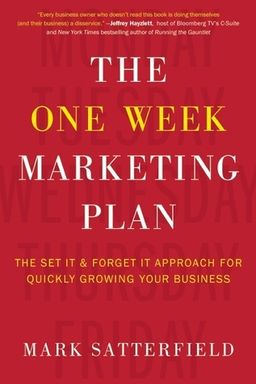
The One Week Marketing Plan cover

The One Week Marketing Plan

by Mark Satterfield

The One Week Marketing Plan is your guide to crafting a successful marketing strategy without the need for extensive resources or time. By focusing on niche marketing, free offers, PPC advertising, and strategic partnerships, this book enables entrepreneurs to achieve remarkable growth quickly and efficiently.

One Week to a Marketing Engine That Runs Itself

What if you could stop chasing clients and have them come to you instead—consistently, predictably, even while you sleep? That’s the promise at the core of The One Week Marketing Plan by Mark Satterfield, founder of Gentle Rain Marketing. Satterfield argues that most business owners struggle with erratic revenue because they lack a repeatable marketing system. Instead of random acts of promotion, he proposes a concrete five-day framework that sets up an automated client-attraction machine.

Satterfield’s central contention is that marketing doesn’t have to be expensive, complicated, or time-consuming. In one focused week, you can establish a foundation—a website, an irresistible free offer, automated follow-up emails, and a clear advertising plan—that attracts qualified leads and converts them into paying clients. He calls it a “set it and forget it” system, but behind the phrase lies a nuanced philosophy: build relationships first, sell second.

Why This Book Matters

Satterfield wrote this book after decades as a marketing consultant frustrated by how many professionals—consultants, coaches, financial advisors, and small business owners—failed to achieve steady growth. Most relied on word-of-mouth and referrals, leading to a feast-or-famine cycle. The One Week Marketing Plan solves that by turning the principles of direct-response marketing into practical, daily steps. It’s a book for reluctant marketers who prefer to do their work rather than shout about it.

Over seven core parts, Satterfield teaches readers how to choose a lucrative niche, create a magnetic free offer, build a simple conversion-focused website, write a series of persuasive follow-up messages, and then drive targeted traffic through online and offline methods. Part II expands into “Marketing Boosts”—tactical add-ons such as blogging, video, social media, joint ventures, and publicity—to sustain growth long term.

A System over Random Acts

The essence of Satterfield’s method mirrors the thinking of marketing innovators like Dan Kennedy and Jay Abraham, whom he credits as influences. Like them, he believes that most professionals approach marketing backwards: they try scattered tactics without an overarching system. His solution is to design a structured funnel so prospects discover you, receive immediate value, stay in contact through automated messages, and eventually convert into clients. This systematic mindset is what turns one-off promotions into a sustainable business engine.

Relationship Before Transaction

At the heart of the book lies an ethos of trust. Satterfield insists that people rarely buy from strangers—they buy from those they’ve come to know, like, and trust. Hence, the aim of all your marketing elements is to start a relationship. Offer free, genuinely useful information; communicate your understanding of your niche’s problems and aspirations; and let automated yet personal emails nurture those relationships over time.

This relationship-first approach differentiates Satterfield’s plan from old-school cold-calling or hard-sell methods. He often states, “It’s hard to follow up with people who haven’t told you who they are.” The free report and autoresponder system solve that: they get prospects to opt into your world voluntarily.

From One Week to Lifelong Leverage

The titular “one week” isn’t about doing everything forever in seven days—it’s about setting the essential components of your marketing infrastructure in place quickly, without overthinking. Once you’ve built these foundations, the system keeps generating leads with minimal upkeep. Later, you can add the “strategic boosts” such as blogging for SEO, producing engaging videos, or securing publicity, all feeding into the same marketing funnel.

Ultimately, The One Week Marketing Plan is about empowerment. Satterfield debunks the myth that great marketing belongs only to “flashy” personalities or big-budget firms. If you can follow directions for a week, you can create a professional, credible, and automated marketing engine that runs even when you’re not. What begins as a seven-day plan can transform into a lifelong tool for freedom, consistency, and client quality.


Choosing a Profitable Niche

Satterfield begins with Day One: identifying the specific audience you will serve. He argues that clarity about your niche is the cornerstone of effective marketing. Too many businesses cast their nets too wide, fearing they’ll miss opportunities. The paradox is that narrowing your focus actually expands your opportunity because your message becomes sharper, more relevant, and more memorable.

Why Focus Beats Generalization

If you speak to everyone, you speak to no one. Satterfield illustrates this through examples such as Matt Sonnhalter’s ad agency, which repositioned itself from a generic business-to-business firm to a specialized “business-to-tradesmen” agency. That micro-focus exploded their visibility and attracted brands eager for an expert who “gets” their industry. Similarly, a dentist targeting athletes or a financial planner working exclusively with widows can immediately connect on a personal, emotional level that generalists never achieve.

How to Pick Your Niche

Satterfield walks readers through a diagnostic checklist to find their ideal market:

  • Who has a strong need for what you do, and the resources to pay for it?
  • Which groups have problems you can solve better than most?
  • Which clients have been most profitable, enjoyable, and easy to serve?

He advises starting with your current clients: identify patterns—industries, professions, age groups, or problems that repeat. Often your most lucrative niche is hiding in plain sight.

Creating Your Niche Story

Once you decide whom to serve, develop a “reason for being” in that niche. Maybe you’ve lived their challenges, like the advisor who helps widows because she’s one herself. Or maybe you can transfer lessons from another field (as marketing consultant Jay Abraham does across industries). Whatever your story, it should answer why you’re uniquely positioned to help them.

The payoff of niche focus is huge. Prospects feel seen and understood, objections drop, and—as Satterfield notes—they often stop shopping around. When your message mirrors their world, they assume you already hold the solution.


Create a Free Offer That Converts

On Day Two, Satterfield tackles the engine that powers lead generation: your irresistible free offer. He explains that the goal isn’t to sell but to start a relationship. The best way to do so is by providing valuable, curiosity-sparking content—most often, a free report, checklist, or list of “secrets” that solves one of your audience’s pressing problems.

Solving Real Pain Points

The secret is relevance. Successful free offers, he says, focus on one of three levers motivating human behavior: pain, fear, or gain. For instance, perfume retailer Sonny Ahuja turned his struggling business into an 18,000-subscriber empire by offering a simple report titled “20 Ways to Spot a Fake Perfume.” That tapped a real fear among online fragrance buyers and built instant credibility.

How to Craft Your Title and Structure

Titles make or break free offers. Use curiosity and specificity (“7 Steps,” “10 Mistakes,” “Secrets Revealed”). A financial advisor’s “Indexed Solutions Simply Explained” flopped, but renaming it “A Simple Solution to Make Sure You Won’t Outlive Your Savings” generated dozens of downloads. Likewise, template formulas like “How to [Desired Result] Even If [Obstacle]” or “The One Mistake 90% of [Audience] Make” reliably grab attention.

Give Enough to Build Trust

Your free report should “satisfy but leave incomplete.” You explain what to do and why, but not every step of how. Like a Thanksgiving cooking guide that inspires novices but saves the recipes for your paid course, the report engages and informs without eliminating the need for your service. He suggests a six-part format: define the problem, show the consequences, examine other solutions, introduce your system, showcase results, and close with a call to action—usually a free consultation.

When done right, this single document can transform anonymous visitors into eager, trusting leads who feel, in Satterfield’s words, “satisfied but incomplete—and ready for more.”


Build a Website That Captures Leads

Day Three centers on your website—the home base where prospects exchange their contact info for your free offer. Instead of a flashy brochure site, Satterfield recommends a focused landing page designed for one goal: opt-ins. He reminds readers that “if they don’t tell us who they are, we lose control of our ability to follow up.”

Persuasive Simplicity

Your page should highlight the visitor’s problem, not your credentials. Use headline templates such as “Free: [Benefit] in [Timeframe]—Even If [Obstacle].” Then follow with 4–12 bullet points that mix curiosity, fear, and gain (e.g., “How to find undervalued properties that could double their value,” or “The one investing mistake 90% of retirees make—and how to avoid it”). Bold key phrases and limit distractions such as navigation menus.

The Opt-In Mechanics

Ask for minimal information—name and email—to maximize signups. If you need extra data for high-value offers, use a two-step process: collect the basics first, then request more details on a follow-up page. Reinforce trust with a short privacy note (“We’ll never share your information”) and use active button text like “Send My Report” instead of “Submit.”

Satterfield also encourages using videos or “reverse squeeze pages,” where you share part of your report before the opt-in, especially when educating professional audiences. And for visibility, build the site on WordPress—Google loves fresh pages, and each blog post adds SEO juice.

In essence, your website isn’t a digital brochure—it’s a conversation starter that trades value for permission to keep the dialogue going.


Automate Your Follow-Up Messages

After prospects download your free offer, you need to nurture them. On Day Four, Satterfield introduces the drip-marketing system: a sequence of automated, personal emails sent through an autoresponder (like 1AutomationWiz or Mailchimp) that keeps you in touch without manual effort.

The Psychology of Drip Marketing

People rarely become clients after one contact. Relationships grow through repetition and trust. Your emails should educate, engage, and make readers feel they know you personally. Satterfield provides seven ready-made templates: from the initial “Here’s your report” email to storytelling, answering questions, sharing client examples, and ultimately offering a free consultation by Email #7 (Day 11). He even suggests previewing your next email at the end of each message—an old novelist’s trick for keeping readers hooked.

Evergreen Value and Personality

Each note should sound conversational and timeless (“evergreen”). Share helpful tips, client stories, and personal insights that reveal your values. Avoid corporate jargon. For instance, a chiropractor might narrate a patient’s quick recovery thanks to one overlooked habit. A financial planner might answer, “What’s the first thing people regret after retiring early?” The goal: be friendly, credible, and human.

Over time, you can add more “broadcast” messages—timely pieces tied to news or seasonal events—but start with automated sequences that build trust on autopilot. As email legend Andre Chaperon (AutoResponder Madness) reminds marketers, “Be helpful first—and sales follow naturally.”


Drive Targeted Traffic with Smart Ads

By Day Five, your system is ready for traffic. Satterfield introduces pay-per-click (PPC) ads on Google, Bing, Facebook, and LinkedIn as the fastest way to attract qualified visitors. Unlike traditional ads that charge for impressions, PPC only costs you when someone clicks—meaning you pay for genuine interest.

How to Use Search Ads

Search ads put you in front of people actively looking for your solutions. Satterfield walks readers step by step through setting up Google AdWords (now Google Ads): creating an account, researching keywords with Google’s Keyword Planner, grouping them into themed “ad groups,” and writing concise, benefit-rich ads like mini headlines. Each includes three essentials: a keyword in the title (“Estate Planning Secrets”), a core benefit line (“Lower Your Costs and Taxes”), and a call to action (“Free Report Shows How. Click Now.”)

Why Relevance Beats Budget

Google rewards relevance. Ads that closely match searchers’ intent earn higher “quality scores,” rank better, and even cost less per click. For smaller budgets, Satterfield suggests testing Bing (cheaper bids) or social sites like Facebook—ideal for consumer offers—and LinkedIn for professional B2B targeting.

His broader message: treat advertising as data, not drama. Start small, test copy and keywords, then scale what works. Done right, even a $10/day budget can feed your marketing machine with steady, qualified leads.


Powerful Add-Ons: Blogging and Content

Once your system is running, Satterfield encourages broadening your reach with what he calls Strategic Marketing Boosts. Blogging tops the list, because it attracts organic traffic, builds thought leadership, and strengthens relationships with existing clients.

Blogging for Authority and SEO

Every new blog post adds a searchable page to your site, improving visibility and trust. Posts should discuss your niche’s real frustrations, share success stories, and showcase expertise. Satterfield even provides scripts like “How I Became a [Your Profession]” to humanize your brand. He emphasizes conversational tone, moderate humor, and occasional personal anecdotes—like the cat that walked through his video shoot, which unexpectedly boosted engagement.

Structured Consistency

He advises posting at least once a week, aiming for 300–600 words per article with clear SEO keywords, bold headlines, and internal links to your free offer. Use WordPress or similar CMS tools to easily upload, tag, and share to LinkedIn, Facebook, and Twitter—using tools like HootSuite for automation. The key: write for value, not self-promotion. As Satterfield summarizes, “Business bloggers create value for others; private bloggers express themselves.”

When merged with your autoresponder and social channels, regular blogging turns one-time visitors into devoted subscribers who already feel like they know you.


Sustaining Growth Through Partnerships and Publicity

Beyond the fundamentals, Satterfield explores advanced strategies—publicity, joint ventures, and referrals—to magnify momentum. These “Strategic Marketing Boosts 7–12” teach you how to leverage other people’s audiences and reputations to grow faster while enhancing credibility.

Get Media Attention

Reporters crave stories, not sales pitches. By crafting hooks tied to trends, local events, or surveys, any professional can earn free exposure. He gives templates for press releases, from “The One Myth Costing Homeowners Thousands” to “Local Dentist Gives Free Care to Kids.” Services like PRWeb and HARO (Help a Reporter Out) can distribute your pitch nationwide. Media coverage not only drives traffic but acts as social proof—boosting trust and SEO.

Form Mutually Profitable Partnerships

Joint ventures (JVs) are collaborations where two complementary businesses promote each other’s products. The secret, says Satterfield, is trust and reciprocity. Don’t start by asking for sales—start by giving value, such as featuring partners on your webinar or blog. Over time, referral commissions can create consistent new revenue streams.

These higher-level strategies convert your once-solo marketing efforts into a networked ecosystem—amplifying reach without additional time investment. As marketing thinker Jay Abraham might say, “Get others to carry your message for you.”


Mindset and Momentum: The Reluctant Marketer’s Toolkit

Finally, Satterfield addresses the psychological side of marketing—the resistance, procrastination, and fear that sabotage implementation. He calls it the “Reluctant Marketer’s Toolkit,” offering practical mental resets to stay productive and confident.

Overcoming Inner Resistance

Many professionals secretly hope clients will “just discover them.” This passive wish, he says, stems from old unconscious messages—like the fear of outshining one’s parents or the belief that self-promotion is unseemly. His antidote is “brain geography”: shift your thinking into a more empowered mental zone using simple techniques such as recalling past successes or deep, focused breathing to trigger calm confidence.

Implementation Over Perfection

Marketing mastery is less about brilliance, more about consistency. Satterfield’s refrain—“Done is better than perfect”—encourages readers to launch their campaign now, then refine later. He even shares his wife Marian’s advice: remember what achievement feels like, breathe through hesitation, and take the next small step. As with fitness, momentum compounds once you start moving.

This mindset chapter reframes marketing not as manipulation but as contribution—a way to help more people by letting them find you. Once that mental switch flips, the One Week Plan stops being a tactic and becomes a habit of growth.

Dig Deeper

Get personalized prompts to apply these lessons to your life and deepen your understanding.

Go Deeper

Get the Full Experience

Download Insight Books for AI-powered reflections, quizzes, and more.