
Idea 1
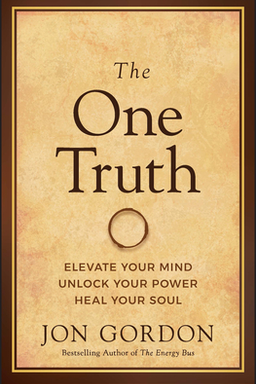
The One Truth: From Separation to Oneness
Have you ever noticed how on some days, the smallest things—traffic, rejection, a snide comment—completely derail your mood, while on other days, the same things barely register? Jon Gordon’s The One Truth: Elevate Your Mind, Unlock Your Power, Heal Your Soul begins with this very observation. He argues that your external circumstances never dictate your peace or happiness—your state of mind does. Building on two decades of work in positive psychology, leadership, and spirituality, Gordon reveals a deceptively simple yet profound framework: every human struggle, from anxiety and fear to division and conflict, ultimately arises from one root problem—separateness. And the ultimate solution is oneness.
In this book, Gordon brings together neuroscience, spiritual wisdom, and practical tools to help you understand how the mind works and how to win what he calls ‘the battle for your mind.’ He shows that when you live from connection, love, and inner trust, you elevate your state of mind and live with clarity, courage, and peace. When you live from fear, doubt, and division, you descend into clutter, anxiety, and separation. The One Truth is Gordon’s most ambitious synthesis yet—a bridge between psychology, spirituality, and human performance.
The Central Battle: Fear and Separation vs. Love and Oneness
Gordon contends that the single thread connecting all human suffering, stress, and inner conflict is the feeling of being separate—separate from others, from purpose, from love, and ultimately from God. When you feel separate, you operate from fear: you worry, control, compare, defend, and withdraw. When you feel one—with yourself, others, and creation—you function from love: you trust, connect, and create with freedom. He calls this the core duality of existence: separation and oneness, fear and love, low mind and high mind.
This inner split manifests everywhere: in racism, narcissism, perfectionism, political polarization, and personal anxiety. The world’s problems, Gordon says, mirror our inner separation. Winning the inner battle—choosing oneness over separateness—is therefore both a personal and collective project. It’s not merely a self-help tactic; it’s the foundation of global healing.
From Mental States to Spiritual Truths
In Book I: A Higher State of Mind, Gordon demystifies emotional ups and downs by introducing the concept of ‘state of mind.’ Life doesn’t cause anxiety—the thoughts you believe about life do. Through stories from athletes, business leaders, and his own struggles with depression, he shows that everyone rides an inner roller coaster of thought: moments of clarity and flow followed by waves of overthinking and fear. The key is to stop treating low mental states as problems to escape and instead see them as temporary ebbs in a natural cycle. The more you accept the ebb and flow, the calmer the ride becomes.
In Book II: The One Thing That Explains Everything, he moves deeper: high and low states, it turns out, are not random brain patterns—they reflect your degree of connection to oneness. The farther you move from love into fear, the lower your vibration. This is not only a psychological truth; it’s a spiritual one. When you remember you are connected to something greater—what Gordon names as God—you operate in your highest, most creative frequency.
Finally, in Book III: The Solution to the Separation, he ties it all together with a visionary theory: the brain itself is an antenna that tunes into either positive or negative spiritual frequencies. Thoughts, he suggests, are not produced by the brain but received by it. Positive frequencies are love, hope, and gratitude; negative frequencies are fear, shame, and doubt. The brain’s health determines how clearly we tune in. This means that spiritual, mental, and physical wellness are not separate—they are one continuum of energetic connection.
Why This Matters: The Mental Health and Connection Crisis
Gordon’s framework arrives at a crucial cultural moment. Despite living in the most connected age in history, people are lonelier, more anxious, and more divided than ever. Teen mental health crises, burnout epidemics, and polarized politics all trace back, in Gordon’s view, to the same lie of separateness. Every addiction, he notes, is an attempt to fill the void left by separation. Every act of judgment or hate stems from fear of that separation. The solution is not found in more coping mechanisms, but in remembering who we truly are—connected beings made for love and unity.
Unlike many motivational books, The One Truth blends the actionable with the transcendent. It offers mental training tools—gratitude walks, positive self-talk, daily trust practices—while simultaneously offering a theology of consciousness that reframes human suffering in universal terms. Rather than telling you to ‘fight negative thoughts,’ it helps you see them for what they are: lies from a lower frequency trying to pull you away from your true, divine connection.
Living the One Truth
For Gordon, this isn’t theory—it’s biography. His own life unraveled when negativity almost cost him his marriage and career. Through practices of positivity, prayer, and surrender, he reconnected with purpose. Now, as a coach to NFL players, CEOs, and students, he teaches others to do the same: identify low states, refuse the Five D’s (doubt, distortion, discouragement, distraction, and division), and use truth, trust, love, and gratitude to elevate the mind. His mantra could be summed up as: “You can’t control the world—only your frequency.”
Ultimately, The One Truth calls you to remember that you are never broken. You are not your low moments, your past mistakes, or your fears. You are one with love, and in remembering that oneness, you heal yourself and contribute to healing the world. That’s why Gordon insists the book is about more than performance—it’s about peace. The One Truth, he writes, is not something to learn anew, but something to remember: the truth that you were never separate to begin with.