
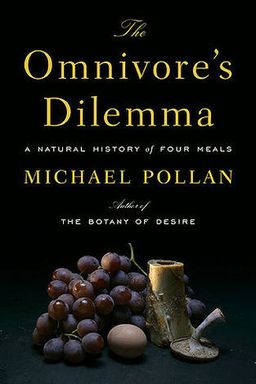
The Omnivore''s Dilemma cover

The Omnivore''s Dilemma

by Michael Pollan

Michael Pollan''s ''The Omnivore''s Dilemma'' delves into the complexities of modern food choices, revealing the environmental, ethical, and health implications of industrial agriculture. It explores alternatives like organic and local farming, guiding readers toward more informed and sustainable eating habits.

The Modern Omnivore's Dilemma: How We Lost Our Way with Food

What should you eat? It sounds like a simple question, but in a world of endless supermarket aisles, fast-food restaurants, and diet fads, even choosing a meal feels surprisingly complicated. In The Omnivore’s Dilemma: The Secrets Behind What You Eat, Michael Pollan dives into this question—the one he calls the omnivore’s dilemma. Humans can eat almost anything, yet our modern food system has made it harder than ever to know what is good for us, our environment, and the creatures we rely on for sustenance.

Pollan argues that our industrialized food culture has broken the link between people, nature, and the sources of nourishment. The book reveals how food has moved from farms and pastures to factories and laboratories, transforming what we eat into products of petroleum, corn, and chemical additives. His mission is part detective work, part philosophy of eating: by tracking four different food chains—from Big Macs to wild mushrooms—Pollan shows how each reflects a different relationship between humans and nature, and what recovering those relationships might mean for our health and our planet.

The Four Food Chains

Pollan structures the book around four meals, each representing a food chain: the industrial meal, the industrial organic meal, the local sustainable meal, and the do-it-yourself meal. The industrial meal, symbolized by a McDonald’s hamburger eaten in a car, reveals a system powered by corn and fossil fuel—cheap, efficient, and deeply disconnected from nature. The industrial organic meal, purchased from Whole Foods, tries to escape that system but ends up mirroring it on a larger, corporate scale. Then comes the local sustainable meal, where Pollan joins Virginia farmer Joel Salatin at Polyface Farm, a microcosm of ecological balance rooted in real soil, sun, and community. Finally, his do-it-yourself meal—made from hunted wild boar, gathered mushrooms, and garden vegetables—brings him face-to-face with human history and the primal act of eating.

Why Our Food Choices Matter

Pollan’s point isn’t just that we’ve lost track of what we’re eating—it’s that this disconnect has profound consequences. When food comes from cornfields, feedlots, and processing labs, the environmental, social, and ethical costs are hidden. Industrial agriculture has polluted waterways with nitrogen fertilizer, confined animals in cruel factory conditions, and created a culture of fast, cheap calories. Our physical health mirrors this system: epidemics of obesity, diabetes, and heart disease trace back to our cheap corn-derived diets. Yet by understanding our food chains, Pollan believes we can rediscover eating as a conscious, joyful act rather than a transaction driven by convenience and marketing.

The Human Relationship with Food

At its heart, The Omnivore’s Dilemma is about reclaiming our relationship with food. Pollan shows how traditional cultures once solved the dilemma through food customs—knowing what to eat, when, and how. In Japan, raw fish is eaten with antibacterial wasabi; in Mexico, corn is cooked with lime and paired with beans for a complete amino acid profile. Yet America, lacking deep food roots, replaced culture with fads and marketing. The result is a confused, anxious nation where food science dictates our meals and we debate carbs, fats, and proteins instead of simply sharing wholesome food around a table. Recovering a true food culture, Pollan insists, means eating together, cooking again, and appreciating real ingredients.

This book matters because it speaks to something universal: the daily act of choosing what nourishes you. Pollan isn’t prescribing a diet; he’s inviting you to think, taste, and participate. By following a grain of corn through the industrial food chain, standing knee-deep in manure at Polyface, and hunting a wild boar in the forest, he shows that how we eat expresses how we live. The omnivore’s dilemma isn’t just about food—it’s about consciousness, ethics, and belonging in the natural world.

“Imagine if we had a food system that actually produced wholesome food,” Pollan writes. “Imagine if we could eat every meal knowing what it is we’re eating, where it came from, how it found its way to our table, and what it really costs.”

In short, Pollan makes a clear case: by reconnecting to the sources and stories behind our food, we can eat better, live healthier, and restore balance to our ecosystems. The omnivore’s dilemma has always existed, but its modern version—driven by marketing, fossil fuels, and disconnection—requires awareness to solve. The solution begins not with a new fad diet, but with our choices, our curiosity, and our willingness to rediscover what real food means.


Corn and the Industrial Food Chain

Michael Pollan begins his investigation in the cornfields of Iowa, where corn is not just a crop but the foundation of America’s entire food economy. He introduces farmers like George Naylor, who depend on government subsidies to grow endless acres of corn and soybeans. This simple plant, once a grass called teosinte in ancient Mexico, became the engine of an industrial food chain that shapes nearly everything we eat—meat, dairy, processed snacks, and even soft drinks.

The Hidden Empire of Corn

Pollan shows that the modern supermarket, with its thousands of brightly packaged foods, hides a single commodity: corn. From corn-fed cattle and pigs to high-fructose corn syrup in sodas, this monoculture underlies most processed foods. Biologist Todd Dawson’s research even proves that Americans “look like corn chips with legs,” since the carbon atoms in our bodies come largely from corn-based diets. This ubiquity stems from industrial efficiency and government support. By turning surplus ammonium nitrate from World War II bombs into nitrogen fertilizer and subsidizing corn production, the U.S. created a food chain powered by fossil fuel and chemical energy instead of sunlight.

The Illusion of Cheap Food

Corn became cheap for consumers but ruinous for farmers. Naylor’s story reveals the paradox of modern farming: the more corn you grow, the less you earn. Government subsidies keep prices low, ensuring corporations like Cargill and ADM profit from cheap raw material. Meanwhile, excess nitrogen fertilizer seeps into rivers, creating toxic “dead zones” in the Gulf of Mexico. What looks like cheap food actually hides immense ecological debt—pollution, disease, and carbon emissions. As Pollan puts it, we’ve replaced solar-powered ecosystems with oil-powered factories that pump out calories but drain the earth.

Turning Corn into Meat

The industrial food chain also transformed livestock. Cows evolved to eat grass, but at feedlots like Poky Feeders in Kansas, they’re fattened on corn and chemically treated feed. Pollan describes his own steer, number 534, who lived knee-deep in manure among thirty-seven thousand others. Veterinarian Mel Metzin tells him most feedlot cows are sick from acidosis—caused by eating corn their bodies can’t digest. Antibiotics keep them alive long enough to reach slaughter weight. This system turns animals into “meat machines” and people into consumers of cheap protein, at enormous environmental and ethical costs.

Through George Naylor’s farm and Poky Feeders’ CAFOs (Concentrated Animal Feeding Operations), Pollan connects the dots: our supermarket aisles, our dinner plates, and even our health all trace back to a single overgrown crop. Corn’s conquest of the American food chain is not just an agricultural story—it’s a cautionary tale of how industrial efficiency can blind us to natural limits and moral responsibilities.


From Industrial Organic to Sustainable Farming

Pollan turns from industrial agriculture to what looks like a better alternative—organic food. At first glance, organic labels and Whole Foods markets promise purity and sustainability. Yet when Pollan investigates industrial organic farms like Cascadian Farm and Earthbound Farm, he discovers that organic doesn’t always mean local, small-scale, or sustainable. It can still be an industrial system driven by profit, packaging, and transportation.

Industrial Organic Illusions

Companies like Cascadian Farm began as small hippie communes in the 1970s, guided by the back-to-the-land ideals of J.I. Rodale and Rachel Carson. But as demand for organic food grew, corporations like General Mills bought them out. Pollan visits Gene Kahn, Cascadian’s founder turned executive, who admits that organic food has become an industry—pre-washed lettuce flown thousands of miles, frozen dinners with 31 ingredients, and cows fed organic corn in “organic” feedlots. These farms use fewer chemicals but often mirror conventional agriculture in scale and energy use.

The Politics of the Label

Pollan traces the label’s evolution through the 1990 Organic Foods Production Act, which set rules for what counts as organic. Agribusiness lobbied for loose definitions, allowing synthetic additives and plastic packaging. Small farmers protested, forcing some restrictions—but the compromise still favored large-scale producers. “If we had lost on synthetics,” Gene Kahn told Pollan, “we’d be out of business.” As a result, “organic” became more of a marketing term than a philosophy of harmony with nature.

Beyond Organic: The Polyface Model

The book’s third section introduces a truer form of sustainability at Joel Salatin’s Polyface Farm in Virginia. Salatin calls himself a “grass farmer” because he grows sunlight through grass, the foundation of his entire ecosystem. Cows graze for a day before moving to new pasture. Chickens follow, eating parasites from the cowpats and fertilizing the grass with their droppings. This cycle mimics natural ecology—no chemical fertilizers, no wasted manure, no animal cruelty. Salatin’s chickens live in portable pens called “eggmobiles,” and his pigs root happily through fermented hay. Everything feeds something else. Pollan calls Polyface “a symphony of relationships” where manure, compost, and sunlight become food again.

Pollan contrasts Salatin’s closed-loop, solar-powered farm with George Naylor’s fossil-fueled one. Polyface may be smaller, but it’s more productive per acre and far more humane. Salatin refuses to ship meat long distances or sell to supermarkets, believing in local food networks and direct relationships with consumers. His philosophy—“eat your view”—embodies what “organic” was meant to be: food that heals the land, the animals, and the people who eat it.


The Biology and Culture of Eating

In one of the book’s most fascinating chapters, Pollan explores why choosing food is so complicated for humans. Unlike creatures with narrow diets—koalas eat only eucalyptus leaves, monarch butterflies only milkweed—humans are omnivores. We can eat almost anything, but we must figure out what’s safe, nutritious, and ethical. That’s the essence of the omnivore’s dilemma.

The Instincts of an Omnivore

Pollan explains how our taste buds evolved as survival tools. Sweetness signals energy-rich foods; bitterness warns of potential toxins. Yet modern food manufacturers exploit these instincts by engineering sugar-rich and fat-laden products. Our “sweet tooth” evolved for scarcity, but now abundance surrounds us. As Pollan writes, we keep eating sugar because our bodies haven’t learned it’s always available in the refrigerator. The result: obesity and chronic disease (echoing Gary Taubes’s Good Calories, Bad Calories). Meanwhile, bitterness—once a cue for danger—gets masked by processing, making it easy to ignore toxic or nutrient-poor foods.

Culture as a Survival System

Before industrialization, cultures solved the omnivore’s dilemma through food traditions. Mexicans paired corn and beans for complete nutrients; Japanese paired raw fish with wasabi’s antibacterial oils. These customs preserved both health and identity. In the U.S., lacking culinary traditions, we turned to experts and fad diets—from Dr. John Harvey Kellogg’s bizarre enemas to “Fletcherizing” (chewing each bite 100 times) to the Atkins craze. Without cultural rules, Americans outsource their decisions to marketers and pseudo-science, creating anxiety instead of nourishment.

The No-Fad French

Pollan contrasts American food confusion with French “food culture.” The French eat smaller portions, avoid snacking, and linger over meals with family. They enjoy wine and butter yet have lower rates of heart disease. Their secret? Social rituals and moderation, not labeling foods as “good” or “bad.” Pollan argues that America’s nutritionism—reducing food to nutrients—has made eating mechanical and joyless. Restoring the cultural act of eating together can recover balance and pleasure.

This chapter invites you to see eating not as a chore or science experiment but as a craft and a celebration. For Pollan, solving the omnivore’s dilemma is about recovering the wisdom of tradition and the community of the table.


Eating Oil and the Cost of Convenience

Pollan’s journey through industrial organic farms exposes another hidden truth: even organic food often rides on a sea of petroleum. From refrigerated trucks to plastic packaging, “organic” doesn’t necessarily mean sustainable. The asparagus flown from Argentina to California may be pesticide-free, but it’s soaked in jet fuel. This part of his investigation reveals how convenience and global trade undermine the local, ecological principles that defined organic farming’s origins.

The Fossil Fuel Paradox

At Earthbound and Cascadian Farms, Pollan calculates that one pound of organic lettuce contains only 80 calories of food but requires 4,600 calories of fossil fuel to produce, wash, chill, and transport. He calls this “the most petroleum-intensive salad on Earth.” While organic rules ban chemical fertilizers, they say nothing about fossil fuel use. “Organic industrial” food chains may eliminate pesticides but still depend on oil for transport and refrigeration. The irony? A philosophy born from sustainability now replicates the environmental footprint of the very system it was meant to replace.

The Economics of Organic

Pollan also shows how price and profit shape consumer decisions. His Whole Foods dinner—Rosie the chicken, Argentine asparagus, Stonyfield ice cream—cost $34 for three people, much higher than conventional food. “Why buy organic anyway?” he asks. His answer is precaution: organic food reduces exposure to pesticides, hormones, and toxins like atrazine (a herbicide that can change frogs’ sex). But he warns that without systemic change, paying more for “clean” food only benefits the wealthy. Sustainable eating must involve fairness, not just purity.

Beyond Convenience

Pollan’s critique extends to our cultural obsession with convenience. Industrial food encourages solitary, rushed eating—protein bars in cars, microwavable soups at desks. Yet food should be social, sensory, and slow. Eating with family is not just tradition; it shapes healthier habits and stronger communities. Pollan reminds you that “food is not just fuel; it’s about family and community.” Undoing industrial convenience begins with reclaiming the rituals of preparation and sharing, even if it means spending more time in the kitchen.


Hunting, Gathering, and Rediscovering Real Food

In the book’s final section, Pollan becomes the food chain himself: he hunts, gathers, and gardens to create one complete meal. His adventures—tracking wild pigs in California with Angelo Garro and foraging mushrooms in rainy forests—transform the abstract study of food into lived experience. Through these experiments, he confronts both the joy and the discomfort of killing and preparing animals for food.

The Ethics of Hunting

Pollan’s pig hunt forces him to examine morality head-on. Inspired by Peter Singer’s Animal Liberation, he briefly tries vegetarianism, questioning whether animals suffer like humans. His conclusion: killing is not inherently wrong, but cruelty is. Watching Joel Salatin’s humane slaughter process and Temple Grandin’s cattle chute designs convinces him that some deaths—quick, respectful, necessary—can be ethical. Hunting, he realizes, makes the eater accountable: “You can’t look away from what you eat.” The thrill and guilt he feels while killing his first boar embodies the full complexity of eating animals consciously.

Gathering and Gratitude

His mushroom hunts with Garro and other foragers reconnect him to ecology and curiosity. Finding chanterelles and morels becomes a metaphor for awareness: “When searching for something, fix its pattern in your mind—then it pops out of the landscape.” Pollan marvels at fungi’s mystery and the delicate web they weave underground between life and decay. Gathering wild food, like hunting, awakens humility and gratitude—it transforms eating into participation with nature rather than dominance over it.

The Perfect Meal

Pollan’s final “perfect meal” combines wild boar, garden fava beans, and home-baked bread made with wild yeast. He invites the people who helped him hunt and gather to share the feast. As they eat, the conversation intertwines stories of woods, farms, and kitchens—the food, people, and place becoming one. He writes, “If we could eat every meal knowing what it is and what it cost, every meal would be perfect.” This closing scene underscores his entire argument: real eating begins with awareness, responsibility, and gratitude. Food connects us not just to calories, but to community, culture, and the living world.


The Omnivore’s Solution: Rethinking How We Eat

The Omnivore’s Dilemma ends not with despair but with empowerment. Pollan offers straightforward principles for eating well in the modern world, captured in three imperatives: eat real food, mostly plants, and not too much. But beyond slogans, he proposes a way of life—buy local, cook often, and share meals as acts of connection and resistance.

Eat Real Food

Pollan calls on you to avoid “edible food-like substances”—packaged items filled with unpronounceable chemicals. Real food is what your great-grandmother would recognize: fruits, vegetables, meat, eggs, and bread. Skip products with more than five ingredients or those containing high-fructose corn syrup. This rule simplifies eating and restores trust in your senses rather than advertisements.

Buy Real Food

He recommends shopping the outer aisles of supermarkets, where fresh food lives, and avoiding the middle sections dominated by processed goods. Better yet, buy from farmers markets or join a CSA (Community Supported Agriculture). Pollan’s concept of “voting with your fork” turns daily choices into activism: every purchase supports either industrial feedlots or local farms like Polyface. Conscious consumption becomes political action.

Eat Real Meals

Cooking, gardening, and eating together are the antidotes to industrial food culture. Pollan insists that meals should be slow, shared, and mindful. When you cook, you regain control over ingredients and portions. When you eat together, you restore food’s cultural and emotional meaning. As he says, “The real meal—family and friends gathered around a table—is in danger of extinction. For your health and happiness, do what you can to save it.”

Pollan’s solution doesn’t require hunting or farming; it requires attention. Knowing your food’s story—where it came from and what it cost—turns eating into a daily act of ethics and joy. In the end, the omnivore’s dilemma is solved not by science, but by awareness, community, and care.

Dig Deeper

Get personalized prompts to apply these lessons to your life and deepen your understanding.

Go Deeper

Get the Full Experience

Download Insight Books for AI-powered reflections, quizzes, and more.