
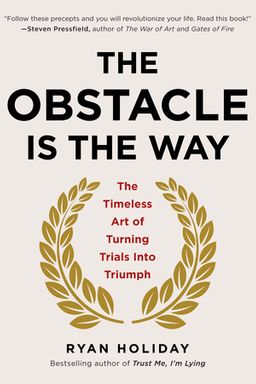
The Obstacle is the Way cover

The Obstacle is the Way

by Ryan Holiday

Ryan Holiday''s ''The Obstacle is the Way'' distills Stoic wisdom into actionable steps, teaching you to transform life''s challenges into fuel for success. Through historical examples, Holiday reveals how to see obstacles as opportunities, empowering readers to thrive in any situation.

Turning Obstacles into Opportunity

What if every setback in your life could become a source of strength? What if the things that frustrate, delay, or block you were actually the path forward? In The Obstacle Is the Way, Ryan Holiday argues that our biggest frustrations, failures, and challenges are not roadblocks to success—they are success. Drawing on the timeless wisdom of Stoic philosophy and examples from history, Holiday shows that obstacles don’t control the outcome—our reactions to them do.

Holiday’s central claim is simple yet radical: when we perceive our problems correctly, act decisively, and strengthen our will, obstacles transform into the way forward. The book’s power lies in its practicality—it’s not an abstract meditation on philosophy but a disciplined method for mastering life’s adversities. This approach applies equally to failure in business, personal loss, creative blocks, or the daily grind of ambition.

The Stoic Framework: Perception, Action, and Will

The Obstacle Is the Way unfolds around three interlocking disciplines: Perception, Action, and Will. Together, these form a mental model for turning adversity into advantage.

Perception is how you interpret what happens. It’s choosing calm objectivity over panic, clarity over distortion. John D. Rockefeller, facing the market panic of 1857, used financial disasters as a classroom—not a curse. Instead of despairing, he observed others’ mistakes, learned discipline, and laid the foundations for Standard Oil. This discipline—to remain objective while others lose control—is the first step in transforming hardship into fuel.

Action is what you do about the situation. It’s the discipline of creative persistence—advancing through problems rather than being defeated by them. Holiday channels the spirit of the Greek orator Demosthenes, who overcame a speech impediment by practicing with pebbles in his mouth. His deliberate, persistent action forged not just skill but identity. Obstacles, when acted on intelligently, shape mastery.

Will is the inner power that remains when everything external has been stripped away. It’s fortified, not brittle—it bends, adapts, and endures. Abraham Lincoln, haunted by depression and political failure, used his suffering to cultivate compassion, patience, and moral courage. In Holiday’s words, will is “our internal power, which can never be affected by the outside world.”

Every Obstacle Becomes a Lesson

Holiday’s approach is simultaneously philosophical and tactical. He finds meaning in situations that seem meaningless. When James Stockdale was imprisoned for seven years in a Vietnamese POW camp, he held firm to Stoic principles. He found purpose by leading fellow prisoners—his cause was “Unity over Self.” Like Rockefeller in finance and Lincoln in politics, Stockdale exemplified how holding to principle under pressure can turn suffering into leadership.

By reframing events as chances to practice courage, compassion, or patience, we cultivate what Nietzsche called amor fati—the love of fate. Instead of fighting reality, we embrace it: every hardship becomes a tool for growth. Thomas Edison, watching his laboratory burn, told his son, “We’ve just got rid of a lot of rubbish.” His optimism wasn’t denial—it was mastery of perspective.

Why It Matters Now

Though Holiday builds on Stoic philosophy, his message is notably modern. In a world obsessed with convenience and comfort, we are unprepared for difficulty. But the truth is that life is difficult—and Stoic principles offer a durable operating system for reality. What the Stoics taught is not cold detachment but practical resilience: control what you can, accept what you can’t, and find meaning in both.

Across the book’s examples—from Barack Obama turning a political scandal into a defining speech, to Amelia Earhart seizing every small chance to fly—Holiday reminds you that power lies not in circumstance, but in character. You can’t always control what happens, but you can always control your perception, your effort, and your endurance. This is how obstacles stop being walls—and start being teachers.


Master the Art of Perception

Perception is the foundation of all resilience. It shapes how you interpret, react to, and ultimately overcome the world’s challenges. In Ryan Holiday’s view, the discipline of perception begins when you strip events of emotional coloring and see them as they are—neither good nor bad, simply information. As the Stoic philosopher Epictetus wrote, “It’s not what happens to you, but how you react to it that matters.”

See Without Distortion

John D. Rockefeller’s calm during the Panic of 1857 illustrates this idea vividly. While crowds panicked and banks collapsed, he decided to study the chaos instead of fearing it. He learned how people overreacted in crises and how patience could turn panic into profit. This was perception as power: not delusion, but discipline. It’s the reason Rockefeller later built one of history’s great business empires while others went broke.

You can train yourself to perceive clearly by pausing before judgment. Miyamoto Musashi, the legendary samurai, taught the “observing eye,” which sees what is, versus the “perceiving eye,” which sees what it wants. Musashi’s victories weren’t from brute force, but from clarity—the ability to see without distortion.

Separate Fact from Emotion

Holiday calls this separating the event (“this happened”) from the judgment (“this is bad”). The two are distinct. When Rubin “Hurricane” Carter was wrongly imprisoned for murder, he refused to let emotion control his reality. He told the warden he’d live on his own terms: no uniform, no compromises. Though physically confined, Carter’s perspective made him mentally free. His imprisonment became an education; his will became indestructible.

Like Roosevelt, who worked daily to outgrow his childhood asthma, Carter—and anyone who learns to control perception—demonstrates the Stoic power of interpretation. When they can’t change reality, they change their relationship to it.

Contemptuous Expression and Objectivity

The Stoics practiced stripping appearances of glamour and intimidation. Marcus Aurelius reminded himself that fine food is just “dead animal” and expensive wine is merely “fermented grape juice.” By speaking bluntly about what things actually are, he cut through distraction. Similarly, when facing obstacles like rejection or criticism, Holiday encourages you to mentally “deflate” the illusion. Underneath glamour or fear is just another situation waiting for your response.

When you practice this form of objectivity, you reclaim agency from emotion. You develop what Nietzsche called “the profound superficiality”—seeing things plainly at first glance rather than overcomplicating them. This clear sight becomes the lens through which every obstacle can eventually become an opportunity.

In the end, mastering perception means mastering your initial impressions. You can’t always control what happens—but you can decide how to interpret it. Like Rockefeller in financial panic, or like a martial artist staying calm mid-battle, your greatest strength lies in restraint, clarity, and the ability to see reality as it truly is.


Take Action, No Matter the Obstacle

After perception comes action—the discipline of doing. Once you see a problem clearly, you must move toward it. Holiday insists that the difference between people who thrive and those who crumble lies in their willingness to act, persistently and pragmatically, no matter how small the step.

Start Where You Are

Amelia Earhart’s first major chance at aviation came under humiliating terms. She was offered a role on a transatlantic flight—but as a passenger, not a pilot, and for no pay. Instead of turning it down, she said yes. That “insulting” opportunity became the foundation of her career and eventually led her to become the first woman to fly solo across the Atlantic. Her story reveals a paradox: motion, not ideal conditions, creates momentum.

Action is rarely glamorous. You might start with menial work, unclear payoffs, or uncomfortable compromises. But as Holiday reminds us, “We must all either wear out or rust out.” Every motion—no matter how humble—compounds into progress.

Persistence is Genius in Disguise

For Thomas Edison, genius wasn’t mystical insight—it was tireless iteration. He tested six thousand filaments before discovering one that made the lightbulb commercially viable. His belief that “genius is 1% inspiration and 99% perspiration” embodied the Stoic ideal that endurance is creative.

Similarly, Ulysses S. Grant persisted through countless failed maneuvers before finally taking Vicksburg in the Civil War. His secret wasn’t brilliant strategy but relentless adjustment—each setback became data. Like Edison, Grant proved that steady repetition of effort can solve “impossible” problems.

Don’t Seek Perfection, Seek Process

Perfectionism is another form of paralysis. Nick Saban, the renowned football coach at the University of Alabama, commands his team to “follow the process.” This means focusing entirely on the next play, not the scoreboard. Under pressure, don’t obsess about the outcome; execute the smallest next step with excellence.

In Stoic terms, this is right action—discipline combined with adaptability. Whether you’re leading troops or launching a project, Holiday challenges you to translate insight into effort. Think like Edison, persist like Grant, and when tired, remember Churchill’s mantra: “Keep buggering on.” Because progress comes not from force alone—but from refusing to quit.


Strengthen the Will Within

When perception and action reach their limits, will begins. Holiday calls will your internal citadel—the invincible core no external event can destroy. This inner fortress must be built, not assumed, and it allows you to endure hardship without breaking.

Building Inner Strength

Theodore Roosevelt’s transformation from a sickly child into a model of vitality captures this beautifully. Plagued by asthma, he promised his father, “I’ll make my body.” Every day, he worked to strengthen himself physically and mentally. Over years, that commitment evolved into a philosophy—the “Strenuous Life”—through which he faced loss, assassination attempts, and political battles with unbreakable energy.

This proactive resilience is your armor. When life’s conditions can’t be changed, your preparation determines your endurance. Holiday urges you to use calm times to forge strength, just as soldiers train before war. The fortress you build now protects you later.

Love What Happens (Amor Fati)

Nietzsche called amor fati “my formula for greatness”—to love one’s fate rather than merely accept it. When Edison’s laboratory burned down, he famously told his son not to grieve but to fetch his mother: “She’ll never see a fire like this again.” His response turned loss into liberation. Instead of despairing, he rebuilt and went on to earn millions that same year.

This attitude—welcoming hardship with joy—requires discipline, not denial. It’s the ability to see every challenge as material for growth. From Lincoln’s serenity during civil war to Edison’s laughter amid flames, Holiday’s point is clear: adversity can be alchemy, transforming misfortune into fulfillment.

When external freedom vanishes, inner freedom begins. That’s the will—the final step from fear into acceptance, from resistance into mastery.

Built over time, your Inner Citadel makes you untouchable. You no longer waste energy resenting life’s difficulties—they become your teacher, your source of power. Your will doesn’t shield you from storms; it helps you walk through them smiling.


Find Purpose Beyond Yourself

One of the most powerful Stoic ideas Holiday revives is that strength multiplies when it’s devoted to something greater than self. Self-preoccupation magnifies suffering; service dissolves it. This principle—Unity over Self—is embodied by those who endured unbearable trials by living for others.

Service as Survival

Admiral James Stockdale’s captivity in Vietnamese prisons tested human limits. Shackled, isolated, and tortured, he refused to collapse into self-pity. Instead, he focused on leadership—creating secret communication systems and encouraging fellow POWs. His motto, “Unity over Self,” gave meaning to pain. John McCain, one of Stockdale’s comrades, made the same choice, declining early release that would have dishonored others still captive.

These men demonstrate that when your mission transcends ego, endurance becomes easier. Suffering for a principle—honor, duty, compassion—transforms hardship into heroism.

Purpose Reduces Fear

Psychologist Viktor Frankl echoed this insight after surviving Nazi death camps, writing that those with a clear “why” could bear almost any “how.” Holiday applies this same Stoic logic: when you shift focus from self-interest to service, despair loses its grip. As Henry Rollins put it, the hardest times call for “moral backbone and civic true north.”

By rejecting narcissism and practicing empathy, you divert energy from fear to purpose. In this way, helping others paradoxically saves you.

Holiday concludes that compassion, not pride, is the mark of an unbreakable will. In a hard world, we are strongest when guided by community, not ego. When obstacles come, don’t ask “Why me?” Ask “Who can I help with this?” That shift changes everything.


Accept and Adapt: The Art of Acquiescence

Hollywood glorifies defiance, but Stoicism praises something harder: acceptance. The “Art of Acquiescence,” as Holiday calls it, means gracefully accepting what is beyond your control—and then using it anyway.

Accept Constraints as Catalysts

Thomas Jefferson was a poor speaker; he accepted this as fact and channeled his intellect into writing instead. The result: the Declaration of Independence. Helen Keller and Thomas Edison turned physical limitations into creative focus. Edison’s deafness, far from a handicap, reduced distraction; Keller’s blindness elevated her inner perception.

What limits you might empower you. When you accept your boundaries, you discover new forms of freedom. As Edison put it, “True genius is a mind of large general powers accidentally determined in some particular direction.”

Fate as Teacher, Not Tyrant

The Stoics called this ta eph’hemin, ta ouk eph’hemin—what’s up to us and what’s not. When fate closes a door, fighting it wastes energy that could move you through another. George Washington accepted weather, uncertainty, and luck as part of command. Eisenhower, before D-Day, told his wife simply, “The answer is in the lap of the gods.” That humility didn’t make him passive—it made him free to act without anxiety.

Acceptance, then, is not resignation—it’s realism at work. Once you stop resisting what “shouldn’t be,” you start working effectively with what is.

Holiday warns against the modern delusion that life should obey us. Traffic, illness, bureaucracy—they are less enemies than reminders to adapt. The world is a moving river; your task is to flow, not to fight the current. That’s how fate, frustrating as it is, becomes your collaborator.


Perseverance and the Power of Endurance

Persistence is trying hard; perseverance is enduring long. Holiday distinguishes them as energy versus endurance—the quick spark versus the eternal flame. The path of mastery demands both, but particularly the latter.

Keep Going When Others Quit

From Odysseus wandering for ten years to Churchill rallying Britain with “Keep buggering on,” perseverance is humanity’s oldest virtue. The Greeks called it andreia—courage through suffering. Ulysses S. Grant embodied this in the Civil War. After countless defeats, he persisted, learning through failure until he found a path to victory. His confidence was not that he couldn’t fail—but that failure couldn’t stop him.

Holiday contrasts persistence’s short-term grit with perseverance’s lifelong steadiness. The Stoics taught that small steps, sustained, move mountains.

The Strength to Endure Difficulty

Beethoven captured this immortal mindset: “The barriers are not erected which can say to aspiring talents, thus far and no farther.” He persevered through total deafness to compose masterpieces—proof that inner will beats physical circumstance. Holiday observes that most people fail not from external defeat, but from internal surrender. “There are more failures from a collapse of will,” he writes, “than from conclusive external events.”

When fatigue sets in, perseverance shifts focus from outcome to process. It remembers why we started and what we stand for. Like Lincoln enduring depression or Grant enduring siege, those who hold on long enough turn struggle into momentum. In a world addicted to shortcuts, perseverance is your quiet superpower.


Preparing for the Next Obstacle

No victory is final. Life, as the Haitian proverb says, is a series of mountains beyond mountains. Holiday ends his book reminding us that success is just preparation for the next challenge. The obstacle never ends—it evolves.

Continuous Adaptation

Marcus Aurelius understood this, ruling not in pursuit of ease but excellence under strain. When military rebellion erupted under Avidius Cassius, Marcus responded not with revenge but with calm forgiveness. Even betrayal was turned into virtue. This moment embodies the book’s final message: The obstacle becomes the way.

Resilience is not a one-time achievement—it’s a lifestyle. Every hardship strengthens the muscles needed for the next one. As Virgil wrote, “Behind mountains are more mountains.” Online or offline, in business or love, stumbling means you’re still moving upward.

From Reaction to Transformation

The final goal, Holiday suggests, is not to eliminate obstacles but to integrate them. You no longer ask, “When will this end?” but “What can this teach me?” By converting calamity into practice—patience into philosophy—you complete the Stoic cycle.

The path of wisdom runs through the terrain of struggle. Once you accept this, you stop fearing life’s hardships and start welcoming them. Every obstacle becomes a starting line, not a stop sign. As Marcus Aurelius taught, “What stands in the way becomes the way.”

Dig Deeper

Get personalized prompts to apply these lessons to your life and deepen your understanding.

Go Deeper

Get the Full Experience

Download Insight Books for AI-powered reflections, quizzes, and more.