
Idea 1
The Nurture Assumption and the Peer Revolution
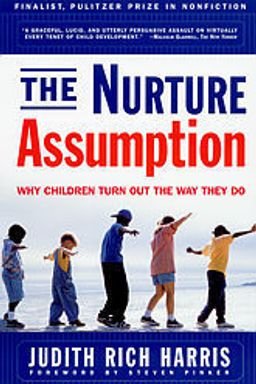
Why do you resemble your parents in some ways but not others? And why do siblings raised in the same household turn out so different? In The Nurture Assumption, Judith Rich Harris argues that the traditional story—genes start the job and parents finish it—gets human development fundamentally wrong. Parents matter for care, safety, and values within the home, but they are not the decisive shapers of your public personality. Instead, the lasting influences come from peers, social categories, and the larger world children inhabit together.
Harris overturns the century-old assumption that nurture means parental rearing. She redefines it as the total environment—then shows that the most formative slice of that environment lies outside the family. That reframing, backed by behavioral genetics and social psychology, forced psychologists to rethink concepts of socialization, learning, and personality.
From parental primacy to group socialization
The old model, shared by Freud and Skinner alike, made parents the architects of character. Harris asks you to look at the evidence. Russian-speaking parents in Cambridge raise kids who sound Bostonian, not Russian. Hired nannies raise English boys who grow up mirroring their fathers’ class style more than their caregivers. Adopted children often resemble their biological parents in temperament but their schoolmates in accent. When a pattern repeats across cultures, you have to ask whether parents are being miscast as prime movers.
Harris’s answer is group socialization theory: children learn how to behave in the world by identifying with peer groups and social categories. From toddlerhood onward, they absorb rules and styles from those they perceive as “like me.” Belonging, status, and imitation become the engines of cultural transmission. That is why children code-switch—speaking one language at home and another at play—and why behaviors that parents reward or punish at home may not transfer to the playground.
Why parental-effect research falters
Harris dissects the methodological weaknesses behind the parental influence story. Most studies are correlational: warm parents have happy kids, so warmth seems causal. But genetics, child temperament, and shared method variance (when the same person reports both sides of the story) distort those correlations. She illustrates this with the large JAMA study “Protecting Adolescents from Harm,” which asked teenagers about both their parents and themselves—creating “shared method bias.” Studies that separate informants or control for heredity find parental effects shrinking or vanishing.
Twin and adoption findings amplify this message: siblings raised together but genetically unrelated (adoptive pairs) are no more similar in personality than strangers, whereas identical twins reared apart often resemble each other strongly. The shared home—same food, closets, and bedtime rules—rarely produces lasting adult personality similarities. That doesn’t mean the environment doesn’t matter; it means the relevant environment is outside the family unit.
Context, code-switching, and the architecture of identity
Children quickly learn different selves for different contexts. Rovee-Collier’s mobile experiments in infancy show how learning is highly context-bound. Likewise, the behavior that wins approval at home might lose face among classmates. The child builds a “home self” and a “public self,” the second of which maps to the peer world—the one that eventually defines adult identity. William James called this “the division of selves,” and Harris uses it to explain why parental lectures rarely override group norms.
This contextual learning also explains immigrant adaptation and bilingualism. Joseph, the Polish boy who became Missouri-accented, didn’t need explicit lessons—he needed peers. The same principle explains how deaf children in Nicaraguan schools spontaneously created full sign languages and new Deaf cultures within a few years, outstripping any adult input. Children create culture collectively.
An evolutionary and policy reframing
Humans evolved in small, kin-based bands where survival hinged on understanding “us” versus “them.” Harris connects peer influence to these deep group instincts. Our social brains are tuned to in-group learning: imitation, conformity, and contrast. School systems, neighborhoods, and adolescent cohorts magnify those processes. The practical implication is radical but useful: to shape children’s outcomes, intervene in their peer ecology—schools, clubs, teams, and neighborhoods—not just inside the living room.
Core redefinition
"Nurture" is not what parents do to children; it is the total social experience that shapes how they act among other people. In modern societies, that experience is dominated by peers and social categories, not parental scripts.
By merging behavioral genetics, social psychology, and anthropology, Harris gives you a new map of development. Parents supply love, nutrition, and values; peers and cultures supply the models of who to be in public. This distinction restores scientific clarity and relieves emotional burden: you can care for your child intensely without believing you sculpt every contour of their future self.