
Idea 1
Meditation, Science, and the Power of the Mind
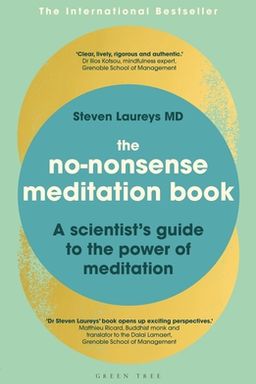
Have you ever wondered why even in moments of peace your mind spins endlessly? In The No-Nonsense Meditation Book, neuroscientist Dr. Steven Laureys argues that the root of much modern suffering lies in our untrained, undisciplined minds—and that meditation is not mysticism but a scientifically validated way to regain control. Laureys, a world-renowned neurologist known for studying consciousness in coma patients, turns his analytical gaze toward the world of meditation, exploring how deliberate mental training can rewire the brain, improve wellbeing, and evoke compassion and clarity.
This book is both personal and scientific. It begins with Laureys’ own collapse after a painful divorce and his skeptical journey toward mindfulness. It weaves his rigorous research with encounters with experts like Matthieu Ricard (“the world’s happiest man”) and the Dalai Lama, and with stories from his own lab where he scanned the brains of Tibetan monks and everyday meditators. The central premise is simple: just as you can work out your muscles, you can strengthen your mind. Meditation is brain fitness — practical, evidence-based, and accessible to anyone willing to sit still for a moment.
From Suffering to Science
Laureys reveals that his fascination with consciousness, once confined to operating theatres and MRI scanners, found new meaning when faced with personal suffering. Nothing in his medical training prepared him for heartbreak or the chaos of emotions. Pills didn’t heal despair. But he discovered in meditation a way to steady his mind. This personal crisis became the entry point for a scientist’s exploration: was meditation merely spiritual tradition—or could its impact on the brain be objectively measured?
Through collaborations with Ricard and the Mind & Life Institute (supported by the Dalai Lama), Laureys helped pioneer the field of contemplative neuroscience. Using EEGs, PET scans, and fMRIs, his team measured changes in both the brain’s structure and function during meditation. They found what Buddhists had described for millennia—focus, compassion, and presence—now visible as thicker cortices and synchronized gamma waves.
Rewiring the Mind
According to Laureys, the human brain evolved for survival, not serenity. Our “monkey mind” constantly scans for threats, triggering stress and anxiety long after saber-toothed tigers disappeared. Meditation teaches us to calm this evolutionary overdrive by training attention. By observing thoughts instead of merging with them, we loosen the grip of fear, obsession, and rumination. Neuroplasticity—the brain’s ability to change—is the science behind this shift: focused mental training can reshape neural circuits for empathy, attention, and emotional regulation. This means happiness isn’t luck; it’s a skill you can cultivate.
Laureys explains this through relatable experiments. Even beginners show measurable changes after eight weeks of mindfulness practice—less activation in the amygdala (fear center), thicker grey matter in the hippocampus (memory and emotion regulation), and stronger connectivity between hemispheres. As the Dalai Lama famously said, meditation proves that compassion and serenity are forms of know-how, cultivated like playing an instrument or sport.
Meditation Without Myths
Laureys calls his approach “no-nonsense” because meditation has too often been misted with mysticism. He removes the clichés: you don’t need to sit cross-legged, chant Tibetan mantras, or belong to a religion. It’s simply the act of becoming aware—whether by focusing on breathing, observing sensations, or cultivating kindness. “It’s not about thinking of nothing,” he writes, “but about noticing what arises without being its prisoner.” Meditation is therefore both accessible and personal: each mind must find its own entry point—whether it’s an app-based practice, a mindful tea ritual, or ten minutes of quiet before bed.
The Bridge Between East and West
A key theme of Laureys’ work is integration. He wants to bridge laboratory precision with ancient wisdom. Buddhism, as he explains, is a “science of the mind,” and the Dalai Lama himself urges collaboration with modern neuroscience. The result is a cross-cultural symbiosis: Western science confirms what Eastern monks have long practiced—that mental habits shape perception, emotion, and wellbeing. Meditation, then, is not a religion but a technology of consciousness, one that can complement medicine—not replace it, but enrich it with holistic care.
A Manual for Modern Minds
Throughout the book, Laureys offers step-by-step exercises—focused attention, open monitoring, loving-kindness, and mindful breathing—grounded in neuroscience but explained in everyday language. His personal tone keeps it conversational: he encourages readers to “do what you can,” forgiving missed sessions or mental restlessness. Each form of meditation targets a different cognitive muscle: breathing sharpens focus, mindfulness sustains presence, compassion expands empathy. And evidence suggests that even ten mindful minutes a day can lower cortisol, improve sleep, and fortify the immune system.
Ultimately, Laureys’ message is both empirical and hopeful: meditation is a practice for reshaping not only neurons but the way we live and connect. He positions meditation as a preventive lifestyle measure—mental hygiene for the twenty-first century. The book closes on a note of wonder, urging readers to preserve curiosity, humility, and kindness in a world saturated with stimuli. Science, he insists, is catching up with what practice has always known: that awareness, compassion, and peace begin within the human brain, and are within everyone’s reach.