
Idea 1
Doing the Next Right Thing: Finding Clarity in Chaos
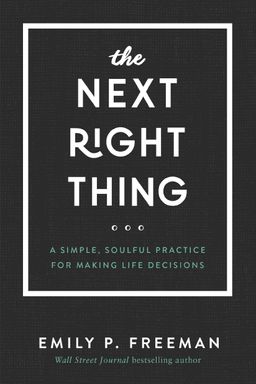
Have you ever been paralyzed by a decision—so weighed down by options and fear of doing the wrong thing that you end up doing nothing at all? In The Next Right Thing, Emily P. Freeman invites you into a radically gentle, deeply practical approach to decision-making rooted in peace, presence, and spiritual formation. Freeman contends that living a life of wise decisions doesn’t come from mastering a five-step strategy but from cultivating inner stillness, paying attention to your soul, and trusting God enough to simply do the next right thing that presents itself.
This book isn’t a manual for productivity or a self-help guide on decision efficiency. Instead, it’s a soulful companion for those who feel weary, rushed, and uncertain. Building on her training in Christian spiritual formation and the success of her podcast of the same name, Freeman explores how unmade decisions hold power—how they follow us around like restless toddlers tugging our sleeves. The anxiety of wanting to get everything right, she argues, is another way of trying to maintain control. But what if the real invitation is not to figure it all out, but to let ourselves be guided step by step?
Doing the Next Right Thing
Freeman borrows the simple but revolutionary phrase “do the next right thing” from a variety of sources—the Big Book of Alcoholics Anonymous, Theodore Roosevelt, Mother Teresa, and even biblical patterns seen in the Gospels. After performing miracles, Jesus often told people to take one small, concrete step—a leper to show himself to the priest, Jairus’s family to feed their resurrected girl. God rarely gives us a life plan; He gives us a single next invitation. “Do the next right thing” means not the next grand, glamorous thing but the next small, faithful thing right in front of you.
Freeman illustrates this through her own agonizing decision to return to graduate school. Torn between motherhood, career, and calling, she spirals through overthinking, seeking signs in sermons and even chocolate wrappers. Only when she stops striving for cosmic clarity and starts tuning in to God’s quiet steadiness does she recognize that the true work of decision-making is not control but communion. Each choice shapes not just our outcomes but our formation—our becoming.
A Soulful Approach to Decision-Making
Across twenty-four contemplative chapters, Freeman offers practices and stories designed to slow you down and train your inner ear for divine direction. Every chapter ends with two simple guides: a prayer and a practice. The prayers reorient your attention toward God’s presence (“O God, I am open”), while the practices translate spiritual insight into tangible motion—writing a list, embracing stillness, or having a soulful conversation. The aim isn’t to arrive at perfect answers but to recover spiritual union in the midst of uncertainty.
Her approach sits alongside other spiritual writers like Henri Nouwen, Dallas Willard, and Ruth Haley Barton, who emphasize discernment as relational listening rather than analytical problem-solving. “The decision is rarely the point,” Freeman reminds us. “The point is becoming more fully yourself in the presence of God.”
Why This Matters
We live in an age of abundance—of choices, information, and noise. Adults make tens of thousands of decisions every day. Yet the modern glut of options leaves us more fractured and anxious than ever. Freeman’s invitation is countercultural in its simplicity: instead of chasing five-year plans or exhausting yourself collecting advice, clear a little space within your soul, listen for what rises, and move toward love.
This, she explains, is both a spiritual and a psychological practice. It heals our addiction to certainty, burns through our fear of failure, and awakens our desire to live courageously present. By learning to become soul minimalists, to name the stories we live by, and to expect surprise rather than script control, we become people who trust God’s process even in ambiguity.
Ultimately, The Next Right Thing is about reclaiming space—in your schedule, your mind, and your spirit—to notice what truly matters. When decisions overwhelm you, you don’t need a divine blueprint. You just need the courage to trust that God delights in you, walks beside you, and whispers one step at a time: do the next right thing in love.