
Idea 1
Life on the Move
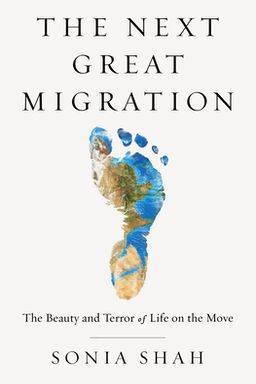
When you think of migration you probably picture dramatic upheavals — overflowing boats, long refugee marches, or armies on the move. Sonia Shah’s book transforms that image. She argues that migration is not crisis but continuity: the restless movement of life itself. Everything from butterflies to coral polyps, from birds to humans, shifts and adapts through motion. To understand migration properly, you must see it not as an act against nature but as one of nature’s organizing principles.
Migration as a biological norm
Across ecosystems, Shah presents data that erase the illusion of fixity. Camille Parmesan’s studies of Edith’s checkerspot butterfly revealed that even small, seemingly sedentary creatures move northward or upward to track changing temperature gradients. When that study spread to other species, scientists documented hundreds showing similar poleward or elevational shifts—terrestrial species by roughly twenty kilometers per decade and marine organisms up to seventy-five. Coral reefs creep north in Japan, frog ranges climb in the Andes, and tree lines in the Himalayas advance uphill. The biosphere is not fixed; it flows.
Human motion within the same pattern
Humans join this biological procession. Shah recounts stories like Ghulam Haqyar fleeing violence in Herat and Mariam, a teenager from Eritrea, escaping by foot through Ethiopia. Their movements mirror planetary forces—climate shifts, resource scarcity, and political conflict. Between 2008 and 2014, over twenty-six million people per year were displaced by environmental and disaster causes. By 2015, more than fifteen million fled across international borders. Such motion isn’t an exception; it’s woven into humanity’s adaptive history.
The false mythology of stasis
Why then is migration treated as threat? Shah traces it to centuries of intellectual habits: Carl Linnaeus’s taxonomy imagined nature as fixed and location-bound. His classifications tied human 'subspecies' to continents, assigning moral attributes that mirrored colonial hierarchies—ideas that turned geography into destiny. Later, the eugenics movement translated those taxonomic divisions into policy, using genetics as a justification to close borders and sterilize the 'unfit'. The Johnson-Reed Act of 1924 institutionalized those boundaries in law, creating a racialized model of control over who may move.
Fear, metaphor, and manipulation
The language of invasion pervades both ecological and social thought. Ecologists spoke of invading species; politicians borrowed the same metaphors for immigrants. Shah exposes even the natural-world myths — from Disney’s staged lemming suicide scene to Elton’s alarm about 'zoological catastrophes' — to show how stories of overrun and collapse appeal more to fear than to data. Modern media amplify this pattern: distorted crime statistics, misleading economic analyses, and visual bombardment of boats and camps instill panic. The error here is not statistical alone; it is conceptual, recasting adaptation as assault.
Science reshapes the narrative
The antidote arises from genetics and movement science. Modern DNA studies show human populations are remarkably similar—99.9% identical—without discrete racial boundaries. The supposed continental clusters often turn out artifacts of modeling choices. Ancient DNA research, especially the sequencing of petrous bones, reveals repeated mixing and migration, from Neanderthal and Denisovan interbreeding to backflows into Africa and Asia. The result is a braided, global lineage; ‘purity’ is biologically incoherent. Migration doesn’t break order—it drives evolution.
From biology to design
When you accept migration as the foundation of life, your response shifts. Ecologists now talk of movement ecology—tracking terns, wolves, zebras, and sharks through GPS and satellite-fed systems such as ICARUS. Conservation moves from preserving static habitats to maintaining corridors. Similarly, humane migration policy must design safe routes rather than barriers. Shah demonstrates how border walls kill both people and wildlife, fragmenting genes and ecosystems while failing to halt crossings. She contrasts this with wildlife overpasses, hybrid forests on Mauna Loa, and the UN Global Compact’s framework for orderly human mobility. Each works by aligning policy with biology: flow, not fortification.
Key insight
Migration is neither anomaly nor emergency. It is life’s strategy for survival and renewal. Recognizing this helps you reinterpret politics, ecosystems, and identity not as battlegrounds for purity but as fields of motion and exchange.
Across this synthesis, Shah invites you to see migration as the planet’s default behavior — from butterfly corridors to human refugee paths. When you shift from the myth of stasis to the reality of motion, you discover solutions founded on continuity, empathy, and design for living systems that must move to thrive.