
Idea 1
How to Balance Empire and Republic in a Turbulent World
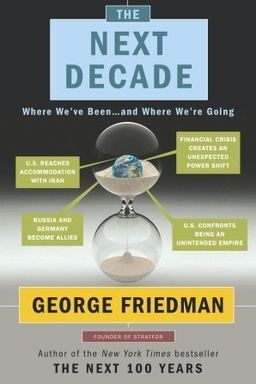
What happens when a republic built on anti-imperialist ideals finds itself ruling the world? In The Next Decade, geopolitical strategist George Friedman offers a provocative answer: the United States has unintentionally become a global empire—and how it manages that power in the next ten years will determine whether its democratic republic can survive. The book argues that America’s vast reach and responsibilities are now facts of life. The challenge is not to retreat but to learn how to exercise power wisely, balancing global dominance with ethical restraint at home and abroad.
Friedman contends that every empire faces a paradox. Power must be used to preserve security and prosperity, yet the very use of that power can corrupt the moral foundations of the republic. For America to thrive, its leaders—especially its president—must become what he calls a Machiavellian president: someone who can reconcile moral purpose with strategic ruthlessness. The next decade, he predicts, will test whether America can maintain global stability while keeping faith with its own ideals.
An Era of Unintended Empire
The book opens with the startling claim that America didn’t choose empire—it inherited it. When the Soviet Union collapsed in 1991, the United States was left with unmatched military, economic, and cultural power. Like Rome or Britain before it, this dominance created systems of dependence that extended American influence to every corner of the globe. But Friedman emphasizes that this empire is informal. The United States doesn’t conquer territories; it shapes global systems—financial, technological, and military—to serve both its own interests and the world’s stability.
This accidental empire, Friedman argues, now faces a balancing act. America must continue to uphold the global order—containing regional powers like Russia, China, and Iran—while also avoiding the overreach that toppled past empires. The nation’s greatest long-term threat isn’t external enemies but internal decay: the possibility that managing an empire will destroy the constitutional balance and civic virtue of the republic itself.
The Machiavellian President
Central to Friedman’s argument is the unique role of the American presidency. Drawing on Machiavelli’s The Prince, he asserts that the successful president must blend moral conviction with deception and pragmatism when necessary. Historical figures like Abraham Lincoln, Franklin Roosevelt, and Ronald Reagan embodied this balance. They were moral visionaries who also lied, manipulated, or broke laws when survival demanded it—preserving the republic through strategic cunning rather than purity of motive. In the coming decade, Friedman says, presidents will again need to act ruthlessly abroad to safeguard freedom at home.
This view contrasts sharply with idealistic foreign policy approaches that seek to impose democratic values universally. Instead, Friedman calls for realpolitik with a moral compass—a policy guided by American principles but grounded in cold strategic calculation. The president must accept that the world is dangerous, that allies often act from self-interest, and that moral purity without power invites chaos.
America’s Global Balancing Act
Friedman structures the book around the geopolitical regions where U.S. strategy will be tested in the next decade. In Europe, the United States must prevent a German-Russian entente that could dominate the Eurasian continent. In the Middle East, it must quietly disengage from moralistic crusades and reestablish a pragmatic balance of power—potentially even striking an accommodation with Iran. In Asia, the focus should be not on containing China’s rise but on managing Japan’s potential resurgence. And in the Western Hemisphere, the goal is simple: maintain security with minimal direct involvement, using regional partners like Mexico, Brazil, and Canada.
Through this lens, the next ten years represent a crucial transitional era. America must evolve from the reactive superpower of the post-9/11 years into a more subtle imperial manager—using diplomacy, proxy alliances, and economic leverage rather than constant wars or worldwide policing. The challenge will be to maintain influence while ceasing to overextend military force.
Empire, Republic, and the Moral Test Ahead
Friedman’s warning is both philosophical and practical. Empires often fail not from external defeat but from moral exhaustion—when the costs of power erode civic unity and ethical restraint. Like Rome sliding into imperial autocracy, America risks losing its republican soul if fear, secrecy, and militarization dominate public life. The presidency, therefore, must serve as the hinge between empire and republic, mastering power without succumbing to tyranny.
Ultimately, The Next Decade calls for maturity—in leadership and in the public. Americans must abandon fantasies of either righteous withdrawal or moral perfection. As Friedman puts it, “Justice comes from power, and power is only possible from a degree of ruthlessness most of us can’t abide.” Yet he insists this realism need not mean cynicism. Power, handled with wisdom and restraint, can serve liberty rather than destroy it.
“The tragedy of political life,” Friedman writes, “is the conflict between the limits of good intentions and the necessity of power.”
This tragedy, he argues, is not a flaw of America but the essence of its global role. The nation’s task in the next decade is to learn how to live with power—honestly, prudently, and without losing the moral backbone that made it great in the first place.