
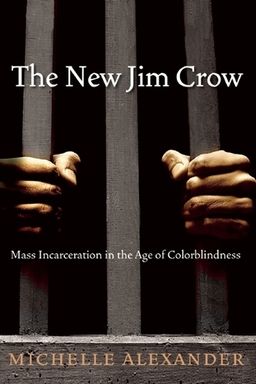
The New Jim Crow cover

The New Jim Crow

by Michelle Alexander

The New Jim Crow unveils the hidden yet pervasive system of mass incarceration in America, echoing the oppressive Jim Crow era. Through an insightful analysis, it reveals how the War on Drugs perpetuates racial discrimination, urging a transformative dialogue on race and justice.

Mass Incarceration as Racial Caste

What if the rise of mass incarceration in America is not an accident of tough-on-crime politics but a deliberate redesign of racial control? In The New Jim Crow, Michelle Alexander argues that the U.S. criminal justice system has created a new racial caste structure—one that controls and marginalizes millions of Black Americans under the guise of colorblind law and order. She invites you to see mass incarceration as the modern reincarnation of slavery and Jim Crow segregation—systems that have evolved rather than disappeared.

The Continuity of Control

Alexander traces a recurring pattern in U.S. history: slavery's end gave rise to the Black Codes and convict leasing; Reconstruction’s brief freedoms yielded to Jim Crow segregation; and when civil rights dismantled Jim Crow, a new system emerged through the criminal justice system. Each transformation kept racial hierarchy intact while adjusting to new legal and moral climates. Jarvious Cotton’s family history—each generation denied basic rights under different guises—illustrates this unbroken pattern.

(Note: Alexander draws on W.E.B. Du Bois’s observation that “the slave went free; stood a brief moment in the sun; then moved back again toward slavery.” That sentence frames her entire narrative.)

The Colorblind Veil

Unlike slavery or Jim Crow, the modern caste system hides behind a façade of colorblindness. Laws no longer mention race; instead, they invoke crime, drugs, and public safety. As Alexander writes, the U.S. has shifted from using racial language to criminal labels: those marked as “felons” become legally discriminated against in housing, voting, employment, and public benefits. This transformation is powerful precisely because it appears fair. You think of mass incarceration as a neutral response to crime, yet it functions as racial subjugation in practice.

Core Insight

In the age of colorblindness, the system no longer uses race to exclude directly—it uses the label 'criminal' to justify legal discrimination, social stigma, and civic exile.

The Scale of the Problem

Within three decades, America’s incarcerated population exploded from about 300,000 to more than two million. The United States now imprisons people at rates unmatched in the democratic world—about 750 per 100,000 compared with Germany’s 93. This expansion did not mirror crime rates; violent crime had fallen before imprisonment peaked. The explosion, Alexander shows, was political and structural—built through policy incentives, electoral rewards, and funding mechanisms that fueled arrests and kept prisons full.

The Human Cost

The prison label itself functions as social death. Once branded a felon, you lose access to voting rights, housing, jobs, education, and family stability. The punishment extends long after release, forming a “second prison” that is invisible yet enduring. In this way, the justice system doesn’t merely punish—it manufactures an undercaste. You may leave your cell, but the box on an application, the denied lease, and the returned job letter continue to confine you.

Where Reform Must Begin

If you think reform means adjusting sentencing laws or adding rehabilitation programs, Alexander urges you to think deeper. The problem is not faulty law but the structure of racialized social control itself. True justice demands a cultural reckoning—a collective awakening that challenges the assumption that some populations can be sacrificed for safety. To end mass incarceration, you must not only change laws but redefine who deserves belonging and dignity in American democracy.

This opening framework sets the terms for the rest of the book. Alexander dissects how the system was built, how it operates through courts and policies, and why reform without moral transformation cannot dismantle what she calls the new Jim Crow.


The War on Drugs

The rise of mass incarceration began not with a crime wave, but with a calculated political project: the War on Drugs. Starting under Nixon and reignited by Reagan, this campaign used coded racial rhetoric to reconfigure national politics and social policy. Alexander reveals that drug enforcement became the vehicle through which the new racial caste was constructed.

Coded Appeals and Political Realignment

In the wake of the Civil Rights Movement, overt racism lost legitimacy. Yet politicians quickly discovered that “law and order” could mobilize anxious white voters without racial language. Nixon’s Southern Strategy and Reagan’s tough-on-crime agenda reframed the political landscape, turning anti-drug and anti-welfare rhetoric into campaign currency. Phrases like “welfare queens” and “crack epidemic” served as proxies for racial fear.

Media Frenzy and Policy Panic

Reagan officially declared the drug war in 1982—before crack cocaine had emerged as a major issue—but by the mid-1980s, sensational media coverage of “crack babies” and urban crime sealed public approval. Alexander shows that the panic was manufactured: drug use rates were declining, yet federal and local spending on enforcement skyrocketed. Media images of Black “gangstas” and poor neighborhoods in crisis hardened racial stereotypes and turned punitive policies into moral necessity.

Incentives and Institutional Growth

Federal funding like the Edward Byrne Grants rewarded police and prosecutors for drug arrests rather than treatment or prevention. The Pentagon transferred military equipment to local agencies. Operation Pipeline trained officers to conduct highway drug interdictions based on vague courier “profiles.” Cash forfeitures allowed departments to keep seized assets, making arrests profitable. These incentives transformed the drug war into a self-sustaining machine that fed institutional budgets while draining communities of freedom.

Key Point

The War on Drugs was not a response to crime but a political strategy that converted racial backlash into state policy. It entrenched a permanent policing infrastructure and made mass incarceration politically profitable.

By the 1990s, Democrats joined the punitive consensus to avoid appearing “soft on crime.” The result was bipartisan support for draconian sentencing, sweeping police powers, and massive incarceration—all sustained by a racial logic too politically convenient to abandon.


Courts, Police, and the Vanishing Fourth Amendment

For the drug war to thrive, courts had to loosen constitutional protections that once limited police power. Alexander shows how judicial decisions steadily hollowed out the Fourth Amendment—the safeguard against unreasonable searches and seizures—creating an environment where racial targeting could flourish under a legal shield.

Consent and Pretext

Supreme Court rulings such as Schneckloth v. Bustamonte and Florida v. Bostick redefined “consent” in police encounters. You may legally refuse a search, the Court said, but in reality almost no one feels free to decline. Later, Whren v. United States allowed officers to use minor traffic violations as pretexts for drug investigations. Combined, these decisions gave law enforcement nearly limitless discretion to stop, search, and question citizens—especially in targeted neighborhoods.

Incentivized Policing and Militarization

Armed with federal money and legal immunity, police departments adopted military tools and tactics. SWAT deployments shot from hundreds to tens of thousands annually. Officers executed no-knock raids for low-level offenses, often injuring or killing innocent residents like Alberta Spruill in New York. (Note: These trends echo the militarization patterns described by Radley Balko in Rise of the Warrior Cop.) The line between community policing and warfare blurred beyond recognition.

Power Without Accountability

Alexander highlights that racial profiling remains nearly impossible to challenge in court. In McCleskey v. Kemp, statistical proof of bias was dismissed as irrelevant without individual discriminatory intent. Armstrong v. United States required defendants to produce evidence they couldn’t access to prove selective prosecution. These rulings effectively legalized systemic discrimination so long as it lacked open racial admission.

Bottom Line

Courts built a paradoxical system: one that forbids racial discrimination in theory but protects it in structure. By expanding police discretion and blocking racial claims, the law itself became the cage’s architecture.

Through legal precedents and financial incentives, the state created an enforcement complex where racialized policing is both predictable and unassailable—a “colorblind” caste system with constitutional approval.


Inside the System: Prosecutors and Punishment

Once arrested, you enter a legal process designed to secure convictions, not justice. Prosecutors hold all the cards: they choose charges, determine sentencing exposure, and compel pleas. Alexander reveals how prosecutorial discretion—combined with weak defense systems and mandatory minimums—ensures that most cases never reach trial.

Plea Bargains and Power

Over 90 percent of criminal cases end in plea deals. Prosecutors exploit harsh sentencing laws as leverage: they threaten defendants with decades in prison to force guilty pleas for lesser terms. Public defenders, overwhelmed and underfunded, often counsel acceptance simply to move dockets. Justice becomes administrative efficiency.

Mandatory Minimums and Three Strikes

Legislatures stripped judges of discretion through rigid sentencing schemes. Alexander cites cases like Weldon Angelos—sentenced to fifty-five years for marijuana sales involving firearms—and Leandro Andrade—imprisoned for life after minor thefts under California’s three-strikes law. The system normalized grotesque penalties in the name of deterrence.

Economic Architecture of Control

Financial motives deepen control. Civil asset forfeiture allows police to seize property on suspicion and keep proceeds. Fines, fees, and restitution bills follow defendants into probation and parole, while prison labor pays pennies per hour. Ora Lee Hurley’s story—held in a work-release center she could never earn out of—shows how debt becomes economic bondage, a modern echo of convict leasing.

Key Learning

Punishment today is not only physical incarceration but also financial and procedural ensnarement. The system profits from poverty, turns guilt into debt, and perpetuates dependence and exploitation.

Through this machinery, courts transform millions of poor, mostly Black citizens into felons—not because they’re the most dangerous, but because they’re the easiest to prosecute. The goal is throughput, not fairness; the outcome, a population branded for life.


Civic Death After Release

Leaving prison does not restore freedom—it marks entry into another stage of control. Alexander calls this 'invisible punishment': the maze of laws, bans, and stigmas that follow people after release. You serve your time, yet society refuses to let you belong again.

The Prison Label

A felony label strips basic rights. You may lose the vote, public housing access, food assistance, professional licenses, and jury eligibility. Jarvious Cotton embodies this civic death: like his forefathers under slavery and Jim Crow, he cannot vote—not because of explicit racism but because of the word 'felony.'

Barriers to Work and Shelter

Employment screens and housing bans institutionalize exclusion. The checkbox on applications—“Have you ever been convicted?”—is a quiet gatekeeper. Sociologist Devah Pager shows that a felony cuts job callbacks by over half, especially for Black men. Federal housing rules like 'One Strike and You’re Out' eject families for minor arrests, spreading instability. The 1996 welfare reform law extended lifetime bans on aid for drug felons, ensuring that punishment extends into hunger and homelessness.

Economic and Political Silencing

Debt, garnishments, and probation fees consume the earnings of those who manage to find work. Many, like Clinton Drake, lose the right to vote until they pay fines—modern poll taxes in disguise. This dual exclusion—economic and political—drains whole communities of agency. (Note: Florida’s 2000 election results illustrate how disenfranchisement can reshape national power.)

Critical Recognition

The post-prison world is not reintegration but continual punishment. By denying jobs, shelter, and suffrage, the state ensures that ex-offenders remain a subordinated caste—visible in stigma, invisible in rights.

Mass incarceration does not end at the prison gate; it extends into neighborhoods and family lines, locking millions into poverty and silence. The undercaste is perpetuated not through chains but through paperwork, debt, and stigma masquerading as lawful order.


Stigma, Culture, and Resistance

Social stigma glues the caste system together. Legal discrimination might exclude you from housing or work, but shame ensures you exclude yourself. Alexander explores how silence, passing, and the spectacle of gangsta culture reinforce marginalization while also generating forms of resistance.

The Tyranny of Shame

Families often hide incarceration as a disgrace. Constance conceals her son’s arrest; Ruth avoids disclosing her brother’s imprisonment. This secrecy fractures community networks and prevents collective action. David Braman calls it “pluralistic ignorance”: each person thinks they’re alone, even when nearly every family nearby is affected.

Gangsta Culture as Response

For many young men, embracing the criminal stereotype becomes a shield. If society already sees you as dangerous, performing that identity restores some sense of dignity. Alexander likens this to earlier identity turnarounds—Black pride and gay pride movements—but warns that mass-media commodification has distorted it. TV and music industries profit by turning stigmatized images into entertainment, echoing the minstrel shows of Jim Crow.

Breaking the Silence

Shame prevents organization; acceptance fuels transformation. Movements like All of Us or None confront stigma by asserting pride in survival and demanding rights restoration. (Note: This parallels the strategy of visibility in other oppressed communities; acknowledging harm becomes the first step toward healing.)

Essential Takeaway

Transformation requires more than reforming laws—it demands restoring dignity. A society that shames its outcasts cannot heal; one that embraces their humanity begins to end the cycle of control.

Cultural resistance must pair pride with policy. Confronting stigma is political work: it forces the nation to see those it has rendered invisible and to redefine justice as inclusion, not exclusion.


The Birdcage and the Way Out

To understand how the components of mass incarceration function together, Alexander uses Iris Marion Young’s birdcage metaphor. Each law, policy, and stigma may seem like a single wire, but collectively they form a cage that confines millions. You cannot remove one wire and expect freedom; dismantling the system requires addressing every strand of control.

Three Stages of Entrapment

Stage one is the roundup—policing that disproportionately targets Black and brown neighborhoods through drug sweeps and pretext stops. Stage two is formal control—court processes that extract pleas and impose long supervision terms. Stage three is invisible punishment—the lifetime of legal exclusion that follows release. Together, these stages transform communities into controlled populations under a colorblind banner.

Parallels and Illusions

Like Jim Crow, the new caste relies on legalized discrimination, political disenfranchisement, and social stigma. Unlike Jim Crow, it denies its racial nature, punishing some whites to preserve its legitimacy. The illusion of fairness sustains public consent; the system’s racial core hides in plain sight.

Toward Abolition and Awakening

Alexander warns that piecemeal reform will not break the cage. You must dismantle the incentives that make incarceration profitable, the laws that perpetuate exclusion, and the narratives that equate safety with punishment. She calls for a moral and political awakening akin to the civil rights movement—a multiracial coalition that demands not simply fewer prisoners but the end of caste itself.

Final Message

Freedom cannot come from adjusting the cage; it comes from recognizing it as a cage and refusing to accept it as normal. Ending mass incarceration requires a collective decision to stop exchanging human beings for a sense of order.

When you step back and see the system as a whole—from drug war origins to post-prison life—you see not separate problems but an unbroken structure. Alexander’s work urges you to expose it, name it, and dismantle it, so that equality under law becomes reality, not rhetoric.

Dig Deeper

Get personalized prompts to apply these lessons to your life and deepen your understanding.

Go Deeper

Get the Full Experience

Download Insight Books for AI-powered reflections, quizzes, and more.