
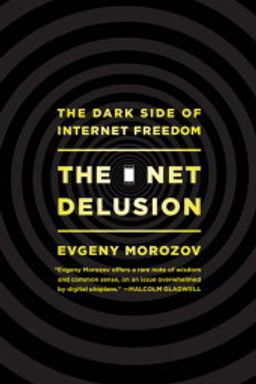
The Net Delusion cover

The Net Delusion

by Evgeny Morozov

The Net Delusion by Evgeny Morozov challenges the notion of the internet as a liberating force. It reveals how both authoritarian and democratic regimes exploit the web for control, censorship, and propaganda. Through compelling examples, Morozov exposes the complexities of digital freedom, urging readers to rethink the internet''s role in modern politics.

The Myth and Reality of Internet Freedom

Can the Internet liberate societies simply by connecting them? In The Net Delusion, Evgeny Morozov shatters that comforting belief. He argues that much of Western Internet policy—especially the U.S. promotion of 'Internet freedom'—rests on cyber-utopianism (the conviction that connectivity equals democracy) and Internet-centrism (the habit of treating technology as a decisive cause rather than a contextual tool). You, as a reader or policymaker, are shown how this mindset leads to naïve strategies and unintended harm.

Morozov's book is both warning and framework. It exposes how the Internet can serve authoritarian agendas as readily as civic ones, how 'slacktivism' hollows genuine activism, and how misplaced faith in apps and platforms has real consequences—from the Iranian crackdown of 2009 to the failed Haystack project. He invites you to trade ideology for what he calls cyber-realism: a grounded approach that treats digital technologies as politically contingent instruments, useful only when embedded in local understanding.

The Google Doctrine: A Modern Faith

At the book's center stands Morozov’s notion of the Google Doctrine—the belief that more information and connectivity inherently weaken authoritarian power. Its roots lie in Cold War analogies: just as samizdat and radio helped delegitimize Soviet regimes, so Twitter and YouTube now promise instant liberation. But the doctrine collapses under scrutiny. In Iran’s 2009 protests, only a handful of Twitter accounts were active inside Tehran; much of the noise came from outsiders. The U.S. State Department’s well‑publicized email to Twitter asking for maintenance delays only fueled regime paranoia and enabled tighter repression.

You learn that good intentions are not enough: policies derived from myth can backfire—making foreign platforms look like American tools, triggering surveillance races, and endangering precisely the people they claim to help. (Note: this echoes critiques of idealism in foreign policy by scholars like George Kennan and realist thinkers who warned against moral crusades detached from context.)

From Context to Consequence

Morozov’s most consistent lesson is simple but profound: context beats technology every time. Digital tools only amplify existing social structures; they don’t rewrite them. He compares post‑1989 myths—when photocopiers and fax machines were romanticized as tools of revolution—to today’s Internet rhetoric. Real change then came from political and economic crises, not gadgets. Likewise, today authoritarians allow entertainment and shopping online while blocking politics, proving they can adapt faster than idealists expect.

Examples include East Germany, where exposure to Western TV increased satisfaction and reduced emigration—not rebellion—and Russia and China, where the web nurtures both dissidents and loyalists. The more finely you map context, the better you understand how technology interacts with power, incentives, and local institutions.

A Dark Mirror: The Spinternet and Invisible Control

Morozov recasts censorship and propaganda for the 21st century. You expect firewalls and site bans; he shows subtler forms instead—crowdsourced takedowns, DDoS harassment, and commercial over‑compliance. Regimes now outsource control to citizens and private firms. China's 'Fifty‑Cent Party' floods comment sections with patriotic posts, while Russia trains pro‑government bloggers. The propaganda model becomes participatory, optimized for algorithms and virality—the Spinternet, where spin replaces silence.

This new censorship is fluid, invisible, and psychological. It destroys communities rather than URLs, overwhelms dissent rather than blocks it, and erodes trust in open platforms. For activists, resilience now depends less on technical evasion and more on social design—redundant hosting, distributed archiving, and transparent narratives countering propaganda.

Slacktivism and the Mirage of Mobilization

The Internet’s low barrier for participation changes the nature of civic engagement. You can 'Like' or retweet and feel virtuous. Morozov calls this the slacktivist trap: mass participation without endurance. Kierkegaard’s reflection on 'chatter'—speaking without commitment—frames the problem: attention cycles crowd out moral depth. Facebook groups like No Más FARC show how spectacle replaces sustained organization. You get crowds without institutions, emotion without structure.

The cure is realism: treat online platforms as amplifiers of commitment, not substitutes for it. Fund local organizations, leadership training, and offline infrastructure. Digital awareness without physical engagement breeds frustration, not reform.

Security, Sovereignty, and Cyber-Realism

Morozov’s later chapters deepen the realism. Surveillance is now automated, predictive, and integrated into commercial data streams. Cloud storage, Tor, and mobile networks each carry exploitable flaws—metadata leaks, Trojanized software, or GPS tracking. States and firms read your digital exhaust as intelligence. Thus, 'Internet freedom' rhetoric rings hollow if the same governments exporting circumvention tools also expand domestic surveillance and restrict cryptography.

The Haystack debacle becomes emblematic: hype and political urgency created unsafe software licensed for Iranian dissidents. Morozov’s plea for cyber‑realism means designing small, context‑aware interventions, reviewed by experts rather than PR strategists. Authoritarian regimes adapt; Western hubris accelerates their evolution. Sustainable progress requires humility, not evangelism.

Core Message

The Internet changes everything—and nothing—until you understand its politics. Liberation, control, distraction, and surveillance coexist. Morozov's realism restores complexity to a narrative oversimplified by hope.

In sum, The Net Delusion teaches you to distrust simple stories about technology and power. Internet freedom, far from automatic, is a contested, strategic domain where naive optimism invites exploitation. The challenge is to replace myth with method—to stay ambitious about liberty but realistic about the medium through which it moves.


The Google Doctrine

Morozov introduces the Google Doctrine as the spiritual foundation of Internet‑freedom policy. You see this doctrine everywhere: the assumption that digital connectivity naturally produces transparency, accountability, and reform. Its lineage stretches from Radio Free Europe to Twitter revolutions. Policymakers rely on the analogy even when evidence contradicts it.

The Persian Test Case

The 2009 Iranian Green Movement exposed the doctrine’s fragility. American commentators hailed it as the 'Twitter Revolution', while data revealed negligible Iranian Twitter use. Most tweets came from outside the country. When a U.S. diplomat asked Twitter to delay maintenance, it validated Tehran's narrative that online platforms were U.S. intelligence instruments. The fallout was harsher censorship, arrests, and propaganda.

The lesson: policy driven by myth harms its subjects. Treating platforms as political tools turns users into targets.

Policy Hubris and Online Nationalism

What Morozov calls 'digital hubris' pushes authoritarian states to strengthen their own tech ecosystems. Iran accelerates censorship innovations; China and Russia cultivate patriotic trolling networks. Western evangelism becomes the catalyst for authoritarian innovation.

(Note: This mirrors Karl Popper’s warning against historicism—the urge to deduce political destiny from abstract theory rather than experience.)

From Doctrine to Doubt

The antidote is humility and local intelligence. You should begin with specific governance conditions, not universal faith. Some contexts turn connectivity into surveillance; others turn entertainment into complacency. Technology's moral valence fluctuates with its political environment.

Key takeaway

The Internet cannot liberate anyone on its own. It magnifies what's already there: repression, hope, distraction, or courage. Policy must follow context, not myth.

By dismantling the Google Doctrine, Morozov reopens the question of what freedom means online—and warns you never to confuse a communication technology with a political movement.


Context Over Connectivity

Morozov’s mantra that 'context beats technology every time' captures his entire philosophy. Connectivity changes possibilities but does not dictate outcomes. If you ignore local history, social structure, and incentives, you mistake cause for correlation.

Beyond the 1989 Analogy

Policymakers often romanticize the fall of the Soviet bloc, linking its collapse to fax machines and radio signals. Morozov corrects this myth: 1989 succeeded because of Gorbachev’s restraint, economic pain, and shifting political elites—not gadgets. Replaying that narrative with Facebook and cell phones misses the crucial variable: people organize under constraints shaped by institutions, not devices.

Samizdat vs. Blogging

Equating photocopied samizdat to modern blogs confuses intent. Samizdat was deliberate dissent; blogging is diverse and often loyalist. Russia and China host armies of pro‑regime bloggers, proving that platforms empower all voices equally—including propaganda. The result is moral symmetry: freedoms of speech and manipulation rise together.

Lessons from East Germany

East Germans who watched West German TV did not rebel—they grew more content. Exposure pacified rather than radicalized. Morozov uses this paradox to show that technology’s psychological effects depend on social interpretation: new media can soothe discontent as easily as mobilize it.

Essential insight

The Internet is an amplifier, not a driver. Who gains from amplification—citizens or rulers—depends on the existing political, cultural, and institutional landscape.

For effective digital policy, you must start from the ground: identify who benefits, who is exposed, and how online engagement integrates with offline realities. The principle is simple: study society first, then choose tools second.


The Spinternet and Invisible Censorship

Authoritarian regimes have learned to thrive online. Rather than block content bluntly, they shape narratives and drown dissent. Morozov calls this evolved environment the Spinternet—a web dominated by spin, crowdsourced propaganda, and invisible filtering.

Propaganda as Participation

In China, the 'Fifty‑Cent Party' mobilizes citizens to post patriotic comments, blurring the line between voluntary opinion and guided messaging. In Russia, Konstantin Rykov and Maria Sergeyeva turned entertainment and youth culture into pro‑Kremlin viral content. Propaganda becomes decentralized, mimicking organic enthusiasm.

New Censorship Techniques

Instead of walls, governments use DDoS attacks, hosting pressure, and community flagging. Thailand’s citizen reporting, Saudi flagged content, or corporate moderation all function as crowd‑enforced censorship. Dissidents become 'digital refugees', moving from server to server.

The Psychology of Credibility

When propaganda masquerades as genuine comment, truth itself erodes. Activists can no longer rely on audience trust; outsiders cannot tell authentic dissent from manipulated discourse. The battlefield shifts from information access to information legitimacy.

Strategic implication

Censorship today works not by silence but by saturation. Countering it requires transparency, redundancy, and community resilience rather than purely technical defense.

Morozov urges you to fight for credibility and capacity, not just bandwidth. The next battles are about trust, interpretation, and endurance.


Surveillance and Security Tradeoffs

Modern surveillance captures more than intercepted messages—it mines behavioral traces. Morozov reframes it as ambient, algorithmic, and commercial. Every click, search, and friend link reveals social graphs, preferences, and activism clues.

The New Panopticon

States now use face‑recognition, packet inspection, and database correlation to map dissent. Belarusian activist Pavel Lyashkovich was identified via VKontakte’s friend network. In China, thousands of cameras feed centralized analysis. Western commercial tools—Face.com or SAPIR—make these practices easy to copy across borders.

Cloud, Tor, and Mobile Vulnerabilities

Convenient tools often expose users. Cloud archives leak metadata; Tor hides IPs but not content; mobile networks betray location and contacts. Malware disguised as local utilities (the Vietnamese keyboard trojan) shows how attackers weaponize trust.

Security by Realism

Morozov’s rule is holistic: the weakest link defines safety. Encryption matters less than operational discipline—segregating identities, vetting downloads, and limiting central points of failure. Secure activism depends on architectural design and user training.

Practical takeaway

Security tools are never neutral guarantees; they are strategies requiring education and redundancy. Treat them as posture, not product.

By redefining surveillance as data science plus behavioral insight, Morozov shows that defending freedom now means shrinking one’s digital footprint and changing institutional defaults, not merely coding better software.


Slacktivism and Shallow Mobilization

Morozov pushes you to examine modern activism through Kierkegaard’s lens of moral seriousness. In an age of clicks, symbolic participation substitutes for personal sacrifice. He terms the phenomenon slacktivism: participation divorced from cost.

Attention Without Action

Digital networks make organizing easy, but sustaining commitment difficult. Facebook groups spike in numbers fast (as in the Danish Stork Fountain experiment) but vanish just as fast. Online attention cycles lack strategy, logistics, and accountability. The result is activism as performance.

Symbolic Success and Real Failure

In Colombia, the No Más FARC campaign resonated because it complemented civic forces; in Venezuela, a similar anti‑Chávez campaign fizzled. Context again decides effectiveness. Digital visibility is not the same as power.

Rekindling Serious Dissent

Morozov invokes historical dissidents like Sakharov—to show that moral courage, institutional effort, and enduring structure matter more than viral reach. Activism should use technology to coordinate—not replace—real risk and leadership.

Lesson for activists

If participation requires nothing, it achieves little. Build institutions that convert attention into sustained pressure.

Morozov’s insight shifts focus from network size to organizational depth: real change comes from structures that survive beyond trending topics.


From Technological Fixes to Cyber‑Realism

The book closes by contrasting technological fetishism with cyber‑realism. Many policymakers seek quick fixes: fund an app, distribute proxies, export software. Morozov argues that such optimism ignores the complexity of authoritarianism—a wicked problem that cannot be algorithmically solved.

Haystack and the Danger of Hype

Haystack promised safe circumvention for Iranians but failed technical review. Political urgency overrode security diligence, sending unsafe tools into risky environments. The episode demonstrates how media hype can produce moral hazard—feel‑good intervention that endangers users.

Principles of Cyber‑Realism

Cyber‑realism roots policy in local expertise and incremental experimentation. It values diplomacy, legal reform, and institutional capacity over gadgetry. Morozov urges regional consultation, independent auditing, and separation of mass‑market tools from sensitive encryption exports. He treats Internet policy as part of foreign relations, not charity work.

Replacing Faith with Method

In essence, you move from worshipping technology to mastering politics. Instead of universal formulas, learn local patterns. Cyber‑realism acknowledges moral ambition but demands evidence, revision, and humility—a philosophy closer to evolutionary policy than revolutionary hope.

Final insight

Technology does not replace politics; it reframes it. Morozov’s realism teaches you to design freedom strategically rather than romantically.

By ending on pragmatism, Morozov rescues the ideal of Internet freedom from utopia, placing it within the disciplined realm of governance and accountability.

Dig Deeper

Get personalized prompts to apply these lessons to your life and deepen your understanding.

Go Deeper

Get the Full Experience

Download Insight Books for AI-powered reflections, quizzes, and more.