
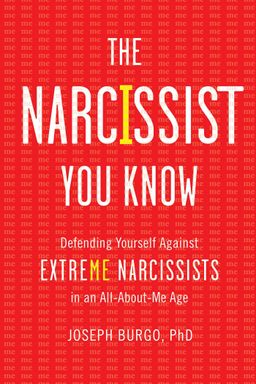
The Narcissist You Know cover

The Narcissist You Know

by Joseph Burgo

Delve into the world of narcissism with Joseph Burgo''s insightful exploration of Extreme Narcissists. Discover the hidden shame driving their behaviors, learn to spot various narcissistic types, and gain valuable strategies to protect yourself in a world increasingly focused on self-interest.

Understanding the Narcissist You Know

Have you ever found yourself feeling small, confused, or strangely off-balance around someone who seems supremely confident? In The Narcissist You Know, psychotherapist Joseph Burgo explores why certain people have a remarkable power to distort reality and damage the self-esteem of those around them—while convincing us they’re dazzling winners. His central claim is that narcissism isn’t simply vanity or self-love. It’s a defensive posture forged in shame, a desperate attempt to escape the unbearable feeling of being small, defective, or unloved.

Burgo argues that narcissism exists along a continuum—from everyday self-absorption (“the occasional narcissist,” as he calls himself) to the dangerous, emotionally predatory behaviors of what he terms Extreme Narcissists. Extending beyond clinical labels, he maps out nine recognizable types that appear in ordinary life: the bullying, seductive, grandiose, know-it-all, self-righteous, vindictive, addicted, and narcissistic-parent varieties. Each type hides the same root wound—shame—and each affects people around them through the same winner-versus-loser dynamic.

The Emotional Architecture of Narcissism

At its core, narcissism is a psychological defense designed to keep unbearable pain at bay. Burgo builds on thinkers like D.W. Winnicott and Andrew Morrison to show how shame lodges “at the core of being,” creating a sense of defectiveness so intense that the narcissist must continually deny or project it. This defense produces inflated self-importance and an absence of empathy—the twin pillars of all narcissistic behavior. Everyone, Burgo insists, uses some version of these defenses when wounded; the difference is that Extreme Narcissists take them to pathological extremes.

Life Inside the Winner–Loser Dynamic

Extreme Narcissists perceive every relationship through the lens of winners and losers. Their self-esteem depends on victory—they must triumph socially, sexually, professionally, or emotionally. The problem is, this need turns every interaction into combat. Some narcissists bully others into submission; others seduce admirers or aestheticize their superiority through charisma. Burgo uses figures like Lance Armstrong, Madonna, Donald Trump, and Steve Jobs to show how narcissists enthrall and exploit people, masking emptiness behind bravado.

Seen this way, narcissists aren’t just cruel—they’re tragic. They wage endless psychological battles to keep shame away. But in doing so, they erode empathy and alienate others, ensuring the very emptiness they’re fleeing. As Burgo reminds us repeatedly, the most effective defense against narcissistic harm is awareness: understanding both the narcissist’s inner turmoil and the ways we unconsciously play into it.

Why This Book Matters

In a culture that rewards confidence and self-promotion—what Burgo calls a “narcissism epidemic”—many of us mistake pathology for charisma. His goal is to help ordinary readers recognize narcissistic behavior in the people around them and in themselves, then learn to respond without escalating shame and retaliation. By identifying the root pattern—shame-avoidance through superiority—he gives readers a practical and psychological map for dealing with these emotional predators.

Core Promise of Burgo’s Framework

Burgo’s message is both sobering and hopeful: extreme narcissists rarely change, but you can change how you relate to them. The key is cultivating self-awareness and boundaries. Learning to recognize the winner–loser game frees you from taking the bait—and, ultimately, from measuring your own worth by their distorted mirror.

Across eleven chapters, Burgo moves from clinical profiles to real-life coping strategies, teaching that the narcissist’s destructive power lies not just in manipulation but in their capacity to trigger our own shame. By confronting that shared vulnerability, he reframes narcissism not as a diagnosis but as a human condition we all must manage—one that defines our relationships more than we realize.

In short, The Narcissist You Know offers a roadmap for understanding narcissism as both a defense against shame and a cultural epidemic—and for surviving, with sanity intact, the winners who make us feel like losers.


The Narcissistic Continuum

Burgo begins by redefining narcissism not as a binary disorder—someone either has or doesn’t have Narcissistic Personality Disorder—but as a continuum of human experience. We all have narcissistic impulses; they are part of how the self protects itself. The question is not whether you are narcissistic but how intensely you rely on these defenses when faced with shame, rejection, or failure.

From Self-Regard to Self-Defense

Healthy narcissism expresses itself as self-respect, confidence, and ambition—the qualities that allow you to pursue goals and assert boundaries. Pathological narcissism, however, turns self-regard into grandiosity. When early emotional attunement is absent—when children feel unseen, criticized, or used—they develop fragile self-esteem that requires constant external validation. Burgo, drawing on Winnicott’s concept of the “blueprint for normality,” emphasizes that empathy from parents teaches children that they are lovable even when imperfect. Without that foundation, shame takes root.

Sam and Naomi: Portraits on Opposite Ends

Burgo opens with two characters to demonstrate the continuum. Sam, the grandiose executive with Narcissistic Personality Disorder, is the extreme end—exploitative, arrogant, and incapable of true empathy. Naomi, the self-sacrificing mother, represents the subtler version: her martyrdom hides manipulation, envy, and the need to feel superior. Both harm others through narcissism, though Naomi’s version masquerades as virtue. In both cases, the core mechanism is the same: turning pain into superiority, ensuring that someone else—an employee, a child, a spouse—feels the shame they cannot bear themselves.

Everyday Narcissism

Burgo even identifies the narcissist in the mirror—himself. After monopolizing his piano teacher with his personal troubles, he realizes he had forgotten to ask about her summer. This small act of self-preoccupation reveals how stress or need can temporarily eclipse empathy. Such moments remind you that narcissism is not alien pathology but a universal human failing. Recognizing these micro-narcissisms allows compassion toward both yourself and others, rather than condemnation.

Burgo’s Central Insight

Everyone faces narcissistic injury—blows to self-esteem that tempt us to defend through blame, contempt, or superiority. Healthy self-esteem recovers; pathological narcissism cannot. The more fragile the inner self, the more one must prove worth by turning others into losers.

By showing narcissism as a spectrum of defenses against shame, Burgo strips the concept of its moral judgment and places it at the core of human psychology. Understanding this continuum shifts your perception—from seeing “bad people” to recognizing people trapped in their defenses.


Shame and the Narcissistic Injury

Why does criticism feel so unbearable to some people? Burgo’s chapter on narcissistic injury answers that question by revealing shame as the emotional engine that powers narcissism. What psychologists call “injury” is simply the pain of being reminded that we are imperfect—the sting of humiliation, rejection, or failure. Most of us recover from such blows. Extreme Narcissists, however, experience them as existential threats.

How Ordinary Shame Works

Through the story of Natalie, the overworked legal assistant who bungles her job review and gets dumped on the same day, Burgo shows the anatomy of a typical narcissistic injury. Her self-esteem plummets; she lashes out with blame (“It’s not fair!”), superiority (“Lawyers are boring”), and rage (“Men are assholes”). These reactions—blaming, contempt, indignant anger—are what Burgo calls narcissistic defenses. Everyone uses them to ward off shame. The Extreme Narcissist, however, turns them into a lifestyle.

The Principle of False Attribution

Burgo introduces a simple but profound psychological rule: when we feel pain, we assume someone must have caused it. This mechanism explains why narcissists interpret even neutral remarks as attacks. The wounded sense of self transforms internal shame into external blame. Since accepting responsibility would mean acknowledging defectiveness, the narcissist retaliates instead—often viciously.

Defenses that Destroy Relationships

Burgo’s examples of Jason, who lashes out at his wife to evade guilt about his pornography addiction, and Denise, who transforms a friend’s boundary into betrayal, show how narcissistic defenses erode intimacy. Each converts shame into moral superiority or cruelty—making others carry the pain that belongs to them. (Note: Donald Nathanson’s theory of affect supports this view, describing shame as an interruption of love or joy.)

Burgo’s Lesson

Understanding shame is the key to compassion. You’re less likely to escalate with a narcissist when you see their rage as a defense against humiliation, not a rational attack. “Criticism wounds the precious pride,” Burgo writes, echoing Dale Carnegie—yet empathy, not confrontation, offers the only path to peace.

Recognizing the cycle—shame, defensiveness, retaliation—helps you break free from the emotional contagion narcissists spread. The task is not to fix them, but to contain your own reactions so you don’t join their battlefield of winners and losers.


The Bullying Narcissist

Among the most visible and damaging types, the Bullying Narcissist finds self-worth by humiliating others. Whether they’re childhood tormentors, workplace tyrants, or famous competitors, their aggression masks fragility. Burgo’s portrait of Lance Armstrong epitomizes this type: behind the triumphant cyclist was a wounded boy proving he was not the loser his chaotic family had made him feel.

How Bullies Are Built

Burgo traces the roots of bullying to broken families where empathy is scarce. Using Winnicott’s “blueprint for normality,” he explains that children need parents who mirror their emotions and make them feel lovable. When raised amid neglect or abuse, they internalize shame as a core defect. To escape this pain, they identify with aggressors—becoming the source of cruelty instead of its victim. He illustrates this through Guadalupe Shaw, a teen who drove a schoolmate to suicide through online bullying while growing up in a violent home.

Projection and the Winner’s Crucible

Bullies externalize their shame: “I’m not the loser—you are.” The victim becomes a container for the bully’s inner ugliness. Burgo’s client Ryan, the shy middle-schooler tormented for his ethnicity, carried the shame projected by his attackers. The classroom, the office, and even global sports become stages where narcissists test superiority and discharge humiliation through competition.

Armstrong: Winning at Any Cost

Born into abuse and abandonment, Armstrong became obsessed with victory as proof of worth. When allegations of doping surfaced, he responded with lawsuits and character attacks instead of remorse. Like the fictional T‑1000 robot Burgo invokes, Armstrong’s defenses regenerated instantly; no criticism could pierce his armor. He annihilated anyone who threatened his winner image—journalists, teammates, even friends. Winning was survival, not achievement.

How to Respond to the Bully

Burgo’s advice is stark: don’t fight back on principle. Reason means nothing to an Extreme Narcissist; confrontation only deepens their shame and wrath. Safety lies in disengagement, boundaries, documentation, and sometimes escape. “Polish your résumé,” one therapist tells a bullied client—sometimes leaving is the healthiest act of self-respect.

Understanding bullies as shame-driven doesn’t excuse cruelty—it explains it. Seeing through their armor allows you to protect yourself from being dragged into their toxic competitions—and maybe, to understand that their rage is really terror in disguise.


The Seductive Narcissist

Not all narcissists attack directly. Some mesmerize. The Seductive Narcissist wins your devotion by making you feel special, adored, and chosen—then discards you once you’ve served their need for admiration. Burgo’s case studies of Harlan, Julia, and Madonna reveal charisma as emotional manipulation, with shame hiding beneath the glamour.

Charm as Weapon

Harlan, the irresistible businessman who boasts “I can seduce anyone,” exemplifies this type. His confidence and eye contact simulate empathy but only to capture attention. The victim feels exhilarated by the illusion of intimacy. Once admiration fades, he moves on. Seductive Narcissists are brilliant mood managers—they read desire and reflect it back. Their motto: “I’ll make you feel like a winner, if you make me one too.”

Behind the Mask: Shame and Loss

Burgo’s client Julia spent her life enchanting men but felt chronically empty. After losing her mother at six, she learned to control vulnerability by controlling attraction. When someone desired her, she felt powerful; when they loved her, she fled. Her seduction was a defense against grief—the oldest wound of all. (Madonna’s biography echoes this origin: losing her mother at five transformed her into the artist who declared she’d “rule the world.”)

Addictive Idealization

Seductive Narcissists turn love into intoxication. Tina Swithin’s “Prince Charming” ex made her feel uniquely adored until marriage exposed control and cruelty. This type feeds on idealization—the feeling of bliss that masks reality. Burgo likens it to a drug dependency: the rush of being adored gives temporary relief from shame, but the crash is inevitable. They want love to prove divinity, not connection.

Defense Against Dependency

Seductive Narcissists fear neediness more than anything. To depend is to be “small.” Their mantra: “I don’t need anyone.” So they reverse the equation—they make others need them. True intimacy feels like surrender, and surrender reawakens shame.

Burgo’s prescription is modesty and skepticism. When love feels like glory, pause. Ask whether adoration is replacing authenticity. Resist anyone who idealizes you too quickly—the charm that makes you feel chosen may also be the trap that turns you into a loser when they move on.


The Grandiose Narcissist

The Grandiose Narcissist lives in a fantasy of exceptional destiny. Burgo distinguishes between healthy ambition, which builds confidence through achievement, and grandiosity, which denies limitation. This type believes the usual rules don’t apply—whether it’s a tech visionary, a cult leader, or a spoiled child convinced of greatness.

From Giant Dreams to Reality Collapse

In clients like Nicole, a self-proclaimed “secret rock-star genius,” grandiosity becomes magical thinking. Her perfectionism and entitlement masked shame. Burgo interprets her dream of a diaper-wearing scientist as symbolic fraudulence—a baby pretending to be brilliant. Her story shows how defensive fantasy replaces growth; redemption begins when she tolerates ordinary effort and imperfection.

Cultural Mirrors of Grandiosity

Celebrity culture multiplies grandiosity. Through portraits of Kanye West, Tiger Woods, Julian Assange, and Lance Armstrong again, Burgo shows how perfect parents, permissive cultures, and inherited shame create people who “must be kings.” The Grandiose Narcissist’s motto: “I am special, therefore I owe no limits.” Even failure becomes proof of martyrdom. Assange’s paranoia—seeing enemies everywhere—reflects wounded superiority rather than genuine persecution.

The Paradox of Greatness

Grandiosity can inspire authentic greatness—Burgo acknowledges that our heroes, inventors, and revolutionary thinkers often channel narcissistic energy into creative work. The danger arises when achievement becomes proof of superiority, not expression of it. The cult of celebrity encourages this distortion, making fame the antidote to shame.

Recognizing Grandiosity in Yourself

Burgo invites readers to question the voice that whispers, “I deserve it all.” True confidence says, “I can try.” Grandiosity says, “I cannot fail.” Learning to accept limits—like Nicole finally did—is the antidote to this seductive flight from shame.

Whether embodied by a cult leader or a child idolized by parents, grandiosity represents the same illusion: the wish to feel invincible. Coping begins by replacing magical thinking with humility—the wisdom that your worth doesn’t require triumph.


Coping with the Narcissist You Know

After profiling every variety, Burgo closes with a pragmatic guide on how to deal with narcissists in real life. The advice is not about changing them—most won’t—but about defending your sanity and dignity while preserving compassion.

1. Begin with Self-Awareness

Burgo insists you examine your own shame first. If narcissists erode your confidence or captivate you with their charm, it may reflect your own vulnerabilities. Recognizing the winner–loser dynamic keeps you from playing their game. Rather than retaliate, observe the urge to prove yourself right—a mirror of their same defense.

2. Setting Limits

With parents or partners, boundaries are vital. You may need to protect yourself physically or emotionally, even sever contact. Children of narcissistic parents must mourn the parent they never had and replace filial duty with self-care. Burgo’s examples of Winona and Mora show how survivors struggle with guilt; healing means grieving, not fixing.

3. Resist Retaliation

When attacked, the temptation to fight back is strong—but fighting inflates the shame spiral. Instead, keep emotional distance and neutrality. “Rolling over” may sound weak, yet Burgo argues it’s strategic self-preservation. Vindictive narcissists thrive on conflict; your peace destabilizes their power.

4. Compassion—To a Point

Empathy, Burgo writes, can protect rather than endanger. Visualizing the narcissist as a frightened child helps defuse your own anger. But compassion has limits; pity can invite manipulation. The mantra: “Feel empathy, not rescue.” You can humanize them without surrendering yourself.

5. Disengage and Protect Yourself

When compassion fails, retreat. Burgo’s chapters on Tina Swithin’s divorce from her vindictive ex show the need for documentation, legal counsel, and firm detachment. Protecting your children, finances, and psyche may mean facing hard truths: some narcissists will never change, and your survival depends on walking away.

Burgo’s Closing Revelation

The narcissist you know forces you to meet the narcissist you don’t—yourself. They trigger your own shame, defensiveness, and need to win. Peace begins when you stop playing their game and choose integrity over victory.

Coping, then, is an act of emotional maturity: learning to hold compassion for someone’s pain while refusing to bear their destructive behavior. Ultimately, understanding narcissism is less about diagnosing others and more about reclaiming your self-respect from those who cannot see it.

Dig Deeper

Get personalized prompts to apply these lessons to your life and deepen your understanding.

Go Deeper

Get the Full Experience

Download Insight Books for AI-powered reflections, quizzes, and more.