
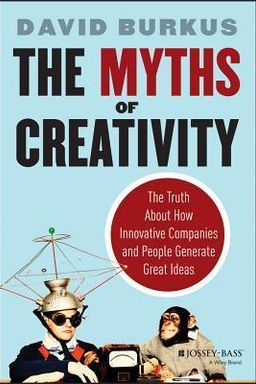
The Myths of Creativity cover

The Myths of Creativity

by David Burkus

The Myths of Creativity by David Burkus challenges the traditional understanding of innovation. It reveals the hidden truths about creativity and offers practical advice for generating groundbreaking ideas. Discover how collaboration, constraints, and time fuel creative success, making innovation accessible to everyone.

The Myths That Mislead Our Understanding of Creativity

When was the last time you felt stuck, waiting for inspiration to strike? Maybe you were hoping for that lightning-bolt moment—the famous “eureka!” that suddenly solves everything. In The Myths of Creativity, David Burkus challenges that romantic view of creativity. He argues that what keeps most of us from being creative isn’t a lack of talent or divine spark but a set of deeply rooted cultural myths that distort how we think creativity works.

Burkus contends that creativity isn’t magic—it’s a process that can be understood, taught, and improved. Drawing from organizational psychology, business research, and vivid historical examples, he reveals that the barriers to innovation are often mental stories we tell ourselves: that brilliance requires inspiration, solitude, rewards, or freedom from limits. By dismantling these myths, Burkus encourages readers and leaders to design environments where creativity and innovation can actually thrive.

A Modern Framework for Understanding Creativity

Burkus begins by exposing the ancient roots of our creative mythology. The Greeks blamed (or credited) the muses for artistic invention; creators, they believed, were vessels of divine inspiration rather than active producers of ideas. Though we may no longer worship the muses, many still speak about “inspiration” as if it floats in from outside ourselves. The author argues for a more empirical foundation inspired by Harvard Business School professor Teresa Amabile’s componential model of creativity, which shows that creativity results when four components—expertise, creative-thinking processes, task motivation, and social environment—interact dynamically.

This framework grounds the book’s mission: creativity is the intersection of knowledge, mindset, enthusiasm, and context. It’s not a random bolt from the heavens but something that can be structured and cultivated systematically.

Why the Myths Matter

Burkus identifies a dozen distinct myths—ranging from the Eureka Myth to the Constraints Myth—that sabotage how individuals and organizations pursue innovation. From the “Lone Creator Myth,” which glorifies individual brilliance, to the “Incentive Myth,” which assumes money can buy ideas, these beliefs oversimplify a complex process. They shape how leaders structure teams, how companies train their people, and even how ordinary individuals judge their own creative potential.

Understanding why these myths persist is crucial. They give us comforting explanations for why creativity seems to come and go. If only geniuses are truly creative, then our lack of ideas isn’t our fault. If inspiration is random, there’s no point building better creative habits. Burkus insists that the truth is far more empowering: creativity can belong to everyone, provided we learn how it actually functions.

A Research-Based Exploration Backed by Stories

By mixing scientific evidence with striking stories—from Archimedes in his bath to Pixar’s collaborative “dailies” meetings—Burkus illustrates that groundbreaking innovation is rarely about lone geniuses but about processes, persistence, and collaboration. Consider Spencer Silver and Art Fry, the team at 3M whose accidental discovery turned into the Post-it Note after years of incubation and iteration. Or the case of W.L. Gore & Associates, which replaced hierarchy with a “lattice” structure to unleash creativity across departments. Each example underscores that creativity is social, iterative, and built on prior work.

Throughout the book, Burkus demonstrates how cognitive biases, corporate habits, and cultural storytelling distort reality. Myths such as the “Brainstorming Myth” lead companies to mistake idea volume for innovation. Misinterpretations of reward systems—like the “Incentive Myth”—push leaders to rely on bonuses that backfire, reducing genuine intrinsic motivation. Others, such as the “Constraints Myth,” reveal how resource limitations can actually stimulate, not suppress, creative breakthroughs.

The Practical Stakes for You and Your Work

If you’ve ever sat through lifeless brainstorming sessions or watched your bold idea wither under bureaucratic indifference, this book feels personal. Burkus’s goal is not just to explain creativity but to empower readers—whether they manage teams, design products, or simply want more everyday innovation—to challenge workplace assumptions. The payoff is enormous: by trading myth for method, individuals and organizations can become engines of meaningful change.

Ultimately, The Myths of Creativity reframes innovation as a shared, learnable discipline. It urges you to stop waiting for inspiration and start building creative systems. Once you realize that constraints, collaboration, and motivation—not miracles—produce ideas, you begin to see opportunities for creativity everywhere.


Myth #1: The Eureka Moment Is a Mirage

We all love the story of Newton and his falling apple or Archimedes leaping from his bath shouting “Eureka!” But David Burkus explains that these tales are deceiving. The Eureka Myth tempts us to believe that creativity strikes in one sudden flash—that if we wait long enough, the right idea will fall into our lap. This belief offers comfort, but it’s rarely true. In reality, breakthroughs arrive through accumulated knowledge, problem incubation, and deliberate effort.

The Science of Insight

Psychologist Mihaly Csikszentmihalyi interviewed over ninety high-achieving creators, from Linus Pauling to novelist Robertson Davies. He found that nearly all followed a five-stage process: preparation, incubation, insight, evaluation, and elaboration. Notice something crucial—insight sits in the middle, not the beginning. The “aha” moment is sandwiched between long stretches of work and refinement. Similarly, French mathematician Henri Poincaré outlined a four-stage version a century earlier: preparation, incubation, illumination, and verification. Both scholars confirm that moments of sudden revelation rely on groundwork and rest.

Incubation and the Wandering Mind

Burkus highlights modern experiments showing why stepping away matters. In one University of Sydney study, students asked to brainstorm uses for paper generated far more ideas after a break doing an unrelated task. Another experiment by Benjamin Baird at UC Santa Barbara found that people whose minds wandered during easy tasks scored better on creative tests. When doing something undemanding, our brains continue unconsciously connecting ideas (“selective forgetting”), freeing us from fixation. That’s why taking a walk or doing chores can trigger insight—the time away lets your subconscious problem-solve.

The Reality Behind Famous Discoveries

Even the iconic stories prove this pattern. Newton had studied gravity for years before that hypothetical apple fell. Archimedes required deep expertise in density and mathematics before realizing how to measure King Hiero’s gold crown. Their “aha” moments were simply the last domino falling after long chains of reasoning. Confabulation—a tendency to invent satisfying stories after the fact—makes us rewrite history as instantaneous genius. In Norman Maier’s famous 1930s psychology experiment, people later misattributed their own insights to internal inspiration even when external cues prompted them.

Post-it Notes and Modern Incubation

Consider Spencer Silver and Art Fry at 3M. Silver’s “failed” attempt to invent a stronger glue left him with an unusually weak adhesive. Years later, Fry—frustrated when bookmarks slipped from his hymnal—connected Silver’s adhesive to sticky paper. They iterated prototypes for over a decade before the eventual success of the Post-it Note. The breakthrough wasn’t luck; it was disciplined incubation, evaluation, and persistence. Like Newton and Archimedes, their eureka moments were built on prior work and reengaged after periods of rest.

The Takeaway: Work, Pause, Return

True creative insight is a rhythm between focus and release. Burkus suggests that when you feel blocked, the smartest thing you can do isn’t to wait passively—it’s to keep feeding your mind relevant knowledge, take strategic breaks, and trust that your subconscious continues connecting ideas. Eureka doesn’t happen by chance; it’s earned by design.


Myth #2: Only Certain People Are Creative

According to the Breed Myth, creativity is a genetic trait reserved for the lucky few—a belief that lets everyone else off the hook. We see “the creatives” in arts and marketing and assume others in operations or finance are inherently unimaginative. Burkus dismantles this false divide by showing that creativity has no special DNA. Instead, it’s a universal human potential influenced by environment and opportunity.

Discovering There Is No Creative Gene

After World War II, psychologist J.P. Guilford challenged peers to study creativity scientifically. Researchers examined twin studies, personality tests, and brain data searching for “the creative type.” The evidence consistently disappointed them. Identical twins, who share 100% of their genes, showed no higher similarity in creativity than fraternal twins. Personality research (the Big Five model) found that one trait—openness to experience—correlates modestly, but creativity spans all personalities and temperaments. There is no breed of genius.

Why Organizations Believe the Myth

Even modern companies reinforce the divide. Tax codes and job categories legally distinguish “creative” professions from ordinary ones. Marketing and design are labeled creative, while operations or finance remain “analytical.” This creates silos that limit idea flow and make innovation somebody else’s job. But research and corporate experiments show that when everyone’s ideas are valued, innovation skyrockets.

Case Study: W.L. Gore & Associates

W.L. Gore, maker of Gore-Tex, rejects hierarchical titles and divides. All employees are “associates,” free to join projects based on passion, not department. Engineers cross into music products (like Elixir guitar strings), and manufacturing specialists co-create materials for medicine and aerospace. This “lattice” structure proves that when authority is flattened and creativity is democratized, even outsiders contribute breakthrough ideas. The company thrives precisely because no one is labeled uncreative.

Case Study: Semco in Brazil

Under Ricardo Semler, Semco reinvented industrial management by firing top managers, erasing rigid departments, and letting employees choose their projects. Teams self-organize around problems they care about. With shared ownership and trust, creativity spreads throughout the enterprise. Semco’s transformation shows that structural freedom, not innate talent, enables systemic creativity.

The Lesson: Creativity Is a Decision, Not a Gift

If genius isn’t genetic, then your team’s innovation potential is vast. By empowering varied perspectives and dismantling elitist distinctions, you can amplify creative problem-solving across the company. As Burkus notes, extraordinary creativity arises not from who people are but from how they work together.


Myth #3: Great Ideas Are Truly Original

The Originality Myth celebrates invention as pure novelty—one lone genius birthing an idea from nothing. Burkus argues that originality is an illusion. Most innovations are recombinations: new links between old concepts, what economist W. Brian Arthur calls combinatorial evolution. From the telephone and the printing press to modern computers, progress happens when existing ideas collide.

No Single Inventor: The Telephone Example

We credit Alexander Graham Bell as the father of the telephone, but Elisha Gray filed a nearly identical patent the very same day in 1876. Both men drew upon identical electrical discoveries and telegraph technology. History remembers Bell because his company scaled first. Gray’s story shows how timing and networks—more than absolute originality—define success.

Ideas as Combinations and the “Adjacent Possible”

Biologist Stuart Kauffman coined the “adjacent possible”—the realm of new combinations just one step beyond current capabilities. Burkus uses this concept to show why so many “simultaneous inventions” emerge independently: calculus (Newton and Leibniz), the steam engine, or the telescope. Each discovery becomes the foundation for another, widening the landscape of possible innovation.

Creativity in Reverse Engineering

From Shakespeare’s adaptations of Marlowe to George Lucas’s remix of samurai films and western serials in Star Wars, even art advances through recombination. Cognitive psychologist Sarnoff Mednick called this “associative thinking.” Neuroscience now supports his claim: MRI scans show highly creative individuals have stronger white matter connectivity, allowing distant brain regions to communicate more freely.

Collaborative Remix: From Xerox to Apple to Microsoft

The evolution of the graphical user interface (GUI) demonstrates combinatorial innovation in action. Xerox PARC developed the first GUI, inspired by earlier prototypes. Steve Jobs saw it, improved its usability for the Macintosh, and then Bill Gates adapted those ideas for Windows. Far from theft, this chain of remix represents the natural inheritance of innovation—each link refining what came before.

The Takeaway: Share to Multiply

When we cling to the idea of originality, we hoard ideas and slow collective progress. Burkus urges teams to share concepts freely and embrace building on one another’s work. True creativity lies in connecting, not isolating. Every new idea stands—literally—on the shoulders of giants.


Myth #4: Expertise Guarantees Innovation

The Expert Myth assumes that more knowledge equals more creativity. Yet Burkus shows that while expertise is valuable, it can also imprison thinking. Experts grow attached to familiar methods and often dismiss radical ideas as “impossible.” Sometimes the best breakthroughs come from outsiders who don’t know what can’t be done.

When Knowledge Becomes a Cage

Prosthetics designer Jay Martin learned this firsthand. After hiring PhD engineers to invent a real-time adaptive ankle, progress stalled—they insisted such a device was impossible. Frustrated, Martin replaced them with students lacking preconceptions. Free from “impossibility thinking,” they succeeded in building a functional prototype for the world’s first adaptive prosthetic ankle. Sometimes ignorance liberates invention.

Age and the Decline of Insight

Historiometric studies (from Adolphe Quetelet to Dean Keith Simonton) reveal an “inverted-U” pattern in creative careers: productivity rises early, peaks, then declines as expertise deepens. Physicists, for example, often produce their best work before thirty. Older scientists may refine excellent theories but rarely overturn fundamentals. Paul Erdős avoided this trap by constantly moving into new mathematical fields, keeping his mind perpetually young and open.

The Power of Outsider Input

Crowdsourcing platforms like InnoCentive and corporate challenges such as the Netflix Prize demonstrate how external minds crack stubborn problems. Eli Lilly’s internal R&D foundered until it invited the public to propose solutions. Outsiders like retiree chemist Werner Mueller solved pharmaceutical challenges professionals deemed unsolvable. Diversity of background, not depth in one specialty, became the innovation engine.

Adapting Expertise Across Sectors

Burkus also profiles Fuse Corps, a nonprofit pairing entrepreneurs and executives with government agencies to address civic challenges—from education reform in California to child advocacy in Oakland. These fellows thrive because they apply private-sector insights in public contexts, injecting fresh approaches into bureaucracies. Their success proves that perspective, not pedigree, fuels problem-solving.

Lesson: Don’t Worship Experts—Combine Them

Creativity requires balance: enough expertise to understand the field, but enough humility to question it. Encouraging cross-disciplinary teams and rotating roles (like W.L. Gore or Fuse Corps does) prevents mental rutting. True innovation happens on the edges, where curiosity outweighs credentials.


Myth #5: Motivation Comes from Money

The Incentive Myth says that bonuses, prizes, or paychecks drive creativity. Burkus argues that extrinsic rewards often backfire, suppressing intrinsic motivation—the internal joy of problem-solving. The most powerful creativity booster, he explains, is autonomy, not incentive.

What the Research Reveals

Teresa Amabile’s studies with professional artists showed that commissioned works consistently received lower quality ratings than self-inspired pieces. Even though the artists earned more, they produced less imaginative art. Psychologist Edward Deci reached similar conclusions: when certain rewards feel controlling, they diminish inner drive. In creative work—unlike rote labor—motivation must come from curiosity and purpose.

The MacArthur Fellowship Model

The MacArthur “genius grant,” $500,000 given with no strings attached, exemplifies this principle. Recipients aren’t told what to produce; they’re trusted to follow their creative impulses. The freedom, rather than the money itself, sparks further accomplishment. It’s a large-scale reminder that trust yields more innovation than micromanaged incentives.

Lessons from 3M and Google’s Spiritual Descendants

3M’s “bootlegging policy”—allowing engineers 15% of work time for personal projects—produced classics like masking tape and the Post-it Note. Modern companies echo this model: Atlassian’s 24-hour “FedEx Days” yield surprising breakthroughs, Twitter hosts hack weeks, and Facebook’s all-night hack-a-thons led to Facebook Chat. Each example replaces monetary pressure with creative freedom and recognition.

Autonomy as the Highest Reward

Burkus emphasizes that intrinsic motivation thrives where employees can choose challenges, experiment, and see meaning in their work. Companies like 37signals (now Basecamp) push this further, giving entire months off for unfettered experimentation. The result? Burst of innovation and renewed enthusiasm—not because of bonuses, but because of trust and ownership.

In short, money buys compliance; autonomy breeds creativity. Reward curiosity, not outcomes, and your teams will innovate naturally.


Myth #6: Creativity Is a Solo Act

Maybe you picture Thomas Edison in his lab, a solitary genius working into the night. But the Lone Creator Myth is perhaps the most enduring—and the most misleading. Burkus reveals that innovation almost always arises from collaboration, not isolation.

Edison’s Mythical Workshop

Edison’s Menlo Park was far from a one-man show. Around fourteen “muckers”—machinists, engineers, and scientists—collaborated on his inventions, trading ideas daily. Many of Edison’s patents actually list his colleagues as co-creators. Yet the group discovered that the public preferred the image of Edison the genius. They turned him into a brand, feeding the myth of solitary invention that still haunts corporate innovation today.

Science, Theater, and the Power of Teams

Psychologist Kevin Dunbar’s camera study of real laboratories found that breakthroughs happen not during solo lab work but in group meetings where scientists discuss anomalies. Similarly, management researchers Brian Uzzi and Jarrett Spiro analyzed 474 Broadway musicals and discovered that the most successful teams balanced familiarity and freshness: neither total strangers nor too-cozy collaborators. Innovation thrives in “small-world networks” where old colleagues and new perspectives continuously cross-pollinate.

Modern Application: Continuum Design

The design firm Continuum exemplifies this blend of diversity and cohesion. Teams combine engineers, ethnographers, artists, and MBAs to create products like Reebok’s Pump shoe and P&G’s Swiffer. Their process—shared research, spirited debate, and iterative prototyping—produces innovative yet practical results. Like Pixar or IDEO, Continuum institutionalizes collective creativity.

Lesson: Greatness Is a Team Sport

Burkus’s takeaway is simple: stop lionizing “lone geniuses.” Real innovation requires interaction, disagreement, and mutual refinement. Build teams that mix the familiar with the novel, and your organization will mirror history’s most creative networks.


Myth #7: Brainstorming Alone Produces Breakthroughs

Brainstorming sessions are corporate rituals—sticky notes, whiteboards, and speed rounds of idea generation. But the Brainstorming Myth misleads us into thinking that shouting out ideas equals innovation. Burkus rehabilitates brainstorming, showing that it works only as one part of a larger creative process.

From Alex Osborn to Keith Sawyer

Advertising executive Alex Osborn coined “brainstorming” in the 1950s with four rules: generate many ideas, defer judgment, welcome wild notions, and build on others’ thoughts. When practiced correctly, structured brainstorming can outproduce unregulated meetings. But organizations often stop there, mistaking idea quantity for progress. Psychologist R. Keith Sawyer expanded Osborn’s insight into an eight-stage creative process, from finding problems and gathering knowledge to externalizing ideas. Brainstorming represents only one mid-stage—the fun part—but without evaluation, selection, and iteration, the ideas die.

Incubation, Evaluation, and Execution

Jim Koch of Samuel Adams Brewing never held a brainstorming meeting to invent his iconic Boston Lager. His eureka came from listening—talking with a pub-goer about imported beer’s “skunky” taste. Observation and preparation, not mere idea spouting, led to his breakthrough. True innovation cycles through research, generation, feedback, and elaboration.

IDEO and Design Thinking

Burkus spotlights IDEO, the global design firm behind products from the computer mouse to the Swiffer. IDEO’s designers follow a disciplined five-step method—understand, observe, visualize, evaluate, implement—anchored in ethnographic research and prototyping. Their famous idea jams are only one step in a loop of testing and refinement. IDEO’s success illustrates that insights emerge not from freedom alone but from process and iteration.

The Lesson: Ideas Are Starting Points

Brainstorming matters, but only as part of a cycle that includes reflection, synthesis, and execution. Burkus warns: don’t confuse creativity with noise. The best ideas often emerge quietly, after the whiteboard sessions end and the real work begins.


Myth #8: Harmony Trumps Conflict

The Cohesive Myth insists that great teams are peaceful and happy, that creativity thrives only in harmony. Burkus reveals the opposite: creative brilliance often comes from productive conflict. True collaboration requires friction, not forced consensus.

Pixar: Fighting for Better Ideas

Pixar’s gleaming campus, designed by Steve Jobs, looks like Silicon Valley paradise—but inside its teams argue passionately. Daily “dailies” meetings let animators critique every frame, line, and light angle. Feedback is blunt but constructive. Director Brad Bird deliberately recruited “black sheep” for The Incredibles to stir debate and challenge complacency. That film became both a technical and creative triumph.

Why Dissent Fuels Discovery

Research by psychologist Charlan Nemeth shows that teams encouraged to debate ideas generate up to 25% more solutions than those told to avoid criticism. Similarly, studies of schoolchildren and corporate teams found that constructive controversy elevates depth and integration of ideas. As Alfred Sloan of GM once said, “If we’re all in agreement, we don’t understand the decision yet.”

Good Conflict vs. Bad Conflict

Burkus distinguishes task conflict—debate over ideas—from interpersonal conflict, which becomes personal and destructive. Pixar’s “plussing” technique helps keep tension healthy: every critique must include a constructive “plus” (“What if the character’s smile also moves his eyes?”), converting criticism into collaboration.

Lesson: Structure Disagreement

Creative teams need norms that reward respectful dissent. Whether it’s Pixar’s critiques, Xerox PARC’s formal debates, or Evernote’s early internal clashes, progress depends on people willing to argue for better ideas. Harmony feels comfortable—but discomfort drives innovation.


Myth #9: Constraints Kill Creativity

The Constraints Myth insists that creativity requires unlimited freedom. Burkus flips this belief: boundaries breed brilliance. Constraints sharpen focus, force resourcefulness, and turn problems into puzzles worth solving.

When Limits Liberate

Humanitarian Jock Brandis invented a $50 concrete peanut sheller for farmers in Mali by embracing strict cost and material limits. Later, engineering professor Lonny Grafman improved it using local waste plastic, solving technical and environmental challenges simultaneously. These innovations thrived not despite constraints but because of them. Burkus summarizes: creativity loves constraints because necessity clarifies priorities.

The Psychology Behind Constraints

Psychologist Patricia Stokes’s research at Columbia University shows that limitations guide creative exploration. Her students produce more original work when given predefined parameters—a “first chorus” or structure—to riff within. Likewise, experiments from the University of Amsterdam found that facing obstacles (like navigating a difficult maze) primes the mind for broader, more integrative thinking.

Companies That Constrain Themselves

Burkus praises 37signals (now Basecamp) for turning scarcity into strategy. Limited staff and budgets forced founder Jason Fried to build simple, elegant software like Basecamp and Highrise. Rather than seek unlimited growth or funding, the company caps product prices and team size to preserve focus. These self-imposed constraints create clarity that bloated competitors lack.

The Lesson: Design the Box

The trick isn’t escaping the box—it’s drawing a smarter one. Whether through time limits, material restrictions, or budget ceilings, you can transform constraints into catalysts. As Michelangelo proved carving marble, limitation is not the enemy of art; it’s its form.


Myth #10: Good Ideas Sell Themselves

The final myth—the Mousetrap Myth—insists that the world automatically rewards great ideas. “If you build a better mousetrap,” the saying goes, “the world will beat a path to your door.” Burkus reveals the harsh truth: most great ideas are ignored or even resisted, not embraced.

The Bias Against the New

When U.S. Navy officer William Sims invented “continuous-aim firing” in 1898—a system that made naval guns drastically more accurate—his superiors dismissed it as impossible. Only after appealing directly to President Theodore Roosevelt did his method revolutionize warfare. This resistance isn’t rare; it’s human. Experiments by researchers Jennifer Mueller and colleagues show that even when people claim to value creativity, uncertainty subconsciously makes them favor safe, conventional ideas.

Organizations and the “Hierarchy of No”

Vanderbilt professor David Owens calls corporate bureaucracy a “hierarchy of no”—every approval layer filters out novelty to minimize risk. Examples abound: Kodak invented the digital camera but buried it; publishers rejected Nobel laureate Paul Lauterbur’s MRI research; Warner Brothers doubted talking pictures. Innovation often dies not because ideas are bad, but because they scare decision-makers.

Rite-Solutions: A Market for Ideas

To fight bias, entrepreneurs Jim Lavoie and Joe Marino created an internal “Mutual Fun” at their software firm Rite-Solutions. Employees post ideas as virtual stocks; coworkers invest time and fake money in the ones they believe in. Popular ideas receive real funding. This gamified marketplace turned half the company’s new business into employee-born innovations, decentralizing judgment away from risk-averse executives.

Lesson: Persistence Over Perfection

Creative people must learn to champion, not just conceive, their ideas. Selling innovation requires storytelling, persistence, and allies who believe before results appear. As Burkus concludes, creativity is only the beginning; innovation requires courage against the world’s initial “no.”

Dig Deeper

Get personalized prompts to apply these lessons to your life and deepen your understanding.

Go Deeper

Get the Full Experience

Download Insight Books for AI-powered reflections, quizzes, and more.