
Idea 1
Leadership, Power, and the Myth of Strength
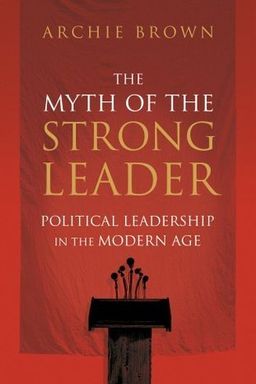
What makes a leader truly effective? In The Myth of the Strong Leader, Archie Brown dismantles one of the most pervasive ideas in politics — that concentrated, decisive personal power produces success. He argues the opposite: real leadership emerges from institutional collaboration, sound judgment, empathy, and the humility to consult others. Across historical and contemporary cases — from Roosevelt, Mandela and De Gaulle to Blair, Stalin and Mao — Brown shows that the most celebrated 'strong leaders' often bring calamity when unchecked, while the most effective leaders govern through cooperation and persuasion.
The strong-leader illusion
You have been taught to equate decisiveness with wisdom. Brown peels back this illusion, noting that public culture, media framing and political marketing glorify strength as the single index of competence. In reality, huge personal authority breeds cognitive closure and overconfidence. Blair’s claim to have personally “won three general elections” symbolizes a pathology that values dominance over deliberation. Empirical evidence shows citizens mostly vote for parties and programs rather than personalities — but leaders, journalists, and even voters collude in the myth because it simplifies complexity into a strong–weak binary.
When strength becomes weakness
Brown’s central warning is stark: concentrated power leads to decision error. When an individual monopolizes choices, aides act in the leader’s name, dissent shrinks, and expertise gets bypassed. Time pressure replaces evidence; institutional scrutiny evaporates. The result ranges from foreign policy hubris — Chamberlain’s appeasement and Blair’s Iraq war — to domestic policy failure born of untested ideas. Leaders who dominate colleagues lose corrective friction, a pattern that repeats from Mussolini’s imperial fantasies to Mao’s Great Leap Forward.
The real anatomy of leadership
Brown places leadership in contextual frames: historical, cultural, psychological and institutional. You learn that personality interacts with system. Political cultures predispose citizens to seek or resist strongmen — older Russians admire Stalin while younger, educated cohorts favour Gorbachev. History shapes habits of governance; culture shapes what power feels legitimate; institutions determine what is possible. Without understanding these intersections, you mistake charisma for competence and forget that even 'great' figures depend on administrative systems that outlive them.
From personal rule to collective leadership
Brown’s core argument is that genuine leadership is usually collective. Cabinets, parties, and parliaments democratize decision-making, ensure expertise, and curb error. Truman’s notion that presidential power is primarily persuasion exemplifies this collegial model. Thatcher, Blair and others proved the opposite: when senior colleagues withdraw support, even powerful leaders fall. Success depends on teamwork and institutional resilience, not one person’s will.
Leadership across regimes and eras
From democratic cabinets to totalitarian dictatorships, Brown uses comparative examples — Stalin’s terror, De Gaulle’s constitutional reform, Suárez’s negotiated transition, Deng’s pragmatic modernization — to show that leadership must be assessed by both methods and outcomes. Revolutionary seizure thrives on coercion, while transformational change rooted in persuasion fosters durable institutions. “Redefining leaders,” such as Roosevelt or Thatcher, shift agendas within systems; “transformational leaders,” like Gorbachev or De Gaulle, rebuild systems through consent. “Revolutionary leaders,” such as Lenin or Mao, rupture systems through violence and coercion.
Democracy, decision processes, and self-deception
In democracies, Brown highlights procedural safeguards as the antidote to self-deception and hubris. When leaders bypass Cabinet committees (Blair before Iraq, Eden during Suez), they lose institutional sanity checks. “Premature cognitive closure” — believing what one wants to be true — replaces debate. The Butler Review later confirmed that truncated process, not mere bad intelligence, drove British misjudges. Democratic strength lies in transparent decision flows, competing expertise, and the courage to challenge a prime minister’s certainty.
The continuum of authoritarianism
Brown also clarifies the sliding scale from authoritarian to totalitarian regimes. Few states reach total surveillance and ideological monopoly, but cults of personality — visible in Stalin, Mao, or Kim Il Sung — approximate the ideal type. In contrast, collective authoritarianism (Tito’s Yugoslavia, Deng’s post-Mao China) moderates violence through institutional bargaining. You learn to separate personal tyranny from oligarchic governance, since both matter differently for foreign policy risk and internal oppression.
The final moral
Brown’s enduring message is both analytical and moral: do not confuse domination with effectiveness. Evaluate leaders by how they use institutions, tolerate dissent, and avoid self-glorification. Strength that silences expertise leads to national ruin; leadership that engages colleagues, admits uncertainty and builds deliberative capacity saves lives and democracies. In every system — democratic, authoritarian, revolutionary or transitional — the test of judgment is whether power invites scrutiny or suppresses it. That is the true measure of political strength.