
Idea 1
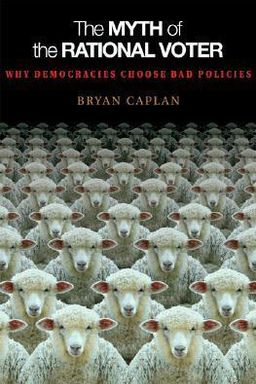
The Myth of the Rational Voter
Why does democracy, designed to serve the public good, so often produce policies that economists call harmful? Bryan Caplan’s The Myth of the Rational Voter tackles this paradox head-on. He argues that democracies routinely choose economically damaging policies—not because politicians are corrupt or voters ignorant, but because ordinary citizens hold systematic, emotionally comforting false beliefs about economics.
You begin with a common intuition: if people rule, policies should serve the people. Yet evidence shows repeated democratic preferences for protectionism, price controls, and rigid labor regulations—policies that economists from Adam Smith to Paul Krugman have warned against. Caplan flips the usual explanation. The problem isn’t just interest groups or apathy; it’s cognitive bias woven into democratic choice.
The paradox of democracy
Caplan calls this the Paradox of Democracy. Democracies are legitimate because citizens choose their leaders, yet voters repeatedly demand policies that make them poorer. Economists and public choice theorists traditionally blame ignorance and lobbying, but Caplan goes deeper: citizens are rationally irrational. They prefer beliefs that feel good—about trade, markets, or employment—over ones that are sober and difficult.
Rational irrationality means people consciously tolerate wrong beliefs when those beliefs are psychologically comforting and politically cheap. Because your individual vote has almost zero chance of changing an election, there’s little cost to indulging a mistake. You can feel patriotic favoring tariffs, moral opposing downsizing, or righteous fearing globalization at virtually no personal cost. Multiplied across millions, those indulgences become law.
Systematic rather than random errors
Caplan contrasts random ignorance with systematic bias. The "wisdom of crowds" intuition holds only if errors cancel. But psychology and survey evidence show voters err in the same direction. His analysis of the 1996 Survey of Americans and Economists on the Economy (SAEE) demonstrates that citizens consistently misinterpret economic cause and effect. Economists attribute gas‑price rises to supply and demand; the public blames corporate greed. Economists support trade and immigration; the public sees them as destructive. These patterns are not noise—they’re structured misconceptions.
Four core biases shaping opinion
Caplan identifies four dominant themes in public misunderstanding:
- Antimarket bias: suspicion that profits are exploitative and middlemen unnecessary;
- Antiforeign bias: fear that trade or immigration harms national welfare;
- Make‑work bias: belief that jobs, not productivity, measure prosperity;
- Pessimistic bias: presumption that the economy is deteriorating despite long‑term improvements.
Together they explain why the average voter resists free trade, deregulation, or immigration liberalization even when economists show these policies raise welfare. Caplan frames this as a psychological cartel of errors.
Aggregation and the failure of wisdom
Classic public‑choice theory, from Anthony Downs and Gordon Tullock, emphasizes rational ignorance—it’s costly to learn political facts. Caplan accepts that but adds that ignorance becomes devastating only when errors are correlated. The Miracle of Aggregation—the idea that many uninformed voters can approximate truth through averaging—breaks when biases point the same direction. Instead of a dispersed fog of confusion, you get concentrated delusion.
From irrationality to policy
Caplan’s thought experiments show how these false beliefs translate into policy. When all voters harbor a slight psychic preference for protectionism, both candidates adopt protectionist platforms. The winner merely reflects mass irrationality. Politicians don’t always manipulate voters—they often obey them. Democracy thus implements what the median voter desires, even when that voter misunderstands his own welfare. In this sense, confirmation feels democratic but produces economic decay.
Why the supply side reinforces demand
Politicians face incentives to pander to prevailing biases. If the electorate rewards comforting rhetoric and punishes technical truth, even honest leaders shade their speech. They resort to delegation or propaganda to satisfy voters symbolically while experts quietly manage policy. Caplan’s "Policy Analysis Market" case—where media outrage killed an innovative prediction tool for terrorism forecasting—illustrates how public emotion can veto evidence.
Improving democracy
Caplan closes with pragmatic reforms: strengthen economic education, encourage clear expert communication, and design institutions that raise the price of irrationality. Selective turnout—more educated citizens voting disproportionately—already modestly improves median voter quality. Still, he urges economists to act as public educators and resist democratic fundamentalism—the belief that majority rule automatically equals wisdom.
Core message
Democracy fails not despite being responsive to voters, but because it is perfectly responsive. When irrational citizens demand comforting myths, rational democratic institutions dutifully deliver them.
Caplan’s paradoxical conclusion reframes your faith in democracy: civic participation alone doesn’t guarantee prosperity unless voters reason well. The book invites you to ask a harder question—less about who decides, more about how wisely we decide.