
Idea 1
The Hidden Madness of Everyday Life
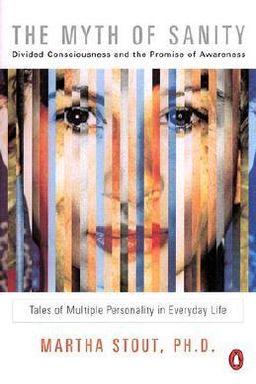
Have you ever felt like parts of you go missing—when you blank out mid-conversation, forget simple things, or find yourself reacting with outsized emotion that makes no sense? In The Myth of Sanity, clinical psychologist Martha Stout argues that these everyday experiences are not random lapses but subtle symptoms of psychological dissociation—small absences of self rooted in how humans cope with threat and trauma. Her central claim is bold: that what we call “sanity” is largely a convenient illusion, and that nearly all of us live, to some extent, as divided selves.
Drawing on decades of clinical work with trauma survivors, Stout reveals that the mind’s capacity to dissociate—to detach from unbearable emotion or pain—is both our species’ most sophisticated survival mechanism and the very thing that can rob us of true presence and wholeness. From the deeply traumatized to the seemingly well-adjusted, everyone uses dissociation to navigate fear, loss, and conflict; the difference lies only in degree. The ‘myth of sanity,’ then, is our collective denial that we spend much of our lives in a fog of avoidance that passes for normalcy.
The Universal Wound of Dissociation
Stout begins with an arresting insight: we are all a little crazy. The human mind, when faced with deep fear—especially during childhood—learns to fragment awareness, storing feelings, memories, and bodily sensations in different compartments. This process, known as psychological dissociation, helps a person survive trauma in the moment, but later leaves them living as scattered pieces, often unaware of the gaps. When mild, it appears as daydreaming, forgetfulness, or emotional numbness; when severe, it becomes dissociative identity disorder (DID), where entirely separate personality states emerge. Yet all of us, Stout contends, operate on the same neural principle. We simply call it “spacing out.”
In her practice, Stout has treated people who survived horrific child abuse, sexual violence, or war. Through their recovery, she learned that trauma doesn’t just haunt memory—it reshapes the brain’s architecture, leaving behind neurological “fault lines.” The amygdala, hippocampus, and Broca’s area—all crucial to memory and emotion—misfire under the stress of trauma, fragmenting experience into wordless images and sensations. A survivor might recall the smell of chlorine from a childhood drowning accident but forget the event entirely. When triggered years later, the body relives the past while the conscious mind remains clueless. This is how people can feel terror, rage, or emptiness without knowing why.
From Survival Skill to Everyday Madness
Stout argues that dissociation begins as a perfectly adaptive response to danger. A beaten child may “leave her body” to avoid overwhelm, and a soldier in battle may go cold and mechanical to act. The problem arises when this self-protective reflex generalizes across life. Years later, the same person may detach from a spouse’s affection or feel nothing while cradling a newborn. In an evocative metaphor, Stout describes the mind as an old fuse box that blows whenever the emotional current surges too high. The power outages—our psychological absences—keep us “safe” but cold and disconnected, cut off from vitality and love.
The result is what passes for normal society: marriages where partners walk on eggshells, families avoiding real intimacy, professionals blanking out from overwork. Everyday sanity, she says, is merely “foggy compromise.” Most of us are not whole but fragmented—“disorganized teams trying to cope with the past.” (Therapist Bessel van der Kolk, in The Body Keeps the Score, corroborates this, showing that trauma continually lives in the body even when forgotten.)
Stories of Fractured Minds and Reclaimed Lives
Throughout the book, Stout uses case studies to make dissociation tangible: Julia, the award-winning filmmaker who “woke up Tuesday morning to find it was Friday”; Garrett, a tortured man whose traumatic childhood split him into multiple named selves; and Marcie, an anorexic survivor of sexual abuse brought back to life after two clinical deaths. Their stories illuminate the spectrum of dissociation—from mild fugue states to profound identity fragmentation—and the possibility of recovery through awareness, therapy, and the reclaiming of memory.
Their recoveries lead to Stout’s essential insight: healing comes not from erasing pain but from reconnecting to reality. When survivors face their memories—despite unbearable fear—they gradually reintegrate their awareness, often becoming more compassionate, present, and “sane” than most people who have never confronted their inner fractures. “To stay in touch with reality,” Stout insists, “is to choose life consciously.”
Why This Matters
The myth of sanity is not just a clinical diagnosis—it’s the human condition. Stout urges readers to see their own minor dissociations—the moments of numbness, the “autopilot days”—as calls to awareness. In an age of distraction and emotional avoidance, recognizing these absences is the first step to wholeness. Her book blends neuroscience, clinical narrative, and moral philosophy into a wake-up call: mental presence is not automatic; it’s a courageous act.
The journey from fragmentation to sanity, she suggests, demands radical honesty, compassion for the self, and an embrace of sometimes terrifying truth. Stout closes by showing that those who have come through trauma often live with greater consciousness and meaning than those who merely “get by.” After all, she writes, sanity itself is not freedom from madness—but its integration.