
Idea 1
The Lie of Multitasking
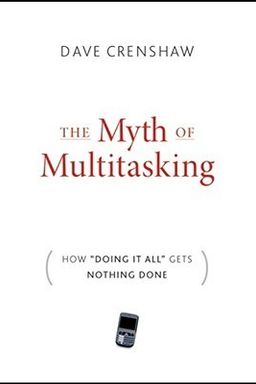
Do you ever feel like there just aren’t enough hours in your day—so you compensate by juggling multiple tasks at once? In The Myth of Multitasking: How “Doing It All” Gets Nothing Done, business coach Dave Crenshaw argues that this common coping mechanism is not a sign of productivity—it’s a costly illusion. Crenshaw contends that true multitasking doesn’t exist for humans; instead, what we call multitasking is really switchtasking: the rapid shifting of attention from one thing to another, each switch extracting a hidden toll on our efficiency, accuracy, and relationships.
Through an engaging parable between Helen Whitman, a frazzled CEO, and Phil, a wise business coach, Crenshaw dramatizes how trying to do it all leads to burnout, poor focus, and damaged communication. The book reveals how leaders—and anyone managing constant interruptions—can rebuild control by setting boundaries, creating recurring systems, and learning to do one thing at a time well.
The Core Argument: Multitasking Is a Cultural Delusion
Crenshaw opens with a simple but bold statement: “Multitasking is worse than a lie.” Why worse? Because while a lie misleads a few, the myth of multitasking misleads entire cultures of professionals. We celebrate busyness as a badge of honor, believing we’re maximizing output when we’re merely fragmenting our attention. Helen initially boasts of being the “Queen of Multitasking,” believing it’s the secret to her success—until Phil reveals that her chaotic schedule, overflowing inbox, and endless interruptions are the direct result of that mindset.
According to Crenshaw, the human brain cannot truly perform two cognitive tasks at once. Like a computer that appears to run multiple programs simultaneously but in reality switches rapidly between them, the brain incurs what he calls switching costs—the mental, temporal, and emotional energy needed to reset after every interruption. Research cited throughout the book confirms that professional workers lose up to 28% of their day to these interruptions and recovery moments.
Two Types of Tasking: Switchtasking vs. Background Tasking
One of Crenshaw’s most helpful distinctions is between switchtasking—doing multiple tasks that require mental effort—and background tasking—pairing one task that requires focus with another that doesn’t. Folding laundry while listening to music is background tasking; answering email during a conversation is switchtasking. The first can be productive; the second is destructive. Helen’s revelation during her “worksheet experiment” demonstrates this principle: when she alternated between writing letters and numbers one at a time, the task took twice as long and led to more errors—proof that switching drains effectiveness.
Why This Matters
The myth of multitasking isn’t just a personal problem—it’s an organizational and cultural epidemic. As Phil observes, Helen’s chaotic company reflects her own poorly managed attention: constant interruptions, unstructured communication, and reactive management. The message resonates in today’s hyperconnected world where smartphones, Slack pings, and email notifications blur the line between focus and distraction. What’s at stake isn’t just productivity—it’s the quality of relationships, leadership, and work satisfaction itself.
A Roadmap for Recovery
Throughout the book, Crenshaw moves Helen (and the reader) from awareness to action. The chapters progress like coaching sessions: identifying the problem (the lie), examining the costs, uncovering the origins, running a hands-on experiment, and then building sustainable systems. Phil’s key recommendation is deceptively simple yet revolutionary: replace reactive work with intentional structure. This means scheduling recurring meetings (“whens” that reduce random interruptions), setting availability boundaries (personal “shop hours”), and mapping a realistic “time budget” aligned with what truly matters—both in work and life.
From Awareness to Transformation
By the end, Helen transforms from a scattered executive into a centered leader whose company culture begins to mirror her new habits. The pragmatic wisdom of the book is timeless: attention is your most valuable asset. Every time you divide it, you diminish its returns. Crenshaw’s conversational fable doesn’t just expose the illusion of multitasking—it offers a roadmap for anyone ready to reclaim clarity, focus, and genuine presence in an age of perpetual distraction.