
Idea 1
Unlocking the Code That Drives Your Best Work
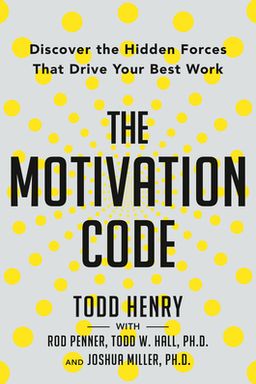
Why do some activities make you feel alive and engaged while others leave you drained and apathetic? In The Motivation Code, Todd Henry and his co-authors Rod Penner, Todd Hall, and Joshua Miller argue that lasting success and deep fulfillment come from understanding a unique set of internal drives—the forces that energize and sustain your best work. They call this personal blueprint your Motivation Code, a combination of distinct motivational themes that explain why you thrive in certain situations and shut down in others.
Henry contends that motivation isn’t just about diligence or personality. It’s not about being lazy versus ambitious, and it’s not defined by external rewards like pay, praise, or perks. Instead, motivation is about the kind of work that naturally feels satisfying to you—the tasks and circumstances that align with your internal wiring. When you operate within your Motivation Code, your effort generates what Henry calls “clean fuel,” energy that flows sustainably without burnout or bitterness.
Seeing Beneath the Surface of Success
Through stories like that of Frank—a talented engineer who excelled when researching and problem-solving but faltered when his new department required endless paperwork and contract management—Henry shows how our motivational sweet spots determine engagement and performance. Frank’s struggles weren’t a matter of skill but of mismatched motivation. After taking the Motivation Code assessment, he discovered his top themes were Demonstrate New Learning, Achieve Potential, and Evoke Recognition. Tasks that tapped these energies energized him, while duties related to Organize and Bring to Completion left him depleted. Once he adjusted his role accordingly, both he and his team flourished.
The Science Behind the Code
The authors root this framework in decades of research dating back to Arthur Miller Jr., creator of the System for Identifying Motivated Abilities (SIMA). Their work combines narrative psychology—the study of life stories and experiences—with contemporary psychometrics to measure motivation scientifically. This hybrid approach provides both validated data and personal insight, bridging the gap between psychology and practical self-understanding. The book’s research shows that each person’s Motivation Code is unique, constant, and unchanging, persisting through success and failure, and shaping life decisions across time. It accounts for both intrinsic drives (personal meaning and enjoyment) and extrinsic motivators (rewards, recognition, results), showing how these interact in subtle but powerful ways.
Why Motivation Matters
Henry cites Gallup’s 2017 State of the American Workplace report, which found that only 33 percent of employees are truly engaged. Two-thirds, he writes, are disengaged because their organizations use “brute force” methods like bonuses or empty praise rather than understanding what actually motivates each individual. By discovering your special blend of motivations, you gain the “combination code” that unlocks sustained energy, teamwork, creativity, and excellence. Managers, too, can orchestrate better collaboration and retention by aligning people’s roles with their Motivation Codes.
From Assessment to Action
The book’s central process moves from identifying achievement stories (moments of peak satisfaction), to taking the Motivation Code assessment, to exploring and applying your results. Across twenty-seven motivational themes arranged in six “families”—Visionary, Achiever, Team Player, Learner, Optimizer, and Key Contributor—you discover patterns that explain both your drive and your friction points. Henry emphasizes that all motivations have a shadow side. For instance, your drive to overcome adversity can also make you combative; your passion for collaboration can lead to overcommitment. Self-awareness, not perfection, is the goal.
Living with Clean Fuel
In the book’s closing chapters, Henry encourages readers to craft roles that activate their Motivation Code intentionally. Instead of relying on “dirty fuels” like anger, fear, or need for approval—which burn hot but leave emotional residue—he urges using clean motivation: work driven by curiosity, creativity, and contribution. This shift, he argues, transforms not only productivity but meaning itself. Operating within your motivation leads to purpose-driven effectiveness that benefits both you and those around you. As he puts it, “The world needs you to be fully alive, fully engaged, and fully yourself.”
Ultimately, The Motivation Code is a guide to understanding why you do what you do—and how to do more of what makes you thrive. It provides a language for motivation, a method for harnessing it, and a mindset for staying energized through all seasons of work and life.