
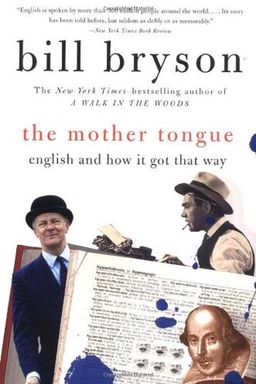
The Mother Tongue cover

The Mother Tongue

by Bill Bryson

Bill Bryson''s ''The Mother Tongue'' takes readers on an enlightening journey through the history of English, highlighting its resilience and adaptability. From ancient invasions to modern innovations, discover how English evolved into a global language by embracing diverse influences and inventiveness.

The Living Story of English

How can you explain the rise of English from an island tongue to the world’s principal language of communication? In The Mother Tongue, Bill Bryson traces the remarkable journey of English—its mysterious beginnings, its patchwork evolution, its playful adaptability, and its global dominance. He argues that English succeeds not because it is perfect or pure, but because it is flexible, acquisitive, and pragmatic. It grows by error and enthusiasm, survives conquest and chaos, and evolves faster than any attempt to standardize it.

Bryson invites you to see language as a living organism—a historical, social, and cultural mirror. He begins with the origins of human speech, then moves through how the English language developed from Anglo-Saxon through Norse and Norman influences. He explores how spelling, grammar, pronunciation, vocabulary, and dialect evolved through accidents and innovations, and how words continuously morph in meaning and form. Finally, he takes you into contemporary concerns: global spread, cultural identity, and the potential future of a language that belongs to no single nation.

From early speech to English beginnings

You learn that human speech itself is an evolutionary puzzle. Bryson shows that anatomical changes such as the lowered larynx gave humans a wide sound palette—the physiological prerequisite for language. From speculative origins (Bow-Wow and Yo-He-Ho theories) to real evidence from child language acquisition and creoles, the groundwork is clear: speech is both biological and cultural. Language, Bryson insists, likely emerged from a mixture of cooperation and mental ingenuity around thirty thousand years ago.

When the Germanic tribes—Angles, Saxons, and Jutes—landed in Britain around A.D. 450, they brought a complex inflected tongue that slowly shed its endings as Norse and Norman influences reshaped it. The Vikings added everyday terms (sky, leg, husband), while the Normans imposed French vocabulary of government and refinement (justice, court, beef). From this fusion came a hybrid language—plain in grammar but rich in synonyms—ready to absorb future borrowings with zeal.

A language of absorption and invention

Bryson’s portrait of English is one of unending acquisition. It borrows shamelessly—sofa from Arabic, ketchup from Chinese, caucus from Algonquin—and reshapes meanings freely. Sometimes it makes words by accident: ghost words like “dord” or mistaken forms such as bridegroom evolve from clerical slips. Writers add their flair—Shakespeare alone contributed over a thousand terms. Words drift in meaning (“nice” once meant foolish; “egregious” meant admirable) and even turn paradoxical (“cleave” means both split and cling).

Its grammar and spelling reflect centuries of compromise. The printing press fossilized forms just as vowels were shifting. Latin-minded reformers banned split infinitives and invented “rules” alien to English. Yet Bryson reminds you that speakers—not schools or committees—decide what survives. Attempts at top-down reform (Franklin’s alphabet or Roosevelt’s Simplified Spelling Board) fail because English resists regulation.

Identity, variation, and global spread

From Britain’s dense dialect network to America’s leveling influences, Bryson shows how accent and vocabulary mark identity. Regional variations—British “lorry” vs. American “truck,” or Martha’s Vineyard vowel shifts as identity defenses—illustrate how speech becomes social boundary. American English proliferates through coinage (commuter, babysitter, striptease) and adaptation (rodeo, bronco, canoe), while British names and idioms preserve centuries of conquest (Beaulieu pronounced “Bewley”).

Globally, English has become the modern lingua franca—used for aviation, business, and science, favored even by institutions without native speakers. Bryson describes the paradox: people adopt English not for its innate superiority, but because it works. It levels communication, projects modernity, and accommodates innovation. Yet this dominance also creates cultural tension. France legislates against anglicismes; Quebec defends French purity; scholars debate whether English’s spread homogenizes or enriches the world’s linguistic diversity.

Creativity, profanity, and play

Language for Bryson is also a playground. From Scrabble and cryptic crosswords to Cockney rhyming slang, speakers celebrate verbal ingenuity. Even taboo words reveal social evolution—from Chaucer’s casual “quaint” to Victorian prudery to modern relaxed standards. Swearing and euphemism track changing notions of morality and power, showing that linguistic emotion never stands still.

The continuing evolution—and future prospects

Bryson ends on a balanced note: English may fragment somewhat in idiom and vocabulary, but technology keeps global mutual intelligibility strong. Few languages are as resilient and adaptable. You see a living contradiction—one tongue constantly reshaped by its users yet still serving as a shared bridge for billions. The book’s message: language is humanity’s most democratic art. Every error and invention you make feeds a system bigger than any nation, older than any book, and still gloriously unfinished.

Core truth

English thrives not through precision but through participation; it grows by borrowing and bending, by living among people who use it with curiosity and humor.

That—Bryson reminds you—is what makes it endlessly fascinating: a language whose peculiarities are not flaws but the fingerprints of its human storytellers.


Origins of Language and Human Speech

Bryson opens with one of humanities’ greatest puzzles: how speech began. He leads you through evolutionary, anatomical, and social clues while warning that definitive answers remain elusive. The descent of the larynx is the major milestone—it allowed a range of distinct vowels but introduced a risk of choking, proof that nature traded safety for flexibility. Philip Lieberman’s studies suggest Neanderthals lacked this range, implying that complex language is uniquely human.

Evolutionary speculation and innate grammar

Ancient hypotheses—the Bow-Wow, Pooh-Pooh, and Yo-He-Ho theories—attempted to explain speech through imitation or emotional exclamation. Bryson presents them humorously but points toward a deeper truth: human syntax requires abstract thought and social complexity. Noam Chomsky’s idea of an innate grammatical template, supported by universal child development patterns, supplies a persuasive foundation. “Child grammar” appears spontaneously, enabling toddlers everywhere to self-generate syntactic logic before they learn exceptions.

Creole evidence and rapid linguistic invention

Derek Bickerton’s research on pidgins and creoles gives field evidence. Children raised among traders speaking pidgin transform it into full grammar—creating tense, aspect, and negation systems independently. You realize language can evolve from minimal input if cognitive scaffolding exists. Hawaiian creole, for example, distinguishes success and failure of action through verb structure in ways English does not, proving biological predisposition interacts with social need.

Historical connections: Indo-European discovery

Bryson then traces how linguistic investigation uncovered deep family resemblances across Eurasia. Sir William Jones recognized parallels between Sanskrit and European languages, leading scholars to reconstruct Proto-Indo-European—a lost ancestral tongue linking words for family, snow, and animals across continents. This detection of linguistic lineage mirrors archaeology, revealing migrations about 5,000 years old and showing that language history is also human history.

Key understanding

Language arose through a fusion of biology and culture—a coevolutionary innovation unique to Homo sapiens. Bryson encourages you to see speech as invention and inheritance combined.

By the chapter’s end, you appreciate that every utterance you make echoes an ancient evolutionary step—proof of humanity’s most creative adaptation.


The Making of English

Bryson portrays English’s early history as a layered manuscript rewritten through centuries of invasion and contact. From Anglo-Saxon’s complex inflections to Norman aristocracy’s French, each wave stripped, added, and fused linguistic elements. The Anglo-Saxon base supplied sturdy everyday words—man, wife, love—while Norse settlers contributed pronouns and body parts. The Norman Conquest injected law, government, and cuisine vocabulary, separating “cow” (peasant) from “beef” (gentleman). You begin to see how social hierarchy shaped synonyms.

Simplification through use

Complex declensions faded as English became the unlettered masses’ tongue. Bryson insists that ordinary people, not scholars, simplified grammar for usability. When literacy arrived with monks and printing, dialect variety still flourished; William Caxton’s concerns about conflicting regional spellings underscore language’s instability. But printing froze orthography just as the Great Vowel Shift transformed speech—a recipe for irregular spelling forever after.

Endurance and expansion

Underneath the Norman and Norse layers survived the resilient Anglo-Saxon core, comprising roughly 85 percent of the most common modern words. This endurance forms English’s heart—sturdy and clear. As the nation expanded abroad, so did its language. Colonial and American experiences would weld new variants and send English back to the world changed but recognizable.

Takeaway

English’s history is not linear but cumulative; every conquest, migration, and invention leaves residues that explain both its irregularity and resilience.

When you study its past, you discover a language constantly democratizing itself—simplifying yet enlarging, adapting without losing its soul.


The Mechanics of Words and Meaning

Bryson’s exploration of words is an adventure in etymological creativity. You see language as chaotic workshop—where entries arise by mistake, transformation, borrowing, or whimsy. Ghost words such as “dord” remind you that dictionaries, too, record human error. Back-formations turn “beggar” into “beg,” and playful coinages by writers expand vocabulary exponentially. Shakespeare’s bounty of words—barefaced, monumental, radiance—exemplifies imaginative power shaping lexicon.

Borrowing without boundaries

English’s appetite for foreign words marks its unique identity. From Hindi “shampoo” to Arabic “sofa,” it collects globally. This borrowing often blurs register distinctions: Anglo-Saxon nouns convey intimacy (“mouth,” “hand”), while latinate or foreign adjectives lend scholarly tone (“oral,” “manual”). Semantic layering gives speakers stylistic choice—plain, poetic, or technical.

Drift, contradiction, and creativity

Words seldom stay fixed. “Sanction,” “cleave,” and “dust” illustrate contronymic flexibility—English loves ambiguity. Such drift fuels literature, humor, and irritation alike. The result is expressive richness unmatched by more rule-bound languages.

Vocabulary scale and growth

While dictionaries list hundreds of thousands of entries, true vocabulary is immeasurable. Scientific terms and names multiply endlessly. Bryson notes that mere dozens of words make up half of everyday speech, proving that communication relies on a functional core while new words rush in at dazzling speed—up to 20,000 annually. A word’s birth tells you as much about human creativity as about linguistic need.

Essential lesson

Language evolves through chaos. Every slip, loan, and joke enriches English’s expressive storehouse—proof that imperfection is fuel for invention.

Bryson’s word-world reveals language as biography, not blueprint: endlessly shaped by accidents, by poets, and by everyday speakers like you.


Sound, Spelling, and the Battle for Consistency

Spelling and pronunciation, Bryson shows, are the twin illusions of order. The schwa—English’s most frequent vowel—demonstrates a language of reduction, while schemes like the Great Vowel Shift explain why letters often mislead. When Chaucer’s “lyf” morphed into Shakespeare’s “life,” orthography froze in print, ensuring permanent mismatch between speech and script. English spelling, molded by Norman scribes and Latinizing reforms (debt, island), remains a fossilized record of change.

Why reform fails

From Franklin’s invented alphabet to Roosevelt’s Simplified Spelling Board, reformers promised clarity but overlooked nuance. Homographs, etymology, and global tradition make sweeping reform impractical. As Bryson reminds you, spelling carries history—recognizing “debt” connects English to Latin “debitum,” an invisible educational thread.

Pronunciation chaos and adaptation

You learn that pronunciation varies with speed, geography, and pragmatism. Pilots’ “fiver” and “niner” reduce ambiguity by functional necessity. Local compressions (“water” pronounced “wooder”) reveal spontaneity. Such adaptations prove that spoken English prioritizes efficiency over orthographic decorum.

Bryson’s verdict

Spelling may resist reform, but pronunciation evolves freely. You must learn to love English’s eccentricities—they are historical fingerprints, not defects.

Language, Bryson concludes, changes too quickly for rules but not too chaotically for understanding; it remains a workable disorder sustained by habit and heritage.


Rules, Grammar, and the Politics of Authority

English survived without a controlling academy—a blessing, Bryson argues. Grammarians obsessed with Latin misunderstood English’s structure, turning stylistic preferences into commandments. Robert Lowth’s polite advice against ending sentences with prepositions hardened into dogma though even Shakespeare and modern speech break it. You realize rule-making often reflects prestige, not linguistic logic.

Latin’s misplaced influence

Early grammarians wed English to Latin categories—cases, infinitives, and tenses—where they did not fit. The result was artificial strictness like forbidding split infinitives. Bryson likens it to using baseball rules for hockey: structurally unsound yet socially powerful.

Who defines correctness?

Absent an academy, authority shifted to lexicographers and style arbiters—Fowler, Gowers, Safire—and major institutions such as newspapers and publishers. Dictionaries oscillate between describing and prescribing; Johnson’s personality, Webster’s nationalism, Murray’s OED thoroughness, and later debates (Webster’s Third vs. American Heritage usage panel) show how “correctness” reflects editorial judgment rather than divine rule.

Grammar and social privilege

What counts as “proper English” often encodes class and power. Using “whom,” avoiding contractions, or pronouncing the prestige “r” can signal social distinction, as Labov observed in New York. Bryson’s ethical message: communication trumps conformity.

Guiding principle

Follow clarity, not tradition. English thrives through descriptive honesty, not prescriptive rigidity.

In Bryson’s view, grammar is a conversation between eras, not an edict; its flexibility is what keeps English alive and democratic.


Global English and Its Local Faces

Bryson’s global chapters sweep you from Tokyo billboards to Brussels business meetings to show how English evolved into the world’s bridge language. Airlines, science journals, and global corporations default to English because it reduces friction. Even non-native communities adopt it for neutrality. In Belgium, billboards used English exclusively despite no native speakers—a sign of modern prestige.

Adaptation abroad

In Japan, Germany, or Italy, English enters as aesthetic import. It decorates products—Mr. Friendly erasers or “tootle with vigor” traffic signs—serving style rather than clarity. Loanwords mutate (“pikunikku,” “steadyseller,” “Big Mäc”). These local forms prove that globalization doesn’t homogenize but hybridizes languages.

Resistance and engineered alternatives

Governments sometimes push back: France legislated against anglicismes through commissions and fines yet still accepts “weekend.” Constructed languages like Esperanto or Basic English tried to offer neutral alternatives but faltered—the world wants utility, not utopia. Bryson concludes that English wins because of practicality, not purity.

Real-world implication

Mastering English connects you globally—but demands cultural sensitivity; every borrowed word carries identity politics and history with it.

Bryson’s portrait of global English balances admiration and caution—it unites, entertains, but also unsettles. You see a language made powerful by its contradictions: universally accessible yet infinitely local.


Names, Swearing, and Wordplay: The Human Imprint

Bryson devotes delight to the eccentric corners of English usage—names, taboos, and playful invention. Names reveal historical layers: aristocratic extravagance like Tollemache-Tollemache-de Plantagenet contrasts with American pragmatism in towns called Why or Truth or Consequences. You learn that pronunciation (“Cholmondeley” said “Chumley”) often hides linguistic ancestry, and branding missteps occur when corporations ignore cross-lingual meaning (Enco meaning “stalled car” in Japanese).

Swearing and social evolution

Profanity mirrors cultural change. Medieval England treated religious oaths (“zounds” = God’s wounds) as scandalous; Victorian prudery shifted taboo to the bodily. Bryson’s anecdotes show that what shocks reflects societal focus—today sexual words carry less weight while slurs or blasphemy still ignite debate. Euphemisms like “darn” or “gosh” perpetuate politeness rituals.

Wordplay as creative instinct

Crosswords, Scrabble, and rhyming slang showcase playful intelligence. Solvers and inventors stretch semantics and phonetics for amusement and community identity. In Boonville’s localized “Boontling” or Cockney rhymes (“use your loaf”), language becomes game and camouflage simultaneously. This joy stands opposite prescriptive tension—proof that users, not rule-makers, shape English’s vitality.

Final reflection

Language’s creativity—from naming to taboo—is the human stamp. Bryson’s anecdotes remind you that humor, embarrassment, and play are as linguistic as grammar or syntax.

You leave these chapters convinced that the best measure of a language’s vitality is how willingly its speakers laugh, curse, and invent with it.


The Future of English

Bryson ends by pondering whether English will splinter or sustain. While experts like Robert Burchfield speculate on divergence between British and American varieties, Bryson emphasizes forces binding them: technology, travel, and global media. Films, music, and academia continually blend idioms and prevent isolation.

Tendencies toward unity

Instant communication and mass content generation flatten linguistic distance. American usages increasingly dominate technical fields, yet regional idioms still thrive in local speech and literature. English’s pluralism becomes its security—no single center can fracture the network entirely.

Ongoing transformation

Immigration, cultural exchange, and the Internet accelerate change. New dialects and slang appear continually, but they coexist with shared intelligibility. Bryson interprets this dynamic as proof that English’s essence is adaptability, not uniformity.

Optimistic outlook

English will persist as a global connector precisely because it tolerates difference. Its unity comes from usefulness; its beauty, from diversity.

Bryson’s final sentiment is celebratory: the language’s unpredictability is its resilience. Whether spoken in Mumbai or Manchester, English continues to prove that humanity speaks best when no single authority owns the words.

Dig Deeper

Get personalized prompts to apply these lessons to your life and deepen your understanding.

Go Deeper

Get the Full Experience

Download Insight Books for AI-powered reflections, quizzes, and more.