
Idea 1
The Art of Thoughtful Investing
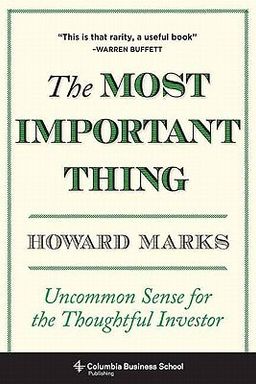
Have you ever wondered why some investors seem almost clairvoyant—consistently making smart calls when everyone else is losing their heads? In The Most Important Thing: Uncommon Sense for the Thoughtful Investor, Howard Marks, famed cofounder of Oaktree Capital Management, offers a sweeping exploration of what separates average investors from the great ones. His core argument is disarmingly simple yet profoundly challenging: superior investment results come not from brilliance or luck alone, but from mastering how you think about risk, value, and behavior.
Marks proposes that investment success is less about formulas or forecasts and more about developing second-level thinking—a deeper, contrarian, and psychologically nuanced way of understanding markets. He insists that to outperform others, you must not only be different but also right. This means being disciplined in valuing assets, patient in recognizing cycles, fearless in acting against the herd, and humble in accepting what you can’t know.
The Philosophy Behind the Book
Marks frames investing as an intricate blend of art and judgment rather than a science reducible to equations. Throughout decades of market booms and crashes—from the Nifty Fifty to the global financial crisis—he’s learned one thing above all: markets are driven not just by data but by human behavior. Investors oscillate wildly between optimism and fear, and this swinging pendulum is both the source of risk and the source of opportunity.
For Marks, real achievement in investing requires an embrace of complexity and uncertainty. There are no easy answers or magic formulas. He views his philosophy not as a system of rigid rules but as a set of guideposts for thinking clearly under conditions of ambiguity. “The most important thing” is never just one thing, he warns—it’s a lattice of interrelated disciplines: understanding value, assessing risk, recognizing cycles, and keeping emotions at bay.
Multiple “Most Important Things”
Marks’ tongue-in-cheek premise—that there are many “most important things”—becomes the book’s organizing principle. Each chapter revisits a core pillar of his investing philosophy: second-level thinking, market efficiency (and its limits), the relationship between price and value, risk awareness, contrarianism, cycles, and patience. Together, these pieces form what he calls a “creed”—his personal religion of finance developed through decades of experience.
The book is steeped in his memos to Oaktree clients, where Marks has long articulated his evolving views on the market mood, investor psychology, and capital discipline. Rather than teach technical analysis or model-based valuation, he teaches readers how to think—how to see what others miss, manage fear and greed, and respond wisely to what history rhymes, not repeats.
Why This Matters to You
If you’re an investor—or even someone deciding how to think logically about uncertain outcomes—this book aims to change your mental map. Marks challenges you to recognize that investing isn’t about predicting the future but about positioning for it. It’s about seeing the world probabilistically, always questioning assumptions, and learning from cycles rather than being victimized by them. As he writes, “Experience is what you got when you didn’t get what you wanted.”
For readers weary of get-rich-quick formulas or algorithmic trading promises, Marks offers something rarer: intellectual honesty and time-tested wisdom. He draws inspiration from thinkers like Benjamin Graham, John Kenneth Galbraith, Nassim Nicholas Taleb, and Warren Buffett—melding their insights into a philosophy rooted in prudence and paradox. Investing, he stresses, is full of contradictions: boldness versus caution, luck versus skill, patience versus opportunism. Navigating those opposites wisely is what defines the thoughtful investor.
A Map for Navigating Complexity
Throughout his career, Marks has lived through oil shocks, bubbles, busts, and crises. Each cycle, he argues, humbles those who believe “this time is different.” His overarching message is to learn from history, stay alert to risk, and embrace a contrarian mindset that prizes survival over sensation. Profits matter, but staying in the game matters more. The great investors, he notes, are “less defined by how much they make in up markets than by how little they lose in down ones.”
In the chapters that follow, he explores twelve essential dimensions of wise investing—from the mindset of second-level thinkers to the discipline of controlling risk, recognizing market cycles, combating psychological biases, and waiting patiently for opportunity. Together they create a manual not for prediction but for preparation—a way to think clearly and act decisively in an uncertain world.
“It’s not supposed to be easy. Anyone who finds it easy is stupid.” —Charlie Munger, quoted by Marks, perfectly captures the spirit of this book: thoughtful investing demands humility, skepticism, and courage—all three at once.