
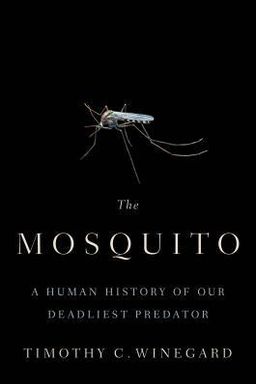
The Mosquito cover

The Mosquito

by Timothy C Winegard

Timothy C. Winegard''s ''The Mosquito'' uncovers the extraordinary influence of mosquitoes on human history, from shaping empires to affecting major wars. This gripping narrative reveals how this small insect has altered the course of civilization and continues to pose challenges today.

The Mosquito and Human Destiny

How can an insect smaller than a grain of rice shape the entire course of human civilization? This is the central question animating the book—a sweeping history that reframes world events through the lens of the mosquito and the diseases she carries. Across wars, empires, genetic evolution, and modern medicine, the author argues that humanity’s story cannot be told without her. You’re not just reading about an insect; you’re meeting history’s deadliest predator and one of its most consistent forces of selection.

The scale of influence

With roughly 110 trillion individuals alive at any moment, mosquitoes represent one of nature’s most effective delivery systems for microscopic agents of death. Over fifteen major pathogens—including malaria, yellow fever, dengue, and Zika—travel by way of her bite. Each has reshaped demographics, economies, and political outcomes. Since 2000 alone, mosquito-borne diseases kill about two million people annually and disable countless more. The author reminds you that, measured by historical impact, the mosquito has humbled generals and altered epochs far beyond her size.

A biological system entwined with civilization

The mosquito’s biology explains her power. Blood provides the protein she needs to develop eggs; standing water—from Roman cisterns to plastic bottle caps—creates her nurseries. Human agriculture, urbanization, and trade have exponentially multiplied her habitats. Every irrigation ditch or rice paddy becomes a micro‑factory for vectors, and wherever people gather, mosquitoes follow. You realize that progress itself—civil engineering, farming, colonial expansion—has served as her partner in survival. (Note: historian J.R. McNeill calls this “co‑evolutionary tragedy”—human success begets vector success.)

Disease as hidden architect of history

The book traces how mosquito-borne disease often did what swords could not: it toppled armies, destroyed colonies, and redirected empires. Athens fell as fever followed overcrowding in the Peloponnesian War; Rome’s Pontine Marshes defended and debilitated simultaneously; Alexander the Great’s death in Babylon likely came from malaria. In the age of exploration, malaria and yellow fever enabled European conquest by first decimating Indigenous populations and then creating niches that Africans—by genetic adaptation and “seasoning”—could survive better in. Biological advantage became economic rationale, fueling slavery and shaping global labor hierarchies.

Evolutionary feedback loops

As the mosquito pressed evolution’s throttle, humans responded with genetics. The sickle cell trait, thalassemia, and Duffy negativity arose as defense mechanisms. Each brought survival advantages at terrible costs—protection intertwined with pathology. This dynamic shows natural selection in action, and how human diversity retains the invisible fingerprint of the mosquito’s pressure. Agricultural patterns, from African yam cultivation to Roman aqueducts, strengthened this feedback loop—what the author calls “mosquito ecology,” a fusion of environmental change, population density, and selective biology.

From conquest to control

Humanity’s counterattack began with medicine. Quinine, extracted from cinchona bark, temporarily leveled the playing field—empowering Europe’s colonial drives into Africa and Asia. Later, twentieth‑century solutions like DDT, atabrine, and artemisinin formed a technological relay against a relentless foe. But each success bred dependency and each chemical triumph invited ecological resistance. The story evolves from conquest to adaptation to reconsideration—an arc mirrored in Silent Spring’s environmental reckoning and CRISPR’s futuristic temptations to rewrite the mosquito’s genome entirely.

The moral horizon

In the final chapters, eradication turns philosophical. Can humanity ethically extinguish another species—even one responsible for hundreds of millions of deaths? CRISPR gene drives promise global health but pose ecological and security risks. The author urges you to see extinction as policy, not biology: a deliberate act in a web of unforeseen consequences. The mosquito’s story concludes as both caution and challenge—proof that disease is as political and moral as it is biological.

Core revelation

History is not just the saga of kings and wars—it’s also the chronicle of an insect that has quietly steered civilization. The mosquito represents the intersection of nature and human ambition, reminding you that progress without ecological awareness always carries the cost of unforeseen vulnerability.

By the end, you see the world differently: each marsh, canal, and colony is a chapter in this shared biography between mosquito and man. The lesson is humbling and urgent—the smallest actors often write the largest outcomes.


Biology Behind the Bite

To grasp the mosquito’s historical impact, you need to understand her mechanics. The female mosquito’s feeding and breeding habits are evolutionary marvels—her bite is not a random irritant but a precise act of survival. When she pierces your skin, six microscopic needles saw, probe, and inject saliva that keeps blood from clotting. That saliva is an ideal vehicle for invisible hitchhikers: viruses, protozoa, and worms that exploit this exchange to find their next host.

Feeding and reproduction

Female mosquitoes require the protein from blood to develop their eggs. A single meal can triple her body weight and enable up to 200 eggs, which she lays anywhere water collects—even a bottle cap. This adaptability makes her omnipresent across climates, from urban gutters to tropical swamps. Water, warmth, and human proximity create the perfect reproductive circuit. (Note: anthropogenic waste like tires and cans expanded breeding sites worldwide.)

Life cycle and temperature sensitivity

You follow her through four stages—egg, larva, pupa, adult—completed within ten days under warm conditions. Temperature defines her limits: below 50°F she struggles, above 75°F she flourishes. Diseases she transmits, like malaria’s Plasmodium, depend similarly on this warmth. When the parasite’s cycle outlasts the mosquito’s lifespan in cooler regions, transmission breaks—a critical insight for ancient civilizations and modern urban planning alike.

Species diversity and ancient history

Fossil evidence traces mosquitoes back 80–105 million years, long before human evolution. Only a fraction of species threaten us—about seventy of the 480 Anopheles varieties carry malaria—but that subset dictates billions of human stories. Their persistence underscores evolution’s efficiency: minimal biological change, maximal impact. These insects have become ancient vectors for newly evolving pathogens—a partnership both accidental and devastating.

The ecological economy of disease

Once you grasp their biology, human choices—urban sprawl, irrigation, neglect of waste—look less like progress and more like vector investment. Every puddle or pipe becomes a future epidemic site.

Understanding this anatomy and adaptation makes history’s outcomes more predictable: whenever humans altered landscapes or climates in favor of standing water and warmth, mosquitoes multiplied—and history bent toward disease.


Mosquitoes, Disease, and Human Adaptation

The mosquito’s power lies not just in her bite but in the pathogens she ferries—and the evolutionary responses those pathogens provoke. Malaria and yellow fever emerge as central players in this evolutionary drama, shaping human genetics, behavior, and empire alike. To see history clearly, you need to see how biology forces politics and adaptation into the same story.

Malaria and Yellow Fever—The Twin Architects

Malaria’s protozoan parasite Plasmodium falciparum turns blood into battlefields, entering the liver before exploding red cells with clocklike precision. Hippocrates and Thucydides described its fevers long before microbes were known. Yellow fever, carried by Aedes mosquitoes, adds a viral horror: jaundice, internal bleeding, and death within days. Before vaccines (1937), entire ship crews were lost to vómito negro, leaving floating cemeteries in the Caribbean. These “toxic twins” dictated who could survive tropical enterprises and whose empires thrived.

Genetic resistance and its price

Under relentless malaria pressure, natural selection reshaped humanity. The sickle cell mutation, born about 7,000 years ago among Bantu agriculturalists, saved carriers while dooming homozygotes to fatal disease. Duffy negativity immunized millions of West Africans against vivax malaria. Thalassemia and G6PDD added partial shields in the Mediterranean and Middle East. These mutations form a genetic map of microbial war—a tradeoff between survival and suffering. Every sickle trait or thalassemic lineage you see today is evolutionary scar tissue from mosquito conflict.

Seasoning and cultural response

Beyond genetics, culture adapted through “seasoning”—gradual tolerance built by repeated infection. Indigenous and African populations survived better in malarial or yellow-fever zones because they were biologically or immunologically acclimated. Colonizers, unseasoned and naïve, often perished en masse. From Jamestown’s 1609 'Starving Time' to Scottish deaths in Panama’s Darien scheme, disease punished unprepared settlers and dictated geopolitical compromises. (Note: the mosquito indirectly forged Great Britain when Scotland’s colonial collapse led to the 1707 Union.)

Evolution as empire

What emperors claimed through conquest, microbes claimed through adaptation. Genetic and ecological conditioning became determinants of labor, colonization, and resistance—proof that evolution and geopolitics run on the same timetable when mosquitoes set the clock.

By connecting disease, genes, and empire, you begin to see that history’s great forces often start under a microscope.


Empire, Slavery, and Epidemiological Economics

When European explorers entered the Americas and Africa, they unknowingly carried—and created—a global biological merger. The mosquito and her pathogens became invisible colonizers, turning disease into an economic system. From the Columbian Exchange to the age of plantations, malaria and yellow fever were as influential as guns and ships in shaping who lived, who labored, and who profited.

The Columbian ecological collision

Transatlantic voyages blended isolated disease ecologies. Indigenous populations—unseasoned to Old World pathogens—faced annihilation. Las Casas chronicled Caribbean depopulation from millions to thousands in decades. As malaria and yellow fever established footholds via Aedes and Anopheles arrivals, European conquest accelerated. Death made land cheap, and surviving Africans became prime labor substitutes.

Mosquito-borne survival and the rise of slavery

Africans possessed partial immunities: Duffy negativity, sickle traits, and seasoning from endemic exposure. These biological advantages were twisted into economic rationale—Africans could endure cane and coffee fields where Europeans and Indigenous workers died. Disease thus structured the transatlantic labor hierarchy. By the eighteenth century auctions priced 'seasoned' Africans higher; nearly 15 million survived ocean crossings into the Americas, fueling sugar, coffee, and rum economies whose profits underwrote European modernity.

Quinine and imperial penetration

Quinine, extracted from cinchona bark, flipped colonial risk into opportunity by reducing European mortality in malarial zones. Dutch plantations in the East Indies (1850s) made quinine affordable, enabling the Scramble for Africa. Belgium’s King Leopold II exploited this advantage catastrophically in Congo—ten million dead under his rule. Medicine became imperial logistics: conquer by surviving. (As William McNeill noted, without quinine European domination would have stalled at Africa’s coast.)

The mosquito’s economic empire

Vector disease didn’t just kill—it dictated profit and privilege. The mosquito decided which bodies were viable labor and which lives powered global trade. Every plantation ledger echoed an ecological algorithm.

By tracing this medical economy, you see how biology structured centuries of exploitation, laying the epidemiological foundation for racial and economic inequality still visible today.


War, Revolution, and the Mosquito’s Political Power

Military strategy often reads like a chessboard of generals, but under the microscope you find another commander—the mosquito. From ancient battlefields to revolutionary wars, disease reshaped outcomes more reliably than weapons. The author reframes geopolitics as an ecological drama in which victory hinged on immunity and timing as much as tactics.

Ancient and early modern campaigns

In Greece and Rome, marshes guarded and destroyed empires equally. Persian forces sickened in coastal swamps; Athens collapsed under fever; Roman legionaries decayed beside their aqueducts. Disease acted as invisible terrain—favoring locals and punishing invaders. (Jared Diamond’s dictum that microbes outperform generals resurfaces throughout.)

Eighteenth-century empires and revolutions

During the Seven Years’ War, Britain lost 22,000 of 29,000 men to tropical fevers at Cartagena, redirecting strategy and resources. Later, in the American Revolution, unseasoned British troops succumbed to malaria along southern rivers—Cornwallis’s army fell at Yorktown partly sick. Disease asymmetry gave colonial militias silent allies. In the Caribbean, similar biological mismatches fueled the Haitian Revolution, where yellow fever killed 55,000 of Napoleon’s 65,000 troops, ending French hopes and forcing the Louisiana Sale that doubled U.S. territory.

Civil War and quinine logistics

A century later, the same ecological logic dictated America’s fate. The Union’s quinine monopoly turned medicine into strategy—19 tons dispensed during the war, while Confederate shortages rendered troops vulnerable. Grant’s success at Vicksburg hinged on abundant quinine amid swampy terrain. Disease management became a military art; 65% of Union deaths came from illness, confirming that victory depended on medical logistics. (Note: in this sense, quinine was the North’s hidden arsenal.)

Strategic law of fever

Across centuries, armies that understood mosquito ecology endured; those that ignored it collapsed. The mosquito effectively dictated which civilizations could project power beyond their climate zones.

Seeing war through this lens converts military history into ecological insight—human conflict has always been a dialogue between ambition and biology.


Science, Sanitation, and the Modern Counterattack

By the late nineteenth century, scientific discovery turned the mosquito from legend to laboratory subject. What began with Cuba’s yellow‑fever epidemics matured into a century of breakthroughs—Walter Reed’s experiments, William Gorgas’s sanitation campaigns, and twentieth‑century weaponization of insect control. This era shows how knowledge itself became imperial power.

Reed and the revelation of vectors

Carlos Finlay theorized that Aedes aegypti transmitted yellow fever; Reed proved it in 1900 with controlled trials on volunteers in Havana. Once the vector was identified, sanitation replaced superstition. Gorgas drained swamps and fumigated homes, eradicating yellow fever from Havana by 1902 and from Panama’s Canal Zone by 1906—transforming engineering feasibility. Disease control became infrastructure policy.

World War II’s technological offensive

Scientific urgency during WWII produced DDT and synthetic drugs like atabrine. Paul Müller’s 1939 discovery of DDT’s potency prompted mass spraying: from 153,000 pounds in 1943 to 36 million by 1945. The U.S. Malaria Project deployed survey units that made entomology a military discipline. Propaganda figures like Dr. Seuss’s “Ann” taught soldiers vector hygiene. For the first time, mosquitoes met organized chemical warfare—and lost, briefly.

From triumph to moral reckoning

Victory bred moral reflection. Wartime experiments on prisoners and civilians blurred ethics. Weaponization of malaria (German flooding of Pontine Marshes, 1944) underscored the dark potential of biological control. Postwar optimism led the WHO’s global eradication campaign, only to falter when mosquitoes evolved DDT resistance and parasites defied chloroquine. Rachel Carson’s Silent Spring (1962) exposed ecological damage and rebalanced urgency with conscience, birthing environmentalism as science’s corrective mirror.

Knowledge as empire

Each stage—from Reed to Carson—reflects how science evolves under the pressures of war, commerce, and ethics. Understanding the mosquito’s biology turned conquest into management; understanding ecology turned management into moral responsibility.

You finish this chapter aware that science, wielded without humility, reproduces imperial patterns. Progress against the mosquito demands respect for both biology and the boundaries of human intervention.


Drugs, Genes, and the Future Fight

The closing chapters present humanity’s newest moves in the long duel with the mosquito—from the rediscovery of artemisinin to CRISPR gene drives that promise species-level intervention. Medicine advances, resistance emerges, and the question becomes not whether we can defeat disease but whether we can do so wisely.

The drug arms race

Each generation invented a cure, lost it to evolution, and invented again. Quinine gave way to chloroquine; chloroquine succumbed to resistant strains; mefloquine caused psychological side-effects; and China’s Project 523 under Tu Youyou rediscovered artemisinin in 1972—a return to traditional herbs under Cold War secrecy. Artemisinin-based combination therapies (ACTs) now define modern malaria treatment, yet resistance reappeared by 2008 in Cambodia. Market greed—monotherapy sales—accelerated the parasite’s adaptation. Drug innovation and economic inequality collided, proving that biology punishes shortcut economics.

Genetic engineering and gene drives

CRISPR has transformed ambition into possibility. Scientists can bias inheritance so a sterilizing gene spreads through mosquito populations, collapsing them within generations. Gates Foundation funds Target Malaria projects exploring this vision. Potentially billions of lives saved—but also billions of ecological unknowns. Eliminating vectors risks destabilizing ecosystems or inviting malicious use; the technology’s low barrier raises real dual-use fears. As with nuclear power, governance lags behind innovation.

Ethical thresholds

CRISPR forces philosophical introspection: should humans choose species extinction for medical gain? The author reminds you that mosquitoes have coevolved over 100 million years; removing them is not like defeating smallpox—a human-only virus—but erasing a multi-species node. Extinction as strategy demands global consensus, ecological modeling, and moral clarity. (Comparatively, Jennifer Doudna’s condemnation of He Jiankui’s human gene-editing scandal underscores how ethical polities often lag behind technological capacity.)

The unfinished fight

Medicine can win battles, not wars, unless coupled with equity and foresight. The mosquito’s final lesson may be humility: evolution never stops, and neither should our ethical vigilance.

You come away realizing that our greatest victories against disease are never permanent—they are negotiations with nature, technology, and morality in equal measure.

Dig Deeper

Get personalized prompts to apply these lessons to your life and deepen your understanding.

Go Deeper

Get the Full Experience

Download Insight Books for AI-powered reflections, quizzes, and more.