
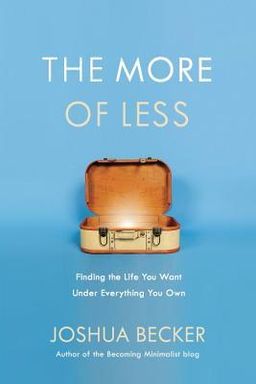
The More of Less cover

The More of Less

by Joshua Becker

The More of Less is a transformative guide that helps you declutter your life and focus on what truly matters. Joshua Becker presents practical strategies to free up time, energy, and resources, allowing you to embrace a fulfilling minimalist lifestyle and escape the traps of consumerism.

The Freedom of Owning Less: Rediscovering What Matters Most

When was the last time your possessions made you truly happy—or did they mostly weigh you down? In The More of Less, Joshua Becker makes the radical but welcoming case that our excess possessions don’t just fail to make us happy—they actively distract us from the things that do. When he first stumbled upon minimalism while cleaning out his cluttered garage one Memorial Day weekend, Becker experienced an insight that reshaped his life: every unnecessary thing he owned was taking time, money, attention, and energy away from what he valued most—his family, his purpose, and his faith.

This book is Becker’s attempt to share that discovery—to show that owning less isn’t about deprivation, but liberation. Rather than advocating austere asceticism or a one-size-fits-all formula, Becker invites readers to design their own form of intentional minimalism: deciding what to keep based on what truly supports their goals, values, and passions. His definition is simple yet profound: minimalism is the intentional promotion of the things we most value and the removal of anything that distracts us from them.

From a Cluttered Garage to a New Calling

The story begins with Becker’s pivotal moment. While struggling through a routine cleaning job, frustrated that his garage had consumed yet another Saturday, a neighbor named June casually remarked, “You don’t need to own all this stuff.” That simple comment pierced through Becker’s exhaustion. Glancing at his five-year-old son playing alone outside, he realized his material possessions weren’t making him happy—they were preventing happiness from happening at all. They demanded maintenance instead of offering joy. That same day, he and his wife Kim began giving things away, and within six months they had cut their possessions by half. What started as a household cleanup soon became a life philosophy and, eventually, a movement. Becker’s blog, Becoming Minimalist, turned into a global conversation about living more with less.

Why Our Culture Needs Minimalism

Becker grounds his message in a critique of modern consumerism. In a world where the average American home contains over 300,000 items and five thousand advertisements bombard us daily, he argues that our sense of self-worth has become tangled in what we buy. This “fog of consumerism” blinds us to the truth that fulfillment doesn’t come from possession, but purpose. Minimalism, in contrast, clears the fog. It reconnects us to our time, energy, relationships, and creativity. Becker warns of the immense cost of overconsumption—not only in money but in mental health, environment, and relationships. He quotes Will Rogers’s quip that too many people “spend money they haven’t earned to buy things they don’t want to impress people they don’t like,” showing how universally this trap ensnares us.

The Promise of Owning Less

Minimalism, Becker emphasizes, is not about austerity or self-denial; it’s about abundance of a different kind. The less you own, the more you free yourself to live. His chapters outline twelve universal payoffs to owning less: more time and energy, more money, more generosity, more freedom, less stress, less distraction, a reduced environmental impact, and deeper connections. Whether you’re a parent drowning in toys or a retiree surrounded by memorabilia, Becker offers attainable tools for reclaiming your space—and, by extension, your life.

Each chapter shows minimalism as a way to reveal, not remove, what matters. By eliminating excess, you uncover what you value most—whether that’s relationships, faith, health, or creativity. The result is not a smaller life but a bigger, more intentional one. Becker reinforces this with real stories: Annette, the wandering journalist who turned mobile simplicity into freedom; Troy, who found hope through decluttering; and countless others who used minimalism to reinvent their lives. Together they demonstrate that less has never meant emptiness—it has always meant clarity.

A Practical Guide to Transformation

Becker weaves inspiration with actionable advice. He guides readers through “rational minimalism”—finding their own definition of enough through experiments, room-by-room decluttering, and self-reflection. He suggests methods like “leveling” (temporarily storing uncertain items) and “29-day experiments” to test what you can live without. His suggestions move gradually from easy wins (cleaning your car or a drawer) to tough decisions (sentimental items, homes, even relationships). Through these steps, minimalism becomes not just a house-cleaning exercise but a lifestyle of purpose.

Becker’s tone is generous, never dogmatic. He knows minimalism looks different for everyone—from a suburban family to a digital nomad. Rather than preaching empty rooms, he encourages “holding things lightly.” The goal is not to have nothing, but to have the right things. This openness makes the philosophy accessible rather than intimidating, allowing readers to tailor it to their own purposes.

The Bigger Life Beneath the Smaller One

Beyond organization, Becker turns minimalism into a spiritual practice. Quoting Scripture and great thinkers like Thoreau and Buddha, he ties the movement to ancient wisdom about detachment and purpose. Later chapters explore how minimalism enhances generosity, fosters gratitude, strengthens families, and clarifies vocation. Becker’s own journey leads to The Hope Effect, his nonprofit that uses minimalism’s dividends to reform orphan care. In practice, owning less released energy for contribution—a theme that echoes in similar works like Greg McKeown’s Essentialism and Marie Kondo’s The Life-Changing Magic of Tidying Up.

By the book’s end, “the more of less” becomes a paradox you can feel: less clutter equals more life—more time, generosity, contentment, and joy. Becker’s message is simple but urgent: the life you want is buried under everything you own. Minimalism is the shovel that helps you uncover it. His invitation isn’t to give up things; it’s to gain yourself back. He offers a path toward freedom that starts with a question every reader must face: what if less really could mean more?


Seeing Through the Fog of Consumerism

Becker argues that most of us live under an invisible spell—a cultural fog that equates consumption with happiness. The rise of modern advertising in the twentieth century created a system designed to stir constant dissatisfaction. Drawing on historical examples, Becker describes how advertisers like Ernest Dichter weaponized psychology to “stir up wants,” linking self-worth to ownership. Today, we are surrounded by 5,000 ads daily, inviting us to buy more, upgrade often, and measure success in square footage and brand logos.

The Mechanics of Manipulation

Becker exposes how corporations expertly manipulate us through scarcity mindsets, faux sales, and status symbols. He lists techniques like instant markdowns (artificial discounts), loyalty programs, and “loss leaders” designed to engineer compulsive buying. In one striking example, he notes research showing that consumers spend twice as much when using retail-store credit cards—a statistic marketers understand better than their customers. Recognizing these strategies, he insists, is the first step in resisting them.

Generational Influence

Your relationship to stuff, Becker explains, isn’t just personal—it’s generational. He outlines how each modern age developed its own consumer patterns: the Silent Generation hoarded out of scarcity, Baby Boomers pursued abundance, Gen Xers balanced cynicism with material comfort, and Millennials, shaped by recession and digital life, are reimagining ownership through access and sharing. This section reads almost sociologically, reminding you that your shopping habits are inherited beliefs, not essential truths.

Success vs. Excess

Becker draws a sharp distinction between success and excess. Society mistakenly celebrates the latter—mansions, luxury cars, overfilled closets—while undervaluing the quiet contentment of enough. “We check the wrong scoreboard,” he warns. Instead of praising accumulation, he encourages us to celebrate self-control, gratitude, and contribution. He invites readers to look at their own “praise habits”: Do we admire abundance or purpose?

The Liberation of Awareness

Perhaps the book’s most countercultural claim is that awareness alone can be transformative. By learning to “spot the tools of the trade,” you arm yourself against them. Becker’s readers—like Margot, the journalist who discarded a thousand items and found herself walking through malls without wanting anything—illustrate this awakening. This isn’t merely about budgeting; it’s a psychological emancipation. As Becker puts it, “Liberation is when your joy comes from what you already have.” In a world of endless marketing noise, minimalism becomes a radical act of clarity.


Minimalism as Personal Transformation

For Becker, minimalism isn’t just tidying—it’s inner renovation. The act of decluttering becomes a mirror, reflecting your hidden desires and misplaced trust. When he and his wife hauled four minivan loads to Goodwill, they asked: why did we ever buy so much? The question revealed that possessions had become their way of seeking control, identity, and comfort. True minimalism, Becker realizes, requires confronting those illusions.

The Three False Promises

Becker names three core motivations driving overaccumulation—security, acceptance, and contentment—and flips them on their head:

  • Security: We build “golden fortresses” of stuff thinking they protect us, but our real safety comes from love and community.
  • Acceptance: We chase social approval through status items, forgetting that excess impresses no one. Becker urges us to redefine normal—not as keeping up, but stepping out.
  • Contentment: We postpone happiness—“when I get this, then I’ll be happy.” Minimalism breaks this loop by cultivating gratitude now. Giving, not gaining, becomes the source of joy.

Through these inversions, Becker transforms minimalism into psychological therapy. It’s not about boxes or bins; it’s about beliefs.

Breaking the Emotional Cycle

The example of Anthony and Amy Ongaro, who discovered they’d spent over $10,000 on Amazon purchases under $40, captures a universal truth: small hits of dopamine from shopping mask deeper dissatisfaction. Minimalism exposes that addiction, forcing you to ask why you buy. The cure isn’t willpower; it’s understanding.

Twisting Desires Toward Purpose

Becker concludes that lasting change comes when we “do the twist”—redirecting motivations rather than suppressing them. Instead of seeking security in things, find it in relationships. Instead of seeking acceptance from others, define success internally. Instead of chasing contentment by addition, practice subtraction. This realignment makes minimalism not self-punishment but self-restoration. You stop consuming to fill emptiness and start living from fullness. In essence, minimalism becomes soul work disguised as housework.


Decluttering as a Spiritual and Practical Discipline

Once the inner transformation begins, Becker turns to the practical side of removing physical clutter—without losing the spiritual foundation. He insists you start easy, not brave. “You don’t need to start with your heirlooms,” he jokes. Start with your car, your counters, or a drawer. The point isn’t perfection; it’s momentum. Becker’s method balances practicality with introspection, combining emotional honesty with doable routines.

Steps Toward Simplicity

He outlines a five-step “baby steps” framework:

  • Declare your “why”: Write down the reasons you want less—freedom, time, purpose—and post them visibly.
  • Grab easy wins: start with low-emotion spaces to feel progress.
  • Go room by room, touching every item. Physical contact sparks honest evaluation.
  • Eliminate redundancy: keep the best, not the most.
  • Share your story: joy multiplies when told—it turns lifestyle into community.

Much like James Clear’s atomic habits, Becker frames simplicity as a habit loop powered by small wins. Each bag donated is a micro-victory for your freedom.

Facing Difficult Items

When decluttering tough categories—books, papers, technology, sentimental keepsakes, even cars and homes—Becker offers compassionate criteria: keep only “the best,” digitize when possible, and memorialize memories with photos. One moving example is his wife keeping three items from her grandmother: a candy dish, a brooch, and a Bible. By displaying them daily, she preserved love without preserving bulk. Becker’s advice contrasts with Marie Kondo’s emotional spark test by emphasizing legacy over sentimentality: what tells the story best, not what tugs hardest.

Tools and Experiments

Becker encourages playful experimentation—his “29-day rule” invites readers to box up uncertain items for a month. If you don’t miss them, you’re free to let go. He also describes Ryan Nicodemus’s famous “packing party,” where every belonging went into boxes, and only essentials were unpacked over time—a dramatic leveling-down exercise. Whether you try Courtney Carver’s “Project 333” (33 clothing items for 3 months) or run your own minimalist experiment, the formula is simple: test enough, discover enough, live enough. For Becker, every bag removed is a step closer to soul-level serenity.


Minimalism in Families and Relationships

What happens when your partner or kids don’t share your enthusiasm for minimalism? Becker dedicates an entire section to this question, showing that simplicity begins not with others, but with empathy. “You can’t declutter someone’s heart,” he reminds readers. The principle is modeled in his family story: when his wife disagreed about what to keep, he compromised, learning the now-humorous 'Jell-O mold incident' lesson—not to throw away another’s treasures without consent.

Partnership Through Example

Becker advises couples to lead through example, not argument. Clean your own side of the closet before touching your spouse’s. Model the benefits—peace, clarity, space—until curiosity replaces resistance. Over time, he reports, many converts follow not from persuasion but from seeing how calm looks. In his words, “A clean, clutter-free side of the closet is more convincing than any lecture.”

Parenting the Next Generation of Minimalists

With children, Becker’s tone is patient yet passionate. He believes raising minimalist kids may be harder, but it’s also more necessary. Children must learn boundaries early so they don’t grow into adults addicted to accumulation. His own kids, Salem and Alexa, learned this through simple rules: toys must fit within specific bins, and art projects within a box. Periodic family purges became rituals of empowerment rather than punishment. The key is to balance limits with experiences—taking trips or hiking instead of shopping for rewards. Experiences, he reminds us, expand memory without expanding closets.

Teenagers and Resistance

For older children and teens, Becker gathers advice from educators and parents: encourage idealism (help teens focus on causes rather than clothes), make them pay for luxury items to teach value, and expose them to other cultures through travel or volunteering. If necessary, set boundaries but never break relationships. Underneath, Becker’s family philosophy echoes his Christian faith: never sacrifice love on the altar of minimalism. Relationships, not rules, define success. By making love the foundation, minimalism becomes a form of nurturing, not neglect.


Generosity: The Shortcut to Significance

At the heart of Becker’s message lies a seismic shift: minimalism’s ultimate purpose is not self-care but service. Once possessions no longer dominate you, your freed time, energy, and money can flow outward. He calls it the 'financial and time dividend of minimalism.' And for Becker, generosity isn’t an afterthought—it’s the endgame.

From Garage Sales to Giving

Initially, Becker admits, he tried to sell his excess in a garage sale—only to make $135 and regret the wasted energy. True joy arrived when he and Kim donated their leftover items to local charities: maternity homes, refugee centers, homeless shelters. Rather than profit, they found purpose. He concluded that giving is better than selling: “We discovered more joy in delivering those items to others than money could ever buy.” The lesson transcends tidiness: our surplus is someone else’s salvation.

Giving as Growth

Becker introduces examples of radical generosity—most notably, Ali Eastburn selling her wedding ring to dig wells in Africa, sparking a movement called With This Ring. These stories illustrate generosity as contagious courage. He then provides practical strategies: start small (even $1), give first, replace one expense with giving, and align giving with passions. In the language of finance, he calls generosity a “return on simplification.” The more you give, the richer you feel.

The Joy of Enough

Generosity brings a paradoxical payoff: the realization that you already have enough. Becker quotes Jesus—“Where your treasure is, there your heart will be also”—to show why giving heals greed. In serving others, you reclaim your humanity. For him, minimalism and meaningful impact are inseparable. His own story culminates in founding The Hope Effect, a nonprofit that channels minimalist savings to reimagine orphan care. Through such acts, Becker transforms minimalism from mere decluttering into a moral movement: ownership replaced by stewardship.


An Intentional Life: Designing for What Matters

Once you’ve owned less, Becker says, you must design what to do with the space you’ve gained—physically, mentally, and spiritually. Minimalism is only meaningful when paired with intentionality. Otherwise, he warns, you risk trading clutter for idleness. Drawing parallels to Greg McKeown’s Essentialism, he defines intentional living as aligning your energy with your true purpose across three major arenas: your schedule, your body, and your relationships.

Unbusyness as Clarity

Overcommitment, like overconsumption, is clutter of the calendar. Becker quotes Seneca—“No one pursuit can be successfully followed by a man who is busied with many things”—and outlines four steps to reclaim time: create gaps in your day for reflection, reduce digital distractions, learn to say no gracefully, and schedule rest as nonnegotiable. These steps mirror digital minimalists like Cal Newport but place equal emphasis on spiritual reflection. Rest, he writes, is as productive as motion.

Bodies as Instruments, Not Ornaments

Becker redefines self-care through stewardship. Quoting Gary Thomas, he urges readers to treat their bodies as instruments—tools for purpose, not trophies for ego. Instead of chasing beauty standards, he promotes health habits that extend your ability to serve: fueling with simple food, hydrating, exercising, and avoiding overindulgence. For him, a minimalist diet or fitness plan is not about aesthetics but about maximizing life capacity. His own transformation—asking for a $10 gym membership instead of gifts—shows minimalism as self-discipline for joy, not vanity.

Relationships Reimagined

After simplifying surroundings, Becker offers the hardest challenge: simplify relationships. He rejects the popular minimalists’ advice to “cut toxic people ruthlessly.” People, he reminds us, are not clutter. They’re sacred. Ending truly harmful ties may be necessary, but real minimalism in relationships means intentional love—focusing your emotional energy where it heals and restores. His friendship with a struggling, unreliable friend named John embodies this: even in one-sided relationships, unconditional love becomes the highest form of minimalism. The goal isn’t fewer people—it’s deeper humanity.


The More of Less: Turning Freedom into Impact

In his closing chapters, Becker widens the lens from homes to humanity. Owning less, he concludes, isn’t the end—it’s the preparation for significance. Once you’ve cleared external and internal clutter, you can pursue what he calls your 'greatest pearl'—the purpose worth selling everything for. Inspired by Jesus’s parable of the pearl of great price, Becker calls readers to identify their own pearl: the cause, mission, or relationship deserving full devotion.

Choosing the Greater Life

Becker’s philosophy culminates in an elegant paradox: owning less to give more. He insists that minimalism is not retreat but reach—an invitation to impact others. Whether by mentoring, volunteering, or entrepreneurship, he urges readers to turn the dividends of space, money, and time into real-world contribution. Serving others, he argues, creates the deepest happiness because it synthesizes simplicity with significance. “Self-centered pleasure,” he warns, “is never as rewarding as giving-centered purpose.”

The Ripple Effect of Influence

Becker redefines success beyond profit or possessions. Influence isn’t about scale; it’s about presence. Every person, he writes, affects others daily through words, actions, and examples. Minimalism amplifies that influence by freeing attention for kindness, creativity, and connection. He notes that ordinary people—blog readers, donors, parents—are the engines behind real change: they supplied the funds for The Hope Effect’s homes for orphans. One decluttered garage can ripple outward to global reform.

Living the Paradox of Service

Ultimately, Becker links minimalism to the ancient paradox of joy: “I slept and dreamt that life was joy. I awoke and saw that life was service. I acted, and behold, service was joy.” This Tagore quote captures Becker’s thesis. Freedom from possession is freedom for compassion. When you simplify enough to give, you discover the richest form of wealth—the ability to make others’ lives fuller. That’s the more of less: discovering that your best life isn’t about what you own but what you offer.

Dig Deeper

Get personalized prompts to apply these lessons to your life and deepen your understanding.

Go Deeper

Get the Full Experience

Download Insight Books for AI-powered reflections, quizzes, and more.