
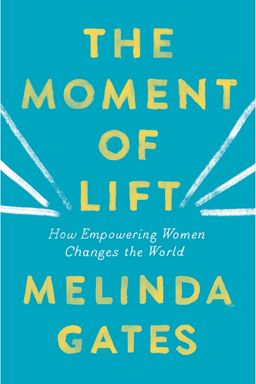
The Moment of Lift cover

The Moment of Lift

by Melinda Gates

The Moment of Lift by Melinda Gates explores the transformative power of empowering women. Through compelling stories and insights, Gates reveals the challenges women face globally and the profound impact of overcoming these obstacles on society''s progress toward equality and justice.

Lifting Women to Lift Humanity

Have you ever wondered why empowering one woman can seem to change an entire community? In The Moment of Lift, Melinda Gates asks this question and argues that when women are lifted up — socially, economically, and emotionally — humanity as a whole rises. Gates builds her case through a blend of global fieldwork, intimate stories, and personal reflection, showing that true progress begins at the intersection of equality and connection.

Her central claim is simple but transformative: empowering women isn’t a side issue — it’s the most effective way to fight poverty, improve health, and create justice. This book weaves together decades of Gates’s philanthropic experience from India, Africa, and the United States to reveal how women’s voices, when amplified, reshape entire cultures. Through her lens, empowerment turns from an abstract ideal into a practical mission driven by data, empathy, and partnership.

From Personal Awakening to Global Vision

The book begins as a personal evolution. Gates recounts her early work and family life — from quitting Microsoft to raise her children to realizing how her own choices around contraception were privileges many women lacked. Bit by bit, she discovers that the barriers facing women worldwide — lack of education, unpaid labor, limited access to healthcare, forced marriage, and workplace inequality — are all symptoms of cultures structured by dominance rather than partnership. Her guiding principle becomes clear: to lift women up is not to put men down; it’s to rise together.

This idea gains emotional depth through stories like those of Meena in India, who wished someone had told her about family planning before it was too late; Anna in Tanzania, who dreamed of starting a business but was buried under hours of unpaid work; and Malala Yousafzai, who risked her life for girls’ education. Each story illustrates the same truth — when women are free to decide how to use their time, to pursue education and income, they can transform the futures of their children and communities.

The Chain of Empowerment

Gates organizes her argument through what might be called the chain of empowerment: maternal health, family planning, education, unpaid work, child marriage, agricultural labor, and workplace equality. Each link shows how social systems hold women back and how solutions emerge when empathy and evidence join hands. For instance, teaching newborn care in rural India leads not only to infant survival but to mothers discovering confidence and asserting agency. Supporting self-help groups among women farmers doesn’t just increase yield; it rewrites gender norms and family power dynamics.

The book also explores how hidden biases — economic formulas that ignore unpaid labor or cultural practices that tie virtue to obedience — perpetuate inequality. Gates highlights pioneers like economist Marilyn Waring, who exposed how national accounts undervalue domestic work, and activist Molly Melching, whose empathy-based programs in Senegal helped communities abandon harmful traditions through dialogue, not condemnation. These examples turn theory into human drama, making the reader feel the moral urgency behind data.

Equality as Connection, Not Competition

What makes Gates’s vision distinctive is how she redefines equality. In the final chapters, she moves beyond empowerment as independence to advocate connection as interdependence. Equality without empathy, she insists, only replaces one hierarchy with another. The goal is mutual respect, cooperation, and shared humanity. Drawing inspiration from peace activist Leymah Gbowee and data scientist Joy Buolamwini, she shows that social change happens when people let their hearts break — when they confront the suffering of others and respond not with guilt but with solidarity.

By the book’s close, “lift” becomes a metaphor for grace and momentum: the engines of compassion ignite, resistance gives way, and culture itself begins to rise. Like the rockets Gates watched as a child, human progress needs thrust — empathy, education, and courage — to overcome gravity. And as she concludes, connection is the ultimate lift. The moment we stop treating others as outsiders and begin working side by side, all of us rise together.


Empowering Mothers and Rewriting Health

How can empowering mothers become the key to combating poverty? Gates presents maternal and newborn health as one of the most powerful entry points for social transformation. She recounts the insight of her mentor, Hans Rosling, who taught her that poverty means not being able to protect your family from preventable harm. When a mother cannot save her child while others can, poverty becomes the most disempowering force on earth.

Seeing Through Mothers’ Eyes

Through vivid stories — like a Mozambican mother whose death was honored by ‘Doctor Tall’ Hans Rosling — Gates humanizes statistics. These women live far from hospitals, without trained attendants or transportation. Rosling’s experiences inspired programs that changed the odds: community health workers trained to provide safe births and newborn care, such as the Saksham project led by Vishwajeet Kumar and Aarti Singh in Uttar Pradesh, India. Their simple interventions — skin-to-skin warmth, immediate breastfeeding — halved newborn mortality in eighteen months. Such success showed that change doesn’t always need high technology; it needs empathy and local understanding.

Delivery Systems as the Missing Link

Gates highlights that innovation is not enough if nobody can access it. Distribution — the “delivery system” — shapes global health outcomes. Her foundation learned that understanding people’s beliefs and customs is as important as having medical knowledge. The mantra Vishwajeet taught her, “Their cup is not empty,” reminds policymakers that solutions must respect cultural context. When villagers are shown scientific ideas through analogies from their own lives — such as cows letting down milk for calves — adoption increases dramatically.

From Technical Fix to Cultural Shift

Over time, Gates reframes maternal health as relational rather than technical. Programs succeed when they move on two tracks — scientific and social. Midwives like Ati Pujiastuti in Indonesia exemplify this blend, building trust house by house until communities welcome skilled attendants. In Rwanda, Dr. Agnes Binagwaho rebuilt a post-genocide health system by ensuring every village had maternal health workers. The result: newborn mortality down 64 percent, maternal mortality down 77 percent. These numbers are the measurable outcomes of dignity restored. Empowering mothers becomes the foundation for empowering societies.


Family Planning and Freedom

When Meena begged Gates to take her children because poverty left her hopeless, the conversation changed everything. Family planning, once seen as a medical issue, became for Gates the heart of women’s empowerment. If a woman cannot decide when to have children, she cannot shape her life. Contraceptives, she realized, are not about population control but about choice, autonomy, and survival.

The Power of a Small Pill

Gates connects her own story — able to space pregnancies through contraception — with that of millions who lack access. In Malawi, women walk miles for injections that might be out of stock when they arrive. In Niger, mothers like Sadi Seyni discuss family planning under village trees, seeing it as a way to give their children “a break.” Research confirms their wisdom: spacing births by three years doubles survival rates for babies. Yet global investment stagnated amid political polarization and religious opposition.

Breaking Centuries of Silence

Gates tackles the unease head-on, tracing how misinformation — from Anthony Comstock’s anti-contraceptive laws to modern political battles — silenced women’s voices. Historical figures like Margaret Sanger fought against these taboos, arguing that contraception is a tool of liberation, not immorality. Gates confronts this same tension as a Catholic advocating for family planning, balancing faith and compassion. Her stance is that conscience must be informed by empathy: when doctrine conflicts with love of neighbor, love must lead.

Changing Culture Through Courage

In countries from Kenya to the Philippines, Gates showcases grassroots leaders redefining reproductive rights. Programs like Tupange (“Let’s Plan”) turn education into celebration — with songs, open discussions, and men joining as allies. In Manila, senator Pia Cayetano fought for national access to contraceptives despite church censure and personal vilification. Each movement, she observes, proves that when women speak out collectively, stigma weakens. Family planning becomes not rebellion but renewal — “bringing every good thing to every child before having another.”


Education: The Lift of Learning

Education is the turning point where empowerment moves from survival to possibility. Gates illustrates this through stories like Sona, a little girl in India who crafted a toy parrot from trash and asked an aid worker, “I want a teacher.” Her courage set in motion legal registration for her slum so children could attend school. That small act symbolizes the lift education gives — lifting eyes, voices, and futures.

Schools That Defy Fate

Girls’ education, Gates argues, ripples across generations. Educated mothers halve child mortality, raise healthier families, and open economic doors. Through figures like Malala Yousafzai — shot for daring to learn — and Sister Sudha Varghese, who teaches “untouchable” Musahar girls karate alongside math, Gates shows how schooling rewrites identity. Sudha’s girls, once unable to raise their eyes, return from national competitions with medals and pride. The physical act of lifting their heads becomes a metaphor for spiritual liberation.

Breaking the Cultural Code

Gates also examines systemic obstacles — child marriage, religious extremism, and poverty — that push girls from classrooms into homes or graves. In her travels, she finds that education challenges not only ignorance but fatalism. In Kentucky’s Betsy Layne High School, teachers end poverty cycles through belief: “Give me two weeks,” they tell students who think they hate math. Academic confidence becomes emotional reform. Whether in slums of Nairobi or rural Appalachia, hope starts when someone believes you are capable.

Education, then, is empowerment in motion. It’s not only about learning facts, she insists, but learning self-worth. The most transformative lesson for gates—and for society—is seeing every child, no matter how marginalized, as deserving of dignity and growth. As she writes, “Whenever you include a group that’s been excluded, everyone benefits.”


Unpaid Work and the Hidden Inequality

Why do so many women, even in modern societies, feel exhausted yet invisible? Gates calls this “the silent inequality” — the imbalance of unpaid work. Across every country, women cook, clean, care, and fetch while men often do half or less. This unpaid labor traps women in dependency, limits education, and drains time that could be used for paid work or political engagement.

Counting What the World Ignores

Economist Marilyn Waring discovered that if unpaid work were counted at market value, it would be the largest sector of the global economy. Yet for decades, national accounts excluded it as “housework.” Diane Elson’s “3 Rs framework” — Recognize, Reduce, Redistribute — became a rallying cry. Recognize by measuring unpaid work in surveys. Reduce through technology like cookstoves or washing machines. Redistribute by sharing responsibilities fairly between men and women. These principles, Gates argues, are the foundation of equality at home and in economic policy.

Personal and Cultural Shifts

Gates blends data with domestic life. She admits her own marriage faced unfair divisions; her story of declaring “Nobody leaves the kitchen until Mom leaves the kitchen” becomes a turning point. When Bill Gates began driving their daughter to school, other fathers followed — proving that cultural norms change when leaders model equality. Through empathy exercises in Malawi, village men discovered that their wives worked much harder than they realized. After role reversals, one man confessed, “At first the word ‘gender’ had no meaning.” Afterward, he saw partnership as progress for both.

The Power of Partnership

In the latter half of this chapter, Gates links unpaid work to emotional equality. True partnership, she writes, is not “parallel play” but shared life — each teaching and learning from the other. Drawing on John Welwood’s Journey of the Heart, she shows how rigid division breeds separation. Shared responsibilities, even messy negotiations, deepen intimacy and mutual respect. Ultimately, ending the silent inequality is about more than chores; it’s about dismantling hierarchy within families and replacing it with love-driven collaboration.


Breaking Child Marriage and Cultural Violence

Few subjects demonstrate the link between gender inequality and human suffering as starkly as child marriage. Gates recounts rescuers in India pulling girls from forced unions, their childhoods exchanged for dowries. These girls, barely eleven or twelve, know only silence, servitude, and early motherhood. Their stories echo through countries like Ethiopia and Niger, where the tradition still claims millions.

Understanding the Cycle

Child marriage perpetuates poverty and illiteracy. Girls become mothers before their bodies mature, leading to fatal complications like obstetric fistulas. Families justify the practice as protection from sexual violence or financial necessity, revealing tragic cultural contradictions. Gates shares the story of young Fati from Niger — forced at thirteen, injured, and abandoned — whose greatest wish after surgery was simply to return to her husband. Such pain underscores how deeply social norms entwine love, dependence, and suffering.

Empathy as the Engine of Change

Change begins not with judgment but dialogue. Molly Melching’s organization Tostan pioneered this approach in Senegal by encouraging villages to imagine their “Island of Tomorrow.” Rather than condemnation, facilitators helped communities align cultural pride with human rights. Through respectful discussion, villages collectively ended female genital cutting and early marriage — reforms sustained through shared conviction, not external pressure. The process reveals a universal truth Gates champions: empathy drives lasting reform better than outrage.

The Courage to Speak

For Gates, these stories also raise ethical questions: What gives outsiders the right to challenge tradition? Her answer — grounded in universal values of equality and compassion — is that moral silence favors oppression. Supporting insiders who seek change, like local imams or mothers who refuse early marriage, respects dignity while empowering resistance. Ultimately, abolishing child marriage isn’t about replacing one culture with another; it’s about expanding humanity’s circle of care.


Women in Agriculture and the Hidden Bias

Agriculture becomes, in Gates’s hands, a mirror of gender bias. She reveals that most smallholder farmers are women, yet policies and technologies overwhelmingly cater to men. In Malawi, Patricia spends seventeen hours a day farming, cooking, and caring, yet lacks land ownership, market access, and decision-making power. Her story becomes emblematic of structural blindness: systems designed for men ignore women’s labor and potential.

Seeing the Invisible Farmer

Gates cites economist Catherine Bertini’s warning to “not forget the ladies.” Agricultural reform fails when women are excluded from planning. Once the Gates Foundation began listening to female farmers, productivity soared. Studies showed that granting women the same resources as men would cut global hunger by 100–150 million people. Through projects like PRADAN in India, women formed collectives, accessed loans, and learned modern techniques — transforming both crops and culture.

From Gender Whisper to Global Mandate

At first, even within Gates’s organization, “gender” was whispered. Staff feared irrelevance or controversy. Over time, data and success spoke louder. Gates herself published a pivotal 2014 essay in Science declaring that gender equity must anchor global development. It marked a philosophical shift: true impact requires confronting inequality, not working around it.

Seeds, Skills, and the Future

One of the most transformative stories in this section is Patricia’s breakthrough: with support from her newly supportive husband and organizations teaching equality, she becomes a seed multiplier, transforming her income and authority. Through her hands, empowerment becomes tangible — the soil responds to fairness. Gates concludes that agricultural equality isn’t just about food security; it’s about rewriting who gets to shape civilization’s oldest occupation.


Creating Equal Workplaces and Cultures

Having traced inequality across homes and villages, Gates turns to the modern workplace — where ambition meets bias. She revisits her years as one of few women in Microsoft’s early days. Despite opportunities, the culture’s competitiveness and intensity pushed her toward perfectionism and self-doubt. Her struggle to “be herself” reflects what countless women face: thriving professionally while navigating masculine norms.

Building Authentic Cultures

Gates learned from mentors like Patty Stonesifer and Charlotte Guyman that cultivating empathy and collaboration could transform cutthroat environments. When she stopped mimicking men’s assertiveness and worked in her own style, she became more effective and attracted star colleagues. This evolution parallels Susan Fowler’s expose of sexism at Uber and the birth of #MeToo—movements proving that authenticity and collective courage can uproot toxic hierarchies.

The Confidence and Care Gap

Studies referenced by Gates (including The Confidence Code) show that women often underestimate abilities while men overestimate theirs — partly because perfectionism is rewarded among women but vulnerability punished. Gates confronts this pattern within herself, recognizing that over-preparation hides insecurity. When she let go of being “practically perfect,” she began listening more deeply and leading more inclusively. True power, she writes, comes from authenticity, not armor.

Workplaces That Fit Families

Equality also demands structural change. Gates advocates for paid parental leave and flexible policies, noting that the U.S. lags behind nearly every country. She shares a story of supporting an employee whose brother had AIDS — improvising “family leave” decades before policy required it. Compassion, she argues, is not weakness but wisdom: organizations thrive when they accommodate care. The goal is workplaces where both women and men can bring their full, imperfect humanity — and rise together.


Connection: The Moment Humanity Rises

After exploring every form of empowerment, Gates closes with her most profound idea: equality must evolve into connection. She revisits Hans Rosling’s final advice to her — “Go to the people on the margins.” The poor, forgotten, and excluded are the moral compass of society. True lift happens when the center moves toward the edges and those edges become part of the whole.

Learning to Let Your Heart Break

Gates draws from peace leaders like Leymah Gbowee and Nelson Mandela to reveal a paradox: strength requires vulnerability. Gbowee’s women’s peace movement in Liberia absorbed pain instead of passing it on, transforming vengeance into reconciliation. Gates calls this “letting your heart break” — facing suffering without turning away. Empathy becomes activism’s engine; acceptance becomes resistance’s deepest form.

From Outsiders to Partners

Visiting Indian sex workers through the Avahan program, she saw marginalized women create self-defense networks, demand respect, and even lead national HIV prevention. Their courage echoed through Gbowee’s activists and others, proving that when women organize, they don’t just survive — they save nations. For Gates, every individual story leads to one truth: inclusion heals. “The outsiders are not the problem,” she writes. “The urge to create outsiders is.”

Love as the Final Lift

In her final reflection, Gates redefines progress as belonging. Equality is the milestone; love is the summit. Whether in Anna’s Tanzanian household where chores are shared or in digital labs where bias is coded out of AI, lift happens when empathy transforms hierarchy into partnership. She ends with grace: “The goal is not the rise of women and fall of men, but the rise of both.” Humanity’s engines finally ignite — and the world lifts together.

Dig Deeper

Get personalized prompts to apply these lessons to your life and deepen your understanding.

Go Deeper

Get the Full Experience

Download Insight Books for AI-powered reflections, quizzes, and more.