
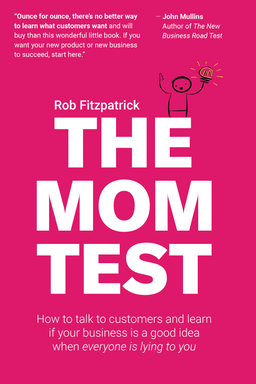
The Mom Test cover

The Mom Test

by Rob Fitzpatrick

The Mom Test offers entrepreneurs crucial insights into how to effectively communicate with potential customers and investors. Learn to ask the right questions, identify real interest, and build a business on solid foundations by transforming polite conversations into valuable feedback.

Learning From Lies: The Art of Honest Customer Conversations

Have you ever poured your heart into an idea—only to realize, too late, that nobody actually wanted it? Rob Fitzpatrick’s The Mom Test begins with this all-too-familiar pain point. He argues that the most dangerous outcome of talking to customers isn’t hearing “no”—it’s hearing polite lies, false encouragement, and untested enthusiasm. Entrepreneurs, he insists, fail not for lack of conversation, but because they mistake flattery and opinion for genuine market insight. Through clear principles and sharp examples, Fitzpatrick shows how to talk to people about your idea in a way that even your own mom can’t lie to you about.

At its heart, the book teaches you how to extract truth from noise. The core argument is simple but radical: It’s your responsibility—not your customer’s—to find out the truth about your business idea. The author contends that traditional advice like “talk to customers more” is incomplete. What matters is how you do it: asking better questions, listening for facts instead of opinions, and separating compliments from genuine signals. Only then can you avoid the trap of validating an illusion.

From Compliments to Concrete Facts

Fitzpatrick opens with a simple story: a hopeful entrepreneur pitches his mom on a digital cookbook app. She’s supportive, complimentary—and completely dishonest. Not because she’s malicious, but because it’s human nature to protect someone’s feelings. Through this hilarious and painful exchange, Fitzpatrick reveals a universal lesson: bad questions invite lies. When you ask, “Do you think it’s a good idea?” you force people to guess about the future and to protect your ego. The right questions, in contrast, gently draw out facts about what people actually do and value.

The antidote is what Fitzpatrick calls The Mom Test—a set of rules to ensure your questions are unbiasing and useful. If the question passes The Mom Test, even your own mother couldn’t give you misleading validation. You do this by: (1) talking about their life, not your idea, (2) asking about specifics in the past rather than opinions or the future, and (3) listening more than you talk. These three principles serve as the foundation of every effective customer conversation.

Facing Scary Questions and Loving Bad News

Once you learn to talk to customers properly, Fitzpatrick warns that you’ll face a new problem—fear. The most important questions are the ones you’re too afraid to ask, the ones that could disprove your entire business idea. In Chapter 3, he urges founders to intentionally include one “terrifying question” in every conversation, the kind that could destroy your delusions or reveal a fatal flaw. His mantra? You should love bad news. Every piece of negative feedback is money and time saved—truth that keeps you from drifting down a dead-end path. The only truly bad answer is one that doesn’t change your plan at all.

He illustrates this with an example of his own failure: a startup that lost half a million dollars because he avoided talking to his client’s lawyers. The legal risk question was scary—but ignoring it proved even more costly. The lesson is universal: growth begins with discomfort. Every fearless conversation moves you closer to reality.

Zooming Out Before You Zoom In

Another powerful insight is about timing. Entrepreneurs often “zoom in” too fast, obsessing over trivial problems before confirming whether the person even cares about that topic. Fitzpatrick dramatizes this with a conversation about fitness apps that spirals into false validation. The key mistake? Assuming the user cared about exercise in the first place. It’s like solving the wrong problem beautifully. By starting broad—asking about goals, annoyances, or priorities—then narrowing only once you hear strong emotional signals, you save yourself from chasing mirages.

Commitment, Advancement, and the Truth of Action

Later, Fitzpatrick shows that love and enthusiasm are worthless without commitment. In Chapter 5, he borrows from sales: every meeting either succeeds (by advancing to the next step) or fails. A successful meeting doesn’t mean you got praise—it means you got something of value. True evidence comes when people give up something they value—time, reputation, or money. A test drive, an introduction, a pre-order: these are the currencies of truth. Compliments cost nothing, so they tell you nothing.

The same logic applies to finding your first customers—what Steve Blank calls “earlyvangelists.” They are the crazy few who love your solution enough to fight for it, buy early, and help you improve it. Spot them, serve them, and ignore everyone else until you’ve built traction in that core group.

Choosing Customers and Staying Specific

As your startup grows, another trap appears: trying to serve everyone. Fitzpatrick reminds you that clarity comes from specificity. Instead of targeting “students,” you might need to focus on “university students preparing for exams on tablets.” Instead of “advertisers,” you might need “creative agencies seeking edgy brand campaigns.” Only then can you learn consistently, improve deliberately, and build something indispensable. In short, you can’t learn from everyone; you can only learn from someone.

Making It a Habit

The final chapters of The Mom Test show how to bake customer learning into your company’s rhythm. Create a team habit of preparing three key questions before every set of conversations, take shared notes, and debrief as a team. Doing so prevents bottlenecks where one “customer whisperer” becomes the single source of truth. Finally, Fitzpatrick concludes with a reminder that conversations themselves are not business success. Talking is a tool, not an excuse to delay building. You should be learning faster, not slower—and courageously facing the facts you learn.

At its core, The Mom Test is a manual for disciplined curiosity. It’s about replacing hope with hypothesis, flattery with fact, and ego with humility. When you stop seeking validation and start hunting for truth, you gain the only advantage that matters—the clarity to build something people truly want.


The Power of the Mom Test

Fitzpatrick’s signature concept, The Mom Test, is both simple and revolutionary. It’s a way of having conversations about your ideas without revealing your ego—or your idea itself—until the moment it truly matters. It’s called The Mom Test because it forces you to ask questions that even your own mother can’t lie to you about. The goal isn’t to validate your idea; it’s to understand your customer’s world deeply enough that your idea either proves or disproves itself through their experiences.

Three Rules to Uncover Truth

Rule one: Talk about their life, not your idea. Stop pitching and instead ask about their habits, frustrations, priorities, and recent behaviors. Rule two: Ask about specifics in the past rather than opinions or hypotheticals about the future. People are terrible forecasters of their own behavior. Past actions, however, never lie. Rule three: Talk less and listen more. The less you say, the more space they have to reveal what truly matters to them.

From Worthless Opinions to Useful Facts

Instead of asking, “Would you buy an app that does X?” Fitzpatrick suggests you ask, “How are you dealing with X today?” or “When was the last time that problem came up?” This change transforms fantasy answers into concrete data. The Mom Test doesn’t just protect you from false positives—it reshapes your conversations into structured discovery sessions. These aren’t sales calls; they’re truth-scouting missions.

Building a Habit of Truth-Seeking

When you continuously apply these principles, you stop measuring progress by how many people said “they liked your idea,” and start measuring by how much real-world evidence you’ve collected. As Fitzpatrick often reminds readers, opinions are worthless; only behaviors count. Once you understand this, you’ll start every conversation with curiosity rather than salesmanship—and that’s when customers finally start telling you the truth.


Avoiding Bad Data

Even when you know how to ask better questions, human nature has a way of slipping lies back into the mix. Fitzpatrick identifies three kinds of bad data: compliments, fluff, and ideas. Each of these feels good but leads you astray. You must learn to recognize and neutralize them before they fool you into building something nobody wants.

Compliments: Fool’s Gold Validation

Compliments are seductive. When someone says, “That’s so cool, keep me in the loop,” it makes you feel validated. But as Fitzpatrick notes, compliments are the fool’s gold of customer conversations—shiny but useless. They usually mean, “I don’t want to hurt your feelings.” If someone compliments your idea, deflect it and refocus the conversation on facts: “Thanks! How do you handle that problem right now?”

Fluff: Anchoring Vague Promises in Reality

Fluff sneaks in through words like “usually,” “might,” or “would.” It’s the language of imagination, not reality. The cure is to anchor fluff in time. When someone says, “I would definitely use that,” ask, “When’s the last time you tried to solve that problem?” or “What did you do then?” Real experiences provide real data. Vague hypotheticals only inflate your optimism.

Ideas: Dig Beneath Features to Find Motives

Customers love sharing ideas. They’ll happily tell you your product “should have analytics” or “should integrate with Excel.” Don’t take these at face value. Ask why. When MTV told Fitzpatrick’s startup they wanted better analytics, he built an entire custom dashboard. Later, he discovered they weren’t using it—they just wanted a prettier PDF report to impress their own clients. By asking “Why do you want that?” or “What would that let you do?” you uncover motives instead of to-do lists.

Avoiding bad data isn’t about mistrusting people—it’s about training yourself to listen for truth underwater. People mean well. But your business lives or dies by what they do, not what they say. Stay skeptical, stay curious, and keep anchoring the conversation in their actual behavior.


Asking the Questions That Scare You

The biggest trap in validating a new business idea isn’t asking the wrong question—it’s avoiding the right one. Fitzpatrick insists that founders must make a habit of posing at least one terrifying question in every customer conversation: one that could invalidate their entire business model. These are the questions that make your stomach turn, but they reveal truths that could save you months—or years—of wasted time.

Finding and Facing Your Fear Questions

To uncover these, Fitzpatrick suggests two thought experiments. First, imagine your startup failed—why did it happen? Second, imagine it wildly succeeded—what had to be true? Use these answers to identify your riskiest assumptions. Each conversation should aim to probe one of these assumptions. If it turns out false, you’ve dodged a bullet. If true, you’ve discovered a foundation worth building on.

Loving Bad News

Learning to love bad news is an emotional skill. Most entrepreneurs crave validation; they interpret mild interest as endorsement. Fitzpatrick flips the script: lukewarm responses—“That’s neat,” “Maybe I’d use it”—are actually great news. They tell you early what won’t work. The only truly dangerous response is enthusiastic vagueness. Validation without commitment is worse than rejection because it feels like success while disguising indifference.

The Rule of Terror

Fitzpatrick’s heuristic is blunt: You should be terrified of one question in every conversation. If you aren’t, you’re probably wasting your time. The best entrepreneurs aren’t great persuaders—they’re great truth-seekers. They pursue disconfirming evidence, eager for reality to overturn fantasy. By facing your fear questions and embracing uncomfortable feedback, you build resilience and develop the only kind of confidence that matters—evidence-based conviction.


Keeping It Casual: Conversations, Not Interviews

In the heat of startup urgency, founders often over-formalize the learning process. They schedule hour-long “customer interviews” with coffee meetings, NDAs, and slide decks—when what they really need is five minutes of honest talk. Fitzpatrick’s advice? Keep it casual. The best insights come not from structured meetings but from everyday conversations where your curiosity feels natural and spontaneous.

The Meeting Anti-Pattern

Formal meetings take time and create pressure. When you book a “research interview,” your counterpart expects to be pitched, not heard. They stiffen. You lose spontaneity. Fitzpatrick compares this to asking someone you just met at a café to go on a formal date—you were already having one! Instead of waiting for the perfect moment, start right where you are. Ask small, genuine questions like, “How did you get started doing X?” or “What’s been tricky about that lately?” Every casual chat can become a discovery session.

Why Casual Equals Credible

When you drop the formality, you allow honesty. Keeping it conversational disarms people and helps them forget you’re collecting data. People open up when they feel they’re just chatting with someone curious about their field. The less you seem like a researcher, the more truth you’ll hear. As Fitzpatrick jokes, customer discovery is best done over beers, not boardrooms.

Fast Learning, Low Cost

By keeping it casual, you massively increase your learning speed. You can have a dozen five-minute chats in an afternoon instead of one draining meeting. Each conversation gives you one more puzzle piece. Later, when you know the problem is real, you can afford the formality of sales meetings and demos. But start casual, listen broadly, and learn fast—the essence of lean entrepreneurship (echoing Eric Ries’s The Lean Startup).


From Compliments to Commitments

As conversations evolve from discovery to validation, compliments become dangerous illusions. Real signals come in the form of commitments and advancements—actions that cost your customers something. Fitzpatrick borrows the notion of “advancement” from sales: a relationship has value only if it moves forward. The ultimate test of validation is not their excitement but their willingness to risk time, reputation, or money.

Currencies of Commitment

Fitzpatrick identifies three “currencies” customers can pay with: time (agreeing to another meeting or a trial), reputation (introducing you to their boss or peers), and money (pre-orders, deposits, or letters of intent). Compliments cost nothing, but these commitments cost something—and that means they’re data you can trust. If someone risks their reputation by making intros, or agrees to a pilot test, they’re signaling genuine interest.

Meetings Either Succeed or Fail

A meeting that ends with, “That’s awesome—keep me posted!” has failed. You may not have pushed for next steps. Fitzpatrick insists that every meeting must end with a clear outcome: better insight or a concrete advance. Ask, “Can we schedule a follow-up with your team?” or “Would you be open to a short pilot?” The goal isn’t always a sale—it’s clarity. A no is a success if it saves you from false hope.

Spotting Earlyvangelists

Your earliest customers are special. Fitzpatrick calls them “crazy first customers” or borrows Steve Blank’s term “earlyvangelists.” They’re desperate enough to adopt early, forgiving enough to help you improve, and enthusiastic enough to tell others. They have four traits: they know they have a problem, have budget to fix it, are actively seeking solutions, and have already improvised a workaround. When you meet someone who fits that profile, stop searching—they’re gold. Serve them well, and they’ll breathe life into your startup.


Finding and Choosing Your Customers

Even the best conversations are useless if you’re talking to the wrong people. In later chapters, Fitzpatrick explains how to find, choose, and focus your customer segments to make learning actionable. The biggest early-stage mistake isn’t starvation—it’s drowning in too many options. You think your product could serve everyone, so you talk to everyone, learn nothing consistent, and build a messy product for nobody.

Segmentation: From Chaos to Clarity

Narrow your focus until your customer segment is so specific you could find 10 of them in one room. Broad groups like “students” or “advertisers” are too vague because they hide subtypes with wildly different needs. Fitzpatrick calls this process customer slicing: start with a broad group, then ask, “Which subset needs this most?” Keep slicing until you reach a concrete “who and where”—a segment you can actually reach and study.

Choosing the Right Slice

Fitzpatrick suggests choosing based on reachability, profitability, and personal enthusiasm. It’s not just about market size—it’s about learning speed. Talking to “finance professionals aged 25–35 training for a marathon in London” beats “busy professionals who want to get fit.” The more specific you are, the faster you’ll iterate.

Talking to the Right People

In B2B contexts, you must also identify all stakeholders: users, buyers, and decision-makers. You might be selling to teachers, but if school administrators hold the budget, they’re a segment too. For marketplaces or multi-sided products, run discovery on each side separately. Fitzpatrick’s rule of thumb: if you’re not hearing consistent problems and goals, your segment isn’t specific enough yet.


Running the Process as a Team

Talking to customers isn’t a hobby—it’s a process. Fitzpatrick concludes by teaching you how to integrate conversation-based learning into your team’s daily rhythm. Without structure, even honest conversations turn into random anecdotes. The secret is preparation, collaboration, and reflection.

Prepping: Decide What You Need to Learn

Before every batch of conversations, align your team on the top three questions you need answered. These should target your biggest unknowns—pricing, decision makers, frequency of pain, whatever seems riskiest. You don’t need a perfect script, just clarity of purpose. Fitzpatrick’s rule: if you don’t know what you’re trying to learn, don’t bother having the conversation.

Reviewing and Sharing Notes

After every chat, debrief quickly. What did you hear? How does it change your assumptions? Which questions worked best? Reviewing together prevents the “learning bottleneck,” where one founder becomes the sole holder of customer truth. Take notes collaboratively and share exact quotes to preserve nuance. Fitzpatrick uses symbols like ☇ for pain and $ for budgets to make notes searchable and concise.

From Feedback to Action

The final step is rapid iteration. Conversation is not validation; implementation is. Use what you learn to refine your focus, prototype, or marketing language within days—not months. Fitzpatrick closes with a rallying cry: “Go build your dang company already.” Conversation is a tool to accelerate, not delay, execution. When done right, honest talk turns uncertainty into momentum.

Dig Deeper

Get personalized prompts to apply these lessons to your life and deepen your understanding.

Go Deeper

Get the Full Experience

Download Insight Books for AI-powered reflections, quizzes, and more.