
Idea 1
Seeing Through Many Models
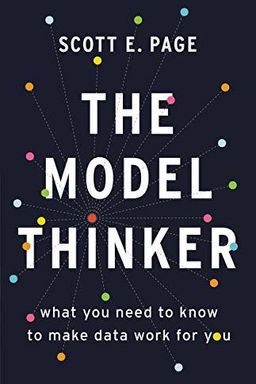
How do you make sense of a complex world where no single explanation fits everything? In The Model Thinker, Scott E. Page argues that wisdom and effective decision-making depend on using multiple models—formal frameworks that simplify reality but illuminate causes, patterns, and mechanisms. His central claim: since ‘all models are wrong but some are useful,’ your job is not to find the correct model but rather to build and compare many logically coherent models to deepen understanding and make more reliable predictions.
Throughout the book Page leads you from individual reasoning to social policy, showing how diverse modeling frames—from statistics and game theory to agent-based simulations—produce complementary insights. You learn not only why models matter (his REDCAPE mnemonic), but also how to apply them, combine them, and respect their limits. In the end, the goal is not intellectual elegance but practical wisdom: using model ensembles to reason better under uncertainty.
Why Models Matter
Page answers the obvious question—why model at all in an era of big data?—through the seven REDCAPE uses: Reason, Explain, Design, Communicate, Act, Predict, and Explore. Models formalize logic where data alone show only correlation. Game theory and simulations designed the FCC spectrum auction at Caltech in 1993, raising billions; diffusion models explained adoption curves; and network analysis shaped crisis responses like the 2008 AIG bailout. Modeling transforms raw data into organized understanding.
Big data, Page insists, does not replace theory—it multiplies its importance. Without models, you misread noise as meaning. Models demand clarity: define actors, incentives, and interactions before drowning in numbers. They create disciplined imagination.
Many–Model Thinking
To meet complexity, Page urges you to use 'many windows.' Each model highlights different forces: for the Cuban Missile Crisis, Graham Allison’s three—rational actor, organizational behavior, and political bargaining—each revealed a piece of truth. None alone sufficed. Using multiple models lets blind spots cancel and tensions sharpen insight. You don’t need hundreds: a few dozen adaptable models can address most domains, from contagion to social diffusion, competition, and inequality.
Practicing this approach means holding multiple explanations simultaneously, constructing dialogues among models, and letting evidence choose which applies. It’s intellectual pluralism built on logic, not ideology.
The Science Behind Many Models
Two formal results quantify the power of ensembles. The Condorcet Jury Theorem shows that aggregating independent judgments improves accuracy when individuals are better than random. The Diversity Prediction Theorem goes further: the collective error of average predictions equals individual error minus diversity. Diverse models cancel opposite mistakes. That’s why average forecasts often outperform the best expert and why bagging and random forests in machine learning succeed.
Yet diversity has limits. Independence is fragile; too-similar models make repeated mistakes. Category constraints and bias–variance tradeoffs mean real ensembles saturate quickly. You gain most from your first few perspectives, not hundreds.
People, Networks, Dynamics, and Policy
Page then turns from abstract modeling to how real people, institutions, and networks behave. Rational-actor models predict strategic choices; rule-based and adaptive models capture bounded rationality and learning; and network structures explain diffusion, clustering, and power. Dynamic models—from random walks to Markov chains and systems dynamics—teach you when history matters and when equilibrium erases it.
Thresholds and feedback models explain riots and startups: diverse thresholds make systems prone to tipping, as Airbnb’s early growth demonstrated. Distribution models (normal, lognormal, and power-law) show how additive versus multiplicative processes yield either predictable averages or long tails of extremes—from inequality to catastrophes. Mechanism design and game theory formalize strategic incentive structures, reminding you that not all desirable properties—truthfulness, efficiency, and balance—can coexist.
Humility and Application
In the closing chapters Page applies many-model logic to opioid addiction and inequality. Bandit, Markov, systems, and network models together explain how medical trials, behavioral transitions, and local diffusion created the crisis. Inequality emerges from interacting engines: technology-driven wage gaps, capital returns (Piketty’s r>g), superstar feedbacks, and persistent neighborhood effects (Durlauf). No single story suffices; each model fits one piece of reality.
Ultimately, Page asks for model humility. Models allow you to reason rigorously but never omnisciently. Use them as a toolbox—each with scope, assumptions, and blind spots. In the complex world, wisdom lies not in knowing which model is right but in knowing why each might be wrong and how their intersection can still guide better decisions.