
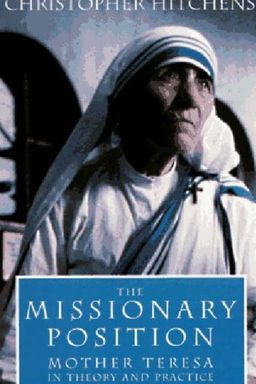
The Missionary Position cover

The Missionary Position

by Christopher Hitchens

The Missionary Position by Christopher Hitchens critically examines the life and legacy of Mother Teresa. Unveiling the myths and realities behind her saintly image, this book explores the controversial aspects of her work, media portrayal, and political associations, prompting readers to rethink the complexities of revered public figures.

Unmasking the Saint: The Politics Behind Mother Teresa’s Holiness

What if the most revered humanitarian figure of the twentieth century was less a saint and more a symbol—crafted not by miracles, but by myth? In The Missionary Position, Christopher Hitchens invites you to remove the halo and face the woman behind it: Mother Teresa. His central contention is both provocative and precise—that Mother Teresa’s global fame arose not from alleviating suffering, but from sanctifying it. She did not, he claims, fight poverty but fetishized it, turning human misery into a theater of piety that served the ambitions of the Catholic Church and reactionary politics rather than the interests of the poor.

Hitchens challenges readers to confront their assumptions about charity, faith, and the moral authority of religious figures. The truth, he insists, is not just hidden under layers of sentimentality and media glorification; it’s intentionally obscured by institutions and powerful allies who found Teresa’s saintly image politically useful. In dissecting what he calls “the cult of suffering,” Hitchens invites you to rethink what genuine compassion looks like—and how faith, when married to dogma and power, can distort the meaning of goodness itself.

The Power of Image Over Substance

Hitchens begins by examining how Mother Teresa’s saintly reputation formed. It wasn’t born in India but in the British media, through Malcolm Muggeridge’s 1969 BBC documentary, Something Beautiful for God. Muggeridge, moved by religious fervor, proclaimed the appearance of a “divine light” in his film footage of Teresa’s hospice in Calcutta—a claim swiftly debunked by his own cameraman, who credited new Kodak film stock, not heaven. Yet this so-called “photographic miracle” helped launch a modern myth. To millions, the image of the gentle nun tending to the dying poor became the definitive picture of Christian love in action—proof that faith could change the world. But to Hitchens, it was propaganda: a manipulative blend of sentiment and sanctimony that obscured the material realities of Teresa’s work.

Where others saw a miracle, Hitchens saw “illusion on film”—the first recorded instance, he quips, of piety triumphing over optics. That illusion became foundational to Mother Teresa’s rise as a global moral authority. Books, films, and religious tracts soon followed, all focused not on her methods but on her virtue. The halo solidified—and scrutiny disappeared.

A Theology of Pain and Submission

Hitchens’s outrage is not directed at faith but at how Teresa translated Christian doctrine into practice. Her hospices, he argues, were not hospitals but houses of death—places where relief was secondary to suffering. Patients languished without proper painkillers or medical treatment, their agony reframed as a spiritual gift. “Pain,” Mother Teresa told one cancer patient, “is the kiss of Jesus.” Her belief that suffering brought souls closer to God, Hitchens argues, was less compassion than cruelty, a perverse moral calculus that elevated pain above healing. Ironically, while preaching the sanctity of suffering for the poor, Teresa herself accepted first-class medical care in Western hospitals when ill.

To her, the poor were not people to be liberated but souls to be saved through endurance. In this theology, poverty was not a problem to solve—it was the path to redemption. The unintended result, Hitchens warns, is that real poverty reduction or empowerment becomes impossible; charity becomes a theater of submission, not transformation.

The Saint as Political Instrument

Mother Teresa’s sanctity, Hitchens notes, found powerful allies in unlikely places: despots, financiers, and ideological crusaders. She accepted honors and donations from figures like Jean-Claude Duvalier of Haiti, known for his brutality and corruption, and Charles Keating of the American savings-and-loan scandal. When Keating’s fraudulent empire collapsed, she even wrote to the judge pleading clemency, apparently unaware—or unconcerned—that his “charity” came from the stolen savings of the poor. In both cases, her silence on their crimes spoke volumes. Hitchens sees her not as naive but as strategically compliant: willing to cloak the rich and powerful in moral legitimacy as long as they advanced the Church’s influence and filled her coffers.

Politicians, too, used her image to sanctify their causes. She stood beside Margaret Thatcher, Ronald Reagan, and Popes John Paul II and Paul VI, speaking against abortion and contraception while praising the virtues of suffering and obedience. For Hitchens, such alliances reveal why the Vatican promoted her beatification so swiftly—she was a perfect emblem of disciplined faith and anti-modern piety in an age of social change.

A Clash Between Reason and Reverence

Ultimately, The Missionary Position is less about one nun than about the broader human tendency to exalt symbols over substance. Hitchens uses Teresa as a case study in how compassion can become corrupted when it escapes accountability. As he puts it, his book is part of an endless struggle between “those who claim the mandate of heaven” and “those who suspect that humanity has nothing but the poor candle of reason by which to light its way.” In challenging the divine myth of Mother Teresa, Hitchens isn’t simply attacking religion; he’s defending the dignity of inquiry, skepticism, and secular ethics in a world all too willing to confuse submission for virtue.

Why does this matter to you? Because the allure of sainthood and moral simplicity remains potent. We still look for figures to absolve us of responsibility—to embody virtue so we don’t have to. Hitchens’s work urges you to ask harder questions before you surrender to reverence. Compassion, he reminds us, should relieve suffering, not praise it. The difference is everything.


The Myth of the Miracle Worker

What makes someone a saint in the modern age? For Christopher Hitchens, it’s not divine power but the suspension of disbelief. The Missionary Position begins its deconstruction of Mother Teresa by tracing the birth of her legend—specifically, the media’s role in elevating her from an obscure nun in Calcutta to an icon of holiness. The crucial catalyst, Hitchens reveals, was Malcolm Muggeridge’s BBC documentary Something Beautiful for God (1969). Muggeridge, once an atheist turned fervent Christian, declared that a supernatural light filled the room as cameras filmed Teresa’s hospice for the dying. He called it “divine illumination”—a visible manifestation of God’s love.

The Manufactured Miracle

Later, the documentary’s cameraman Ken Macmillan offered a mundane explanation: the BBC had recently acquired a new Kodak film sensitive to low light. The “miracle,” he explained, was simply better technology. But by then, it was too late. Muggeridge’s account spread worldwide, securing Mother Teresa’s mystical status. From that moment, every act of hers—no matter how ordinary or questionable—was interpreted through a lens of sanctity.

In Hitchens’s view, this episode encapsulates the power of faith to transform coincidence into revelation. It also illustrates how media and religion can fuse into a potent force of mythmaking. He notes that Muggeridge’s other claims—such as Teresa spending charity funds on golden chalices instead of medicine—were equally revealing. The issue wasn’t money mismanagement but moral priorities: her emphasis on glorifying God over helping humans. For Muggeridge, that was proof of holiness; for Hitchens, it was proof of moral blindness.

From Calcutta to Canonization

This “miracle” served as the first domino in a chain leading to Teresa’s canonization. Hitchens notes that under Pope John Paul II—famous for accelerating the sainthood process—the Vatican beatified hundreds, treating holiness like an assembly line. Mother Teresa fit this new model perfectly: photogenic, globally beloved, and unwaveringly conservative. Her image of radiant self-denial masked a more fundamental truth—that sainthood, in the twentieth century, had become a public-relations project.

Hitchens’s conclusion is both ironic and sobering: the only true miracle surrounding Mother Teresa was her success in convincing millions that poverty was sacred. That, he argues, required not divine intervention but extraordinary timing, media manipulation, and a willing suspension of reason—a combination as potent as any religious myth.


Suffering as Salvation

“Pain is a kiss from Jesus.” For Christopher Hitchens, this single line from Mother Teresa captures the moral core—and the moral catastrophe—of her worldview. Far from being a figure of healing and emancipation, he sees her as a preacher of submission, someone who glorified human suffering as spiritually redemptive. Her mission wasn’t to cure the sick or feed the hungry, but to help them suffer more beautifully in preparation for heaven. In this inversion of human compassion, Hitchens finds not divinity but danger.

Neglect Disguised as Devotion

Hitchens recounts testimony from volunteers and medical professionals who visited her facilities. Even those most sympathetic to her found disturbing conditions: reused needles, the absence of diagnostic tests, and a refusal to administer adequate pain relief. Dr. Robin Fox, editor of The Lancet, diplomatically called her Calcutta hospice “alien to the ethos of a medical institution.” Volunteers described scenes reminiscent of wartime death camps—rooms of feeble, dying patients lying on stretchers with minimal care.

Mother Teresa, Hitchens argues, did not consider this neglect accidental but essential. She believed true love required suffering, and her staff were forbidden from modernizing or improving the experience of patients. It wasn’t material deprivation she wanted to end—it was spiritual emptiness. Calcutta, in her narrative, was not a place of despair but a crucible of salvation. The result, writes Hitchens, was a cult built not on healing, but on the theology of pain.

Double Standards of Mercy

Hitchens finds a bitter irony in how Mother Teresa treated her own health. When she fell ill, she sought treatment in some of the best Western hospitals, including those with advanced cardiac and orthopedic facilities. For herself, suffering was not a kiss from Jesus—it was a medical condition to be treated with precision. For the poor, it was a gift to be endured. Her own comfort was proof, Hitchens writes, that the theology of suffering was never meant to apply upward.

In exposing these contradictions, Hitchens doesn’t simply indict a person; he indicts an entire worldview that sanctifies misery instead of confronting it. True compassion, he insists, seeks to end suffering, not rationalize it as noble. The difference between a healer and a missionary, he suggests, is that one seeks human flourishing, and the other demands human submission.


Faith, Money, and Manipulation

Follow the money, Hitchens advises, and the halo begins to tarnish. Mother Teresa publicly claimed that her order, the Missionaries of Charity, accepted no payment for their work and served exclusively the poorest of the poor. Yet her financial records tell a more troubling story: millions of dollars flowed into her organization from opaque sources, with little or no auditing. Former members, such as Susan Shields, revealed that vast sums sat untouched in bank accounts—even as her clinics lacked basic amenities like sterilized equipment and medicine.

Saints and Scoundrels

Hitchens details her troubling proximity to some of the world’s most corrupt figures. In the 1980s she accepted over $1 million from Charles Keating, later convicted in the Savings and Loan scandal for defrauding small investors. In court, she wrote to the judge pleading for leniency, claiming Keating had only done “something beautiful for God.” Los Angeles prosecutor Paul Turley wrote back, explaining Keating’s crimes and urging her to return the stolen money to its victims—a letter, Hitchens notes pointedly, to which she never responded.

Before that, she accepted the Haitian Legion of Honour from “Baby Doc” Duvalier, praising his wife Michèle as someone who “loved the poor” while Duvalier’s regime impoverished them further. These partnerships, Hitchens argues, were no accidents of naivety but deliberate alliances: each mutually beneficial, each reinforcing the myth of goodness while concealing exploitation.

Faith as Financial Shield

The effect of sanctity, writes Hitchens, is immunity from accountability. Auditors, journalists, and even governments hesitated to question where the money went, fearing they’d appear cynical or sacrilegious. This moral shielding—what he calls “the armor of holiness”—allowed Teresa to operate like a multinational brand while claiming the virtue of poverty. Donations poured in from both pious believers and guilt-ridden plutocrats. Her work, Hitchens observes, became a global laundering mechanism for the conscience of the rich.

Seen through this lens, her mission was not a rebellion against materialism but its quiet servant. The poor, for the Missionaries of Charity, were props in a celestial drama—proof that poverty ennobles and suffering redeems, so long as the system stays intact.


The Vatican’s Perfect Ambassador

Why did the Vatican—and particularly Pope John Paul II—elevate Mother Teresa with such zeal? For Hitchens, the answer lies in political alignment. During the late twentieth century, the Church faced pressure from liberal theology, feminist movements, and secular modernization. Mother Teresa represented its moral counteroffensive: a living embodiment of pure obedience, chastity, and faith untainted by doubt. Her message—“accept your suffering as Christ’s plan”—served as both theological balm and ideological defense.

A Weapon Against Modernity

Hitchens situates Teresa’s rise within the Vatican’s broader strategy to reassert moral authority. As contraception, divorce, and abortion gained social acceptance, she became the Church’s global spokeswoman against all three. Her Nobel Peace Prize speech in 1979—supposedly about peace—was a sermon condemning abortion as “the greatest enemy of peace.” She exhorted Ireland to ban contraception, telling a crowd, “Let us promise Our Lady never to allow a single abortion—and no contraceptives.” Her focus wasn’t poverty relief but sexual control, aligning perfectly with the Vatican’s priorities.

The Saint and the Statesman

World leaders discovered in her not just a saint, but a diplomat. She met with Ronald Reagan, Margaret Thatcher, and even brutal dictators like Enver Hoxha’s regime in Albania, all under the guise of apolitical charity. But her timing and statements always aligned with conservative or clerical agendas. When visiting disaster zones like Bhopal, she told victims to “forgive” the corporation responsible. When meeting Thatcher, she discussed abortion, not poverty. Her ability to bless power while condemning reform made her invaluable to the Vatican’s anti-secular campaign.

In this sense, Hitchens portrays her less as a maverick and more as a model: the quintessential missionary of obedience, not rebellion. The Vatican didn’t merely canonize her for virtue—it capitalized on her as a living sermon against the modern world.


Politics of the Halo

Every halo casts a political shadow. Hitchens’s later chapters, especially “Ubiquity,” show how Mother Teresa’s travels and endorsements were not random acts of goodwill but carefully chosen interventions that affirmed power under the guise of piety. Her visits to Haiti, Albania, Guatemala, and Nicaragua reveal a stunning consistency: wherever there was authoritarianism wrapped in religious rhetoric, she found common cause.

Selective Compassion

In Haiti, she praised the Duvaliers; in Albania, she laid flowers on dictator Enver Hoxha’s grave. In Central America, she sided publicly with Cardinal Obando y Bravo—the CIA-funded ally of the contras—while ignoring massacres carried out by military regimes against peasants and clergy. When pressed, she claimed to be “above politics.” But Hitchens dismantles this pretense: indifference to injustice, he argues, is itself a political choice. Her neutrality always aligned with reactionary forces, and her praises for dictators were not naive—they were strategic.

Antipolitics as Power

Hitchens identifies a deeper hypocrisy: the way declarations of being “beyond politics” often mask extreme political intent. Mother Teresa’s message of personal humility deflected attention from systemic causes of poverty and injustice. By redefining compassion as charity rather than equity, she absolved both governments and corporations of responsibility. In the process, she turned faith into a force of compliance rather than resistance.

Thus, her “nonpolitical” stance was, in effect, the most political of all—helping uphold an order that benefited from keeping the poor passive and the powerful sanctified.


The Cult of Simplicity

In his afterword, Hitchens turns his critique toward the culture that made Mother Teresa possible: a world hungry for moral simplicity. Why, he asks, do people long so desperately to believe in saints? The answer lies in our discomfort with moral complexity. Faith promises certainty, while secular ethics demand doubt and effort. It’s easier, he argues, to project goodness onto a single figure than to face the structural causes of suffering ourselves.

Simplicity as an Escape

Mother Teresa’s aphorisms—“Smile more,” “Love until it hurts”—offered digestible hope to a public weary of nuance. As Hitchens notes, even advice columnists like Ann Landers quoted her as moral scripture. Yet this “fortune-cookie wisdom,” as he calls it, peddled submission, not empowerment. It turned hardship into a virtue and made resignation sound profound. For intellectuals and politicians alike, invoking her became a way to sentimentalize suffering while avoiding accountability.

Beyond the Halo

By the end, Hitchens’s indictment extends beyond one woman to a civilization that confuses self-denial with virtue. He concludes that Mother Teresa’s influence reveals how easily religious authority merges with political convenience. “Those who claim the mandate of heaven,” he writes, “must always be challenged by those who trust to reason.” To challenge her myth, therefore, isn’t to attack faith—it’s to defend truth from sentiment.

Hitchens leaves you with a paradox: the world that adored Mother Teresa did so not because she alleviated pain, but because she sanctified it. Her success, therefore, says as much about us—as seekers of moral comfort—as it does about her.

Dig Deeper

Get personalized prompts to apply these lessons to your life and deepen your understanding.

Go Deeper

Get the Full Experience

Download Insight Books for AI-powered reflections, quizzes, and more.