
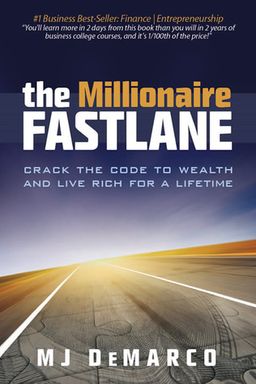
The Millionaire Fastlane cover

The Millionaire Fastlane

by MJ DeMarco

The Millionaire Fastlane reveals the secrets to achieving wealth and retiring young. MJ DeMarco challenges traditional financial wisdom, presenting a powerful alternative path. By understanding and applying the Fastlane formula, readers can transform their financial destiny and enjoy life''s riches while still young.

Rewriting the Road to Wealth

How do you escape a life of working, waiting, and hoping for financial freedom? In The Millionaire Fastlane, MJ DeMarco argues that most people are driving down the wrong financial road. He divides wealth creation into three roadmaps: the Sidewalk, the Slowlane, and the Fastlane. Each represents a blueprint of beliefs, behaviors, and time-use patterns that lead inevitably to different destinations—poverty, mediocrity, or wealth.

DeMarco’s central claim is clear: wealth is a process you can design, not a lottery you can win. Instead of chasing single events—a raise, a home sale, a viral idea—he asks you to build systems that scale, control variables like profit and asset value, and detach time from income. The book is both a mathematical model and a philosophical reorientation: financial freedom isn’t slow, but it isn’t easy either—it’s fast because it relies on controllable leverage.

Three Maps of Financial Destiny

The Sidewalk is the realm of instant gratification—the paycheck-to-paycheck lifestyle where money serves consumption rather than freedom. You might look rich but have no insulation from crisis. The Slowlane is the socially approved route: get a good education, save 10%, and let the market’s compound interest work across decades. Its flaw is mathematical dependency—it bets your future on time, lifespan, and uncontrollable market forces. The Fastlane, in contrast, is DeMarco’s alternative model that divorces income from hours worked. It builds businesses and systems that serve many and generate profits that multiply through scale, automation, and asset valuation.

Wealth as a Road Trip

DeMarco frames the journey to wealth as a road trip composed of four parts: your roadmap (belief system), your vehicle (skills and mindset), your roads (markets and industries), and your speed (execution). The book’s spontaneous examples—his brief Lamborghini encounter that woke his ambition, the years refining his internet venture that yielded multi-million-dollar offers—illustrate that every “overnight success” hides years of precise process.

Process Over Event Thinking

The Fastlane rejects “Get Rich Easy” fantasies but reframes “Get Rich Quick” as “Get Rich from Fast, Focused Process.” Events of wealth—a big sale, an acquisition—are only the visible results of long iterations. DeMarco’s Chuma and Azur parable dramatizes this distinction: Azur carries stones by hand; Chuma builds a machine. After brief effort building the system, Chuma enjoys both time and wealth, while Azur labors endlessly. The lesson: industrialize what you do. Systems, not sweat, create exponential acceleration.

Core Formula and Law of Effection

At the center of DeMarco’s framework is his Fastlane wealth equation: Wealth = Net Profit + Asset Value. Unlike salary math (hours × pay rate), this formula scales through units sold, profit per unit, and market multipliers. The more profit a system generates, the higher its valuation. This leads directly into his Law of Effection: the more lives you positively affect (reach × impact), the more wealth you can earn. Scale—affecting millions with small value per person—or magnitude—affecting fewer people with immense value—both yield freedom. Replace attraction with effection: serve millions, and money follows.

From Principles to Practice

From here DeMarco builds a complete life-engineering toolkit. You learn to recognize the theft of time via parasitic debt and the illusion that higher salary equals wealth. You gain selection criteria for Fastlane opportunities (NECST: Need, Entry, Control, Scale, Time). You discover decision heuristics (WCCA and WADM) to steer through pivotal crossroads, manage social gravity, cultivate fast education cycles, and build money trees that outlast your labor.

The ultimate objective isn’t financial excess—it’s free time. Wealth equals choices, and choices are made possible by systems that produce income without demanding your minutes. When you internalize DeMarco’s formula, you stop thinking about frugality and start designing freedom: affect others, automate income, and buy back your life from the clock.

Fastlane distilled

Sidewalk → Poorness. Slowlane → Mediocrity. Fastlane → Freedom via controllable leverage, impact, and time autonomy.

DeMarco’s philosophy bridges psychology, math, and entrepreneurship. It’s a rebellion against cultural mediocrity and a manual for those willing to trade comfort for control. His case is uncompromising: stop driving the road everyone else takes. Design your own highway, accelerate responsibly, and arrive decades sooner than you were told was possible.


Escaping the Sidewalk Trap

The Sidewalk represents the default financial life in modern society—where pleasure now eclipses preparation later. MJ DeMarco calls it “lifestyle servitude”: you live for the next Friday, trap yourself with payments, and blame external forces for every setback. It’s not defined by income level but by dependence: when your expenses consume your earnings, you’re one layoff away from collapse.

The Money Illusion

Sidewalkers often appear wealthy: new cars, designer brands, Instagram vacations. But this visible prosperity masks a hollow balance sheet. DeMarco illustrates this with celebrities who go bankrupt despite seven-figure incomes. The underlying flaw is equating wealth with consumption. Real wealth is measured in time ownership—how long you can live freely without relying on earned income. The Sidewalker’s shiny image hides a profound fragility.

Consequences of Instant Gratification

Every purchase stretches future servitude. DeMarco calls debt “parasitic” because it converts free time into indentured time. A $4,000 gadget bought on credit at $10 per hour equals 400 hours of your life. Paying interest makes the exchange worse. The Sidewalk mindset mortgages freedom for momentary excitement—and when life shocks arrive (a job loss, illness, or market crash), the entire façade crumbles.

Breaking the Pattern

Escaping the Sidewalk begins with awareness. Ask: Do you buy based on payments? Is your net worth stagnant or negative? Are your weekends the only “free” time you own? If so, you live under lifestyle servitude. DeMarco’s prescription is radical accountability: stop externalizing blame, stop justifying consumption with earned status, and start converting spending into investment. The Sidewalk is not evil—it’s a teacher—but if you camp there, you’ll never reach wealth.

The choice is binary: prioritize appearances and remain indentured, or embrace responsibility and invest time into systems that free you. Recognizing the Sidewalk’s seduction is the first pivot toward real freedom.


Why the Slowlane Stalls

The Slowlane sounds prudent: study hard, get a good job, invest consistently, and let compound interest multiply your savings. Yet DeMarco dismantles this narrative mathematically. The Slowlane formula—Job Income + Compound Interest—rests on variables you can’t fully control: time, lifespan, and market performance. Because both components depend on time, the result is slow and fragile wealth accumulation. That’s why millions who followed this map retire late or never—or see decades of progress evaporate during recessions.

Uncontrollable and Limited Leverage (ULL)

DeMarco defines the Slowlane’s core flaw as ULL: Uncontrollable Limited Leverage. You can’t multiply time, nor can you command markets. One recession wipes out years. Meanwhile, your lifespan is finite and uncertain, meaning time is an unreliable partner in the wealth equation. Betting decades on “average returns” is a risk disguised as safety.

The Negative 60% Life Trade

DeMarco’s 5-for-2 metaphor captures the life inefficiency: trading five days of labor for two days of freedom is a -60% return on your life. The Slowlane promises that someday—decades later—you’ll enjoy those seven days. But if you die early or markets crash, the payoff evaporates. In contrast, the Fastlane seeks to invert the ratio: front-load effort, systemize income, and enjoy freedom now, not at 65.

Education Without Leverage

Slowlaners often try to “fix” the formula by chasing higher-paying jobs or advanced degrees. DeMarco warns that this only magnifies risk through debt and limited scale. A doctor or MBA still trades hours for money, just at a higher rate. True leverage requires detachment from hours—something only scalable systems or assets provide.

In sum, the Slowlane’s flaw is not moral but mechanical: you can’t reach financial independence with tools reliant on lifespan and external yields. The map’s fine print reads “hope”—and hope isn’t a business strategy.


Building the Fastlane Engine

The Fastlane is not luck, nor gambling, nor even entrepreneurship by default. It’s a discipline of engineering leverage. DeMarco distills it into a formula—Wealth = Net Profit + Asset Value—and ties each element to controllable input. When you design a system that earns profit independently of your time and can grow in market value, you enter the Fastlane.

Controllable Variables

Unlike salary math, where hours cap your income, the Fastlane lets scale and efficiency multiply results. You control unit price, conversion, volume, and system optimization. Raising traffic or conversion rates increases profit. Over time, recurring profits build asset value—businesses typically sell at a multiple of annual profit (e.g., a 10× industry multiple transforms $1M profit into $10M valuation). That’s how wealth compounds fast without compounding time.

Money Trees and Passivity Grades

DeMarco classifies five “money tree” models for creating passive income: rental or royalty systems, software/internet systems, content systems (books, videos), distribution systems (franchises, wholesaling), and human resource systems (companies scaling via employees). Each has a different “passivity grade.” The closer a model comes to replicating without proportional labor, the freer you become. His own web-based lead generation model was a textbook example—automated, repeatable, and hugely scalable.

The Law of Effection

The Law of Effection underlies all Fastlane ventures: wealth correlates directly to how many lives you improve and by how much. Affect millions modestly or a few profoundly, and wealth follows mathematically. J.K. Rowling’s books, Apple’s innovations, or a simple iPhone app downloaded 50,000 times all obey this law. Money measures the breadth and depth of value delivered.

The Fastlane’s power is not mystical; it’s algebraic and ethical. You prosper by producing disproportionate value for others while liberating your time. Design systems that compound profit and purpose, and the race isn’t toward money—it’s toward autonomy.


Choosing the Right Road

Even among entrepreneurs, not every road leads to wealth. DeMarco provides a screening tool—the Five Fastlane Commandments, or NECST: Need, Entry, Control, Scale, and Time. It’s a diagnostic framework to avoid seductive but doomed ideas.

NECST in Practice

  • Need: Serve a genuine market pain, not personal preference. Businesses built “for fun” rarely survive. Fulfill a demonstrable need; money follows value.
  • Entry: High-entry barriers deter copycats. If anyone can start it, margins collapse—blogging and dropshipping prove the risk of easy-entry fields.
  • Control: Own your platform. Building on someone else’s infrastructure (e.g., Amazon sellers, affiliate links) limits autonomy and risk management.
  • Scale: Can it reach millions or command high-ticket pricing? Local small businesses often fail here unless they systemize and expand.
  • Time: Detach income from personal hours. Otherwise, it’s self-employment, not freedom.

Three Interstates

The best opportunities reside on three “interstates”: the Internet (digital reach), Innovation (invention or new value creation), and Intentional Iteration (scalable replication such as franchising). These roads maximize NECST alignment. The Internet stands out since it inherently satisfies Control, Scale, and Time.

By vetting opportunities through NECST, you avoid the false summits of easy-entry traps and invest only in assets that will compound control, leverage, and longevity.


Mastering Perception and Decision

Mental models decide your movement even before execution begins. DeMarco insists you must first “wipe your windshield clean” of limiting beliefs. Perception dictates possibility: if you see wealth as luck, you will act accordingly. The author’s early belief—“I can own that Lamborghini”—became a self-fulfilling engine for choices leading to entrepreneurship. The teenager beside him at the pump, who said “I’ll never own one,” sealed his fate too—by perception alone.

Choice Horsepower

Small decisions compound immense outcomes, a principle DeMarco calls choice horsepower. Early in life, slight course corrections yield giant life changes (the asteroid analogy: one-degree shifts far away prevent disaster). The related concept—impact differential—shows how choices diverge over time. For example, youthful decisions to skip school or join the wrong peer group can shape entire decades. Conversely, smart moves—like DeMarco’s relocation from Chicago to Phoenix—can accelerate progress exponentially.

Decision Tools: WCCA and WADM

Two tools operationalize wise decision-making: Worse-Case Consequence Analysis (WCCA) and the Weighted Average Decision Matrix (WADM). WCCA filters out treasonous choices—acts with unacceptable downside risk, such as impulsive financial gambles or self-destructive behavior. It takes seconds but saves years. WADM quantifies complex choices (career, relocation) by weighting key factors and scoring options numerically. DeMarco used WADM to choose Phoenix, a move that catalyzed his business success.

These tools, paired with a clean windshield, transform perception into precision. They remind you that decisions compound; early clarity is a superpower others mistake for luck.


Education, Execution, and Headwinds

The Fastlane mindset doesn’t end at mindset—it demands execution fueled by continuous learning and resistance to social gravity. Education is your oil; execution is your engine; social selection is your aerodynamics.

Continuous, Practical Learning

Forget formal degrees as markers of worth. DeMarco’s own journey began with free tools: libraries, forums, experimentation. He advocates ongoing education through reading, building, and failing. Knowledge stagnates like unchanging oil—it must be refreshed. Unlike Slowlane education that buys credentials, Fastlane learning buys competence. He famously calls cars and commutes “universities” of their own—drive time and downtime are learning time.

Execution Over Ideation

Ideas are cheap; execution prints results. Burn the business plan—test the market. Feedback loops expose truth faster than spreadsheets. Every great enterprise in the book—from Vitamin Water to app developers—won by execution speed, not by perfect planning. Failures teach mechanics of the next success.

Turning Your Back to Headwinds

Society’s gravity favors mediocrity. DeMarco calls it “headwind culture”—friends, family, gurus, and traditions that urge you toward safe Slowlane predictability. Escaping means curating environment and relationships. Uplifting mentors or peers become tailwinds that accelerate your path, as seen when DeMarco left Chicago’s depressive winters for Phoenix’s energy. Choose companions as carefully as you choose investments; people are roads, too.

The trio of perpetual learning, relentless execution, and selective environment delivers compound acceleration. It’s how ordinary people create extraordinary speed without shortcuts—by aligning knowledge, action, and momentum.

Dig Deeper

Get personalized prompts to apply these lessons to your life and deepen your understanding.

Go Deeper

Get the Full Experience

Download Insight Books for AI-powered reflections, quizzes, and more.