
Idea 1
The Fastlane Philosophy
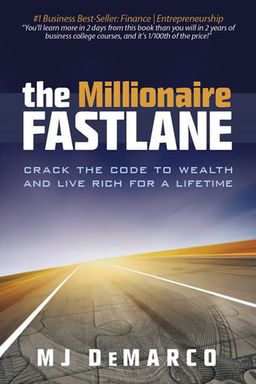
How can you escape the default script of “work, save, retire”—a plan that trades your most precious asset, time, for a slow promise of security? In The Millionaire Fastlane, MJ DeMarco argues that conventional financial wisdom—the Slowlane—keeps most people trapped in deferred dreams. He insists that wealth isn't an event you stumble upon but a process you design, powered by control, leverage, and execution. His core argument is that real freedom comes not from incremental saving but from engineering scalable systems that decouple income from time.
You were likely taught the respectable roadmap: go to school, get a job, buy a house, invest for 40 years. DeMarco calls this path the “Get Rich Slow” trap. The Slowlane offers predictability but almost no control—it ties your income to hours and market returns you can’t influence. His teenage “Lamborghini moment”—when he met a young inventor who owned one—proved that wealth could be created through innovation and ownership rather than decades of delayed savings. The book then lays out an alternative: the Fastlane.
The Slowlane vs. the Fastlane
The Slowlane depends on uncontrollable, limited leverage (ULL): time-bound income, uncertain market performance, and slow compounding. With finite hours and no scalability, it’s mathematically impossible to reach substantial freedom quickly. In contrast, the Fastlane operates under controllable, scalable leverage. You identify needs, create value for many people, and design processes that generate income independently of your daily labor. The difference isn’t just speed—it’s structural control over how wealth is produced.
Wealth as a Process
DeMarco reframes wealth as an outcome of repeatable processes. Rather than chasing “events” like IPOs or viral sales, you engineer a vehicle—your business or system—that can move quickly when finely tuned. His four-part metaphor of the “Wealth Road Trip” includes your roadmap (mindset), vehicle (skills and discipline), roads (industries and models), and speed (execution). When he built his limousine-directory web business, most outsiders saw a sudden payday; in reality, it came from iterative learning, customer feedback, and tuning conversion rates—a process that ultimately produced a multi-million-dollar asset.
Mathematics of Control
Fastlane math distills wealth creation into a formula: Wealth = Net Profit + Asset Value. You raise net profit through two levers—units sold and unit profit—and multiply that profit by your industry’s valuation multiple to grow asset value. This controllable model lets you manipulate variables instead of waiting for compound interest. Each incremental improvement—traffic, conversion, pricing—can exponentially raise both cash flow and long-term equity. (Note: DeMarco’s algebra mirrors the entrepreneurial equations seen in books like The Lean Startup or Zero to One.)
From Money Trees to Effection
DeMarco translates abstract math into tangible roads—his “money trees.” They include rental assets, software systems, content platforms, human teams, and distribution networks. These seedlings grow passive income when cultivated correctly. What distinguishes them is scalability: you can serve thousands through automation, not personal time. The driving principle behind all of them is the Law of Effection: the more lives you affect—in scale or magnitude—the more money you make. Affecting millions with modest value or deeply impacting a few with large value both create wealth. You follow the money by following impact.
Owning Yourself and Your Time
A Fastlaner doesn’t just work for someone else’s dreams. DeMarco advises incorporation (LLC, S-corp, or C-corp) to “own yourself.” Structuring through entities lets you pay yourself before the government does, control income extraction, and protect assets. Equally essential is recognizing time as your true currency. People trade hours for dollars and fall into parasitic debt—purchases that cost future labor. The Fastlane reverses the equation: you use money to buy back time. Debt destroys this freedom by converting free time into indentured hours, so wise choice and minimal consumption are moral imperatives.
Choices, Perception, and Execution
Underlying all economics is decision horsepower—the cumulative effect of small choices. A one-degree change today shapes decades ahead. Through examples of individuals whose early decisions either created freedom or disaster, DeMarco illustrates that young choices have maximum impact. To support wise decision-making, he introduces perception tools—cleaning your mental “windshield” of limiting beliefs—and decision frameworks like Worst Case Consequence Analysis (WCCA) to avoid catastrophic risks, and Weighted Average Decision Matrix (WADM) to rationalize complex life choices quantitatively. (This echoes thinkers like Ray Dalio’s emphasis on clear decision principles.)
Environment and Execution
Fast success demands supportive surroundings. Headwinds—negative friends, conformist family, toxic locations—slow progress. Tailwinds—motivated partners, entrepreneurial peers, energizing environments—accelerate it. Curate your platoon carefully; beliefs and habits are contagious. Combine this social foundation with continuous education (“Driving University,” “Waiting University”) and relentless execution—the Redline of full commitment. Ideas mean nothing without action. DeMarco’s mantra is clear: wealth responds to execution velocity, not inspiration. Commitment, smart risk, and endless learning keep your engine at full speed.
In sum, The Millionaire Fastlane isn’t about cars or quick riches—it’s about reclaiming control of your time, processes, and decisions. You drive your own vehicle, design roads that scale, and execute with purpose. The faster you convert value to broad impact, the sooner wealth becomes not just probable but inevitable.