
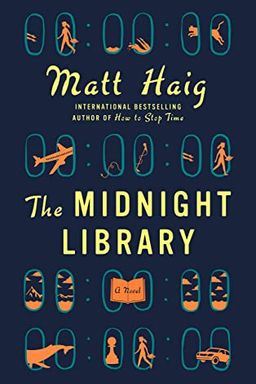
The Midnight Library cover

The Midnight Library

by Matt Haig

In Matt Haig''s The Midnight Library, follow Nora Seed as she navigates infinite lives, each a reflection of different choices. Through this journey, she discovers that true fulfillment comes not from living others'' dreams, but from embracing her own. A compelling tale of introspection, possibility, and the courage to live authentically.

The Infinite Possibility of Life: Regret, Choice, and Meaning

Have you ever felt trapped by your choices, haunted by regrets you can’t undo, or wished you could restart your entire life? That’s the emotional heartbeat of The Midnight Library by Matt Haig—a moving philosophical novel that asks the most human of questions: what if you had the chance to live every possible version of your life? Would that knowledge finally make you happy—or prove that happiness was never about perfect choices at all?

At its core, Haig’s novel explores the relationship between regret, possibility, and acceptance. Through the story of Nora Seed—a woman consumed by despair and ready to end her life—the book lays open the universal desire to know: could things have been different? When Nora awakens between life and death, she discovers the Midnight Library, an endless archive of her possible lives, each representing a world where she made one different choice. Guided by her old school librarian, Mrs. Elm, she is given the chance to undo her regrets—one life at a time.

A Thousand Lives, a Thousand Lessons

Each life Nora enters pushes her to confront a version of herself shaped by alternate decisions—a famous musician, an Olympic swimmer, a philosopher, a mother, an explorer of the Arctic. These lives act as reflections, teaching her that fulfillment doesn’t come from escaping pain but from finding meaning within it. Haig artfully uses quantum physics and philosophical metaphors—the library, the multiverse, even Schrödinger’s cat—to explore the tension between possibility and limitation. The Midnight Library becomes both literal and symbolic: it’s the space between despair and renewal, the liminal zone where the choice to live gains actual moral weight.

Regret as a Catalyst, Not a Curse

Haig’s profound insight is that regrets are not mistakes to erase but teachers to learn from. Nora begins with an encyclopedic book of regrets—a heavy tome chronicling all the opportunities she’s missed, the people she’s disappointed, and the versions of herself she has lost. But as she travels through the Library’s infinite shelves, regret transforms from paralyzing weight into a guide toward self-understanding. In one life, she’s married to Dan in a country pub; in another, she’s a glaciologist fighting climate change in Svalbard. Through these, she learns that each dream also carries its own burdens, and that every life, no matter how glittering, still circles back to vulnerability and struggle.

The Philosophy of Possibility

Haig blends existentialism and quantum theory in a way that feels tangible. Referencing real philosophical thought—from Sartre to Thoreau—he crafts the library as a physical representation of the multiverse. Every decision, every indecision, creates a new branch of existence. (The idea parallels Hugh Everett’s multiple worlds interpretation, which physicist Erwin Schrödinger hinted at in his famous cat paradox.) But philosophical speculation is not the book’s end goal. Haig’s message is humanistic: life’s value lies not in eliminating pain but embracing imperfection. There’s no ideal universe—there’s only the courage to exist inside one.

Acceptance as the Ultimate Freedom

The novel’s turning point comes when Nora realizes that even the most glamorous lives—fame, success, adventure—still contain emptiness and loss. Her perfect family life with Ash and daughter Molly, which seems ideal at first, collapses under the realization that she hasn’t earned it; it’s borrowed from another self’s choices. Acceptance, therefore, becomes liberation. By recognizing that life is not about being a flawless version of herself but owning the flawed one she already is, Nora discovers what Haig calls “the beauty of being alive.” The idea echoes the themes in Viktor Frankl’s Man’s Search for Meaning: happiness arises not from ideal circumstances but from the meaning we make out of suffering.

Why It Matters to You

Haig’s story offers more than literary escapism—it’s a mirror for our own regrets. The Midnight Library’s emotional wisdom is simple yet transformative: if you lived every possible version of your life, you would still encounter loss. The goal isn’t to find the right life but to want to live the one you have. The book reminds you that every ordinary day contains infinite meaning—that choosing to be alive is itself the act of courage that makes all others possible. In the end, Nora’s journey isn’t about escaping death—it’s about rediscovering how to live.

“You don’t have to understand life. You just have to live it.” — Matt Haig, The Midnight Library

This first idea frames the book’s key promise: that beneath all our missed chances and alternate selves lies one truth—you are already enough, because you are still here, still choosing, still alive. The rest of the key ideas will explore how Haig’s philosophy of regret, possibility, and acceptance unfolds across Nora’s many lives, each teaching a different facet of what it means to be human.


Regret: The Doorway to Transformation

When Nora first enters the midnight library, the only book that stands apart from the green shelves is The Book of Regrets. This weighty gray volume chronicles every moment she wishes she had done differently—from lost friendships and failed ambitions to trivial decisions like not exercising enough. But Haig redefines regret not as self-punishment, but as the necessary doorway to transformation.

The Anatomy of Regret

Each regret carries emotional energy—a record of what we once valued. When Nora reads the book, its intensity nearly suffocates her, illustrating how unprocessed guilt can overwhelm. Yet, as her librarian-guide Mrs. Elm explains, regrets are not frozen verdicts; they're mutable. The moment Nora faces her guilt over her cat Voltaire’s death, for example, she learns the truth: his passing was inevitable. That realization doesn’t erase the sadness—it dissolves its power. The regret no longer defines her story; it becomes one page among thousands.

Learning Through Alternate Lives

Each alternate life allows Nora to confront one regret directly, acting as a living experiment in personal growth. When she enters the life where she remains with Dan in the countryside pub, she discovers that safety and familiarity can still breed emptiness. When she explores the life as an Olympic swimmer—one built on her father’s ambitions—she realizes success doesn’t guarantee fulfillment. Regret is the tool that widens perception; the pain becomes the teacher. (Compare this with Alain de Botton’s perspective in The Consolations of Philosophy, where walls of suffering become portals to wisdom.)

Acceptance Over Perfection

Haig suggests that the antidote to regret is not correction but acceptance. Nora’s learning culminates when she stops asking for the “perfect life” and starts seeking understanding. The Midnight Library itself begins to collapse only when she embraces imperfection—recognizing that even in ideal scenarios, pain exists. As Mrs. Elm says, “Sometimes the only way to learn is to live.” Transformation arises not when you remove regret but when you integrate it.

Regret is not evidence of failure—it is proof that you cared deeply enough to wish for more.

When you treat your regrets as guides instead of chains, as Nora learns to do, they reveal what you value most. That insight transforms despair into possibility. In Haig’s philosophy, addressing regret is not about rewriting history—it’s about choosing, right now, to begin again.


Choosing Life in the Face of Despair

One of Haig’s most powerful themes is the decision to keep living when life feels unbearable. Nora’s suicidal despair at the book’s start is not just personal—it’s existential. She believes she has no purpose, no hope, and no reason to stay. Yet the library’s collapse near the novel’s end symbolizes the destruction of her death wish and the rekindling of her will to live.

Facing the Polar Bear

In the Arctic episode, Nora faces an actual polar bear that could kill her. At first, she cries out for Mrs. Elm to remove her from that life. But then she realizes she doesn’t want to die. That revelation changes everything—the fear transforms into determination. Her survival becomes not just physical but spiritual. This moment in Svalbard epitomizes Haig’s assertion that the desire to live often emerges in confrontation with death. (Note: This echoes Viktor Frankl’s concept that meaning arises most strongly “in the tension between what we are and what we could be.”)

The Collapse of the Library

When Nora finally decides to live, the Midnight Library begins to burn. Rather than being punished, she’s being freed. The flames represent transformation: she can no longer hide in hypothetical lives, because she’s now choosing the real one. As she writes “I AM ALIVE” in her unwritten book, time restarts. The courage to choose life—imperfect, painful, limited—becomes the most heroic act the novel portrays.

Life as an Ongoing Choice

Haig doesn’t romanticize recovery. When Nora wakes up in the hospital, she’s still fragile, still uncertain—but she’s also aware of the wonder of existence. The flicker of recognition in the doctor’s conversation, her brother’s visit, and Mr. Banerjee’s kindness form a mosaic of small miracles. Life begins again not with grand triumph but with quiet gratitude. Her final realization: She doesn’t want to escape life—she wants to experience it.

Choosing life is not a single decision—it’s a continual practice of saying “yes” to existence, even when you don’t understand it.

By transforming despair into desire, Nora’s journey reminds you that moments of hopelessness are not endpoints—they are bridges. Survival is not passive endurance but active participation in life itself, no matter how messy or uncertain it gets.


The Power of Small Choices

One of Haig’s most liberating ideas is that life’s significance lies in small, ordinary choices. Not all transformative acts come from grand gestures or dramatic decisions. Sometimes they’re minor shifts—a conversation, a kindness, or simply waking up one more morning. Each choice, Mrs. Elm reminds Nora, opens millions of possible lives. The ordinary is the gateway to the infinite.

“Never Underestimate the Big Importance of Small Things”

Early in the book, Mrs. Elm gives Nora this line after a game of chess, echoing Thoreau’s notion that simplicity reveals truth. It becomes a recurring principle throughout Nora’s journey. When she helps an elderly neighbor, teaches a boy piano lessons, or simply pays attention to a dying cat, she unknowingly shifts the trajectories of lives around her. Later, she learns that the absence of these small acts—like missing Leo’s lesson—creates ripples of pain. The message: meaning is not built from success; it’s built from presence.

The Butterfly Effect of Kindness

In one of her last scenes, Nora encounters Leo in an alternate world where she never taught him piano. He’s being arrested. Without her influence, his creativity—and maybe his future—was lost. That discovery reveals how impact often hides in micro-decisions. (Psychologist Martin Seligman’s research on positive psychology mirrors this: nurturing small moments of compassion produces long-term well-being.)

Living Deliberately

Haig borrows heavily from Henry David Thoreau’s transcendental philosophy. Nora’s rediscovery of purpose in a “gentle life” among animals, helping where she can, becomes her version of Walden Pond. She learns that even tending flowers or comforting a frightened dog is a profound act of engagement with the world. These small choices remind her that she matters—not because of fame or achievement, but because she participates in kindness.

Great lives aren’t measured in milestones—they’re made in moments. The smallest kindness can rewrite the story of another person’s world.

By reframing significance from monumental to personal, Haig offers a radical message of empowerment. Every choice counts—not because it changes the universe, but because it reminds you that you belong within it.


Philosophy and the Meaning of Imperfection

Matt Haig threads philosophy throughout The Midnight Library with Nora as its living experiment. From classical thinkers like Thoreau, Nietzsche, and Sartre to modern psychology, the book mines centuries of wisdom to illuminate one truth: imperfection is not failure—it’s the texture of existence.

Existential Freedom

Existentialists like Sartre and Camus argued that meaning is never given—it’s created through choice and engagement. Nora embodies this idea when she realizes that “you don’t have to understand life, you just have to live it.” Haig uses everyday imagery—rain, cats, music—to show that existence requires no metaphysical justification. Being alive is justification enough. (Compare this to Albert Camus’ The Myth of Sisyphus, where pushing the boulder up the hill becomes the source of meaning.)

Thoreau’s Influence

Nora’s love of Thoreau’s Walden appears repeatedly in her happier lives. Thoreau’s call to “live deliberately” and find beauty in simplicity permeates Haig’s narrative. When Nora settles into the Cambridge life—a quiet home with her daughter, a garden full of flowers, and small joys—the philosophy becomes embodied. Yet she learns that perfection, even in paradise, prevents growth. “It wasn’t my life,” she admits. Desire for flawlessness is a form of detachment.

Learning to Be Human

The philosophical center of the novel is a redefinition of success. In her TED-style speech, Nora tells a crowd of thousands that success is a “delusion.” Awards, wealth, medals—these attempts to measure value contradict the messy truth of humanity. The only authentic life is one lived from kindness, love, and curiosity rather than metrics. She declares, “What we consider the most successful route actually isn’t.” The unpredictability of life is not weakness—it is wonder.

Imperfection doesn’t diminish meaning; it multiplies it, reminding you that life’s rough edges are the proof you’re engaged in living.

In rejecting perfection, Nora discovers the essence of philosophical joy—not certainty, but participation. The lesson resonates far beyond the novel: happiness is not an equation to solve but an experience to embrace, flaws included.


Connection and Kindness as Redemption

Haig suggests that redemption arrives not from personal success, but from connection and compassion. Nora’s reconciliation with others—her brother Joe, her neighbor Mr. Banerjee, even strangers—serves as proof that relationships are both fragile and transformative.

Reuniting with Her Brother

In one life, Nora encounters a version of Joe who is happy, sober, and married. Their conversation becomes a mutual confession—they had each misunderstood the other’s pain for years. Joe’s apology for not valuing her gives Nora a sense of completion she never thought possible. Their exchange highlights that forgiveness is not about absolution—it’s about mutual recognition of suffering. It restores humanity where blame once lived.

Small Human Rituals

Haig’s symbolism of small rituals—burying her cat with Ash, teaching piano, bringing Mrs. Elm chess pieces—anchors connection in ordinary kindness. These gestures become sacred because they affirm care. Nora’s visit to Mrs. Elm in the care home bridges her past and present, revealing that compassion is timeless. Even Mrs. Elm remarks, “You were never a pawn.” Connection makes every simple act meaningful.

The Web of Impact

In the final chapters, Nora realizes how intertwined all lives are. The people she thought she disappointed—her brother, her students, her neighbor—each hold threads of her influence. Helping one person, teaching one child, forgiving one hurt, are not single events; they’re echoes across the multiverse. (Psychologically, this parallels ripple-effect theories of altruism discussed by Adam Grant in Give and Take.)

Redemption doesn’t mean being perfect; it means caring again. It means returning to the world, even when it’s broken, and choosing love anyway.

By returning kindness to the center of her existence, Nora transcends despair. Haig reminds you that even after loss, love endures—and that human connection, though fragile, is the most powerful form of healing available.


Embracing the Ordinary Miracle of Being Alive

The novel ends on a powerful thesis: life itself is the miracle. There’s no need for extraordinary achievements or perfect circumstances. The simple act of awareness—of noticing irises in a garden, or hearing rain on glass—is enough to justify existence. Nora’s awakening after her overdose transforms the mundane world into a sacred space.

Rediscovering the Everyday

In her final chapters, Nora sees Bedford not as a prison but as “a conveyor belt of possibility.” The same streets that once symbolized stagnation now pulse with life. She notices trees breathing, sunlight glancing off glass, and people simply being. This shift mirrors mindfulness teachings from Buddhist philosophy and modern psychology—freedom begins in perception.

Writing Her Own Story

After declaring “I AM ALIVE,” Nora’s blank book becomes the unwritten future—a life she can now author herself. The unwritten pages illustrate potential rather than emptiness. This reframing turns impermanence into hope. The act of writing doesn’t promise perfection; it promises participation.

From Survival to Celebration

Haig’s final message is deeply humanistic: once you accept existence as messy, pain becomes part of joy. Nora’s piano playing, her laughter with her brother, her gratitude toward Mr. Banerjee—all reflect the shift from enduring life to loving it. “You are already infinite while alive,” Haig concludes. The book closes with two characters playing chess—a metaphor for ongoing motion and possibility. Nothing is resolved, because life never is. And that’s the beauty of it.

You don’t need to live every life to feel infinite; you just need to notice the one you are already living.

Through Nora’s awakening, Haig redefines what survival means. To live is not only to breathe—it’s to choose, forgive, and notice. The ordinary, he insists, is extraordinary once you see it clearly.

Dig Deeper

Get personalized prompts to apply these lessons to your life and deepen your understanding.

Go Deeper

Get the Full Experience

Download Insight Books for AI-powered reflections, quizzes, and more.