
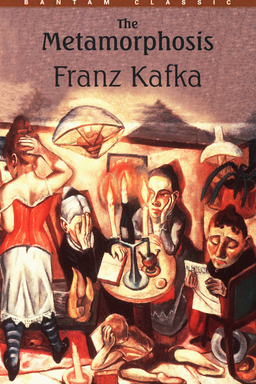
The Metamorphosis cover

The Metamorphosis

by Franz Kafka

Franz Kafka''s ''The Metamorphosis'' is a groundbreaking novella exploring the surreal transformation of Gregor Samsa into a bug. Grappling with alienation, absurdity, and change, this allegorical tale remains a poignant reflection on modern societal challenges and personal identity.

Transformation, Alienation, and the Tragic Absurdity of Modern Existence

What happens when you wake up one day and find that your body—and your entire identity—no longer make sense? In The Metamorphosis, Franz Kafka takes this question to its extreme conclusion: a traveling salesman named Gregor Samsa awakens to discover that he has become a monstrous insect. But this transformation is merely the surface of the deeper metamorphosis at the story’s heart—the dissolution of identity, humanity, and belonging in an alienating world. Kafka’s novella is one of the most haunting explorations of isolation, family duty, and the dehumanizing effects of modern life ever written.

Kafka’s core argument isn’t just about a man turning into an insect; it’s about how society and family transform in response to that change. Gregor’s metamorphosis makes visible the invisible truths of his existence—his enslavement to work, the fragility of love built on utility, and the existential absurdity of a human striving to belong in a system that values productivity over personhood. When Gregor loses his ability to labor, he loses his very place in the human world. The story becomes a cruel allegory for how quickly empathy erodes when usefulness disappears.

Kafka’s Symbol of Modern Entrapment

Kafka wrote the novella in 1912, a time when industrial labor, bureaucracy, and social expectations tightly constrained individual freedom. Gregor Samsa’s transformation exposes those invisible chains. As a traveling salesman, Gregor works tirelessly to pay off his parents’ debts—an act of self-sacrifice that is both noble and self-annihilating. His bug form becomes the perfect expression of his previous life: he has always been crawling, scurrying, enslaved by schedules and superiors. The transformation merely literalizes his mental and emotional condition.

Ironically, the moment Gregor stops being human, he begins to feel things that are profoundly human—shame, confusion, longing for connection, and self-sacrifice. Yet his family, unable to see beyond the surface, gradually stops perceiving him as Gregor at all. His father attacks him, his sister grows indifferent, and his mother retreats into fear. In Kafka’s world, love and recognition are conditional—granted only when one conforms to expectations. The metamorphosis thus becomes a testimony to the collapse of empathy within the modern household.

A Mirror for the Reader’s Own Transformation

Kafka forces readers into a deeply uncomfortable role: you begin reading in sympathy with Gregor, then slowly find yourself adopting the cold gaze of the Samsa family. You understand why they recoil, why they want him gone. In showing your identification shift, Kafka exposes the fickleness of human morality. We recoil not just from Gregor’s grotesque body but from the recognition of our own powerlessness and dependency. His suffering mirrors the quiet despair anyone might feel in a world dominated by inhumane routines and expectations.

Why the Story Still Matters

A century later, The Metamorphosis endures because it captures an existential truth that transcends time and place: the alienation of the individual in a system that demands perfection and productivity. Gregor’s story resonates with anyone who has ever felt unseen or reduced to their contributions, whether at work, within family, or by society. His slow starvation and quiet death are not just physical—they’re spiritual, the ultimate symbol of being consumed by a world indifferent to one’s inner life.

This summary will explore the key ideas that make Kafka’s story such a psychologically rich and philosophically unsettling work: Gregor’s role as the sacrificial everyman, the family’s parallel transformation, the grotesque comedy of daily life, and the existential reading explored by later thinkers and artists—from David Cronenberg’s reflections on aging and identity to Susan Bernofsky’s linguistic insights into Kafka’s ambiguous German. Together, these perspectives reveal how The Metamorphosis continues to challenge us to look at what we fear most: the loss of our sense of self in a world that demands nothing less than total conformity.


Gregor Samsa: The Man Before the Bug

Before Gregor becomes a life-sized insect, he’s already trapped in another kind of grotesque existence—a life of drudgery, guilt, and endless obligation. Kafka takes care to show that Gregor’s physical metamorphosis only makes visible the psychological and emotional imprisonment that has long governed his life.

The Dutiful Worker

Gregor is a traveling salesman—a job that he despises but endures to pay off his parents’ old debts. He embodies the ethos of early twentieth-century capitalism: disciplined, compliant, and joyless. His transformation does not disrupt a life of freedom; it interrupts a life already consumed by servitude. Kafka describes Gregor’s work routine with absurd precision: train schedules, sample cases, and the oppressive hierarchy of his employer. Even before his metamorphosis, Gregor is treated as something less than human. His boss doesn’t trust him, and his family depends entirely on his income. All of this makes his transformation not a fall from grace, but a grotesque revelation.

Family as Parasitic System

One of Kafka’s cruel ironies is that the Samsa family become financially active only after Gregor’s downfall. His father, who has feigned infirmity for years, returns to work. His sister, Grete, gets a job as a shop assistant. Even his mother starts sewing for a local garment maker. While Gregor’s body deteriorates, their vitality returns. In a strange inversion, the insect becomes the family’s necessary sacrifice—the price for their rebirth. (In existential terms, Gregor’s suffering becomes a tragic parable of meaning through negation: his existence defines theirs.)

Kafka suggests that familial love, like corporate loyalty, is conditional. Gregor’s worth is only recognized when he can pay the bills. Once his body ceases to produce, he becomes an economic embarrassment—a burden to be hidden. His family’s revulsion mirrors a capitalist logic: discard what can no longer serve production. Gregor’s death becomes the family’s liberation.

The Tragic Humor of Gregor’s Humanity

Kafka threads the early scenes with light absurdity: Gregor, panicking about missing his train despite having six wriggling legs, or worrying more about his boss’s disapproval than his monstrous new body. These moments are darkly comic, but they’re also deeply human. His first thoughts are not about existential crisis but punctuality and debt—perfect symbols of how thoroughly routine and necessity dominate his sense of self. (As Susan Bernofsky notes, Kafka’s humor reveals the wretched comedy of obedience itself.)

By portraying Gregor’s pre-insect life as morally and spiritually equivalent to his post-metamorphosis existence, Kafka inverts our understanding of what it means to be human. The tragedy is not that Gregor becomes an insect—but that his life before the transformation was already one of crawling servitude.


The Family’s Metamorphosis

While the story appears to center on Gregor’s transformation, Kafka also describes another metamorphosis—that of the Samsa family itself. The family’s psychological and social evolution is as unsettling as Gregor’s physical one. As Gregor deteriorates, the rest of the Samsas awaken from dependency to cruel independence.

The Father’s Resurrection

Herr Samsa’s reawakening is one of Kafka’s most symbolic reversals. At the beginning, he appears weak, indebted, and passive—a man emasculated by financial ruin. Yet when confronted with Gregor-the-insect, he recovers a violent sense of control. Dressed in a uniform (a bank porter’s outfit), he assumes new authority, pelting his son with apples as if to reclaim dominance. The apple embedded in Gregor’s shell stands as a cruel echo of biblical sin—son punished by the father, flesh corrupted by guilt.

Grete’s Coming of Age

Grete, Gregor’s sister, transforms from a dependent adolescent into a pragmatic young woman. At first, she shows compassion, feeding Gregor and cleaning his room. But as months pass, her empathy erodes. She eventually insists that “it” must go. In her final outspoken scene, she symbolically inherits Gregor’s sacrificed energy—her vitality contrasts with his decay. As she stretches her youthful body in the closing pages, Kafka reframes transformation as cyclical renewal built on quiet eradication. (In this sense, Grete’s growth mirrors how modern societies reconstitute themselves through the exploitation—and disposal—of their laboring classes.)

A Family Reborn Through Denial

The final chapter marks a chilling resolution. With Gregor dead, the Samsas leave their gloomy apartment for the first time in months. They enjoy sunlight, discuss moving to a smaller flat, and begin dreaming of Grete’s future marriage. Kafka ends with this disquieting domestic rebirth: life goes on, but only because the inconvenient reminder of their guilt has been erased. The family’s cheerful outing is both comic and horrifying—a reminder that human resilience often depends on denial.


Language, Ambiguity, and the Limits of Understanding

One of Kafka’s most distinctive techniques is how he blurs the boundaries between categories—human and animal, guilt and innocence, empathy and revulsion. Language itself becomes the story’s unreliable medium. Gregor can understand his family, but they cannot understand him. This single asymmetry encapsulates Kafka’s vision of isolation: everyone speaks, but no one truly communicates.

The Untranslatable “Ungeziefer”

Susan Bernofsky’s afterword highlights a crucial nuance: Kafka never names Gregor’s new form precisely. The German word Ungeziefer suggests “vermin” or an unclean creature unfit for sacrifice—a word steeped in biblical impurity. By keeping the insect undefined, Kafka sustains existential ambiguity: Gregor’s horror is never fully visualized, forcing readers to imagine their own threshold of disgust. This linguistic slipperiness mirrors how language fails to bridge Gregor’s inner consciousness with the outer world’s perception.

Communication Breakdown as Existential Theme

Gregor can hear everything but cannot make himself understood. His voice, distorted into meaningless squeaks, becomes a metaphor for the futility of human expression in the face of social structures that refuse to listen. Kafka, who struggled to reconcile his love of language with its limitations, uses Gregor’s speech as a symbol of every artist’s torment: to speak a truth no one else can hear. (This theme also echoes in Kafka’s other works like “The Trial” and “The Castle,” where opaque bureaucracies render human voices powerless.)

Language thus becomes both Gregor’s prison and Kafka’s instrument of liberation—an act of describing the indescribable, the paradox of expressing alienation itself through words.


The Body as Existential Symbol

Kafka transforms Gregor’s body into a site of philosophical and moral meaning. His physical deterioration dramatizes a crisis of identity that transcends biology. The crawling, disjointed form becomes a visual metaphor for the inescapable awkwardness of being human in an incomprehensible world.

From Worker to Creature

When Gregor awakens as an insect, his instinct to get up and catch the 7:00 train is absurd but deeply symbolic. His body refuses obedience to the old order; it has literally revolted. The struggle to coordinate his many legs reveals the friction between internal will and external form—a representation of how societal structures deform personal agency. The more he clings to routine, the stranger he becomes.

The Pain of Embodiment

David Cronenberg’s introduction makes the comparison between Gregor’s metamorphosis and aging: both confront the self with the betrayal of one’s own body. Cronenberg—known for films that explore the horror of flesh and transformation—argues that Kafka foresaw the existential dread of a consciousness trapped in decaying matter. In that sense, Gregor’s inability to control his limbs mirrors our mortality, the moment when the mirror reveals not who we are, but what we cannot remain. “Isn’t aging,” Cronenberg asks, “just a slower metamorphosis?”

Kafka’s genius lies in collapsing the physical, psychological, and spiritual into one grotesque continuum: to be aware is to be trapped in a body that defies comprehension.


Comic Horror and Kafka’s Unique Tone

Though deeply tragic, The Metamorphosis is also relentlessly, disturbingly funny. Kafka’s fusion of comedy and horror transforms dread into absurdity. Gregor’s clumsy attempts to open doors or hang from the ceiling, his family’s escalating discomfort, and the housemaid’s deadpan reaction all produce a laughter mixed with guilt.

Laughter as Defense Against Despair

Kafka’s humor arises from disproportion—the gap between catastrophe and formality, between horror and trivial worry. Gregor’s family debates cleaning duties while he decomposes in the next room. His employer frets over lateness rather than metamorphosis. The ordinary tone of bureaucracy applied to monstrous detail becomes comedic. (This tone anticipates later absurdists like Albert Camus and playwrights such as Samuel Beckett.)

Tragicomedy as Truth

Laughter in Kafka is never pure relief; it is a reflex of recognition. You laugh, then realize the target is you—the reader caught in the same ridiculous systems of fear and control. Gregor’s plight exaggerates the tiny humiliations of everyday life until they reveal their monstrous proportions. That balance between compassion and cruelty is what makes Kafka’s tone so unforgettable: every sentence oscillates between empathy and mockery, reminding you that despair itself can be absurd.


Death, Liberation, and Meaning

Gregor’s quiet death closes the story with chilling tranquility. Starved, injured, and rejected, he feels a strange calm as he fades. This is more than resignation; it is Kafka’s dark vision of liberation through annihilation. When Gregor dies, he fulfills an unspoken wish shared by everyone—including himself—that peace can only exist after disappearance.

Death as Ultimate Communication

Gregor’s final gaze at dawn—the moment before his last breath—serves as a silent reconciliation with existence. By dying, he restores order to the world; his death becomes his only meaningful act, a reversal of his lifelong passivity. His family, too, finds peace only because he ceases to exist. Kafka thus redefines sacrifice: the act of dying becomes an unintentional gift that permits the social system to continue untroubled. This irony haunts the novella’s ending, where the family’s outing feels grotesquely cheerful.

Freedom Through Disappearance

In existential terms, Gregor’s death represents the absurd freedom Camus would later describe—a release from meaning rather than its discovery. His metamorphosis was inexplicable; his end, inevitable. Yet those who survive create new narratives to justify it. Kafka leaves us with no cosmic reason, only a blank mirror in which our own compliance and denial reflect back. In that way, Gregor’s metamorphosis never really ends—it continues every time someone disappears into the machinery of modern life.


Kafka’s Enduring Influence

Kafka’s The Metamorphosis remains more than a century old, yet its influence permeates literature, art, and even film. Susan Bernofsky’s translation and David Cronenberg’s introduction reveal how its themes continue to echo in discussions of identity, technology, and mortality. Kafka’s mastery lies in turning a private anxiety into a universal allegory of existence under pressure.

A Vision That Anticipated Modern Alienation

From existentialist philosophy (Camus, Sartre) to postmodern absurdism (Beckett, Pinter), Kafka’s vision of a divided self in an indifferent world helped define twentieth-century consciousness. Gregor’s inability to communicate prefigures the alienation of individuals within bureaucracy and technology—people surrounded by networks yet perpetually silenced. Cronenberg, reflecting on aging and transformation, interprets Gregor's fate as a metaphor for biological inevitability, much as he explored in his film The Fly.

Laughter, Horror, and the Human Condition

Kafka’s genius—captured beautifully by Bernofsky’s fluid translation—is in depicting horror as ordinary. The story’s tone invites empathy but denies comfort. It speaks to every reader who has ever felt invisible in their own home or workplace. To read Kafka is to confront the fragile line between humanity and objecthood—and to sense, uneasily, that the line was never real at all.

Dig Deeper

Get personalized prompts to apply these lessons to your life and deepen your understanding.

Go Deeper

Get the Full Experience

Download Insight Books for AI-powered reflections, quizzes, and more.